A variable message sign trailer requires coordinated energy, site, and service planning for dependable long-term roadside use. Size a solar VMS trailer around its actual daily load, not nominal battery or panel ratings, while accounting for display demand, solar generation, battery capacity, weather, communications equipment, and maintenance.
Set the Real Duty Cycle to Size Solar Autonomy
Energy planning starts with the operating profile of the variable message sign trailer.
A sign may run around the clock, yet display brightness, message content, controller activity, and modem traffic can change its energy demand across each day.
Estimate Daily System Energy Demand
List every electrical load and record its power draw in each operating state. Include the LED display, controller, cellular router, GPS unit, cameras, warning beacons, and any auxiliary equipment.
Daily energy demand can be estimated with:
Daily energy = Power draw × Hours in each operating state
Use measured or supplier-provided average consumption where available. Peak display consumption alone can create an oversized and costly system. A daytime message with high brightness may require far more energy than a dimmed nighttime message.
A solar variable message sign trailer also needs an allowance for conversion losses, battery charging losses, standby demand, and temperature effects. Record these separately so project teams can update assumptions as site conditions change.
Set the Required Autonomy Reserve
Solar VMS trailer autonomy is the period a trailer can operate without enough solar charging. The required reserve depends on local low-sun periods, route criticality, site access, and the time needed to dispatch service personnel.
A lane-closure warning trailer on a remote road may require a deeper reserve than a trailer near a maintenance depot. Projects with a strict message-availability requirement should also model the energy needed to recharge batteries after poor weather.
Use a sensitivity review rather than a single optimistic weather assumption. Test normal solar conditions, several low-irradiance days, and an abnormal load case.
Match the Trailer, Display, and Energy System
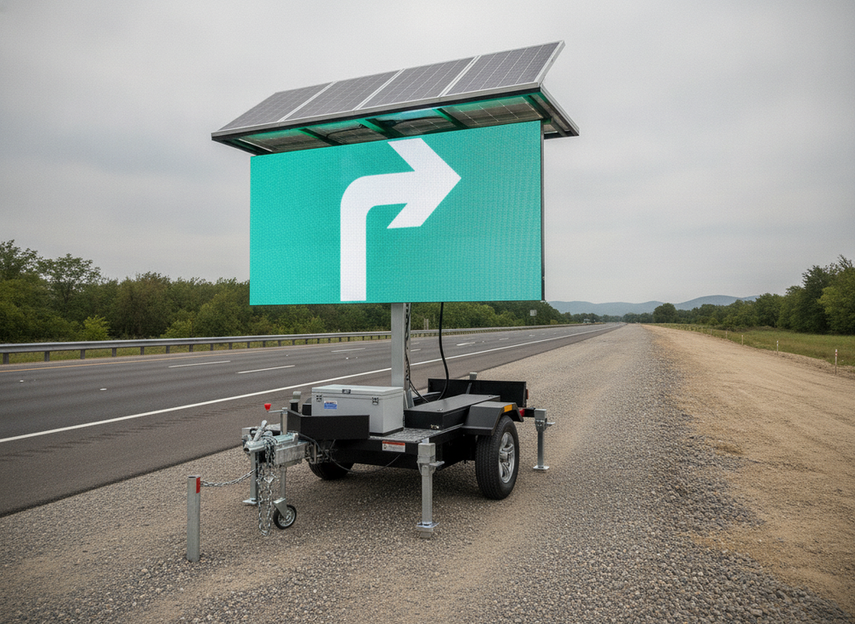
A variable message sign trailer is a mobile system. The chassis, mast, display, batteries, solar modules, charging hardware, and stabilizers must work together under transport and roadside conditions.
A strong solar design cannot compensate for a trailer that lacks suitable ground clearance, wind stability, service access, or display placement.
Define Trailer and Display Requirements
Start with transportation and roadside constraints. Confirm towing vehicle capacity, route restrictions, storage space, permitted trailer dimensions, and setup time.
Then define display requirements:
- Specify the message format, character height, viewing distance, and required readability under expected ambient light.
- Confirm display height and mast travel against sightlines, roadside barriers, and overhead obstructions.
- Check stabilizer placement, ground bearing conditions, and clearance around the trailer.
- Allow room for safe battery access, solar-panel service, and connector inspection.
Check site suitability as well as equipment suitability. A trailer that fits the transport plan still needs a permitted operating position, a clear viewing angle and safe service access. See Portable VMS trailer for related context.
Size Battery and Solar Capacity
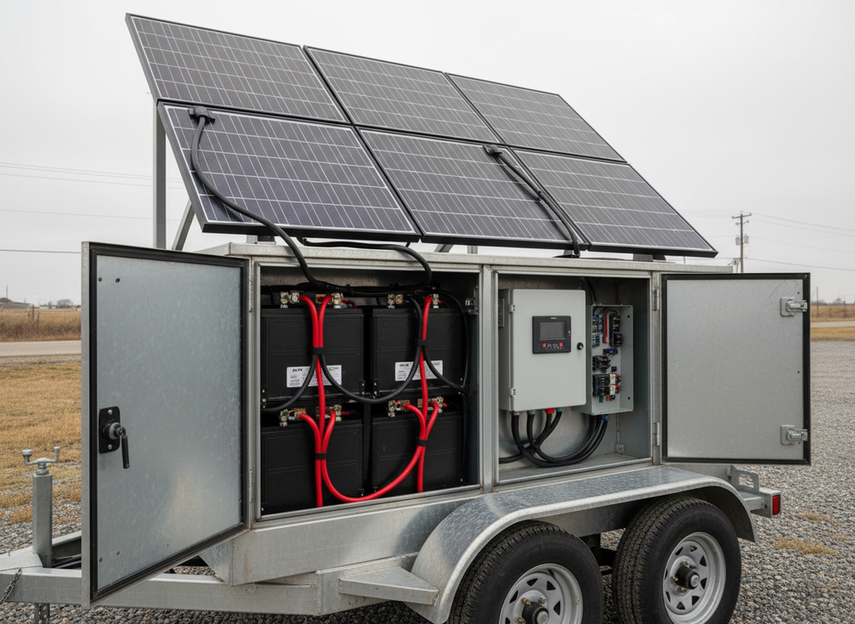
Battery capacity must cover daily demand and the selected reserve period. The nominal battery figure must also account for usable depth of discharge, cold-weather capacity reduction, aging, and charging-system losses.
A practical configuration calculation includes:
| Input** | Configuration Role** | Project Check** |
|---|---|---|
| Daily energy demand | Establishes the baseline load. | Separate day, night, standby, and communications loads. |
| Required reserve days | Sets the energy available during low solar input. | Link reserve to site access and operational risk. |
| Usable battery capacity | Limits how much stored energy can be drawn safely. | Apply the battery supplier’s operating limits. |
| Solar resource | Determines expected charging energy. | Use local, seasonally relevant solar data. |
| System losses | Reduces usable solar harvest and stored energy. | Include controller, cabling, charging, and temperature effects. |
| Recovery target | Defines charging needed after a low-sun event. | Confirm the system can restore reserve during normal conditions. |
Solar capacity should support the daily load and restore energy removed during low-sun periods. A solar field that only balances a typical day may leave the variable message sign trailer undercharged for long stretches.
Plan Backup Charging
Long deployments need a defined response for insufficient charging. Options may include a compatible external charging source, a service vehicle charging procedure, battery exchange planning, or a temporary generator under the project’s operating rules.
Document the trigger for backup charging. A clear threshold prevents teams from waiting until the sign has already lost service.
Check the Roadside Site in Detail
Site review connects the variable message sign trailer configuration to actual roadside conditions.
Assess viewing distance, driver approach angle, parking space, ground slope, pavement condition, solar shading, prevailing wind, drainage, maintenance access, and cellular coverage. Trees, bridges, buildings, parked equipment, and seasonal vegetation can materially reduce solar harvest.
Check access at the planned inspection time, not only during initial setup. A trailer may be reachable during daytime construction activity but inaccessible during overnight lane-control periods.
Photographs, site coordinates, a shading record, and a basic communications test should form part of the deployment file.
Define Remote Control and Monitoring Needs
VMS trailer remote control should support approved message updates without unnecessary field visits. Access permissions, message templates, scheduling rules, and audit logs should be agreed with the operating authority.
Remote monitoring should provide actionable operating data:
- Display and controller status should identify operating, standby, fault, or offline conditions.
- Battery voltage, state of charge, and charging current should reveal energy trends.
- Solar charging status should show poor harvest or possible panel obstruction.
- Cellular signal and data connection status should identify communications risk.
- Alarm records should flag low energy, enclosure access, controller faults, or loss of communication.
Remote data supports early intervention, yet it does not replace field inspection. A stable connection cannot confirm that solar modules are clean or stabilizers remain secure.
Build a Solar VMS Maintenance Schedule
Long-term roadside use requires planned checks for energy, mechanics, display performance, and communications.
A solar VMS maintenance schedule should assign responsibility, inspection frequency, escalation contacts, replacement parts, and evidence required after each visit.
Pre-Deployment Inspection
Inspect the display, controller, batteries, solar modules, trailer frame, mast, stabilizers, connectors, cables, communications equipment, and remote-management account.
Verify that the sign displays approved messages, reports telemetry correctly, charges as expected, and enters the required operating mode. Record battery condition and initial charging performance as the baseline for later comparison.
Routine Field Inspection
Field personnel should inspect display readability, trailer stability, solar-module cleanliness, shading, connector condition, battery enclosure condition, and network status.
Inspection frequency should reflect site risk. High-traffic work zones, dusty routes, coastal sites, or locations with repeated vandalism reports may need tighter checks than protected municipal storage areas.
Periodic and Seasonal Maintenance
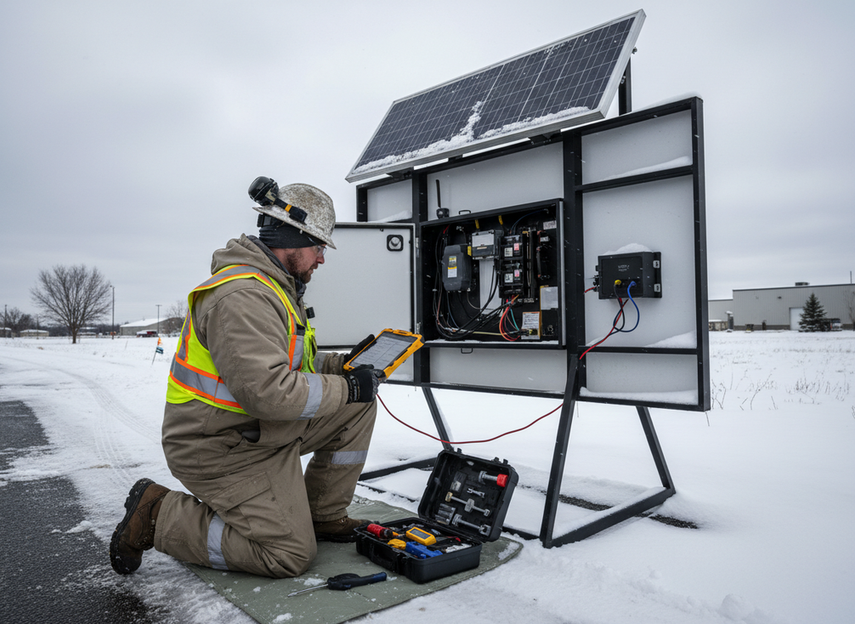
Seasonal daylight changes can alter the energy balance of a solar variable message sign trailer. Review charge trends and battery recovery after weather changes, shorter winter days, or shifts in the sign’s brightness schedule.
Periodic maintenance should also check corrosion, cable wear, fasteners, trailer tires, brakes, mast hardware, and enclosure seals. Trend data can identify declining solar harvest or battery performance before a service interruption occurs.
Plan Fault Recovery and Service Continuity
A fault plan protects the message service during low irradiance, battery problems, communications loss, or component failure.
Define who receives alerts, who can approve a message change, which spare components are available, and how quickly a technician can reach the site. Keep a recovery procedure for external charging, modem replacement, controller reset, battery isolation, and temporary trailer substitution.
For critical corridors, plan a replacement variable message sign trailer or an alternate communication method. Service continuity should be specified alongside the equipment configuration.
Prepare a Variable Message Sign Trailer Configuration Brief
A complete configuration brief gives suppliers and operators the inputs needed to size a variable message sign trailer accurately. Include the deployment period, daily operating profile, display content and brightness requirements, local solar conditions, target autonomy, communications method, transport limits, site photographs, maintenance capability, and fault-response expectation. A well-prepared brief turns solar sizing into an operational decision. It also gives project teams a clearer basis for comparing trailer, battery, solar, and support-service options.
FAQs About Solar VMS Trailer Planning
Q1. How Do You Calculate Solar Autonomy for a Variable Message Sign Trailer?
Calculate daily energy demand for the display, controller, communications equipment, and auxiliary loads. Multiply that demand by the required reserve days, then adjust for usable battery capacity, temperature, charging losses, and expected solar generation. Use measured operating data where possible.
Q2. How Many Days of Battery Reserve Should a Solar VMS Trailer Have?
Set reserve days from local seasonal solar records, the operating duty cycle, message criticality and service response time. Test several low-sun scenarios and agree the required reserve with the project owner; there is no standard reserve period suitable for every trailer deployment.
Q3. What Site Conditions Should Be Checked for Portable VMS Trailer Deployment?
Check driver sightlines, roadside parking space, ground bearing, slope, wind exposure, solar shading, drainage, maintenance access, and cellular coverage. Confirm these conditions at the planned operating position, including the solar-panel orientation and the trailer’s stabilizer footprint.
Q4. What Can Be Monitored Remotely on a Solar VMS Trailer?
Remote systems can report message status, controller status, battery voltage, state of charge, solar charging activity, modem connectivity, GPS location, and alarms. The available data depends on the selected controller, communications hardware, and approved remote-management platform.
Q5. How Often Should a Solar VMS Trailer Be Inspected During Long Deployments?
Assign remote and field inspection intervals in the operating plan according to site risk, supplier instructions and service response time. Include checks after storms, suspected tampering and repeated low-charge alarms. Seasonal reviews should reassess energy trends and mechanical condition.