

Solar VMS runtime battery winter planning starts with one question: will the unit still have enough reserve in the worst month, not just on an average day? For DOT and municipal buyers, the answer depends on solar harvest, battery reserve, load level, and how hard the site is to service. That is why off-grid highway VMS reliability is really a site-planning problem, not a brochure-spec problem.
Why Winter Changes Solar VMS Runtime
Winter changes a solar VMS energy budget in four ways at once. Shorter days reduce charging time, the lower sun angle cuts harvest, snow or dirt can block panels, and cold weather can reduce usable battery performance. That does not mean every unit fails in winter. It means the margin gets tighter, so a setup that works in warm weather can become risky once low-sun conditions and delayed service are part of the operating reality.
For buyers, the practical question is whether the system has enough reserve to cover the least favorable month. If the site is remote or the board must stay visible through long dark stretches, compare winter conditions first and average conditions second. The Traffic & VMS category is only a starting point; the real check is whether the system fits the site’s winter reserve need.
A useful decision rule is simple: if winter service access is poor, treat every lost charging day as a bigger risk than it would be at a staffed yard. In that case, the question is not “How long does it run?” but “How much reserve remains after the worst week of weather and the next truck roll delay?”
How Cold Weather Affects Battery Autonomy
Cold weather can shrink autonomy even when the unit is still receiving some sunlight. Batteries often deliver less usable capacity in low temperatures, and charging can become less efficient at the same time. The result is a narrower operating margin: the board may still work, but it has less cushion for cloudy days, overnight use, or brightness demands.
That is why the 21-day autonomy benchmark matters as a planning reference, not as a universal promise. Some DOT specs use that kind of continuous-operation expectation for portable solar VMS units, which gives buyers a concrete way to think about reserve. The key is to compare it with your site conditions, not to treat it as a guarantee for every winter deployment.
The other piece is visibility control. The automatic brightness adjustment context in the MUTCD matters because legibility and power use are linked. In plain terms, brighter output helps visibility in some conditions, but it also consumes more energy. For winter planning, that means load management is part of autonomy planning, not a separate issue.
A warm-weather pass does not automatically become a winter pass. A unit may look fine in a short field test, yet still miss its reserve target when low sun, colder batteries, and fewer service opportunities all hit at once. If the vendor cannot explain the reserve assumptions clearly, the risk is higher than the brochure suggests.
| Winter-Ready Check | What To Verify | Why It Matters In Winter | Buyer Question |
|---|---|---|---|
| Battery reserve | Site-specific reserve assumptions for the least favorable month | Winter reduces the buffer between charge and load | What reserve margin do we have after the worst week of weather? |
| Solar input | Low-sun and short-day charging expectations | Less harvest means less daily recovery | What does the unit expect in the worst month, not the average month? |
| Low-temperature behavior | How the battery and enclosure are expected to behave in cold weather | Cold can reduce usable autonomy | What changes in runtime should we expect below normal operating temperatures? |
| Brightness control | Whether brightness adjusts automatically | Power use and visibility must stay balanced | Does the sign reduce output when conditions allow? |
| Service delay buffer | How long the site can tolerate delayed access | Remote access turns small shortfalls into outages | How many missed service days can the site absorb? |
What Maintenance Costs Increase in Winter
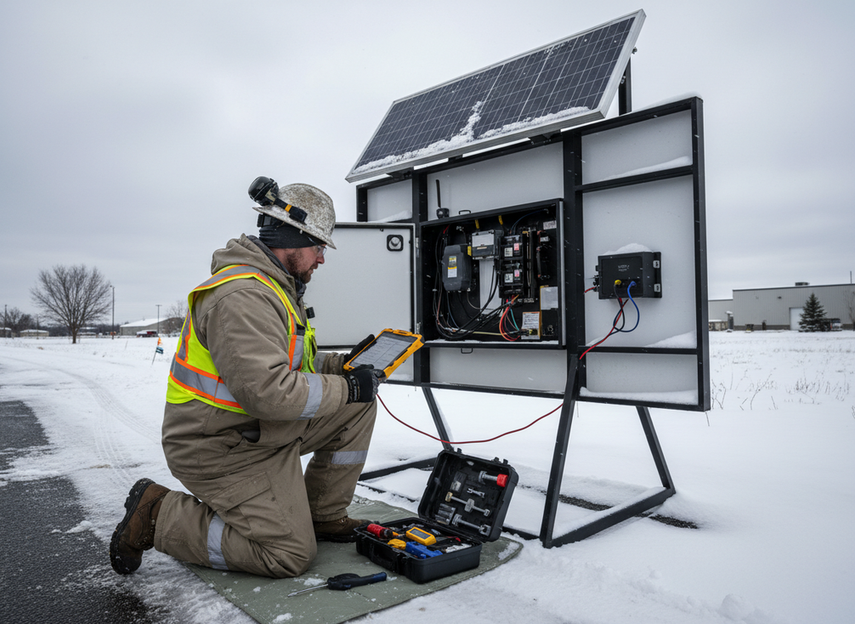
Winter maintenance is where hidden cost often shows up. The most obvious tasks are panel cleaning and screen checks, but the labor is usually wider than that. Snow access, battery inspection, connector checks, enclosure checks, and trailer readiness can all turn into truck rolls if the site is hard to reach or the weather window is short.
The Portable Changeable Message Sign Handbook supports monthly solar panel and screen maintenance as a planning assumption, and it also points buyers toward periodic battery inspection. That is useful because it turns maintenance into an operating line item instead of a vague support promise. For remote sites, that burden matters almost as much as the sign itself.
The yearly charging output tests guidance adds another useful signal: winter planning should include testing, not just inspection. In practice, buyers should expect recurring cleaning, output verification, and winter access planning. If the site is hard to reach after storms, the real cost is not just the technician’s time, but the delay before a problem can be corrected.
For municipal fleets, this is where solar message board trailer maintenance becomes a procurement issue instead of a shop issue. A technically adequate unit can still be expensive to own if every small fault triggers a long drive, a second visit, or a missed work window. That is why off-grid highway VMS reliability should be judged against labor and access, not only hardware price.
How to Evaluate a Solar VMS for Winter Duty
Use a winter-specific comparison framework before you shortlist options. The goal is to separate systems that merely look solar from systems that are actually planned for low-sun duty, remote access, and routine upkeep. If you need a broader browse path, start with VMS display options and then confirm the winter assumptions that matter for your site.
| Evaluation Area | What To Verify | Why It Matters In Winter | Buyer Question |
|---|---|---|---|
| Battery reserve | Reserve assumptions, not just battery size | Reserve determines how long the board can survive low-sun periods | What happens after several weak-sun days in a row? |
| Solar input | Panel capacity and low-sun expectations | Winter harvest is the weak link in many deployments | How does the system recover after a cloudy stretch? |
| Low-temperature behavior | Battery and enclosure behavior in cold weather | Cold can reduce usable autonomy and charging efficiency | What winter behavior is documented for the battery setup? |
| Weather resistance | Enclosure, mounting, and access protection | Snow, moisture, and wind complicate maintenance | What parts of the system stay serviceable in bad weather? |
| Service access | How fast the unit can be inspected or repaired | Remote sites magnify downtime risk | How many truck rolls do we need for a typical issue? |
| Remote monitoring | Alerts or status visibility, if supported | Faster detection can reduce outage time | Can we see a low-power warning before the unit drops out? |
If you are comparing product families, the relevant question is not which one sounds more rugged. It is which one gives you a clearer winter reserve story, a simpler maintenance path, and a support plan that matches the site. The C-Tra-VMS series is a useful place to compare that structure, while front-service VMS options make more sense when you want easier access for inspection and upkeep. If the vendor cannot connect the hardware to the service plan, keep looking.
What to Check Before You Buy
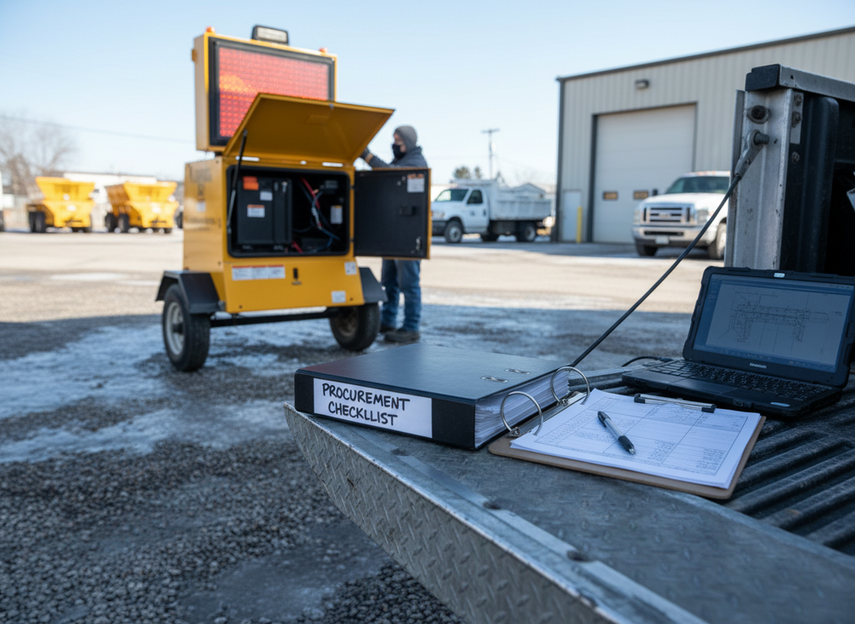
Before approval, ask for the winter assumptions in writing. The list below is the fastest way to reduce avoidable outages and surprise maintenance.
- Confirm the winter load assumption, including brightness behavior and any seasonal duty changes.
- Ask for the reserve margin used for the least favorable month, not the average month.
- Review battery reserve and low-temperature behavior together, because those two issues interact.
- Map service access, snow access, and truck-roll timing for the actual site.
- Check enclosure, mounting, and access points so winter maintenance stays practical.
- Confirm warranty, support response, and documentation for winter operation.
- If the site is critical, request a pilot, acceptance test, or field validation before full rollout.
If a bidder cannot explain these items clearly, the winter deployment risk is still unresolved. For teams that need a final check path, vehicle-mounted VMS can help frame the broader off-grid conversation, but the buying decision should still come back to reserve, access, and support. For winter duty, the safest approval is the one that tests the site assumptions before the first snow event.
Final Takeaway
The safest way to judge solar VMS runtime battery winter performance is to treat it as a reserve and maintenance problem, not a headline-spec problem. Compare the worst month, not the average month, and ask how the unit behaves when service access is delayed. If you are building a shortlist, use the checklist above, then confirm the winter assumptions with the vendor before purchase. That is the practical path for municipal and DOT buyers planning solar VMS deployments in low-sun conditions.
FAQs
How Long Will a Solar VMS Run Without Sun?
There is no single answer that fits every site. No-sun runtime depends on battery reserve, current load, temperature, brightness settings, and how quickly the site can be serviced. The useful buyer question is whether the system can survive the longest expected low-sun stretch for that location, not whether it has a generic runtime claim.
Are Solar VMS Trailers Reliable in Winter?
They can be, but reliability depends on winter reserve, cold-weather behavior, site access, and maintenance discipline. A unit that works well in warm weather may still be a poor fit if your site has heavy snow, weak winter sun, or slow truck-roll response. Winter reliability is a planning outcome, not a label.
What Maintenance Tasks Matter Most for Remote Solar VMS Sites?
The highest-impact tasks are panel cleaning, screen visibility checks, battery inspection, connector checks, enclosure checks, and access planning. For remote sites, the biggest cost is often delay, not just labor. A minor issue can become a missed uptime target if the site is hard to reach after weather events.
What Should DOT Buyers Ask Before Approving a Winter Deployment?
Ask what winter reserve assumption was used, how low-temperature performance is expected to change, how many service days the site can tolerate, and what support response looks like in bad weather. You should also ask for documentation on brightness behavior, maintenance cadence, and any acceptance testing tied to your site conditions.
Can Low Sun Alone Cause a Solar VMS Outage?
Yes, if low sun combines with high load, cold weather, shading, snow cover, or delayed maintenance. Low sun by itself does not fail every site, but it can be enough to tip a marginal setup into an outage. That is why the winter decision should focus on reserve margin and access, not just solar panel size.