

Highway VMS procurement is won or lost on compliance details, not just hardware specs or price. Before you release an RFP, check whether the project’s message rules, controller compatibility, sourcing language, and acceptance terms are written tightly enough for vendors to prove fit. If they are not, a sign can look acceptable on paper and still be vulnerable to rejection, protest, or delayed acceptance.
Why Procurement Fails on Compliance Details
For most buyers, the mistake is not choosing the wrong display panel. It is writing a spec that leaves too much room for interpretation. In highway VMS procurement, the real risk is that a bidder will meet the hardware description but miss the standards, documentation, or acceptance terms the agency actually needs.
The safest way to read this category is as a procurement checklist with four gates: MUTCD, NTCIP, TAA, and acceptance testing. Each one answers a different question. MUTCD shapes what the sign may say and how it fits the traffic-control context. NTCIP asks whether the sign must talk to a control system. TAA asks whether sourcing language is even the right rule. Acceptance testing asks what proof the agency will require before sign-off.
If a solicitation blurs those four questions together, bids become harder to compare and easier to challenge. If it separates them clearly, vendors have a better chance of submitting the right documentation the first time.
One practical way to reduce risk is to define the governing rule hierarchy in the RFP before you ask for pricing. That keeps the bid review focused on proof, not assumptions. For readers browsing category options while they build the package, the broad traffic VMS options page can serve as a navigation starting point, but it does not replace the contract language or the standards review.
MUTCD Requirements That Shape the Spec
MUTCD is the first compliance filter because it governs what a changeable message sign may be used for in traffic control. FHWA’s Chapter 2L says a CMS should display only traffic operational, regulatory, warning, and guidance information, and it prohibits advertising messages on the sign or its supports. FHWA’s interpretation materials also make clear that promotional or non-traffic messages are not the intended use of CMS devices.traffic-only message rules
For procurement teams, that means the spec should describe the sign as a traffic-control device, not as a generic digital billboard. The buyer should tie the intended use to corridor operations, incidents, work zones, weather, or similar traffic needs. That keeps the evaluation aligned with the actual federal-use framework instead of a marketing description.
For highway-speed use, message format matters too. FHWA-linked state guidance summarizes a common rule of thumb: messages should stay within two phases, with no more than three units per phase and four units total for the full message.message phase and unit limits That is useful because it turns a broad standards reference into a checkable procurement item. If a vendor proposes a long, crowded message format, the buyer can push back before award instead of discovering the problem during setup.
For high-level visibility and placement checks, the important judgment is simpler than the engineering language suggests: the sign has to fit the roadway context and the contract deliverables. If state or local overlays add requirements, the RFP should name the governing authority hierarchy so bidders know which rule set controls. That reduces the chance of a post-bid argument over whether the federal baseline was enough.
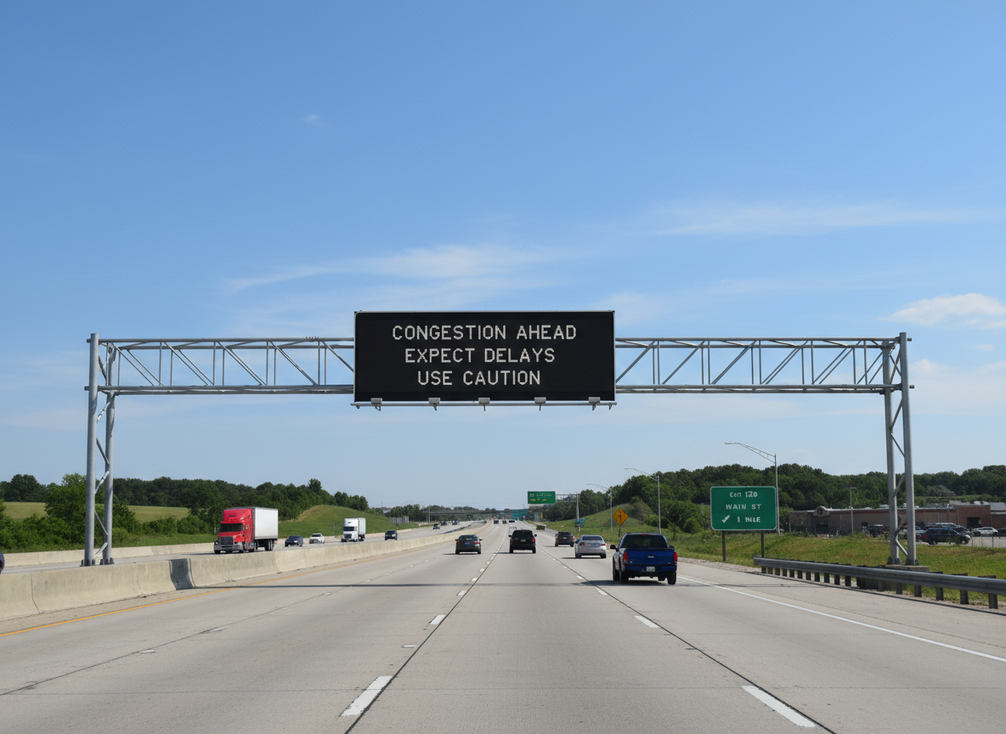
A good decision sentence here is: if the sign will carry traffic messages on a highway corridor, treat MUTCD as a spec-shaping rule; if the project is being described like a general-purpose display, the language is too loose and should be tightened before release. For some projects, the better fit is to browse a gantry sign solution only after the traffic-use language is already locked down.
NTCIP and Controller Compatibility
NTCIP is not a blanket approval rule. It is an interoperability rule. FHWA’s NTCIP 1203 fact sheet says the standard defines the commands, responses, and data elements used to control and monitor dynamic message signs, which is exactly why it belongs in procurement language when the owner needs a sign to integrate with a traffic-management system.
That distinction matters. If the agency’s control environment expects centralized monitoring, remote updates, or a specific controller interface, then NTCIP should be written into the RFP as a required compatibility item. If the agency only needs a standalone sign with limited local control, forcing NTCIP without a real integration need can over-specify the project and add cost without improving the bid.
A useful buyer check is to separate three questions in the evaluation matrix:
| Buyer question | What to verify | What can go wrong if it is omitted |
|---|---|---|
| Controller compatibility | Whether the sign speaks the protocol the agency actually uses | The sign powers on, but it cannot be managed the way the owner expects |
| Network integration | Whether the sign fits the traffic-management system and communications path | The agency has to retrofit control logic or accept a workaround |
| Acceptance evidence | Whether the vendor shows the proof required by the contract | The project stalls after delivery because the documentation is incomplete |
That matrix is also why the article’s NTCIP guidance is conditional. If the agency control environment requires it, write it in. If the integration scope is unclear, verify it before award. If the project sits outside that scope, treat NTCIP as optional and document why.
For buyers who need a more formal fit path, the natural next step is to check controller compatibility against the agency’s actual control environment rather than assuming every highway VMS needs the same interface stack.
What TAA Means for Highway Message Signs
TAA is a sourcing-rule question, not a sign-function question. That is the key point procurement teams often miss. FHWA’s Buy America guidance says that for many highway and mass transit federal-aid projects, Buy America is the more relevant rule, and those projects are specifically excluded from WTO GPA and TAA coverage.whether TAA actually applies
So the first job is to read the solicitation and confirm which rule actually applies. If the project is direct federal procurement, TAA may matter. If it is a federally funded highway project, Buy America may be the controlling rule instead. A TAA label should never be dropped into an RFP just because the buyer wants a domestic sourcing preference.
If TAA truly applies, the basic federal definition is that the item is wholly produced or substantially transformed in the United States or a designated country. That definition is useful background, but it should not override the solicitation language or the funding path.TAA definition background
A simple procurement sequence helps here:
- Read the solicitation first.
- Confirm the funding source.
- Identify whether the rule is TAA, Buy America, or another agency-specific sourcing clause.
- Ask for the documentation that proves the applicable sourcing rule, not a generic compliance claim.
- Keep the sourcing rule separate from the sign’s display capability and control interface.
A buyer-focused decision sentence is easy to remember: if the project is a federal-aid highway job, do not assume TAA is the governing rule; if the solicitation explicitly uses TAA, then request the source-of-origin evidence that matches that clause. For vendor-side review, the vendor documentation path is only a navigation aid, not proof of sourcing compliance.
Acceptance Testing and Submittal Checks
Acceptance is where many projects slow down after award. FHWA’s systems-engineering guidance for dynamic message signs recommends a Verification Plan and materials submittals so the buyer can evaluate whether the proposed system fulfills the contract before acceptance.verification plans and submittals That is the right frame for procurement: prove the system against the contract before the agency signs off.
The practical issue is that acceptance testing should be tied to the contract, not improvised after delivery. Buyers should know in advance what submittals are due before shipment, who owns the field checks, and what documentation counts as final proof. Otherwise, a fully installed sign can still sit in limbo because the paperwork does not match the delivered configuration.
A compact pre-acceptance checklist helps reduce that risk:
- Confirm the vendor submittal package before shipment.
- Verify that drawings, control information, and compliance paperwork match the RFP.
- Tie field tests to the exact functions named in the contract.
- Decide who witnesses and signs off on the tests.
- Align the submittal checklist with the acceptance checklist before award.
The most common regret triggers are missing paperwork, mismatched controls, and vague responsibility for testing. None of those are hardware failures. They are procurement failures. That is why the safest acceptance language is specific enough to be testable but not so prescriptive that it invents a universal test recipe the contract never asked for.

If your team is still shaping the bid package, this is the point where you should stop thinking about the sign as a standalone purchase and start thinking about it as a documented system deliverable. The acceptance checklist should match the proof the agency expects, not the proof the vendor prefers to provide.
A Buyer Checklist for the RFP and Award
Use this sequence to move from requirements to award without leaving a compliance gap:
- Confirm the governing standard hierarchy for the project.
- Write MUTCD-based message-use language that fits the roadway context.
- Decide whether NTCIP is required, verifiable, or optional based on the agency control environment.
- Identify the actual sourcing rule, especially whether TAA or Buy America applies.
- Require the verification plan and submittal package before acceptance.
- Make field testing and sign-off responsibilities explicit in the contract.
- Review bidder proof against the same checklist before award.
That sequence keeps the decision path clean. It also gives procurement, traffic engineering, and the contractor the same map before the project starts. If the RFP can answer those seven questions clearly, the bid package is far less likely to fail on a technicality later.
Final Takeaway
Highway VMS procurement gets easier when you treat compliance as a sequence, not a buzzword. First confirm what MUTCD allows, then decide whether NTCIP is a real integration need, then verify whether TAA even applies, and finally lock down acceptance proof before award. If those steps are clear, bidders can respond cleanly and the agency can review bids with less risk of rejection, protest, or closeout delay. Use the checklist above as your RFP review pass before release.
FAQs
Is This VMS MUTCD Compliant?
Only if the project documents make it clear that the sign is being used for traffic-control purposes and the message content stays within MUTCD limits. A generic product label is not enough. Buyers should verify the roadway context, message rules, and any state or local overlays before they treat compliance as settled.
Do I Need NTCIP for a Highway Sign?
Not always. NTCIP belongs in the spec when the agency needs the sign to integrate with a traffic-management or control system. If the sign is standalone or the control environment is different, the buyer should verify whether protocol compatibility is actually required before making it mandatory.
What Does TAA Compliant Actually Mean?
It refers to a sourcing rule, not a display feature. If TAA applies, the item must fit the federal origin rule in the solicitation. For many highway federal-aid projects, though, Buy America is the more relevant requirement, so the buyer should confirm the governing clause before using TAA language.
What Should Be in the Acceptance Test Plan?
At minimum, the plan should match the contract’s required submittals, field checks, and sign-off records. The exact tests are agency-specific, but the buyer should require a verification plan that shows how each contract requirement will be proven before acceptance.
Can a Highway VMS Be Rejected After Award?
Yes. Rejection or delayed acceptance can happen if the delivered system does not match the contract, the documentation is incomplete, or the tested functions do not line up with the RFP. The best prevention is to lock down standards, sourcing, and acceptance terms before bidding.