Traffic tenders rarely fail because a supplier cannot show an EN 12966 document. They fail when the quoted unit cannot be tied to that document. For variable message sign specifications, review the exact model, installed configuration, required performance classes, and evidence trail together. A manufacturer-level statement alone does not resolve a project approval.
Turn EN 12966 Tender Clauses Into Verifiable Requirements
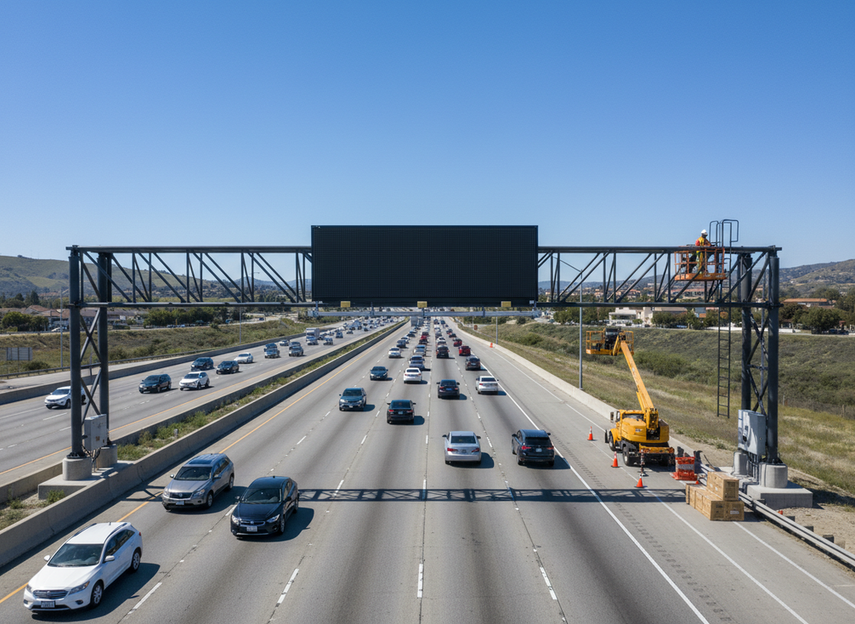
EN 12966 covers visual and physical characteristics, durability, test methods, AVCP, and marking for traffic VMS. It applies across mobile, temporary, and permanently installed signs in circulation areas, including tunnels. The standard also has stated exclusions, so a tender may require evidence beyond its scope. NEN’s EN 12966 listing provides the published scope. Use the adopted edition named in the tender, not an assumed revision.
Convert each tender clause into a checkable entry rather than reading “EN 12966 compliant” as a single requirement.
Start with the quoted product identity. Record the manufacturer, model code, pixel pitch, display dimensions, cabinet construction, installation form, and performance-affecting options. In variable message sign specifications, a classification only supports the proposed configuration if its test object represents that configuration.
Create a requirement register with a tender-clause reference in its first column. Place the requested EN 12966 class, value, or condition next to it. Add a third column for the proposed VMS configuration, plus a fourth for the documentary evidence. A final status column should distinguish “matches,” “requires clarification,” and “not supported.”
The register prevents a common review error. A datasheet can describe a capability while the certificate or test report covers a different module, pitch, enclosure, or sign arrangement. Keep the sales quotation, technical offer, certificate, test report, and datasheet under the same product identifier.
Match EN 12966 Certified VMS Models to the Required Performance Classes
Model-to-class matching is the decisive check within variable message sign specifications.
EN 12966 uses performance classes and declared characteristics. Tender reviewers should compare the tender’s requested classes with the exact results supported for the VMS offered. “Tested to EN 12966” lacks enough detail for that decision.
Do not assume a larger cabinet inherits a smaller product’s results. A different pitch, LED type, optical treatment, cabinet depth, sealing arrangement, or support arrangement can change the evidence. The same applies to options that alter the tested configuration.
Build a Model and Configuration Coverage Matrix
Use a matrix to make coverage visible. Populate it with document identifiers and page references, not generic labels such as “certificate available.”
| Review field** | Proposed VMS entry** | Evidence to cite** | Decision point** |
|---|---|---|---|
| Exact model | Full model code from the quotation | Certificate and test-report title pages | Codes must match or be explicitly cross-referenced. |
| Pixel pitch and display technology | Proposed pitch and LED/display arrangement | Report sample description and datasheet | Treat a pitch change as a new coverage question. |
| Sign configuration | Dimensions, cabinet count, access, cooling, enclosure, and mounting condition | Drawing, bill of materials, report configuration | Identify every difference from the tested unit. |
| Application form | Permanent, mobile, or temporary installation | Tender clause and declared product use | Confirm the evidence applies to the intended deployment. |
| EN 12966 performance classes | Tender class beside achieved class | Classification page or declared performance record | Compare each class separately. |
| Evidence status | Certificate, report, declaration, or supplemental test | Document number, revision, and issuer | Record gaps as open actions. |
For a traffic VMS such as our C-Slim Vent VMS, we position the series for EN 12966 tenders. Project teams still need to confirm the proposed pitch, sign configuration, and supporting documents for the specific offer. Tender-ready positioning does not replace model-level evidence.
Compare EN 12966 VMS Performance Classes With Tender Requirements
Place the tender requirement and proven result side by side. For variable message sign specifications, include the test condition, report page, and result status. Check all visual, environmental, mechanical, EMC, safety, and durability items named in the procurement documents.
| Requirement area** | Tender review question** | Suitable supporting record** |
|---|---|---|
| Visual and optical performance | Does the offered configuration meet every requested visual class under the required condition? | Classification result or EN 12966 test report. |
| Environmental resistance | Does the evidence cover the required temperature, ingress, wind, corrosion, or other named exposure? | Test report, declared performance, or project-specific report. |
| Mechanical performance | Does the submitted sign assembly match the tested construction and loading condition? | Assembly drawing, calculations, and applicable test record. |
| EMC and electrical evidence | Does the unit’s power and control configuration match the documentation? | EMC and electrical test records with model identification. |
| Durability and production controls | Are the required declarations and production-control records current and traceable? | Declaration, certificate where applicable, and factory records. |
An achieved class should meet or exceed the tender requirement only where the class hierarchy and test condition support that comparison. If the tender uses a national supplement or a project-specific criterion, ask the authority or designer how it must be interpreted.
Check VMS Certificate Coverage and Scope
A certificate is useful only within its stated scope. Read its annexes, referenced reports, standard edition, date, issuer, model list, and limitations.
Identify the document type. Certificates, Declarations of Performance, type-test reports, production-control records, and laboratory reports serve different functions. The tender and national implementation determine the applicable route.
EN 12966 describes AVCP and marking. Supports, foundations, message size and shape, plus some control and monitoring equipment, sit outside its scope. Those items can require separate evidence.
Verify the Certified Model and Configuration

Compare the part number on the certificate with the part number in the commercial offer. If a family designation appears, locate the schedule or annex that defines included variants. Check each differentiator: pixel pitch, LED color, cabinet size, display area, enclosure construction, power supply, controller, cooling approach, and installation arrangement.
Then trace every cited report number. Confirm the report names the same sample or provides an explicit technical link to it. A clear manufacturer cross-reference can help, but it should identify the engineering basis for equivalence. A vague statement that products are “similar” does not provide enough traceability for variable message sign specifications.
Identify What Falls Outside the Certificate Scope
Treat unlisted variations as unverified until evidence closes the gap. A certificate for a family member does not automatically cover a different size, pixel pitch, display face, enclosure, or option set.
Mark these differences in a controlled deviation log. State the proposed configuration, the supporting document, the missing link, and the owner of the action. Possible remedies include a relevant supplemental report, a manufacturer engineering statement tied to test evidence, an approved extension, or an approved project deviation. Acceptance remains with the authority or its appointed reviewer.
Match Each Requirement to Supporting Test Evidence

Traceability makes variable message sign specifications auditable. Build an index from each tender clause to a specific page, table, figure, annex, or drawing revision.
Use the certificate for the facts it certifies. Use an EN 12966 test report for the actual result, conditions, sample description, and test method. Use a datasheet for the product’s declared commercial specifications. Use drawings, calculations, and system documents for requirements that fall outside the product-standard scope.
Avoid adding a long document bundle without an index. Reviewers need to find the answer fast. A concise index can flag a required class as supported, partially supported, pending clarification, or unsupported. It also exposes conflicts, such as a datasheet showing one pitch and a test report describing another.
Build EN 12966 Technical Submittal Documents
The technical submittal should present the proposed sign as a single, consistent configuration. It turns variable message sign specifications into an approval package rather than a loose document bundle.
Include these controlled documents, with revisions shown clearly:
- The quotation should state the exact VMS model, pixel pitch, sign dimensions, quantity, and options.
- The compliance matrix should map every tender clause to an evidence reference and status.
- The applicable certificate, declaration, and EN 12966 test report should show their issuer, number, edition, date, scope, and model coverage.
- The datasheet and general-arrangement drawing should match the quoted configuration.
- The configuration schedule should identify cabinets, display area, power, controller, cooling, access method, enclosure, and mounting interfaces.
- Separate reports, calculations, or approvals should support supports, foundations, message control, monitoring, and other out-of-scope requirements.
- A deviation log should state all gaps and the proposed resolution instead of hiding unsupported requirements.
Use controlled PDF copies and revision-controlled translations where required. Screenshots and undated brochures weaken document control.
Run a Final Pre-Submission Compliance Check
Run a two-person cross-check across the quotation and technical package. One reviewer reads each tender clause. The second finds the cited page and confirms product identity, configuration, and class.
Resolve contradictions ahead of release. Check report numbers, model codes, pitch, dimensions, date validity, declared classes, and standard editions. Escalate evidence gaps for a supplemental test, clarification, or deviation response.
Use this final checklist:
- The exact quoted model is clearly identified.
- The product configuration matches the supporting certificate.
- Required performance classes are documented.
- Each key tender requirement has supporting evidence.
- Certificate and report references are traceable.
- Datasheet specifications match the submitted evidence.
- Any requirement outside the certificate scope is clearly identified.
- Additional supporting evidence is included where required.
Finalize Variable Message Sign Specifications With Clear Evidence
Complete the technical review with a documented release decision. Each tender requirement should link to the quoted VMS model, its installed configuration, the required performance class, and a traceable document reference. For variable message sign specifications, record every open item with an owner, required evidence, and target date. This gives EPC teams, ITS consultants, and procurement reviewers a clear basis for technical approval and project delivery.
FAQs About EN 12966 VMS Compliance
Q1. Does EN 12966 Certification Apply to Every VMS Model From the Same Manufacturer?
No. Coverage depends on the certificate’s stated scope and referenced models or configurations. Review the exact proposed model, pixel pitch, display construction, and options. Treat unlisted variants as open until a report, annex, declaration, or accepted clarification links them to the evidence.
Q2. How Do You Match EN 12966 Performance Classes to Tender Requirements?
Create a clause-by-clause matrix. Put each required class beside the achieved class and cite the report page, sample configuration, and test condition. Confirm the comparison is valid under the tender’s adopted EN 12966 edition and any national or project-specific rules.
Q3. How Do You Confirm That an EN 12966 Certificate Covers a Specific VMS Model?
Compare the certificate’s model schedule, annexes, and referenced test reports against the quotation and technical submittal. Check model code, pixel pitch, cabinet design, display area, enclosure, power, controller, cooling, and installation arrangement. Obtain a documented technical link for every difference.
Q4. What Documents Should Be Included in an EN 12966 Technical Submittal?
Include the quotation, compliance matrix, certificate or declaration as applicable, EN 12966 test report, datasheet, drawings, configuration schedule, and an evidence index. Add calculations, approvals, or system documents for supports, foundations, and other requirements outside the certificate scope.
Q5. What Should You Do if a Tender Requirement Is Not Covered by the Available Certificate or Test Report?
Declare the gap in the compliance matrix and deviation log. Request relevant supplemental evidence, an approved extension, or written clarification from the tender authority. Do not mark the requirement compliant until the document scope and proposed VMS configuration support the required result.