Solar VMS trailer battery autonomy is mainly a sizing and deployment-cost question, not just a product choice. For temporary, off-grid, or frequently moved work zones, start with autonomy and recharge assumptions first; for permanent sites with stable power, a fixed sign may make more sense. The key is to size for the actual duty cycle and the worst stretch of low sun, not for a best-case day.
How Solar Mobile VMS Power Sizing Works
For most buyers, the first sizing mistake is treating battery capacity as the whole answer. The better starting point is the sign’s load profile, the autonomy target, and the solar recovery window. The MUTCD says portable changeable message signs must be used as a supplement to standard signing and be legible from at least 650 feet, so visibility and message use stay separate from endurance planning MUTCD.
Load Profile and Duty Cycle
Start by mapping how the board will actually run. A sign that updates often, runs at higher brightness, or changes messages more frequently will usually draw more power than a simple static display schedule. In practice, that means the deployment calendar matters as much as the hardware label. If the trailer will sit in one lane-closure pattern for long stretches, size it to that pattern instead of averaging across the whole project.
Battery Bank Capacity and Autonomy
Autonomy means the number of days the battery bank can power the full load without solar input, and usable storage depends on depth of discharge PVsyst autonomy and battery sizing guidance. For buyers, that changes the decision: a larger battery bank is useful only if it is matched to the real load and recovery conditions. A practical rule is to treat autonomy as a reserve buffer, not a promise. If the route is critical or the lane closure cannot tolerate downtime, a conservative reserve target is safer than a thin margin.
Solar Array Output and Seasonal Conditions
Solar output changes with season, angle, weather, and site exposure. That matters most when a deployment happens in winter, at higher latitude, or in a shaded laydown area where recharge is slower than expected. Florida DOT guidance for solar VMS materials calls for automatic recharging and charge-state monitoring, which is a good reminder that recovery behavior is part of reliability planning, not a nice extra FDOT Section 990. In other words, the array is not just there to save fuel; it has to restore the battery after cloudy stretches and overnight use.
Standby Margin for Cloudy Days
A conservative planning benchmark can be much higher than a casual design target. West Virginia DOT procurement language has required up to 21 consecutive days of operation in flash mode without sun input, which shows how much reserve some public buyers expect in worst-case planning WV DOT solicitation. That does not mean every project needs 21 days, but it does mean buyers should ask a simple question: if solar recovery stalls for several days, does the site still stay compliant and visible without emergency intervention?
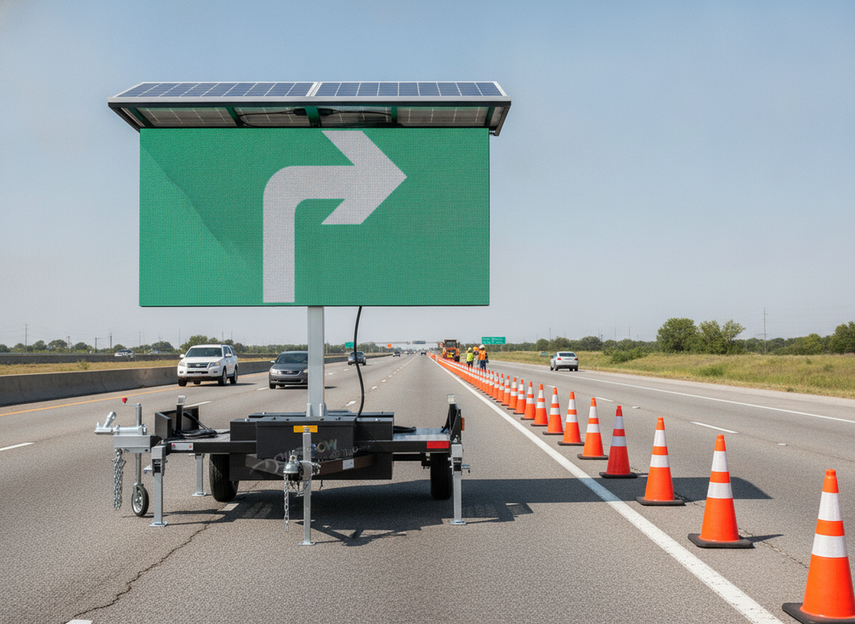
If you need a quick decision sentence: a bigger battery helps when the sign must ride through low-sun periods, but oversizing the bank without checking load and recharge can hide the real problem. If your deployment is short, high-visibility, and easily serviced, a tighter reserve may work; if it is remote, winter-heavy, or hard to revisit, build in more margin.
What Drives Deployment TCO
Deployment TCO is the whole ownership picture, not the sticker price. The ATSSA work-zone guidance pushes buyers to think beyond purchase cost and account for transport, towing labor, storage, and battery replacement cycles. That matters because a lower upfront quote can still become the more expensive choice once the unit starts moving between sites.

| Cost bucket | Mobile solar trailer VMS | Fixed installation |
|---|---|---|
| Upfront equipment | Usually centered on the trailer, solar, battery, and sign package | Often centered on permanent mounting and site infrastructure |
| Transport / redeployment | Repeats as the trailer moves between sites | Usually lower after installation if the sign stays put |
| Setup labor | Needed each time the unit is placed and secured | Higher at install, then lower for steady locations |
| Power infrastructure | Can reduce or avoid utility work at the site | More tied to utility access or permanent power planning |
| Maintenance access | Battery checks, charging, and inspections still matter | Service access depends on the site and mounting method |
| Storage | Must be budgeted when the trailer is off-site | Less storage burden if the sign remains installed |
| Replacement cycles | Batteries and wear items affect seasonal cost | Replacement can be more tied to fixed-site hardware and access |
| Downtime risk | Can rise if towing, charge state, or site access is poorly planned | Can rise if the site depends on utility work or complex access |
The main judgment is simple: mobile solar trailer VMS often shifts cost away from utility work and toward logistics, while fixed installation often does the opposite. That means the cheapest buy is not always the cheapest deployment. If the unit will move often, the mobility advantage can outweigh some recurring labor. If it will stay in one place for a long period, the moving costs may erase the first-price appeal.
Mobile Trailer VMS Versus Fixed Installations
The fit usually flips on duration and power access. NYSDOT guidance describes mobile VMS trailers as the preferred choice for temporary road work and lane closures, while fixed installations are reserved for more permanent sites with utility power NYSDOT guidelines. That makes the buying rule straightforward: if the site is temporary, relocatable, or off-grid, mobile is usually the better starting point; if the site is permanent and power-backed, fixed is often the cleaner fit.
Best-Fit Scenarios for Mobile Solar Trailers
A mobile trailer makes the most sense when the same message board needs to move from one work zone to another, when the project has limited utility access, or when setup speed matters more than permanent infrastructure. That is common in short- to medium-term lane closures, rural maintenance, and remote roadside projects. In those cases, self-powered deployment can simplify the site plan and reduce utility coordination.
Where Fixed Installations Still Make Sense
Fixed signs still make sense when the location is expected to stay active for a long time, when utility access is already in place, or when towing and trailer storage would add unnecessary friction. The fixed model can also be easier to justify when the sign does not need frequent relocation. In that scenario, the value comes from permanence and stable infrastructure, not mobility.
Operational Tradeoffs That Change the Decision
The hidden costs are often practical rather than technical. Storage space, towing permissions, weather exposure, maintenance access, and repositioning labor can change the final cost more than the purchase quote suggests. For buyers, that means the better choice is the one that fits the site rhythm. If you expect repeated moves, the trailer is usually the cleaner operational tool. If you expect one long stay, fixed infrastructure may be simpler.
Browse mobile VMS options if you want to compare deployment formats side by side.
Sizing Checklist for a Work-Zone Deployment
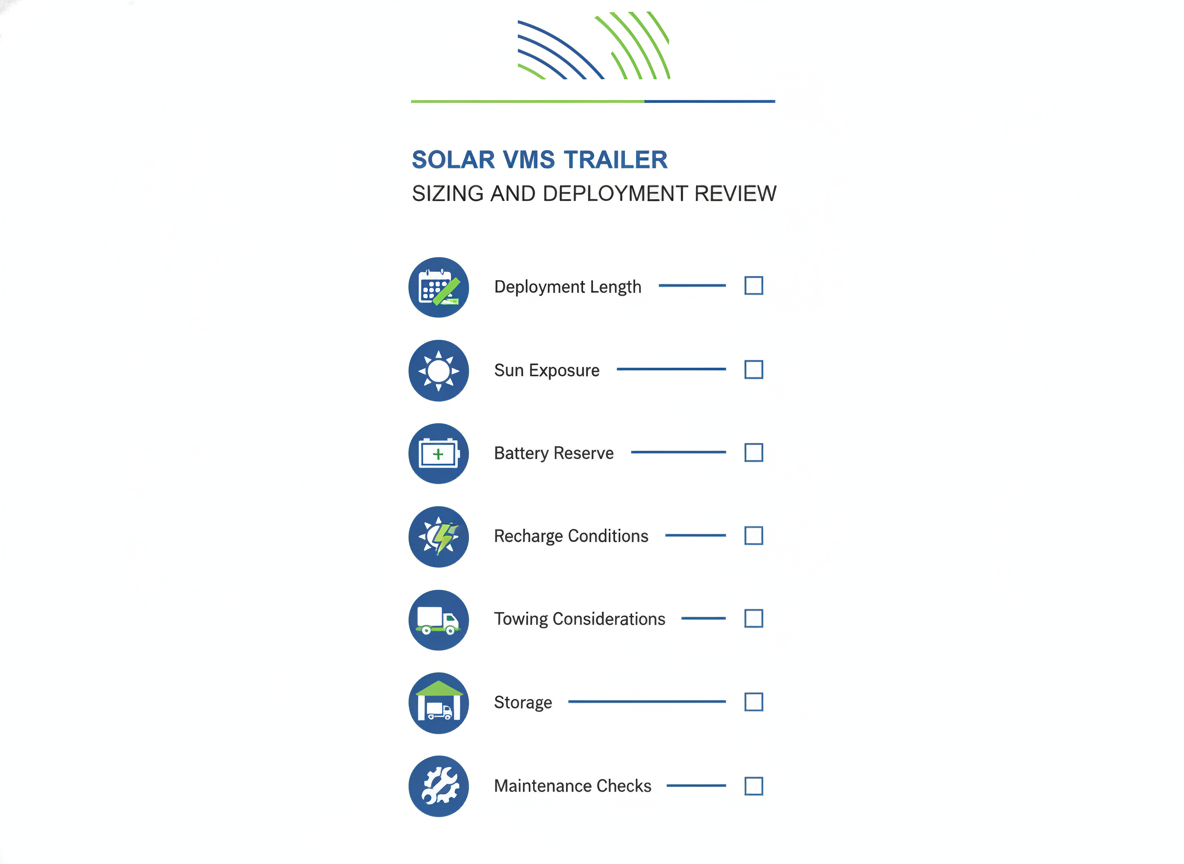
Use this before you request quotes for solar VMS trailer battery autonomy. It turns the sizing and TCO questions into a field checklist instead of a guess.
- Define the deployment window. Is the sign needed for days, weeks, or a longer season? Short-term work usually supports mobile deployment better than permanent infrastructure.
- Estimate the real load. Note brightness level, message refresh pattern, and expected active hours per day.
- Set the reserve target. Ask how many no-sun days the site should survive before service is needed.
- Check the recharge conditions. Confirm season, angle, shading, and whether the trailer will sit in a low-sun laydown area.
- Review recovery features. Automatic recharge and charge-state monitoring are worth checking because they reduce surprise outages and service visits FDOT Section 990.
- Count ownership costs. Include towing, setup labor, storage, battery replacement, and repositioning.
- Match the form factor to the site. Short, moving, or off-grid work usually supports a trailer or vehicle-mounted unit. Long-duration, power-backed sites usually favor fixed installation.
If you want a concrete gate, use this: choose a trailer when the work zone is temporary, relocatable, or power-limited; choose fixed infrastructure when permanence and utility access dominate the decision. If the site sits in between, compare the repeat moving cost against the cost of permanent installation before you commit.
Final Takeaway
Solar VMS trailer battery autonomy should be treated as a planning margin, and deployment TCO should be treated as a life-cycle decision. If the site is temporary, off-grid, or frequently relocated, a mobile trailer usually deserves first look. If the site is permanent and utility-backed, a fixed sign may be the cleaner fit. Before you quote, check the load profile, reserve days, recharge conditions, and all recurring costs. That is the fastest way to avoid downtime and overbuying.
FAQs
How Long Can a Solar VMS Trailer Run Without Sun?
It depends on the battery bank, the duty cycle, and how much reserve margin the buyer built in. Published autonomy should be treated as a planning estimate, not a universal guarantee. For critical work zones, the useful question is not just "how long," but "how many cloudy days can this site survive before service is needed?"
How Big Should the Battery Bank Be for a Work Zone?
Start with the daily load, then add the number of no-sun days you want to cover. After that, adjust for season, shading, and how critical the route is. If the sign must stay live through a bad-weather stretch, the battery bank should be sized to the deployment risk, not just the average day.
What Costs Should Be Included in Mobile VMS TCO?
Include purchase price, towing, setup labor, storage, maintenance access, battery replacement, and relocation labor. Those recurring costs are what often separate a cheap-looking trailer from a truly economical one. If the unit moves often, logistics can matter as much as the hardware itself.
When Is a Mobile Solar Trailer Better Than a Fixed Sign?
A mobile trailer is usually the better fit when the deployment is temporary, off-grid, or likely to move. Fixed signs are often better when the location is permanent and utility power is already available. The choice flips when mobility stops being valuable and permanence starts being the priority.
Can a Solar VMS Reduce On-Site Power Work?
Yes, in many deployments it can reduce or eliminate utility hookup needs. That said, towing, siting, storage, and maintenance still affect the total effort. Solar helps most when the site is hard to power and the trailer can be serviced without frequent emergency trips.
What Is the Biggest Sizing Mistake Buyers Make?
They often size from the battery label instead of the real workload and recovery window. That can hide the effect of brightness, weather, winter sun, and repeated message updates. The safer approach is to size from actual use plus reserve margin, then compare that against the deployment schedule.