


Smart city LED display integration is a verification problem, not a plug-and-play assumption. Before procurement, buyers should confirm which parts of the stack are standards-backed, which depend on vendor software, and which still need site-level proof. That matters most for corridor, downtown, and campus rollouts where network access, alerting, and maintenance ownership all have to line up.
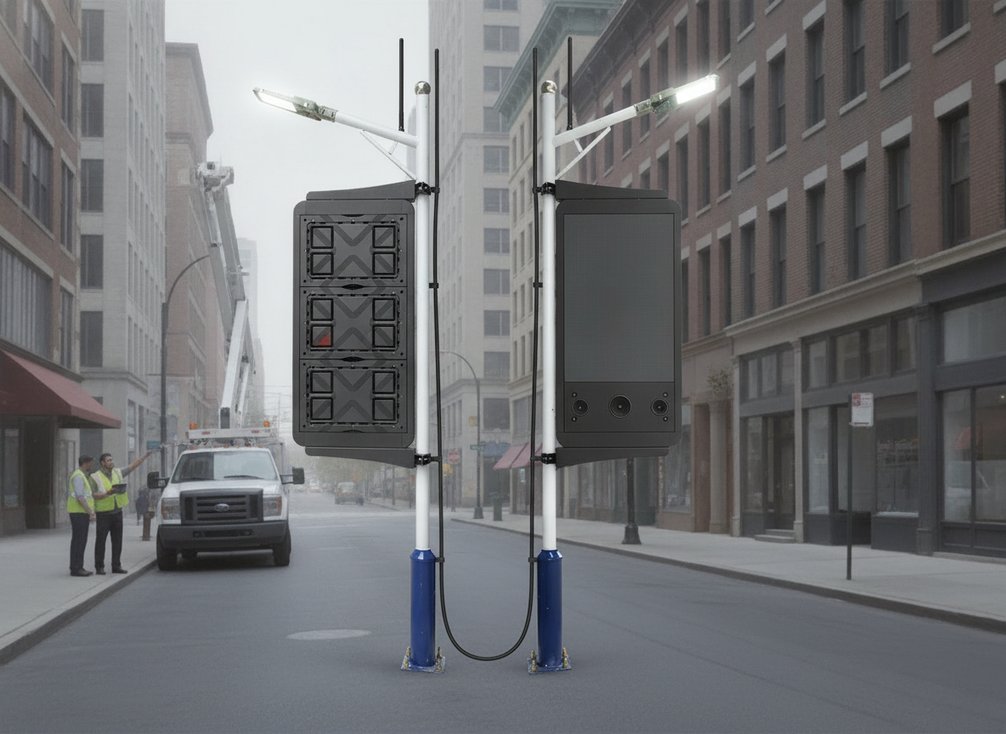
What Smart City LED Pole Integration Needs
The safest way to think about a smart city LED display is as one node in a larger municipal system. NIST’s interoperability framework treats interoperability as a set of junctions, not a single all-or-nothing promise, so the buyer’s real question is which interfaces are proven and which are still vendor-assembled.
In practice, that means checking four layers: network access, sensor inputs, alert publishing, and operations control. The pole form factor alone does not prove compatibility with city software, power design, enclosure needs, or remote management. If those layers are not documented, the safest reading is that the display may fit the site, but the full smart city LED display integration still needs proof.
A useful rule of thumb is simple: if a vendor can show only the hardware and not the data path, the project is not ready for award. If it can show the data path but not the operating roles, the project is only partly ready.
For buyers comparing product families, the C-Pole Smart City Display page or the broader C-Smart line can serve as a navigation aid, but only as a navigation aid. Published product language can point you to a candidate; it does not prove citywide compatibility.
How the Display Fits Existing City Systems
For most municipal teams, the biggest mistake is treating the display as the system instead of one endpoint in the system. The buyer should ask how the pole receives data, who can change content, which platform owns the schedule, and how diagnostics are exposed to maintenance staff.
Sensor Inputs and Data Paths
Environmental sensors are the clearest place to start because the interface question is more concrete. The NTCIP 1204 Environmental Sensor Station protocol is the right reference point when a smart pole needs to exchange sensor data with transportation or city management systems. That makes the decision less about the pole’s appearance and more about whether the controller and software stack can actually speak the same language.
What this means is that the city should verify sensor class, data format, refresh behavior, and ownership of the data path before procurement. If the deployment needs air quality, weather, or similar inputs, the question is not whether sensors can physically mount on the pole. The question is whether the sensor data can be read, routed, and maintained without a custom workaround that becomes a support burden later.

Cloud Control and Remote Management
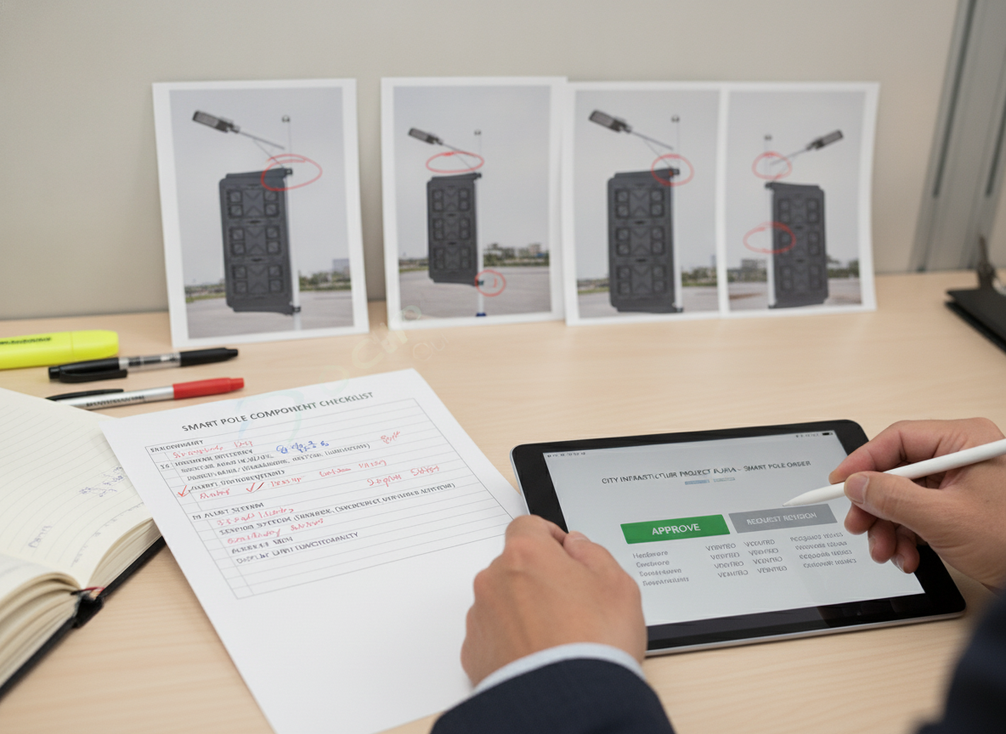
Remote management is useful only when the operator can do real municipal work from it. Buyers should verify whether staff can publish content, schedule messages, view device health, and hand off maintenance tasks from a central console. If the platform can do only one of those things, the operation will still depend on manual steps.
That is also where role separation matters. Operators, approvers, and maintenance users should not all have the same permissions, and audit logs should show who changed what and when. Those controls do not prove security by themselves, but they are part of a procurement-grade review for a city deployment.
Third-Party Platform Fit
For many cities, the hard part is not the pole itself but how it connects to existing software. A third-party platform may fit through APIs, file exchange, middleware, or a vendor-specific connector, and those are not interchangeable. If the buyer already has a city operations platform, the procurement question is whether the pole can connect to that platform cleanly or whether the team will need a custom integration layer.
This is also where the line between standard and vendor-led matters. Standardized sensor interfaces can reduce risk, but they do not guarantee that every dashboard, content system, or asset-management tool will plug in without extra configuration. If a vendor says a connection is possible, the city should still ask for the interface method, sample data, and a pilot path.
What the Product Page Suggests
The C-Pole Smart City LED Pole Display product page is relevant because it presents the unit as a smart city hub with IoT sensor integration, 5G micro-cell language, and public alert workflows. That makes it a reasonable candidate for a buyer to evaluate. It does not, however, prove that every claimed function is ready for every city stack or every deployment model.
If you are mapping a current procurement list, use the page to decide whether the family belongs on the shortlist, then verify the exact interfaces before assuming fit. That approach is better than reading the product description as a promise of complete interoperability.
5G and Network Boundaries to Verify
A 5G label by itself does not tell you whether the pole is ready for municipal use. Buyers need to separate physical connectivity from operational readiness, because a device can be attached to a network and still fail the deployment test if backhaul, latency, redundancy, or control ownership are unclear.
| Verification bucket | Needed for 5G-ready? | Needed for public-alert-ready? | Notes / condition |
|---|---|---|---|
| Physical network connection | Required | Required | Verify the actual handoff, not just the presence of wireless hardware. |
| Backhaul ownership | Required | Required | City, carrier, or hybrid ownership changes support and escalation paths. |
| Latency sensitivity | Required | Conditional | More important for time-sensitive monitoring and operator workflows than for static messages. |
| Redundancy and failover | Required | Required | If the network is a single point of failure, the deployment is fragile. |
| Carrier or IT coordination | Conditional | Conditional | Usually needed when the pole shares municipal, carrier, or edge-network infrastructure. |
| Verification evidence | Required | Required | Ask for diagrams, pilot results, and acceptance criteria before award. |
For a 5G smart pole display procurement review, the deciding question is whether the network role is clearly defined. If the pole is only a connected endpoint, the procurement is simpler. If it also hosts a micro-cell or depends on edge services, the buyer should expect more coordination with municipal IT or the carrier.
DHS’s SCITI Labs procurement framing is useful here because it pushes the review toward fit-for-purpose and cyber-aware procurement rather than wishful assumptions. That does not certify the deployment, but it does support a more disciplined question set before purchase.
Public Alerts, Monitoring, and Operator Workflow
Public alert capability is not just a display feature. It is an operating workflow that should move from message creation to approval, publishing, acknowledgement, and later review. That is why the buyer should verify the process before treating the pole as part of a public communications plan.
Alert Routing and Approval
FEMA’s Common Alerting Protocol guidance matters because it gives buyers a standards-based way to think about public alert dissemination. CAP is about getting one message into multiple channels with the right workflow controls, not about assuming the hardware itself guarantees emergency compliance.
In procurement terms, the city should ask who can issue a message, who must approve it, how urgent notices override scheduled content, and how the system logs the event afterward. If those steps are unclear, the risk is not just technical failure; it is operational confusion during a real event.
Monitoring Dashboards and Device Health
Monitoring is useful when it supports action. A city team should be able to see whether a pole is online, whether a fault exists, whether brightness or scheduling status has drifted, and whether a maintenance ticket needs dispatch. The best dashboard is the one that shortens response time without adding unnecessary complexity.
That is also where public alert LED display cloud platform claims need careful reading. A cloud interface may help with remote oversight, but the buyer still needs to know which alerts are supported, which devices are included, and what happens if the network drops. A dashboard should improve control, not hide operational gaps.
Role-Based Access and Audit Trails
Municipal alerting needs separation of duties. Operators, approvers, and maintenance staff should not share the same credentials or the same rights. Audit trails matter because they help with accountability, incident review, and post-deployment due diligence.
A practical test is straightforward: if the city cannot tell who changed a message, who approved it, and when it was published, the workflow is not mature enough for public-facing use. That is especially important for emergency notices, detours, and scheduled city announcements that may affect traffic or public confidence.
Procurement Checks Before You Buy
The cleanest procurement package is the one that reduces guesswork before award. For smart city LED display integration, that means asking for documents and test results that show how the system will behave in the field, not just how it looks in a brochure.
- Request interface specs first. Ask for the sensor protocol, API or connector details, alert workflow description, and the exact controls used for content, diagnostics, and access.
- Request network diagrams next. Confirm backhaul ownership, handoff points, failover design, and any municipal or carrier dependencies.
- Request acceptance criteria before the pilot. The city should know what counts as success for alert publishing, sensor exchange, remote monitoring, and maintenance response.
- Verify site conditions. Pole access, power availability, mounting constraints, and enclosure environment can turn a promising design into a maintenance issue.
- Review service terms. Warranty ownership, response time expectations, and support escalation should be clear before award.
- Use a pilot or acceptance test where possible. If the vendor cannot prove the workflow on a limited site, it is too early to assume citywide readiness.
DHS’s cybersecurity-oriented procurement framing reinforces the same idea: smart city IoT purchases should be fit for purpose and cyber-aware, not driven by broad claims alone. In other words, a short checklist can save a long deployment failure.
If a vendor cannot provide the interface documents, a network diagram, and a workable acceptance plan, the safer answer is to pause. If those materials are available and the pilot behaves as expected, the project is closer to award.
Final Takeaway
Smart city LED display integration works best when buyers verify each layer separately: sensors, network, alerts, and operations. That is the safest way to judge fit without overtrusting marketing language. If you are building an RFP or shortlist, start with interface documents, network diagrams, and a pilot plan, then narrow to the vendors that can show real integration evidence before award.
FAQs
Can Smart City LED Pole Displays Connect to Third-Party Municipal Platforms?
Yes, but only when the interface method is documented. The buyer should verify APIs, data formats, connector support, and which system owns scheduling or alert publishing. Without that proof, compatibility should be treated as a question, not a feature claim.
What IoT Sensors Are Most Common in Smart Pole Deployments?
Common categories include environmental, mobility, and safety-related sensors, but the real decision is whether the controller and software can ingest the data cleanly. Mounting a sensor is easy compared with keeping the data path stable and supportable over time.
How Should Buyers Evaluate 5G Support in a Smart Pole Display?
Treat 5G as a deployment question, not a category label. Verify the network role, backhaul, redundancy, latency needs, and whether carrier or municipal IT coordination is required. A connected pole is not automatically a 5G-ready municipal asset.
How Do Public Alert Workflows Reduce Communication Risk?
They reduce risk when approval, publishing, role-based access, and logging are separate steps. That structure helps prevent unauthorized posting and makes later review possible. It does not guarantee delivery, but it does make the process more controllable.
What Documentation Should a City Request Before Procurement?
Ask for interface specs, network diagrams, access-control details, acceptance criteria, warranty terms, and a pilot plan. Those documents show whether the project is technically and operationally ready, or whether the vendor still needs to prove fit.





