


A strong LED wall maintenance SLA template is a control document, not a support afterthought. For a 24/7 command center, the agreement should define what is covered, who owns each step, how help starts, how repairs are restored, and how spare parts and monitoring work when the wall fails.
What a Command Center LED SLA Should Cover
A formal SLA is the part of the contract that records services, priorities, and responsibilities between the provider and the customer, which is why it matters so much for a mission-critical display. AVIXA’s SLA definition is broad, but a command center version should be sharper: service scope, incident ownership, escalation, exclusions, and proof of completion all need to be named in writing.
[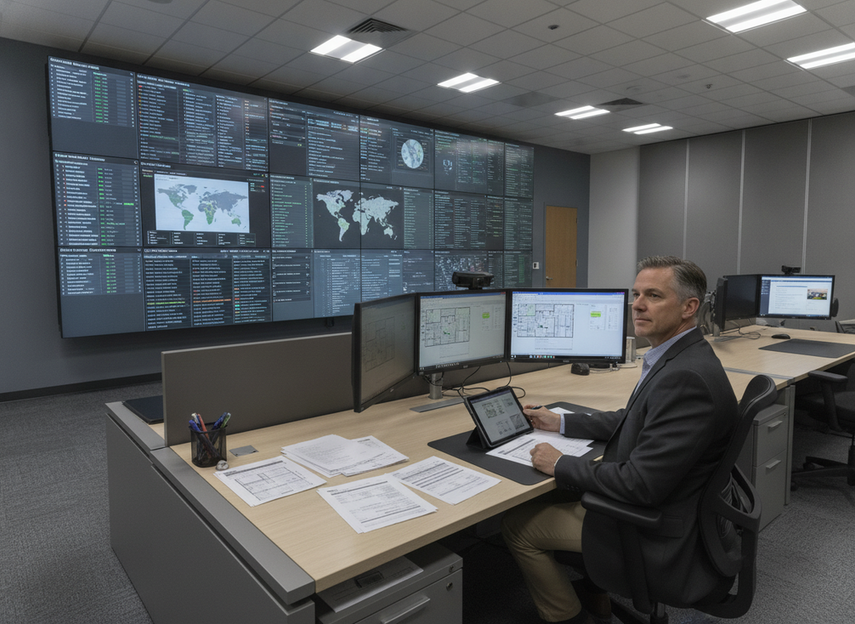 ]
For 24/7 environments, the service window should read like a real operations commitment, not business-hours language. The VA.gov SLA template is a useful benchmark because it explicitly uses 24/7/365 coverage language. That does not force the same wording in every contract, but it does show the level of clarity buyers should ask for.
Core SLA Terms
Start by listing the system in plain terms: cabinets, modules, controllers, power supplies, signal paths, firmware or software support if included, and any auxiliary monitoring tools. Then separate preventive maintenance from incident response. If the wall needs cleaning guidance, inspection, calibration, or post-repair verification, those items should appear as distinct tasks, not buried inside a generic "support" clause.
A practical LED maintenance SLA should also say what the vendor reports after each service visit or remote session. That gives facility teams a way to track repeat faults and recurring hot spots instead of treating every issue as a one-off. If the agreement includes regular verification or preventive checks, monthly or quarterly review language can be used as a scheduling example, but it should stay tied to the site’s operating risk rather than presented as a universal rule.
Incident Ownership and Escalation
The fastest way to lose time during an outage is to let the contract stay vague about who does what. The University of Illinois SLA template is useful here because it distinguishes remote troubleshooting from on-site dispatch and makes escalation part of the workflow. That is the right model for command centers: someone must receive the alert, someone must triage it, someone must authorize dispatch, and someone must close the ticket.
LED-specific service guidance also points toward remote diagnostics and routine preventive maintenance instead of generic IT-only language. In practice, that means the contract should say whether virtual troubleshooting is required before dispatch, whether it can happen in parallel, and what happens if the first response does not restore the wall. For mission-critical rooms, that separation matters because a fast acknowledgement is not the same as a recovered display.
Spare Parts and Replacement Scope
The SLA should name the spare parts that matter most to the wall, then state who owns them and where they are stored. For many buyers, the useful list starts with modules, power supplies, receiving equipment, cables, and any control components that can stop the wall from operating normally. If temporary replacement pieces, loaner hardware, or local inventory pools are part of the service, those terms need to be explicit.
This is where a mission-critical LED wall line can be a useful navigation path for buyers who are comparing support expectations against low-downtime display designs. A mission-critical LED wall option page can help buyers think through that fit question, especially where redundancy and service access are part of the design. Manufacturer-led features such as front-service access or redundant power and signal paths may support easier recovery, but they should be treated as fit context, not proof of a market standard. In a contract, the real question is simpler: what parts are stocked, how fast can they be released, and what is the fallback if the site is far from the warehouse?
Repair Speed, MTTR, and Escalation Expectations
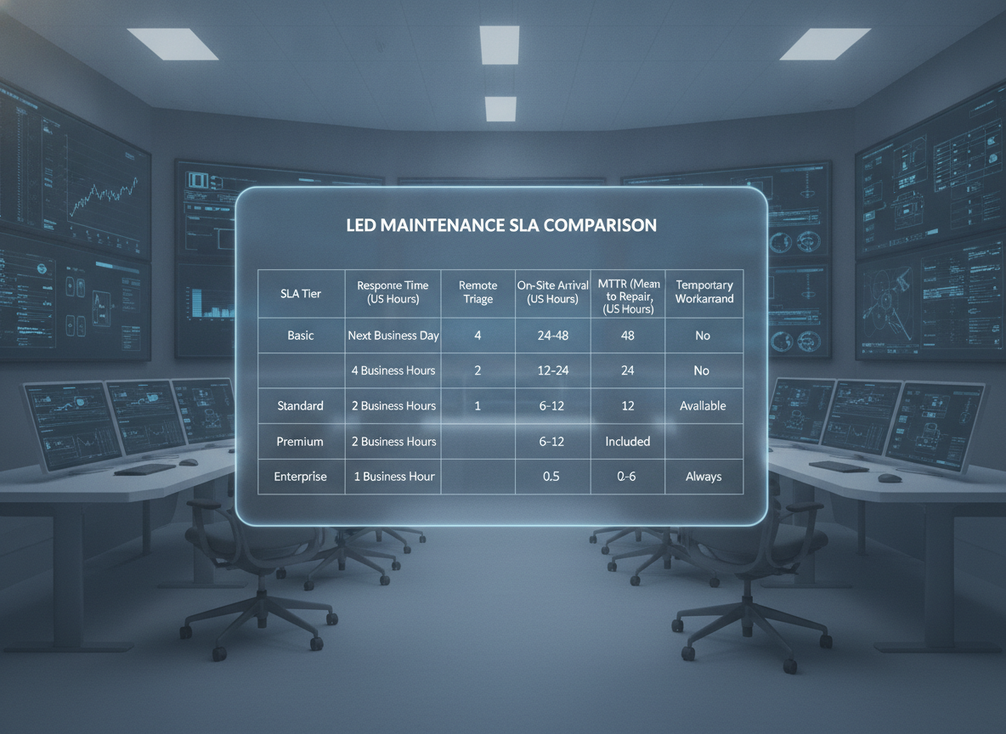
For a 24/7 command center, the most useful timing language separates response time, remote triage time, on-site arrival, MTTR, and temporary workaround or recovery provisions. Those are not interchangeable. Response time tells you when the vendor starts handling the fault. MTTR tells you when the wall is back to service, or at least restored to an agreed operating state.
[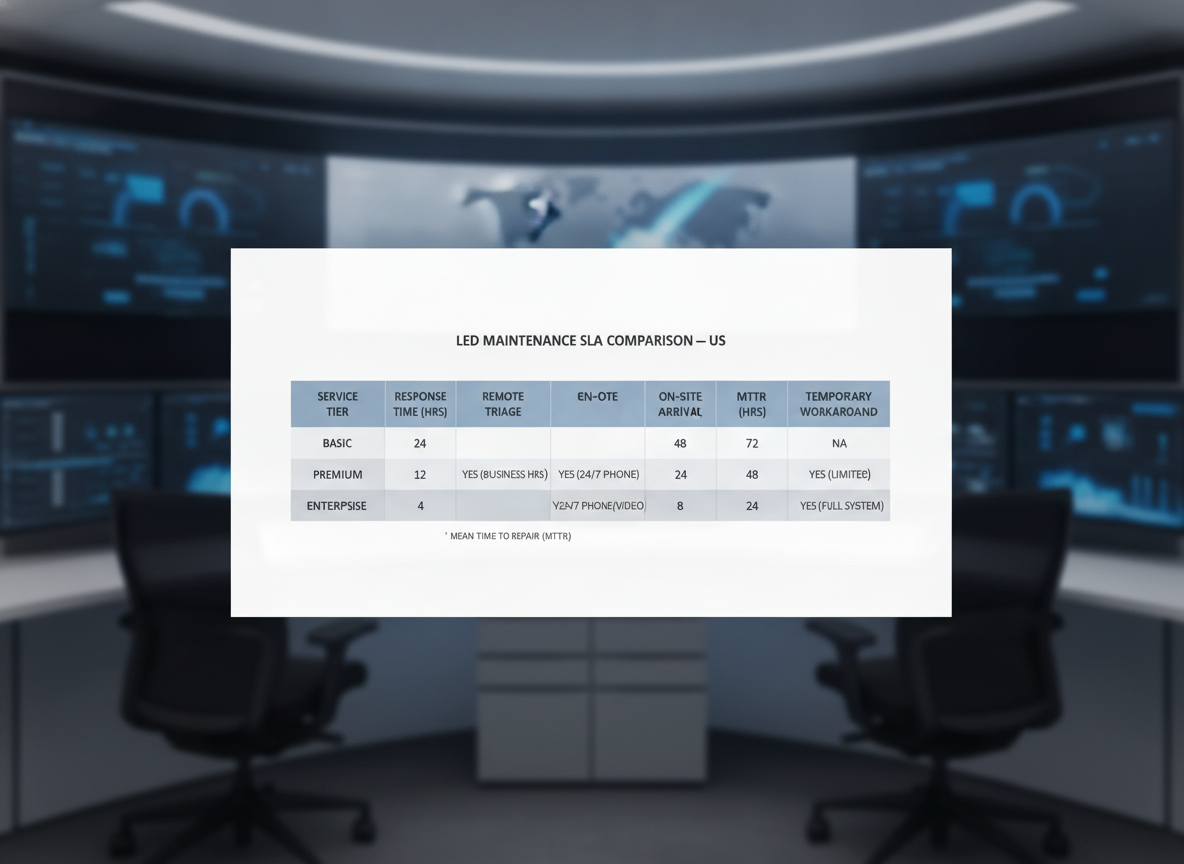 ]
That distinction matters because buyers often accept a quick acknowledgment and assume the problem is solved. It is better to compare timing terms by contract function, not by headline promise. A support model with strong parts access and local coverage can justify tighter restoration expectations, while a remote-only model may need longer recovery language even if it answers quickly.
| Contract term | What it means in practice | What to confirm | Risk if left vague |
|---|---|---|---|
| Response time | How quickly the vendor acknowledges the fault | The clock start, the contact channel, and weekend coverage | The vendor can answer fast without moving the repair forward |
| Remote triage time | How long diagnosis should take before the next step | Who receives alerts and whether remote diagnosis is required | Tickets can stall in "under review" status |
| On-site arrival | When field support reaches the site | Geography, holiday coverage, and dispatch trigger | The wall can stay down while everyone waits for travel |
| MTTR | Time to restore the display or agreed function | What counts as restored and whether temporary workarounds count | Recovery can be declared only after the room is still impaired |
| Temporary workaround | Interim service that keeps operations moving | Whether partial display mode or substitute equipment is acceptable | The vendor can avoid a full fix while the room remains at risk |
A 24/7 command center should use the site’s criticality to judge acceptable timing, not a universal benchmark copied from another project. If the wall has little redundancy and the room cannot absorb visible downtime, the SLA should push for tighter escalation and clearer spare-parts language. If the site has more tolerance, the contract can allow a more measured recovery path, but it still needs written dispatch and closure rules.
[ ]
The mission-critical LED wall option page can help buyers think through that fit question, especially where redundancy and service access are part of the design. Use it as a navigation aid, not as a substitute for SLA language. The contract should still spell out whether the vendor is promising remote triage, on-site support, or both, and what happens if the first repair attempt does not fully recover the wall.
Remote Monitoring and Spare-Parts Terms
Remote monitoring only lowers downtime risk when the contract defines what is monitored, who receives the alert, and what happens next. AVIXA’s support materials on remote monitoring and management reinforce the idea that monitoring is part of a larger support workflow, not a magic fix. For command centers, the useful promise is diagnosis speed, not automatic prevention.
Remote Monitoring Service Levels
Ask the vendor to name the events it monitors, such as power faults, signal loss, controller errors, or module-level alarms where supported. Then define alert ownership and reporting frequency. If the vendor sees a problem before operators do, that is useful only if the ticket moves to the right person fast enough to matter.
Critical Spare-Parts Inventory
The SLA should distinguish customer-owned stock, vendor-owned stock, and shared service pools. That difference affects whether the site can recover quickly or wait for parts to move through a general warehouse channel. If the wall uses serviceable front-access architecture or a redundant design, those features can reduce repair complexity, but the contract still needs a release-time commitment for the parts that actually fail in the field.
Local Warehouse and Dispatch Coverage
If the site is in a region with limited coverage, geography becomes part of the SLA risk. Ask whether the vendor uses a local warehouse, regional dispatch, partner dispatch, or ship-from-central-stock model. Also confirm holiday coverage, cutoff times, and whether weekend shipping is included or only "best effort."
The practical rule is simple: monitoring can shorten diagnosis, but stocked parts and dispatch coverage shorten outage duration. When one of those pieces is missing, the contract should say so plainly instead of implying full readiness.
How to Compare Vendors on SLA Risk
Use a pass-fail review before you compare prices. If a vendor cannot state the service window, escalation path, parts ownership, and dispatch geography in writing, it is not ready for a 24/7 command center award. A cleaner contract with slightly higher price may be the lower-risk choice if it removes ambiguity around outages.
- Define the room’s criticality first. If a visible outage interrupts operations, set stricter timing and escalation terms before discussing cost.
- Separate response from restoration. A fast ticket reply is useful, but it does not replace MTTR language.
- Check whether remote troubleshooting is required, optional, or bundled with dispatch.
- Verify spare-parts ownership, release timing, and warehouse location.
- Ask what exclusions remain, especially for holidays, geography, and third-party network issues.
The best vendor is usually the one whose SLA can be enforced without interpretation fights. That is especially true for renewal reviews, where old assumptions can linger after the original project team has moved on.
RFP Checklist for a Final SLA Review
Before signing, confirm the service scope, response and repair terms, parts ownership and release timing, escalation contacts, and renewal language. If any of those points are still vague, ask the vendor to rewrite the clause in plain language rather than leaving it open to interpretation.
FAQs
What Should an LED Maintenance SLA Include for a 24/7 Command Center?
At minimum, it should name the covered system, service window, response path, escalation path, spare-parts rules, and what counts as repair completion. For mission-critical rooms, it is also smart to require written exclusions and a post-service report so repeat faults do not disappear into general support notes.
How Is MTTR Different From Response Time in an LED SLA?
Response time is when the vendor starts handling the issue. MTTR is when the wall is restored, or restored enough to meet the contract’s recovery definition. That difference matters because a fast callback can still leave the room impaired for hours if the repair path is not written clearly.
What Spare Parts Should Be Included in a Mission-Critical Display Contract?
The contract should name the parts that most often stop the wall from operating normally, such as modules, power supplies, receiving equipment, and related cabling or control components where applicable. The key question is not just what is listed, but who owns the stock, where it sits, and how quickly it can be released.
Can Remote Monitoring Reduce Downtime Risk for an LED Wall?
Yes, but only when the SLA defines monitored events, alert ownership, and the next action after detection. Monitoring helps most when it speeds diagnosis and dispatch. If the contract only promises visibility, the buyer may get earlier notice without faster recovery.
How Should a Buyer Review SLA Exclusions Before Signing?
Check weekend and holiday coverage, geography limits, third-party dependencies, and any statement that weakens dispatch or parts release. Exclusions should be written in plain language. If a clause sounds broad but hides an exception, ask for a revision before award so the support promise matches the room’s real risk.





