Highway VMS standards are easiest to review when you separate the standard name from the evidence behind it. For municipal bids, that usually means checking which solicitation language applies, then verifying the exact quoted model, configuration, and documents before you treat any submittal as ready for shortlist. In practice, NEMA TS4, EN 12966, and AASHTO often play different roles, and a product page alone is not enough proof.
Which Standards Usually Shape a Highway VMS Bid
For U.S. highway VMS procurement, the most common starting point is NEMA TS4, the hardware standard for dynamic message signs with NTCIP requirements. That makes it the first document family many reviewers expect to see when a bid asks for highway VMS standards.
EN 12966 works differently. The official EN 12966 scope is a European reference that organizes optical performance and durability expectations for variable message traffic signs. In municipal bidding, that usually matters as a performance and documentation reference, not as a universal U.S. requirement.
AASHTO usually comes into the review when the bid needs structural context, support design, or roadway-specific installation language. The AASHTO-linked equipment specification context shows why buyers should not treat a road-authority name as proof that the sign itself is fully compliant. The MUTCD background context is useful for traffic-control context, but it should not be used as a substitute for project-specific VMS submittal evidence unless the solicitation says so.
A practical rule: if the solicitation names a standard, verify the version and scope it actually cites. If it does not name one clearly, ask which standard family the agency wants the vendor to prove first. That small step prevents name-only claims from crowding out the real review criteria.
EN 12966 in Municipal Procurement
EN 12966 is often used to benchmark optical performance and durability, so it matters most when the bid language talks about visibility, contrast, or environmental exposure. The useful question is not just whether a vendor says "EN 12966 compliant," but whether the quoted configuration and supporting records match the cited version, annexes, or classes. A general claim is weaker than a document set that can be traced back to the exact sign being offered.
NEMA TS4 in Highway Sign Bids
NEMA TS4 is the most direct U.S. hardware reference for highway changeable message sign standards. Reviewers should check whether the solicitation asks for direct compliance, an equivalent test method, or a documentation package that references the standard. If the bid language is specific, the vendor’s evidence has to be equally specific. A broad family claim does not replace model-level proof.
Where AASHTO Fits in the Review
AASHTO usually belongs in the structural and installation part of the file, not in a one-line compliance badge. That distinction matters because a sign can look acceptable on paper while still leaving support design, loading, or installation scope unresolved. If the bid references roadway structure, support, or PE-sealed calculations, treat that as a separate review lane from message-sign performance. The AASHTO procurement context is a good reminder that a transport standard can shape the review without replacing the submittal package.
What Documents Buyers Should Request First
Before you compare pricing or delivery dates, ask for the documents that let you verify the bid package without chasing the vendor for basic proof. A useful municipal VMS test report requirements for municipalities checklist usually starts with:

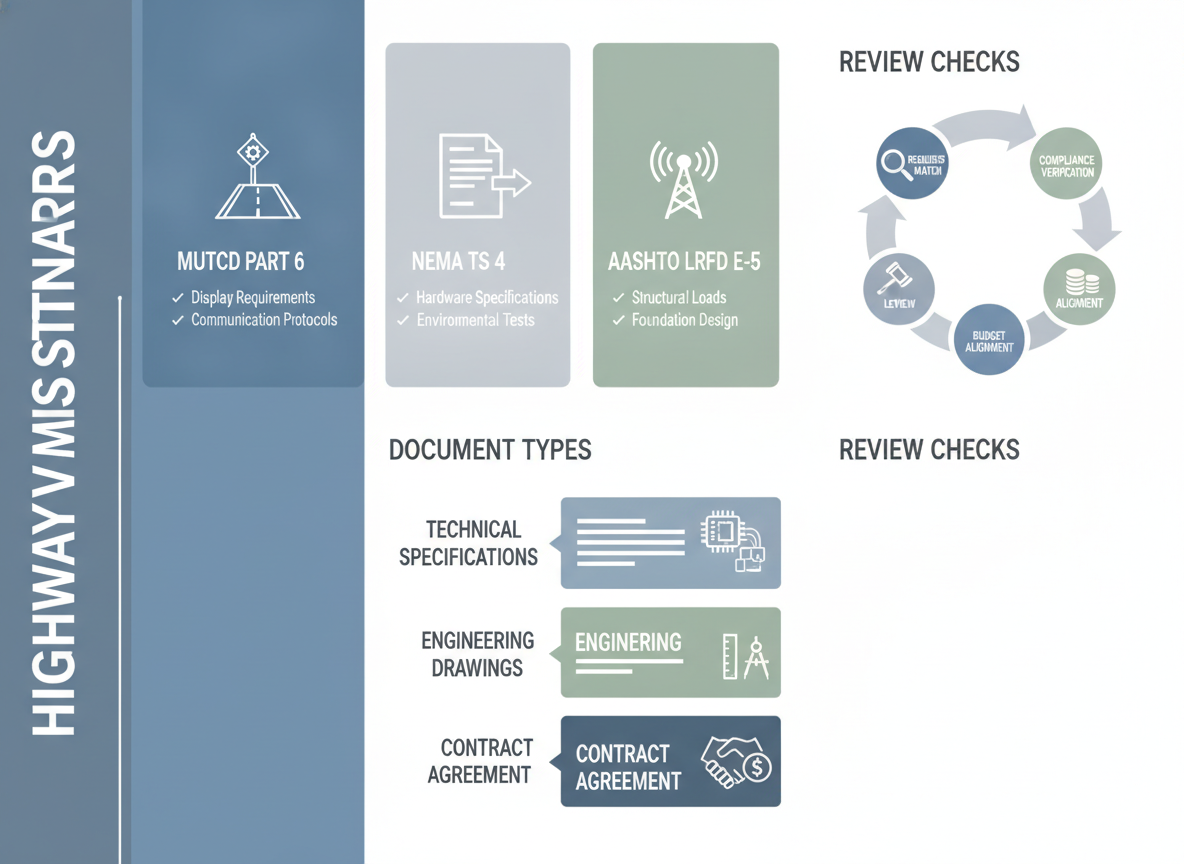
- The exact certification or compliance statement tied to the quoted model.
- Type-test or performance reports that name the same configuration.
- Drawings, wiring details, and installation documents.
- Manuals and maintenance instructions.
- Warranty language and any exception notes.
The strongest procurement template in the source set is the NYSDOT VMS qualification checklist, which shows why reviewers should expect more than one attachment. In that kind of file, structural calculations, MIB files, drawings, and test results are separate pieces of evidence, not interchangeable extras.
The main screening rule is simple: if the document name, revision date, or model identifier does not match the quoted configuration, the package needs follow-up before shortlist. Missing paperwork is not a late-stage cleanup item; it is a reason to slow the review early.
How to Compare Vendor Compliance Submittals
When you compare submittals, keep the review columns separate: standard reference, evidence quality, exact configuration match, and open exceptions. That format makes it easier to spot a package that looks polished but does not actually answer the bid.
| Bid Review Item | What Good Evidence Looks Like | Common Gap | Review Action |
|---|---|---|---|
| Standard reference | The bid cites the same standard family the vendor claims | Name-only claim with no scope detail | Verify version and citation language |
| Test report | Report names the exact quoted model or configuration | Family-level report only | Ask for model-matched report pages |
| Drawings and structure | Drawings and calculations align with the support and installation scope | Structural evidence missing or generic | Hold shortlist until structure is clear |
| Documentation set | Manuals, warranty, and exceptions are attached | Missing or inconsistent attachments | Pause review and request the missing items |
| Brightness or display claim | The tested setup matches the actual operating current and configuration | Overstated performance language | Recheck the test basis before accepting the claim |
That last line matters because test reports should be verified against the exact quoted model and configuration, not just the product family name. The technical warning in this procurement evidence paper is a useful reminder that pushing LEDs harder to reach brightness can distort the evidence and shorten service life. For reviewers, that means a "better-looking" number is not automatically a better bid.
If the submittal package is vague, ask one focused question: "Which attachment proves the quoted configuration?" That is usually more useful than asking for a general compliance statement.
Where Product Fit Meets Bid Requirements
Different deployment forms change which evidence matters most. For overhead gantry projects, the buyer usually needs to focus on structural context, access, and whether the package matches the span or support condition in the bid. For retrofit work, load limits and maintenance access become more important than a glossy feature list. For mobile or temporary deployments, power, transport, and setup evidence often matter more than a fixed-installation style submittal.
That is where a broader Traffic & VMS browsing path can help buyers sort by deployment type before they narrow down a specific configuration. It is also where a product-side review can be useful as navigation, as long as you still check the document package against the solicitation.
If you are looking at a gantry-oriented VMS setup, treat it as a fit check, not as compliance proof. The same caution applies to mobile deployment options and vehicle-mounted units: the form factor may suit the job, but the bid still has to be verified against the exact written requirements.
The practical question is whether the deployment context changes the evidence set. If it does, do not compare the sign on looks alone. Compare the structure, access, power, and documentation trail that the municipality will actually review.
Final Bid Review Checks Before Submission
Before you submit a municipal bid package, confirm three things: the document titles match the quoted configuration, the report dates are current enough for the solicitation, and every required attachment is present. Then check whether the vendor answered each required line item directly instead of leaving the reviewer to infer the answer from marketing language.
Also verify installation, maintenance, and warranty paperwork. A package that looks compliant but leaves service or support terms vague can create delays later.
The safest final step is to send one concise follow-up list for anything unclear: model match, report scope, structural calculation status, and missing attachments.
FAQs
What Standards Does a Highway VMS Need?
It depends on the solicitation. In U.S. municipal bids, reviewers commonly see NEMA TS4, AASHTO-related structural language, and sometimes EN 12966 when the agency wants optical or durability references. The key is to verify which standard family the bid actually names, because not every reference applies to every project.
What Documents Do I Need for Procurement?
At minimum, ask for the compliance statement, the test report or type-test record, drawings, manuals, and warranty terms. Then check that the model name, revision date, and configuration all match the quote. If one of those pieces does not line up, the package needs follow-up before shortlist.
What Is EN 12966 in a VMS Bid?
EN 12966 is a standards reference for variable message traffic signs that helps organize performance and durability expectations. In a municipal bid, it should be read alongside the actual solicitation language and the supporting documents, not as a standalone proof of bid readiness.
How Do I Verify Test Reports Before Bid Submission?
Start with the report date, then check the issuing body, the scope of testing, and the exact model or configuration name. If the report only names a product family, ask for the pages that tie it to the quoted build. That extra step is especially important when performance claims could change with operating current or setup.
Can a Product Page Be Treated as Compliance Proof?
No. A product page can help you find a candidate or understand a configuration, but it does not replace bid-specific evidence. For municipal review, the deciding documents are the ones that match the solicitation, the quoted model, and the attached reports or drawings.