


Cold-weather battery sizing for solar VMS trailers starts with winter autonomy, not summer nameplate capacity. In low-sun, cold conditions, a setup that works in July can lose practical runtime fast enough to matter on the road. The question is not only whether the trailer can run, but whether it can keep messaging on through short days, snow, and slow recharge cycles.
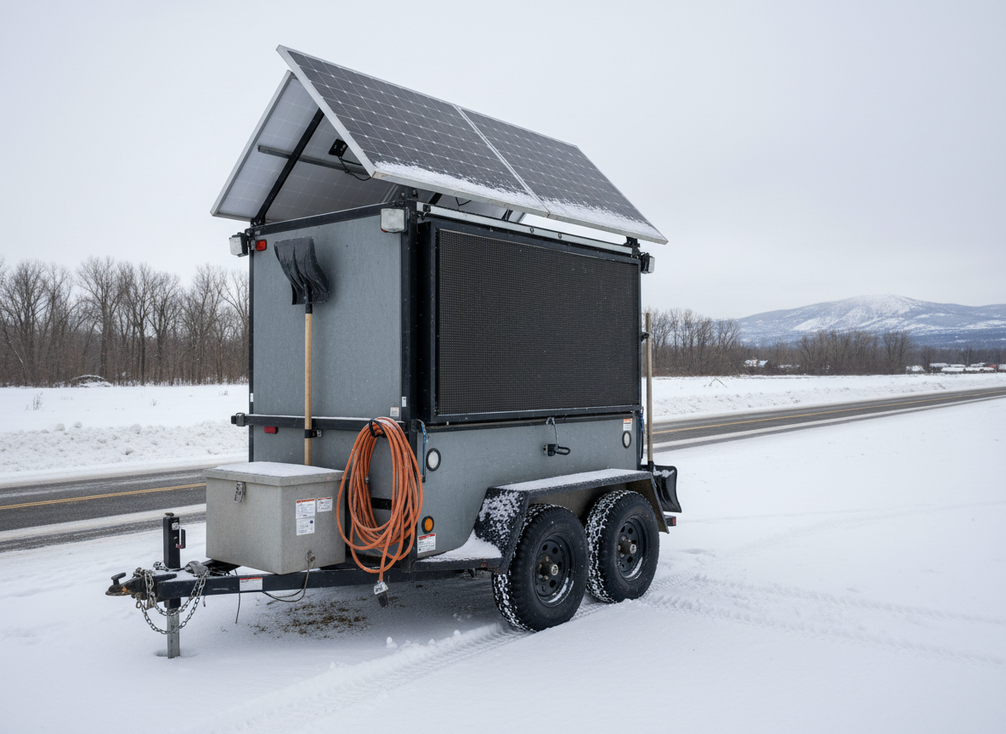
Why Winter Changes Solar VMS Runtime
Winter changes solar VMS runtime because it cuts both sides of the equation. You usually get less solar input, fewer usable charging hours, and colder batteries at the same time. That combination can shorten the time a sign stays online even when the summer sizing looked comfortable.
For northern deployments, the main risk is simple: the board may hit a low state of charge before the next useful charging window opens. That is why winter planning should treat autonomy and recharge recovery as separate checks.
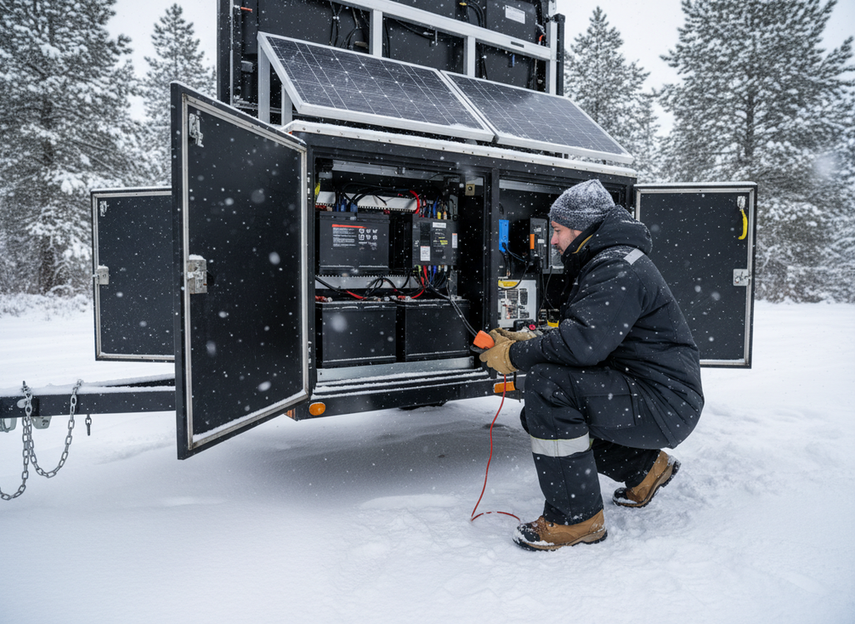
A useful question is whether the design still works when the sun is weak, the air is cold, and the site gets shaded or snow-covered. If it only works when conditions are close to summer, it is not a good fit for portable solar VMS deployment in the north.
The Cold-Weather Factors That Reduce Autonomy
Low Sun and Shorter Winter Charge Windows
Winter reduces the time available to refill the battery bank. Shorter days, lower sun angle, cloud cover, and snow on the array can all cut the margin between daily use and daily recharge. In real deployments, that matters more than a nameplate battery figure because the system has less time to recover from the previous day’s load.
That is why solar powered highway sign reliability is less about peak summer output and more about how much energy comes back on the weakest days of the season. If the site is shaded or the trailer sits through storms, recharge can become the limiting factor even when the battery bank looks large on paper.
Cold Temperatures and Usable Battery Capacity
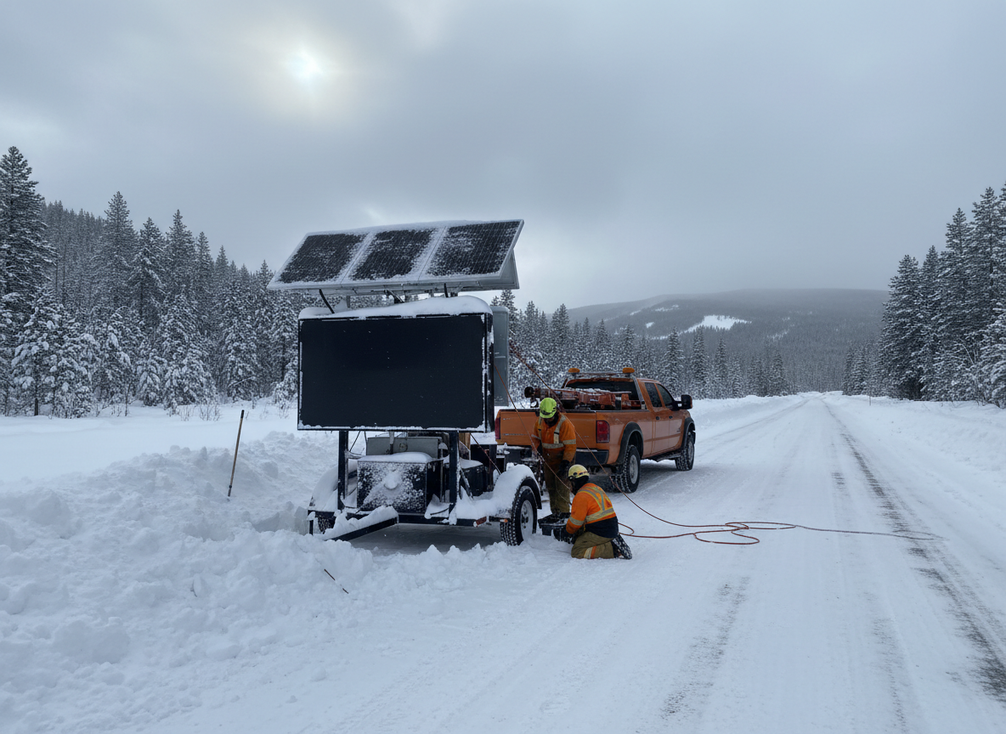
Cold weather can reduce how much of the battery’s stored energy is practically available. For lead-acid systems, lead-acid cold derating can be substantial at 0°F, so winter sizing needs a real adjustment instead of a summer carryover. The exact impact depends on chemistry, temperature, and how the system is built, but the direction is the same: less usable reserve in cold conditions.
That means a battery bank that seems adequate in mild weather may not deliver the same autonomy in a northern winter. For buyers comparing traffic VMS displays or a broader traffic VMS solution, the question is not only how much capacity is installed. It is how much of that capacity remains usable in the cold.
Load Profile and Message Duty Cycle
Daily energy use is not just about the sign face itself. Brightness, message complexity, scroll timing, modem or GPS accessories, and how long the board stays active all affect the battery draw. A trailer that runs a simple message schedule may need less reserve than one that changes often or stays bright for long periods.
The practical takeaway is to size from the real duty cycle, not the marketing version of the deployment. If your team uses different brightness settings for daytime and overnight, estimate winter demand from the actual schedule. That gives a better answer than assuming every portable solar VMS deployment will behave the same.
Controller and Charging Constraints
A system can have enough battery reserve and still fail the winter test if charging is too constrained. The controller has to accept and manage whatever the solar array can provide, and in low-sun weather that recovery window may be tight. In cold climates, lithium systems also need a careful check because LiFePO4 charging below freezing is a real verification boundary unless the system includes heating or equivalent protection.
For buyers, that means controller limits are not a fine-print detail. They affect whether the bank can recover after cloudy days, snow cover, or partial discharge. If you are reviewing portable VMS options, check the cold-weather charging behavior before you treat the trailer as winter-ready.
How to Size Batteries for Northern Use
Start with the actual winter load, then work backward. NYSDOT’s portable VMS specification gives a useful baseline for portable VMS daily load, and the plan should also respect the 21-day autonomy floor commonly used by state DOTs for no-solar backup.
A practical sizing sequence looks like this:
- Estimate daily energy demand from the real winter message schedule, including accessories.
- Apply a conservative cold-weather derating so the usable battery reserve reflects actual conditions.
- Set the autonomy target first, then convert that target into battery capacity.
- Check whether the system can recover fast enough after partial discharge.
That last step matters as much as the reserve itself. NYSDOT’s two-day recharge recovery target is a good winter check because a bank that recharges too slowly can stay partially charged for too long. In other words, the design is not just big enough or too small; it either preserves reserve and recovery together, or it does not.
For planning, a winter solar-to-load margin of roughly 1.2 to 1.3 can be a helpful worst-case heuristic, but only as a checkable guide. It is not proof that a specific site will stay online through every storm, shade condition, or snow event. If the site is harsh, the safer answer is usually to increase reserve, improve recharge access, or both.
| Winter Sizing Check | What It Means | What to Look For |
|---|---|---|
| Autonomy floor | Can the trailer keep running without solar input? | Enough reserve for the required no-sun period |
| Recharge recovery | Can it refill fast enough after partial discharge? | Reasonable recovery after cloudy days or snow cover |
| Cold-charge boundary | Will the chemistry charge safely in winter? | Heating, controller behavior, or another cold-weather safeguard |
If the trailer can meet the autonomy target but cannot recover in two winter days, it is not a dependable northern deployment choice.
What to Verify Before You Buy
- Confirm the battery chemistry first, because cold-charge behavior differs by chemistry and can change the whole winter fit.
- Ask how the controller behaves in low-sun conditions, not just how much power the array can produce in summer.
- Verify whether the system can recover from a partial discharge within your acceptable winter window.
- Check whether the bank still supports the required autonomy after cold-weather derating.
- Inspect the site for shade, snow buildup, and orientation issues that can reduce charging time.
- Make sure maintenance access is realistic after snowfall, because blocked access slows both servicing and recharge checks.
- Separate the sign load from accessory loads so you do not undercount the daily draw.
- If the spec sheet is vague, treat every winter-ready claim as something to verify with conditions, not assume from the product category alone.
If you are narrowing options, browse the C-Tra-VMS Solar Trailer as a starting point, then check winter fit against your load, chemistry, controller limits, and site exposure. A trailer that looks suitable in summer can still miss the mark in northern use.
Winter Deployment Checklist
- Verify the starting charge state before rollout.
- Review controller settings for cold-weather behavior and recovery limits.
- Inspect the site for shade, snow drift, and panel exposure.
- Confirm that maintenance access stays workable after storms.
- Monitor the first cold-weather operating cycle and compare it with the autonomy target.
A field team that checks those five items early is less likely to get surprised by winter performance drops. If you need to compare a specific trailer against your winter duty cycle, check the autonomy target, cold-derating fit, controller charging limits, and site exposure before you request a quote or finalize the spec.
FAQs
How Cold Does a Solar VMS Trailer Need to Be Sized For?
Size it for the coldest realistic deployment window you expect to face, not for a single temperature on paper. The better rule is to size for the autonomy you need after cold derating, then confirm whether recharge still works in your worst likely winter conditions.
What Reduces Battery Runtime Most in Winter?
Usually it is the combination, not one factor. Low sun, shorter charging windows, colder batteries, and a heavier message schedule can all pull runtime down together. The biggest risk is assuming summer performance will carry over unchanged.
Can a Solar VMS Trailer Work in Northern States?
Yes, if the battery reserve, controller behavior, and site exposure all match winter conditions. The key is to treat northern deployment as a sizing and verification problem, not as a guarantee that any solar trailer will behave the same in January as it does in July.
What Controller Limits Should Buyers Check?
Check how the controller handles low-sun charging, partial recovery, and any chemistry-specific cold limits. If the trailer uses lithium batteries, confirm the charging boundary below freezing and whether the system has heating or another cold-weather safeguard.
What Should a Winter Deployment Checklist Include?
Start with charge state, controller settings, and site exposure, then confirm snow access and early monitoring after installation. Those checks help you catch problems before they turn into a missed message during the first cold stretch.
Is a Two-Day Recharge Target Enough for Every Site?
No. It is a useful recovery check, but it is still only a planning benchmark. A shaded site, frequent storms, or a heavier duty cycle may need more margin, especially if the trailer cannot recover quickly after a partial discharge.
Should Lead-Acid and Lithium Trailers Be Sized the Same Way?
No. The overall method is similar, but the winter limits are different. Lead-acid banks need cold derating, while lithium systems need a careful charging check below freezing. The same autonomy target can lead to a different practical design.





