


Selecting a variable message sign requires more than comparing display size or peak brightness. ITS integrators, EPC contractors, traffic authorities, and project owners need a configuration that fits the road environment, viewing conditions, structural constraints, compliance evidence, control interfaces, and service plan.
Match the VMS Architecture to the Traffic Environment
Start with the traffic setting, because it determines how the variable message sign will be mounted, powered, controlled, and serviced.
Highway and Gantry-Mounted VMS
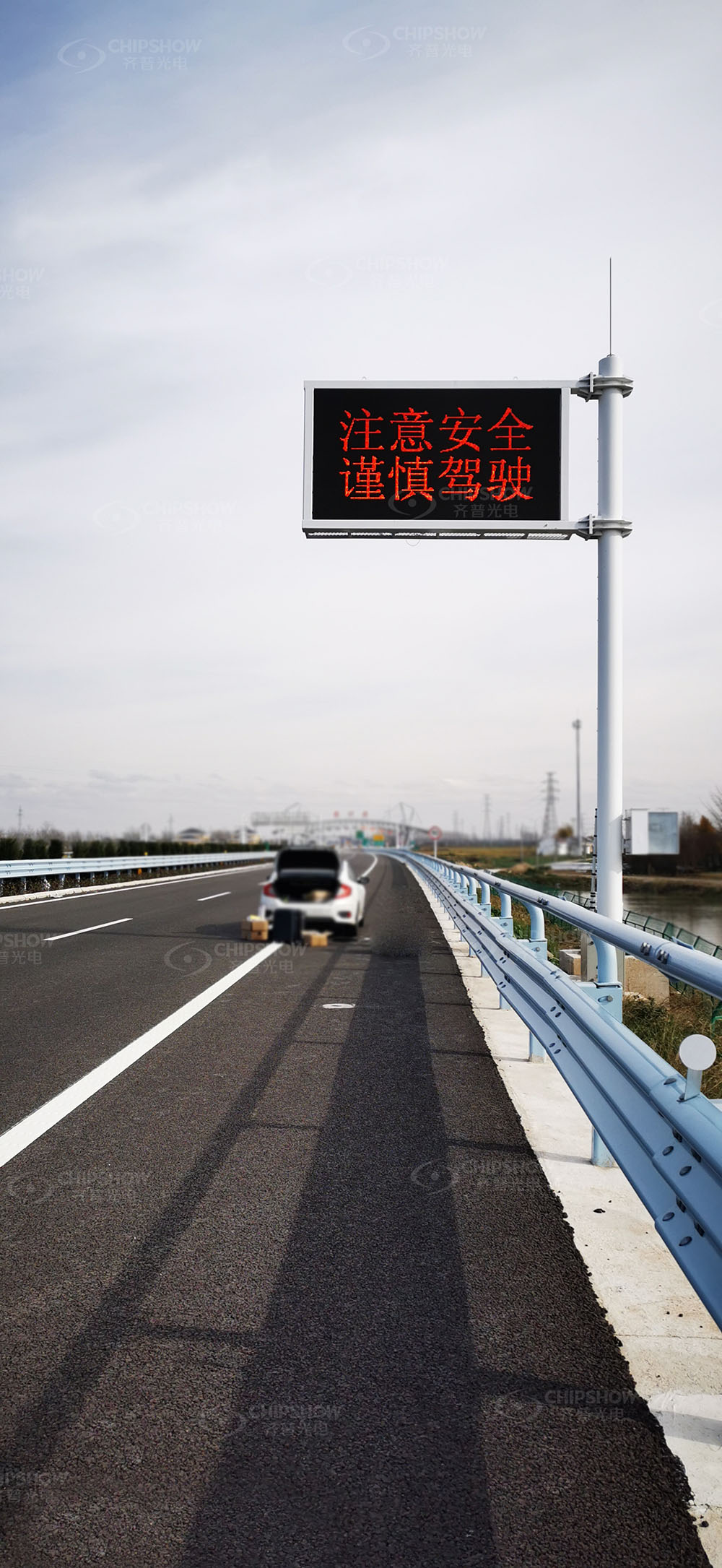
A highway variable message sign must remain legible at speed and over long approach distances. Message design, character height, pixel pitch, luminance control, and sign position must work together.
Gantry-mounted installations add structural considerations. The support structure must accommodate cabinet weight, wind loading, access equipment, cable routing, and safe maintenance procedures. Environmental exposure also tends to be higher on open highways, so enclosure protection, thermal management, and corrosion resistance belong in the technical specification.
The VMS should also connect reliably to the traffic management center. Operators may need to publish incident warnings, lane-control instructions, travel times, weather alerts, or planned closure messages without site attendance.
Urban Road and Municipal VMS
Urban deployments often serve shorter viewing distances but more complex traffic movements. Drivers may approach from several lanes, pedestrians may see the display, and surrounding lighting can change quickly due to buildings, intersections, and street furniture.
A variable message sign for a municipal corridor should match the available roadside space and sightline. A display positioned too close to a junction can give drivers insufficient reading time. A display placed too far from the decision point can lose operational value.
Urban and tunnel projects need defined operating states and authority to publish messages. For tunnel approaches and interiors, record sightlines, lighting transitions, emergency-message priority, ITS integration, and service access. Match these requirements to the project owner’s design and acceptance tests.
Temporary and Mobile Traffic Control

Temporary traffic projects require a different VMS architecture. Roadwork, emergency response, event traffic, and short-term lane management often favor mobile or trailer-mounted variable message signs traffic teams can deploy quickly.
Mobility affects power and communication choices. A unit may need battery capacity, solar charging, generator compatibility, cellular communication, GPS location reporting, and local control access. The message workflow must also support rapid updates from an authorized operator.
For these projects, deployment speed should not reduce message readability or maintenance planning. The display still needs a stable mounting arrangement, suitable viewing angle, and accessible service points.
Compare the Key Specifications for a VMS
A useful comparison looks at the operating system as a whole, not a single specification in isolation.
| Selection Factor** | Highway and Gantry Use** | Urban Road Use** | Temporary or Mobile Use** |
|---|---|---|---|
| Viewing distance | Long approach distance and high-speed reading are priorities. | Shorter, varied sightlines often matter most. | Must fit the temporary traffic-control zone and approach speed. |
| Cabinet and mounting | Gantry loading, wind exposure, and safe elevated access require review. | Roadside poles, walls, or compact structures may limit size and weight. | Trailer stability, lifting points, and transport dimensions affect deployment. |
| Brightness control | Automatic adjustment must support daylight and nighttime legibility. | Control must handle changing ambient light near buildings and intersections. | Operators need readable output under changing jobsite conditions. |
| Power supply | Permanent utility supply and protected distribution are common. | Existing municipal infrastructure may shape the power design. | Battery, solar, generator, or hybrid power may be required. |
| Communication | Fiber, Ethernet, cellular backup, or agency network connections may apply. | Integration with city ITS networks and local controllers may be needed. | Cellular communication and local fallback controls are often practical. |
| Service access | Elevated maintenance planning is critical. | Roadside access windows and traffic disruption require planning. | Field-replaceable parts and quick inspection access support uptime. |
Viewing distance should guide display dimensions, pixel pitch, message layout, and character sizing. A denser pixel pitch does not automatically improve traffic communication if drivers view the sign from far away.
Brightness also needs context. High daytime output may be necessary for exposed locations, while automatic dimming protects nighttime legibility and supports safe operation. Procurement documents should define the required optical performance under relevant ambient conditions instead of naming a peak brightness alone.
Installation details deserve equal attention. Confirm front or rear access, cabinet opening clearance, lifting arrangements, cable paths, and the space needed for technicians. These details can influence civil work, lane closures, and future operating cost.
Verify Compliance Evidence for the Selected Configuration
Tender compliance depends on documented evidence for the exact VMS configuration being offered.
Confirm Model and Configuration Coverage
A certificate or test report only supports the model, configuration, and conditions listed in that document. Check the cabinet size, pixel pitch, display type, control equipment, enclosure configuration, and installation arrangement against the quotation and design drawings.
Do not assume that evidence for one pixel pitch covers every pitch in a product family. The same caution applies to power supplies, communication components, access design, and environmental options.
For traffic tenders, review the C-Slim Vent VMS configuration against the required EN12966 edition, optical class, pitch, and access design. Request the report naming the offered model and class before recording a grade as accepted.
Match Certificates and Performance Grades to Tender Requirements
Create a compliance matrix that maps each tender requirement to a document, test result, or design submission. Typical categories include optical performance, environmental resistance, ingress protection, mechanical construction, electrical safety, electromagnetic compatibility, and control-system functions.
The matrix should identify any gap clearly. A supplier statement may support a commercial discussion, but formal project approval usually needs the document type and scope requested by the client or authority.
Review dates, issuing bodies, product references, and test conditions. A clear document package can reduce clarification cycles during technical evaluation.
Define Control and Communication Requirements
The VMS control strategy should be defined early, because it affects the display controller, network design, cybersecurity controls, and acceptance testing.
Confirm Traffic Management System Integration
VMS control system integration should reflect the daily operating model. Confirm who can publish messages, approve message templates, receive alarms, view equipment status, and manage user permissions.
A control center may require remote message scheduling, priority overrides for incidents, fault reporting, brightness status, power status, and audit records. Integrators should also confirm how the VMS behaves during a network interruption. Local fallback control and stored approved messages can be relevant for some projects.
The VMS system architecture should show the relationship among the central platform, operator workstation, field network, communication gateway, sign controller, sensors, and local maintenance interface. A simple diagram in the design package can expose missing responsibilities early.
Confirm Protocol and Network Requirements
Protocol requirements should come from the project owner or ITS platform design. Confirm the required communication protocol, network medium, IP addressing approach, cybersecurity policy, remote-access method, and data-reporting format.
A VMS may support several communication methods, yet the selected control system must support the required project interface. Confirm integration details through interface documentation, test procedures, and a defined acceptance process.
Network resilience also matters. Consider primary and backup communication paths, modem management, firewall rules, remote firmware procedures, and service access permissions. These decisions affect ongoing operations long after installation.
Plan Maintenance and Service Access

Maintenance planning affects availability, safety, and lifecycle cost. It should be treated as a selection criterion rather than a handover detail.
Review how technicians access LED modules, power supplies, receiving cards, sensors, cooling components, and control cabinets. Front-service access can simplify work where rear clearance is limited. Gantry installations may need purpose-designed platforms, lifting procedures, or scheduled lane closures.
VMS maintenance interface requirements should state what technicians can inspect locally, what data can be retrieved remotely, and which faults trigger alarms. Clear status feedback helps maintenance teams distinguish a communication issue from a cabinet, power, or module fault.
Also define spare-parts expectations. A practical package may include matched LED modules, power supplies, controller components, communication devices, and specialized tools. The required quantity should reflect the project’s installed base, access difficulty, and response-time commitment.
Build a Procurement-Ready Variable Message Sign Checklist
Use the following checklist to convert project needs into an RFQ or technical specification for a variable message sign.
- Define the road type, approach speed, viewing distance, message purpose, and decision point for drivers.
- Confirm the mounting location, structural loading, wind exposure, cabinet orientation, access route, and maintenance clearance.
- Specify display dimensions, pixel pitch, optical performance, automatic brightness control, environmental protection, and thermal-management needs.
- State permanent or temporary power requirements, including backup-power expectations where relevant.
- Define the VMS system architecture, control-center functions, protocol requirements, network interfaces, remote-access rules, and cybersecurity responsibilities.
- Request configuration-specific certificates, test reports, drawings, data sheets, and a tender compliance matrix.
- Specify service access, fault reporting, spare parts, training, documentation, warranty scope, and maintenance response expectations.
A complete checklist helps procurement teams compare like-for-like offers. It also gives the integrator a clearer basis for design, commissioning, and acceptance.
Specify Your Variable Message Sign Requirements With Confidence
For highway, urban, or temporary traffic projects, begin with the site conditions and operating workflow rather than a display specification alone. Confirm viewing distance, mounting constraints, control-system interfaces, compliance evidence, and maintenance access in the RFQ. We can support project teams in reviewing VMS configurations, documentation scope, and integration requirements for tender-based traffic applications.
FAQs About Choosing a Variable Message Sign
Q1. How Do You Choose Between Gantry, Roadside, and Mobile VMS?
Choose gantry VMS for long-range highway communication, roadside VMS for fixed urban or corridor sites, and mobile VMS for temporary control. Confirm sightlines, support structure, power source, network availability, and safe service access for the intended installation.
Q2. What Specifications Matter Most When Choosing a Variable Message Sign?
Viewing distance, message format, optical performance, automatic dimming, pixel pitch, mounting design, environmental protection, power, communication, and maintenance access all matter. Prioritize the specifications that affect driver readability and the project’s operating conditions.
Q3. Which Compliance Documents Should Be Checked for VMS Procurement?
Check model-specific certificates, test reports, data sheets, drawings, and a requirement-by-requirement compliance matrix. Verify that the listed pixel pitch, cabinet configuration, optical grade, environmental rating, and controller arrangement match the offered VMS configuration.
Q4. What Communication Requirements Should Be Confirmed for VMS Installation?
Confirm the central platform interface, communication protocol, network medium, IP addressing, cybersecurity controls, alarm reporting, remote message publishing, local fallback control, and acceptance-test process. These items define how the VMS operates within the wider traffic-management environment.
Q5. How Should Maintenance Access Affect VMS Selection?
Maintenance access should influence cabinet design, mounting height, front or rear service choice, lifting method, spare-parts plan, and lane-closure needs. A sign that is difficult to service can increase downtime, safety exposure, and long-term operating cost.





