

Highway VMS brightness standard is not just a single luminance number. For US DOT projects, the better question is whether the sign is visible at the right distance, legible at highway speed, and specified in language that can hold up in procurement.
What Highway VMS Specs Need to Cover
A defensible highway VMS spec starts with four things: brightness basis, visibility distance, legibility distance, and mounting context. That is the easiest way to avoid a spec that sounds strong on paper but leaves too much room for interpretation in the field.
The federal baseline is already more specific than many buyers expect. For roadways at 55 mph or higher, the MUTCD says changeable message signs should be visible from 1/2 mile under both day and night conditions, and they should be legible from at least 800 feet in the day and 600 feet at night. The 18-inch minimum letter height for roadways at 45 mph or higher is also part of that legibility conversation, as described in the MUTCD visibility and legibility sections.
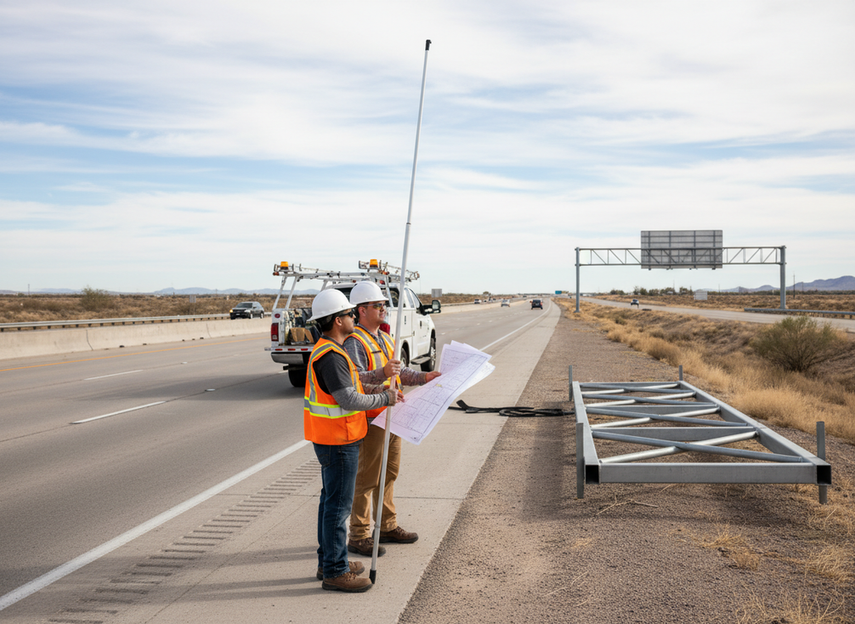
That means the spec should not stop at "bright enough." Brightness supports visibility, but geometry, message design, and approach speed still decide whether the driver can read the message in time. In practice, overhead gantries and roadside installations need to be treated as different decision paths because viewing angle, attention demand, and maintenance access all change the requirement.
For standards context, NEMA TS 4 and NTCIP 1203 are useful reference points for hardware and communications expectations, but they do not replace project-specific visibility language. The safest approach is to define what the sign must do at the site, then map the hardware to that need.
Brightness Requirements in Practice
Brightness should be written in the spec as a procurement check, not as a marketing headline. A state DOT example can help here: NYSDOT procurement language uses a 40-candela minimum for amber LEDs, which shows how brightness can be quantified without pretending that one number solves every site. The NYSDOT item 683.1503 specification is a useful comparison anchor.
What matters most is whether the sign can stay readable across changing light conditions. NYSDOT example specs also require automatic dimming with up to 255 discrete brightness levels, which is a useful reminder that day/night control matters as much as peak output. In the NYSDOT item 680.840287 M specification, that control logic is part of the procurement language, not an extra feature. If a vendor only gives you a single brightness figure, you still do not know how the sign behaves at dawn, dusk, or under glare.
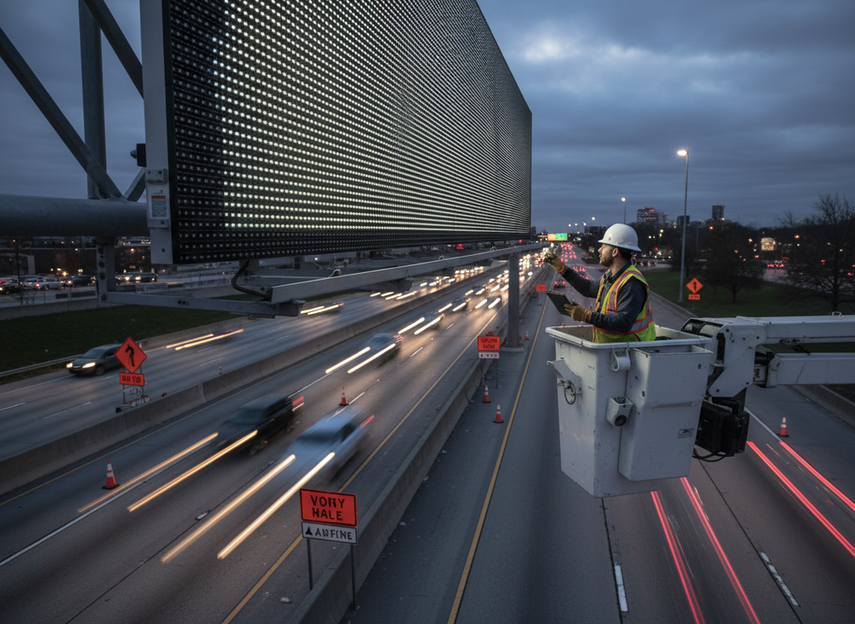
That is where higher-output products can fit, especially on mainline highways with long sightlines or bright ambient light. Our high-brightness gantry VMS line is positioned for those conditions, but it should be evaluated as a project-fit option, not as proof that the project is automatically compliant. If the corridor has strong sun exposure, wide approach spacing, or overhead placement, a brighter display may reduce the risk of a sign that looks adequate indoors but fades in real traffic.
The practical comparison is simple: if the site is harsh, prioritize stronger output plus dimming control; if the site is more constrained, compare load, access, and viewing geometry first. Brightness only matters when the rest of the spec lets drivers use it.
How Visibility and Legibility Work Together
Visibility and legibility are not the same thing. Visibility means the driver can see the sign at distance; legibility means the driver can read and act on the message before the sign passes out of useful view.
For a highway VMS spec, that difference changes the acceptance question. The MUTCD visibility baseline of 1/2 mile on 55 mph or higher roadways tells you when the sign should be noticed, but the 800-foot day and 600-foot night legibility targets tell you whether the message is actually readable when the driver is moving at speed. The MUTCD Section 2L.03 visibility and legibility guidance also ties that baseline to the 18-inch character height rule for 45 mph and faster roads.
A useful rule for spec writing is to ask two questions in order: can drivers see it, and can they read it in time? If the answer to the first is yes but the second is no, the problem is not just brightness. It may be sign placement, angle, character size, message length, or the approach environment.
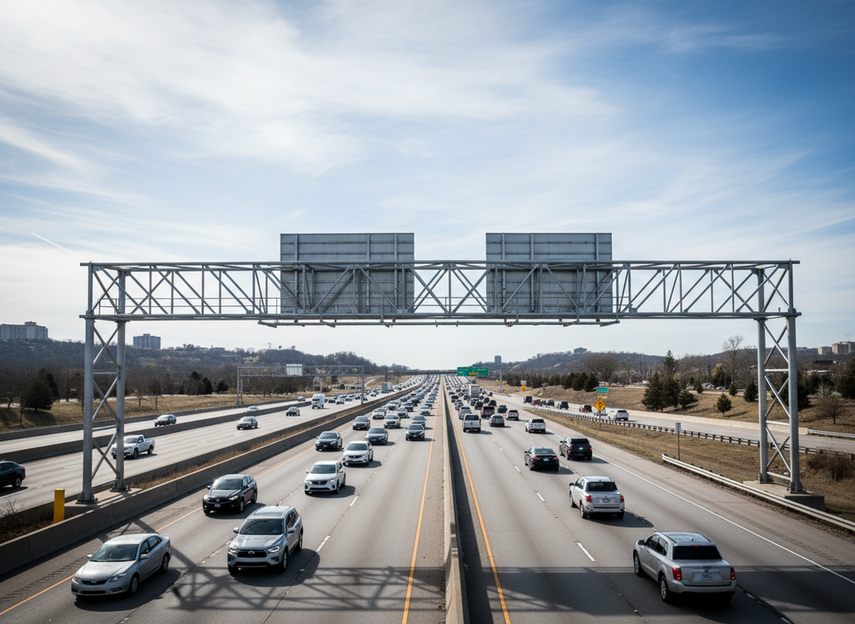
That is also why overhead and roadside VMS should not share identical wording. Overhead placement often gives you better lane-wide awareness but a narrower timing window; roadside placement may be easier to install or maintain, but it can bring a less forgiving angle and a more complex background. If your project is on a curved alignment, in glare, or near an interchange decision point, the legibility requirement needs to be written more carefully than a generic "visible from X feet" note.
Overhead Versus Roadside Placement
| Comparison axis | Overhead gantry VMS | Roadside VMS |
|---|---|---|
| Viewing geometry | Better for lane-wide visibility and forward-looking driver attention | More dependent on side-angle visibility and local sightlines |
| Typical project fit | Mainline highways, larger corridors, and full-width message applications | Retrofit projects, constrained rights-of-way, and locations with simpler structure needs |
| Visibility considerations | Often needs stronger long-range readability and clearer character presentation | Often needs careful angle control and background management |
| Structural implications | Higher structural and load coordination, especially on larger spans | Usually less demanding structurally, but still project-specific |
| Maintenance access | Can be more involved and may require planned access methods | Often easier to service if the site layout allows it |
| Spec-writing caution | Do not assume overhead mounting alone guarantees better readability | Do not assume roadside mounting is automatically the lower-risk option |
The big tradeoff is that overhead placement can improve driver awareness while increasing structural complexity, and roadside placement can simplify construction while creating a tougher sightline problem. That is why the mounting decision should be part of the brightness discussion, not a separate afterthought.
If the project is a new highway build or a large-span portal, compare it first with a gantry-mounted VMS. If it is a retrofit or a lighter structural situation, a roadside retrofit VMS may be the more realistic fit, but only if the viewing geometry and support conditions are verified for the corridor.
Writing a DOT-Friendly VMS Spec
Use a short drafting sequence so the specification stays consistent across bidders.
-
Define the project context. State the roadway speed, mounting location, sightline issues, and whether the sign is overhead or roadside. That keeps the rest of the spec tied to an actual operating condition, not a generic catalog claim.
-
Set the brightness and visibility criteria. Use a quantified brightness basis where the project needs it, then pair it with the MUTCD visibility and legibility requirements instead of replacing them. State-level examples such as NYSDOT’s candela-based language are useful as writing patterns, but they should stay examples, not national rules.
-
Specify dimming and control behavior. Ask for automatic brightness control or an equivalent method that can keep the sign readable across changing ambient light. NYSDOT’s example of 255 discrete brightness levels is a good model for how control logic can be written into procurement language.
-
Require submittals that prove the claim. Ask for measurement basis, installation type, dimming method, and any documentation tied to the stated brightness figure. That helps you compare bidders on the same footing instead of comparing one vendor’s lab number to another’s field assumption.
-
Add acceptance language that matches the project. If the corridor needs a long-view-distance message, require review under the actual mounting geometry and ambient conditions. Do not write acceptance language that sounds like a universal guarantee.
A good spec makes it hard to oversell the sign and easy to verify the fit. If a bidder cannot show how the display is meant to work at speed, in glare, and at the selected mounting height, the bid is not ready yet.
Choosing the Right Fit for Your Project
Before you select a highway VMS, check the fit against the corridor, not against the brochure. The strongest procurement choice is usually the one that matches the site geometry, speed, brightness control, and maintenance access with the least interpretation risk.
Use this final review list:
- Does the submittal show how brightness is measured and controlled?
- Does the project need overhead or roadside sightlines, and is that reflected in the spec?
- Are visibility and legibility both stated, instead of only one headline distance?
- Do the mounting and structural conditions match the selected form factor?
- Is the documentation strong enough to compare bids on the same basis?
If the project still has open questions, review the corridor conditions first, then compare a highway VMS solution against the site before you move to submittals or approval.
FAQs
How Bright Should a Highway VMS Be?
Brightness should be high enough to support the project’s visibility goal under site conditions, but not treated as a universal number. Start with the mounting context, ambient light, and approach speed, then ask whether the sign also has automatic dimming and a written measurement basis that fits the corridor.
What Is the Difference Between Visibility and Legibility?
Visibility is about seeing the sign from a distance, while legibility is about reading the message in time to act on it. For spec writing, that means you should check both the distance target and the character/message design, because a sign can be visible but still too hard to read at speed.
Can a Single Brightness Spec Guarantee Highway Readability?
No. Readability also depends on viewing angle, character height, message length, ambient glare, and where the sign sits relative to traffic. If a bid relies only on one brightness number, ask for the dimming method, the mounting assumptions, and the installation type before treating it as comparable.
What Should DOT Specifiers Ask for in Submittals?
Ask for the measurement basis, the intended installation type, the dimming or control method, and any documentation that ties the display claim to the project setting. The useful test is whether a reviewer can compare two bidders on the same corridor conditions without guessing how each number was obtained.
When Is a Gantry-Mounted VMS a Better Fit Than a Roadside Sign?
A gantry-mounted sign is usually the better fit when the project needs overhead visibility, lane-wide messaging, or a high-speed mainline corridor. A roadside sign may be easier to place in constrained sites, but it should only win if the sightline, angle, and maintenance plan are better for that corridor.
Do State DOT Examples Replace MUTCD Guidance?
No. State examples are useful for showing how a procurement spec can be written, but the MUTCD remains the federal baseline for visibility and legibility on highway-speed projects. Use state language as a drafting pattern, then check it against the project’s roadway class and mounting conditions.