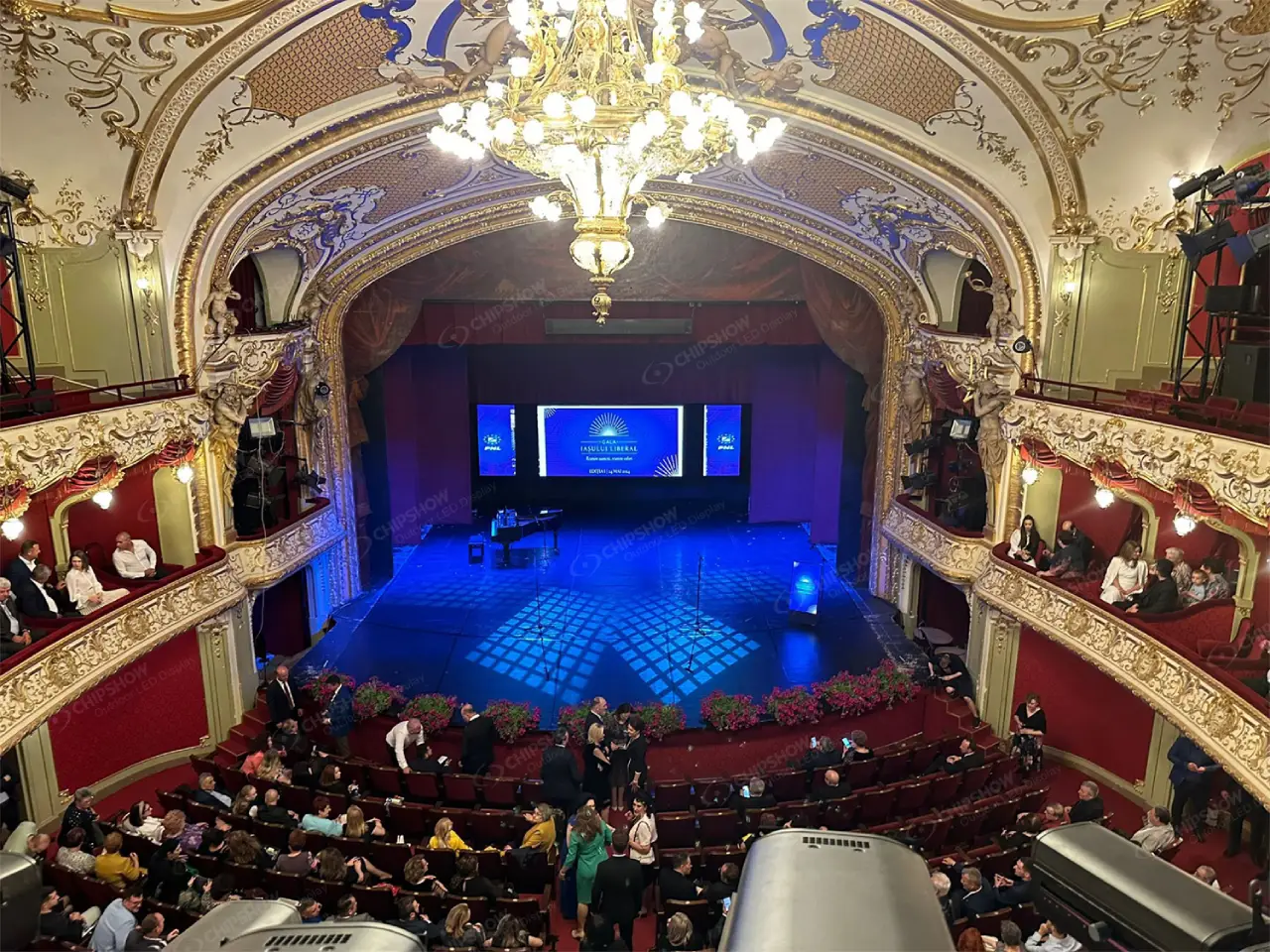


A church LED video wall helps worship spaces improve scripture readability, lyric clarity, camera capture, and stage visuals. Projectors can still fit smaller dark rooms, but LED walls often perform better in sanctuaries with stage lighting, livestream cameras, and wide seating areas. The right specification should start with viewing distance, pixel pitch, brightness control, refresh rate, installation method, maintenance access, and long-term support.
Is a Church LED Video Wall Better Than a Projector for Worship Spaces
A projector and a church LED wall can both support worship spaces. The better choice depends on room lighting, screen size, camera use, and service workflow.
| Decision Factor | Church LED Video Wall | Projector |
| Ambient light | Holds stronger contrast under stage lighting and window light | May lose contrast in brighter rooms |
| Lyrics and scripture | Supports clearer text across wider seating areas | Text can soften at long viewing distances |
| Installation path | No throw distance or projection shadow path | Needs throw distance and a clear projection path |
| Camera capture | High refresh options help livestream and IMAG | Camera results depend on projector, screen, and room lighting |
| Smaller dark rooms | May exceed the real display need | Often practical and cost-effective |
A church video wall is usually a stronger fit for larger worship spaces with stage lighting and livestream needs. A projector can still work in chapels, classrooms, and dark fellowship rooms.
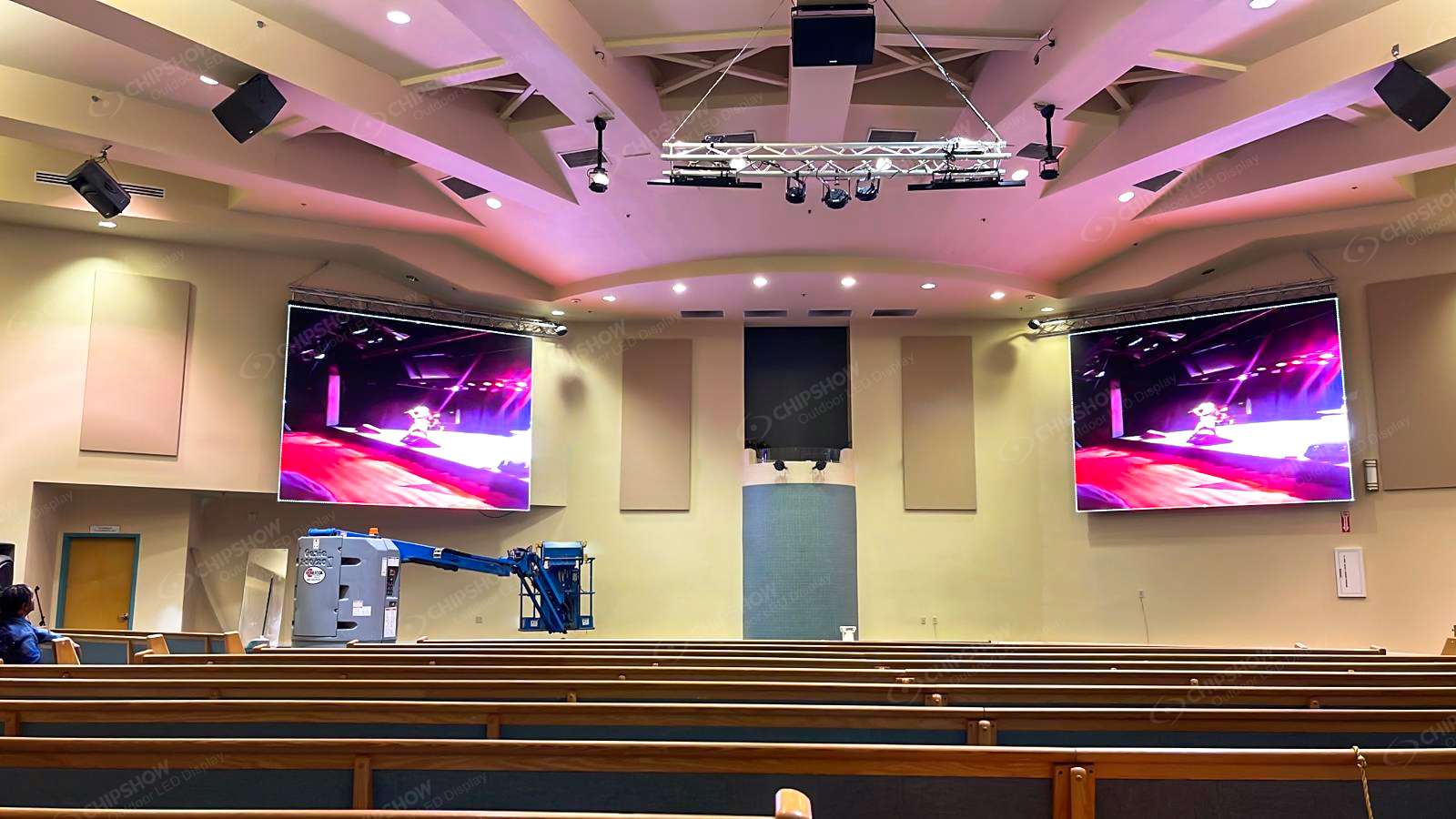
Ambient Light and Stage Lighting Affect Screen Visibility
Projectors reflect light from a screen surface. Strong stage wash, daylight, and house lights can reduce image contrast.
A church LED display emits light from the screen surface. Lyrics, sermon points, and worship visuals stay easier to see under changing room conditions.
Lyrics and Scripture Need Clear Viewing From Every Seat
Text readability is a core worship requirement. Lyrics and scripture should remain clear from front rows, back rows, balcony seats, and side seating.
A worship LED video wall can improve text clarity when pixel pitch, screen size, and viewing distance are matched. Readability should be the first display target.
LED Walls Reduce Throw Distance, Shadows, and Alignment Work
Projectors need lens distance, screen alignment, and an open projection path. People, trusses, instruments, and stage structures can block the image.
An LED wall for church can mount to a wall, frame, ground support, or truss system. That setup reduces shadow risk and weekly alignment work.
Projectors May Still Fit Smaller Darker Worship Rooms
A projector can fit a smaller chapel or classroom with controlled lighting. It also works for simple announcements and basic lyric display.
For a larger sanctuary with livestream production, a church LED video wall usually offers better control over visibility and camera output.
How to Match Pixel Pitch to Church LED Wall Viewing Distance
Pixel pitch should be selected from the closest real viewer. Do not choose pixel density only from price or screen width.
| Closest Viewing Distance | Practical Pixel Pitch Range | Common Church Use |
| Under 1.5 m (5 ft) | P0.9 to P1.5 | Close-view lobby walls or very close front rows |
| 1.5 to 3 m (5 to 10 ft) | P1.5 to P2.6 | Main sanctuary screens with lyrics and scripture |
| 3 m (10 ft) and above | P2.6 to P3.9+ | Larger sanctuaries and IMAG side screens |
Rule of thumb: minimum viewing distance in meters ≈ pixel pitch in millimeters.
For imperial planning, minimum viewing distance in feet ≈ 3 × pixel pitch in millimeters.
For example, P2.6 usually starts to look comfortable from about 2.4 to 2.6 m (7.8 to 8.5 ft).
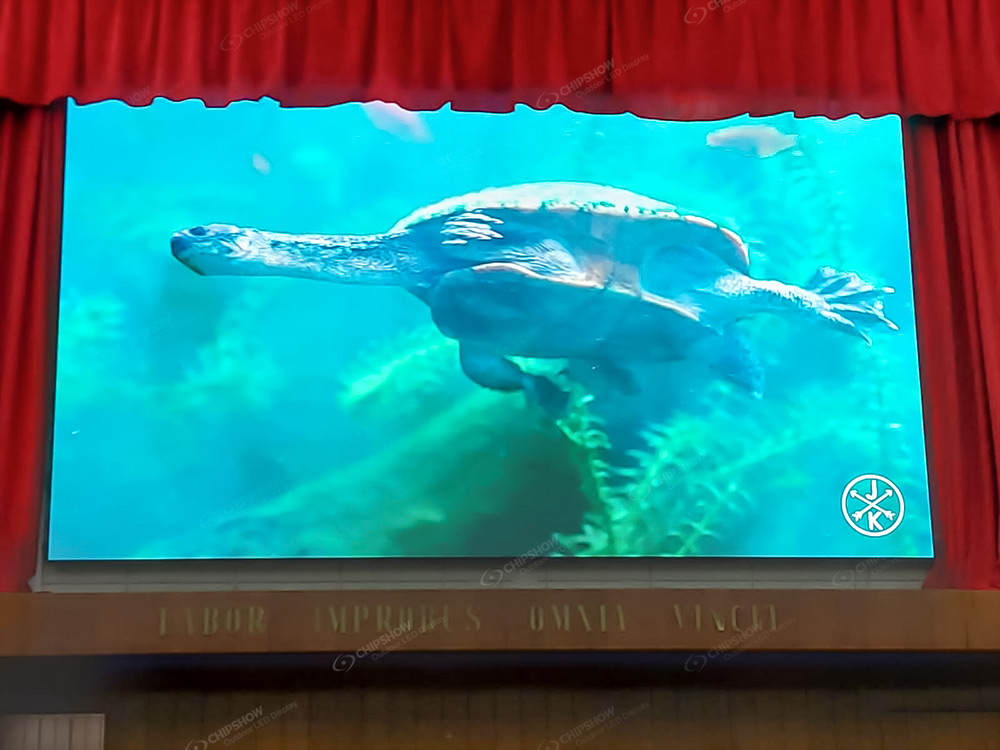
Start With the Closest Real Seat
Measure from the screen plane to the closest real seat. Do not base pixel pitch only on the back row.
If the closest seat is 2.4 m (7.8 ft) away, P2.6 may work. If the closest seat is 1.5 m (5 ft) away, a finer pitch needs review.
Finer Pixel Pitch Helps Lyrics, Scripture, and Sermon Notes
Fine pixel pitch helps when the screen shows small text, Bible references, bilingual lyrics, and sermon outlines.
A tighter church LED wall can improve front-row comfort. It can also support cleaner camera framing during close shots.
Larger Sanctuaries Can Use More Cost-Effective Pixel Pitch
A larger sanctuary does not always need the finest pitch. If the closest viewing distance is over 3 m (10 ft), P2.6 or P3.9 may be enough.
That approach keeps the budget focused on visible improvement. It avoids paying for pixel density that viewers may not perceive.
Screen Size and Aspect Ratio Should Match Worship Media
Most worship media uses 16:9 layouts. Some stage designs use wide formats for motion backgrounds and lyric zones.
Confirm slide format, playback resolution, camera framing, and stage width early. Screen shape affects content design and production workflow.
Which Display Specs Matter for a Camera-Friendly Church Video Wall
A camera-friendly church video wall depends on brightness control, grayscale, refresh rate, contrast, color stability, and viewing angle.
| Spec | Why It Matters for Worship |
| Low-brightness performance | Keeps front rows comfortable during dim services |
| High grayscale at low brightness | Preserves detail in worship backgrounds and skin tones |
| 3,840Hz or higher refresh | Helps reduce scan lines and flicker in camera footage |
| Contrast consistency | Keeps lyrics, scripture, and faces from looking flat |
| Wide viewing angle | Helps side seating areas see readable content |
Low-Brightness Performance Matters More Than Maximum Brightness
Indoor worship spaces rarely need extreme brightness. Many sanctuaries run comfortably around 600 to 800 cd/m² (nits).
The key is image quality after brightness is reduced. A weak screen may look gray or flat at lower brightness settings.
High Grayscale at Low Brightness Keeps Images From Looking Washed Out
High grayscale at low brightness helps the screen preserve color depth and shadow detail after dimming.
This matters during prayer, acoustic worship, evening services, and darker stage scenes. It also helps skin tones look more natural on camera.
A Refresh Rate of 3,840Hz or Higher Supports Camera Capture
For livestream and image magnification, use 3,840Hz or higher as a practical camera-facing baseline. Broadcast-heavy setups may review 7,680Hz options.
Refresh rate helps reduce scan lines and flicker. Moiré also depends on pixel structure, camera distance, lens choice, and shutter settings.
Contrast and Color Consistency Affect Worship Media and Skin Tones
Worship screens show people, text, motion backgrounds, and sermon graphics. Poor color consistency can make faces or white text look uneven.
Ask suppliers about calibration, white balance, grayscale behavior, and processor compatibility. Those details affect the room and the livestream.
Wide Viewing Angle Helps Side Seating Areas See Clearly
Church seating is rarely centered only. Side aisles, choir areas, overflow seating, and balconies may view the screen from wider angles.
A wide viewing angle helps maintain readable text and stable color. It is important in traditional sanctuaries with broad layouts.
Should a Church Use a Fixed LED Wall or a Rental Style LED Wall
The right structure depends on screen movement, setup frequency, crew training, and room control.
| Use Case | Fixed Church LED Display | Rental Style LED Wall |
| Weekly worship | Strong fit | Possible, but less efficient for permanent rooms |
| Portable church | Less flexible | Strong fit |
| Shared venue | Depends on mounting permission | Strong fit |
| Volunteer setup | Lower weekly labor after installation | Needs handling and setup training |
| Maintenance | Front access is important | Fast module service is important |
A fixed church LED display suits stable sanctuary use. A rental style system suits mobile churches, seasonal events, and shared venues.
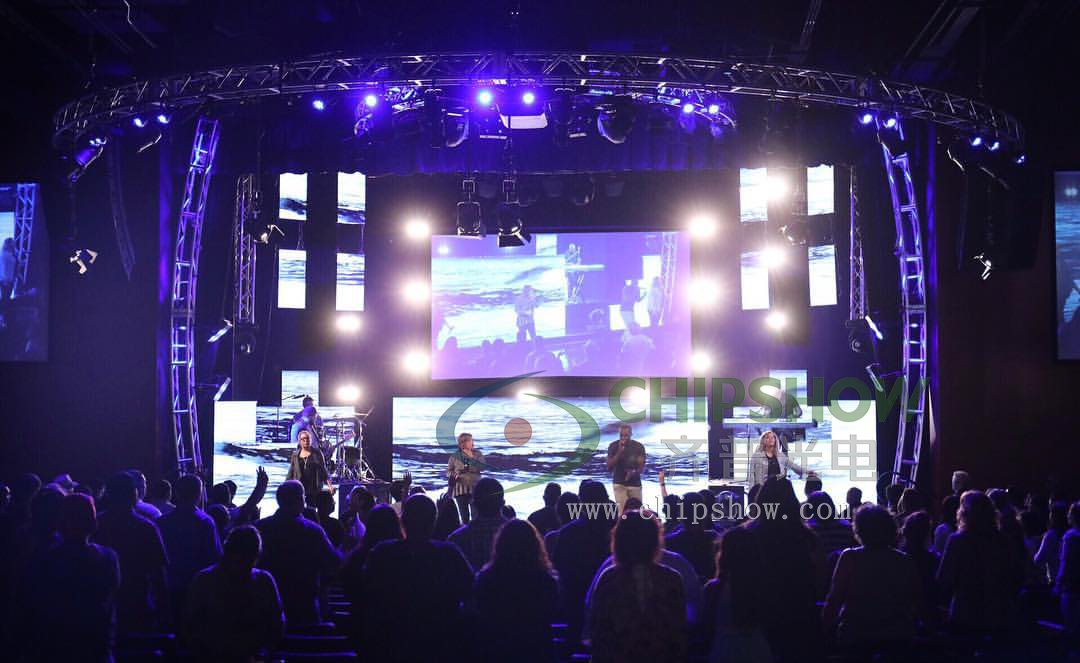
Fixed Church LED Displays Work Best for Weekly Worship
A fixed installation fits churches that use the same worship space every week. It reduces repeated setup, alignment, and teardown work.
For larger indoor worship spaces, C-Max Commercial fits projects that need readable text, front service, and flexible wall sizing. It supports P1.25 to P4.0, a 640 × 480 × 70 mm (25.2 × 18.9 × 2.8 in) cabinet format, die-cast aluminum or magnesium cabinet options, and full front service. That combination suits wall-mounted sanctuaries, auditoriums, and school worship spaces.
Rental Style Systems Fit Events, Portable Churches, and Shared Venues
Rental style systems fit churches that meet in schools, theaters, hotels, and shared venues. They also fit seasonal productions and youth events.
C-Shine-Plus supports portable stage screens, quiet operation, and camera-facing worship production. It offers P1.9, P2.6, P2.9, and P3.9 options. Its 500 × 500 mm (19.7 × 19.7 in) cabinet weighs up to 7 kg (15.4 lb), while its 500 × 1000 mm (19.7 × 39.4 in) cabinet weighs up to 13 kg (28.7 lb). Fanless operation at ≤40 dB helps quiet worship environments.
Lightweight Cabinets Reduce Labor, Transport, and Setup Pressure
Cabinet weight affects rigging, transport, storage, and labor. Rental teams and volunteer crews feel that difference during every setup.
Modern fixed cabinets can also reduce installation load. Fixed LED walls should not be treated as automatically heavy or slow to service.
Front Service Access Makes Long-Term Maintenance Easier
Front service is important when the screen sits close to a wall. It allows module, power, and receiving card access from the viewing side.
That design can reduce the need for rear service corridors. It also helps teams handle weekday maintenance with less disruption.
What Should Buyers Check Prior to Ordering a Church LED Display
A reliable quote should cover the room, structure, power, signal path, service access, documentation, and operating pattern.
Room Layout, Viewing Distance, and Wall Structure
Confirm wall width, ceiling height, closest seat, farthest seat, balcony seats, and side-view areas.
Check wall strength, mounting depth, rigging points, and access routes. A site survey should happen ahead of final screen sizing.
Power Supply, Heat Control, and Cable Routing
Confirm power availability, breaker capacity, grounding, signal routing, and cable paths. Large screens need planned electrical work.
Modern indoor LED cabinets can use metal structures as heat paths. Fanless or low-noise designs are useful for sermons, prayer, and recording.
Average Power Consumption and Weekly Operating Costs
Budget with average power, not only peak rating. A practical planning value is about 180 W/m² (16.7 W/sq ft) under typical operation.
Use this estimate: Weekly kWh = screen area × average power × weekly hours ÷ 1,000.
For example, a 20 m² (215 sq ft) screen running 12 hours weekly uses about 43.2 kWh per week at 180 W/m² (16.7 W/sq ft). Local utility rates determine cost.
Maintenance Access, Spare Parts, and Service Response
Ask how modules, receiving cards, power supplies, and cables are accessed. Confirm the expected replacement process.
Keep spare modules from the same batch where possible. That helps color consistency after future service.
Warranty and Safety Documentation for the Target Market
For the US and Europe, buyers should confirm relevant electrical and safety documentation. Common checks may include CE, FCC, ETL, RoHS, or other local requirements.
Required documentation varies by country, venue, and installation type. Request the project-specific compliance file early.
How Should a Church LED Video Wall Budget Be Planned
A useful budget should include the full installed system, not only the LED cabinets.
| Budget Item | What to Check |
| LED panels and cabinets | Pixel pitch, cabinet size, batch consistency, spare modules |
| Video processing | Inputs, scaling, backup sources, camera compatibility |
| Mounting or rigging | Wall load, ground support, truss points, safety review |
| Power and signal | Breakers, distribution, grounding, data cable paths |
| Installation labor | Access, lift equipment, alignment, commissioning |
| Training and support | Operator handover, maintenance steps, response terms |
A low hardware price may not reduce total cost if installation, service access, or power planning is weak. Ask for an itemized quote.
Hardware Cost Depends on Pixel Pitch and Screen Size
Finer pixel pitch usually increases panel cost. Larger screen area also increases cabinet count, processing needs, and installation work.
Do not select pixel pitch from price alone. Match it to the closest viewing distance and content type.
Installation Cost Depends on Structure and Access
Wall reinforcement, lift equipment, truss work, and cable routing can affect project cost.
A clear site survey helps avoid late changes. It also helps the supplier choose the right cabinet depth and service method.
Operating Cost Depends on Brightness and Weekly Hours
A sanctuary screen may run only during services and rehearsals. A lobby wall may run for longer weekly hours.
Separate those operating patterns in the budget. This gives a clearer view of energy use and service needs.
Create a Better Worship Experience With a Church LED Video Wall
Choose a church LED video wall around worship clarity, camera performance, installation method, and service access. Fixed walls fit weekly sanctuaries. Rental systems fit mobile churches and event spaces. Confirm viewing distance, low-brightness image quality, refresh rate, average power use, maintenance access, and documentation needs prior to ordering.
FAQs
Q1. What Pixel Pitch Should a Church LED Video Wall Use?
Most churches should choose pixel pitch from the closest viewing distance. Use minimum viewing distance in feet ≈ 3 × pixel pitch in millimeters. P1.9 to P2.6 often fits main sanctuary screens. P2.6 to P3.9 often fits IMAG side screens or larger rooms with longer viewing distances.
Q2. Is a Church LED Wall Better Than a Projector for Lyrics and Scripture?
Yes, in brighter or camera-facing worship spaces. A church LED wall usually keeps lyrics and scripture clearer under stage lighting. A projector can still fit smaller dark rooms. For LED walls, many indoor worship screens operate around 600 to 1,200 cd/m² (nits), depending on room light and screen role.
Q3. How Bright Should a Church Video Wall Be Indoors?
Most indoor church video walls should run around 600 to 800 cd/m² (nits) in controlled sanctuary lighting. Main stage screens or IMAG side screens may use 800 to 1,200 cd/m² (nits) when room light is stronger. Low-brightness grayscale matters more than maximum brightness.
Q4. Why Does a Church LED Wall Show Lines on Camera?
A church LED wall may show lines when the camera shutter, refresh rate, scan design, or processor settings do not align. Use 3,840Hz or higher for regular livestream and IMAG use. For broadcast-heavy worship production, 7,680Hz can be considered. Refresh rate helps scan lines, not all moiré issues.
Q5. What Costs Should Be Included in a Church LED Video Wall Budget?
Include LED cabinets, processors, mounting, power work, signal cabling, installation, training, spare modules, warranty, shipping, and maintenance. For energy planning, use average power. A practical estimate is about 180 W/m² (16.7 W/sq ft). A 20 m² (215 sq ft) screen running 12 hours weekly uses about 43.2 kWh per week.