

A fan checking the score, a sponsor buying a camera-visible slot and a producer lining up a replay need different things from the stadium’s displays. Plan the system by position and job: main video boards, halo boards, perimeter boards, scoreboards, ribbon displays and concourse screens. This guide helps you choose the mix that serves the venue and makes the most of its budget.
How Do Stadium LED Screens Serve Fans, Sponsors, and Broadcasters at Once?
Every stadium LED display screen simultaneously serves three distinct groups, and their technical requirements often differ.
Three Stakeholders, One Screen
- Fans need real-time scores, instant replays, and clear visuals from any seat.
- Sponsors need high-visibility ad placement with dynamic content rotation.
- Broadcast crews need screens that perform cleanly on camera, with no flicker, no moiré patterns, and consistent brightness across the frame.
A perimeter LED display, for example, must deliver broadcast-quality refresh rates while also being physically impact-resistant enough to withstand contact from athletes. A halo board must maintain consistent color calibration across its full 360-degree span while supporting simultaneous content zones for sponsors, scores, and crowd engagement.
Indoor Arena vs. Outdoor Stadium: Core Requirements Differ
The operating environment defines most technical requirements before any other spec is considered.
| Parameter | Outdoor Stadium | Indoor Arena |
| Brightness | ≥6,000 nits (direct sunlight) | 800–2,500 nits |
| IP Rating | IP65 minimum | IP54 or above |
| Pixel Pitch (main screen) | P6–P10 typical | P3–P6 typical |
| Ambient Light | Variable, sun angle changes | Controlled, consistent |
| Structural Exposure | Wind, rain, temperature swings | HVAC load, ceiling rigging limits |
Outdoor venues prioritize brightness and weatherproofing. Indoor arenas prioritize resolution, rigging load management, and color uniformity under artificial lighting.
What Are the Main Types of Sports LED Displays Used in Venues?
A well-configured sports venue uses several display types, each assigned to a specific position and function. Below is a breakdown of the six most common types found in professional and semi-professional venues.
Main Video Boards
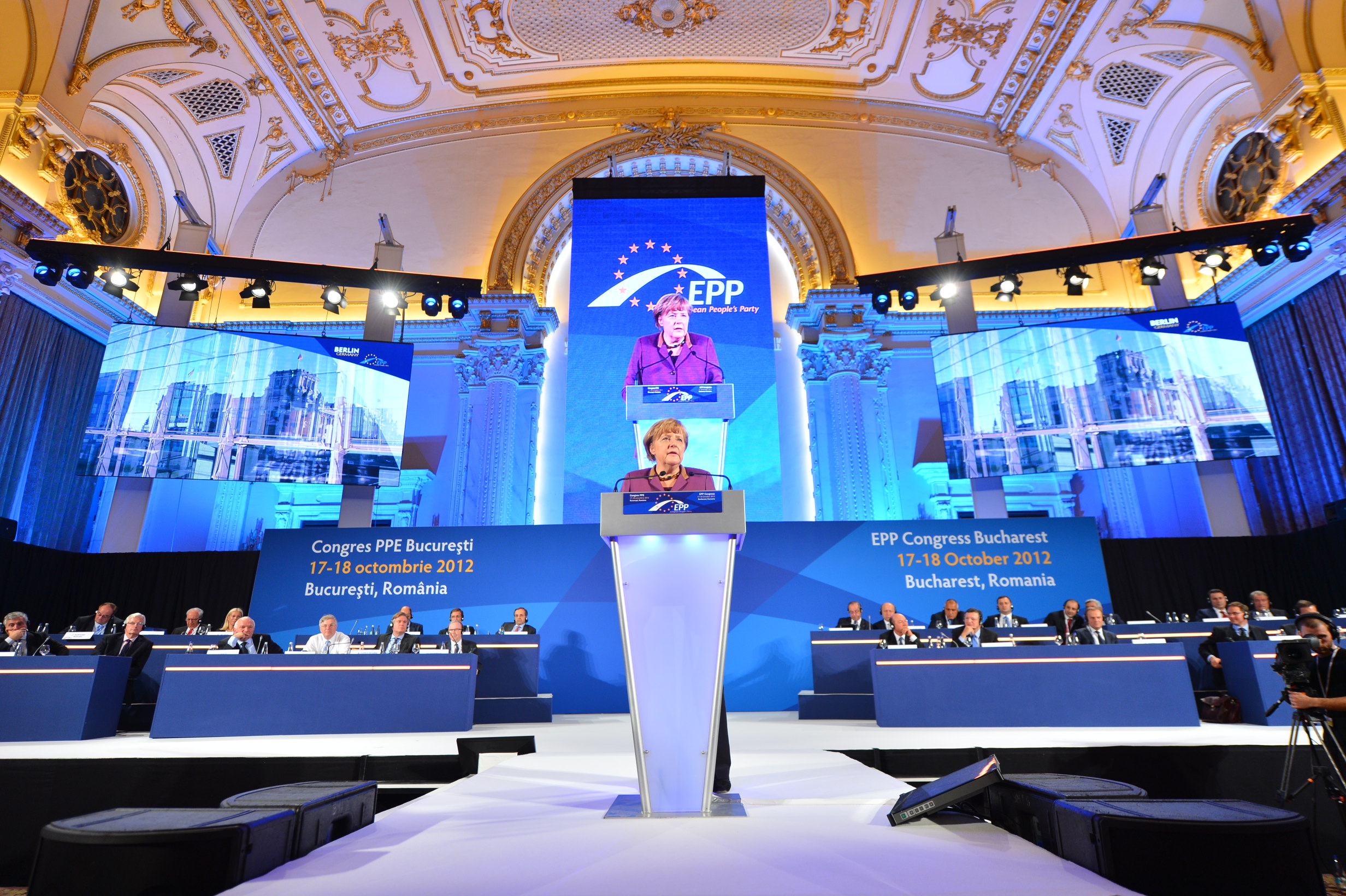
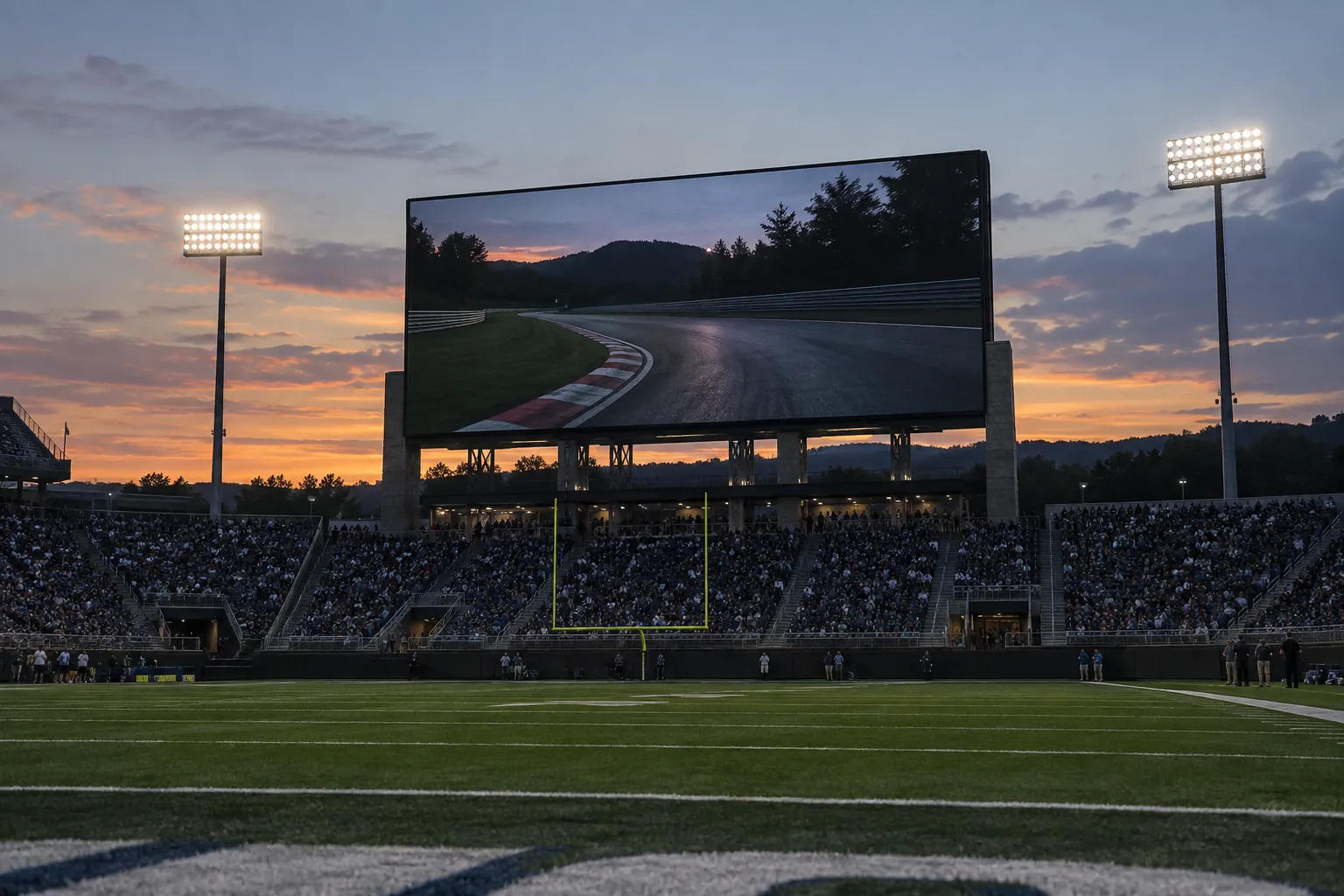
The main video board is the primary visual reference point for fans. It is typically mounted at one or both ends of the field, or above the stands in outdoor stadiums.
Pixel pitch for outdoor main screens runs from P6 to P10, depending on the nearest viewing distance. Brightness requirements start at 6,000 nits for daytime visibility. These screens handle live video, slow-motion replays, and graphic overlays for player statistics.
Main video boards are standard equipment in football stadiums, baseball parks, and outdoor athletic fields.
Halo Boards
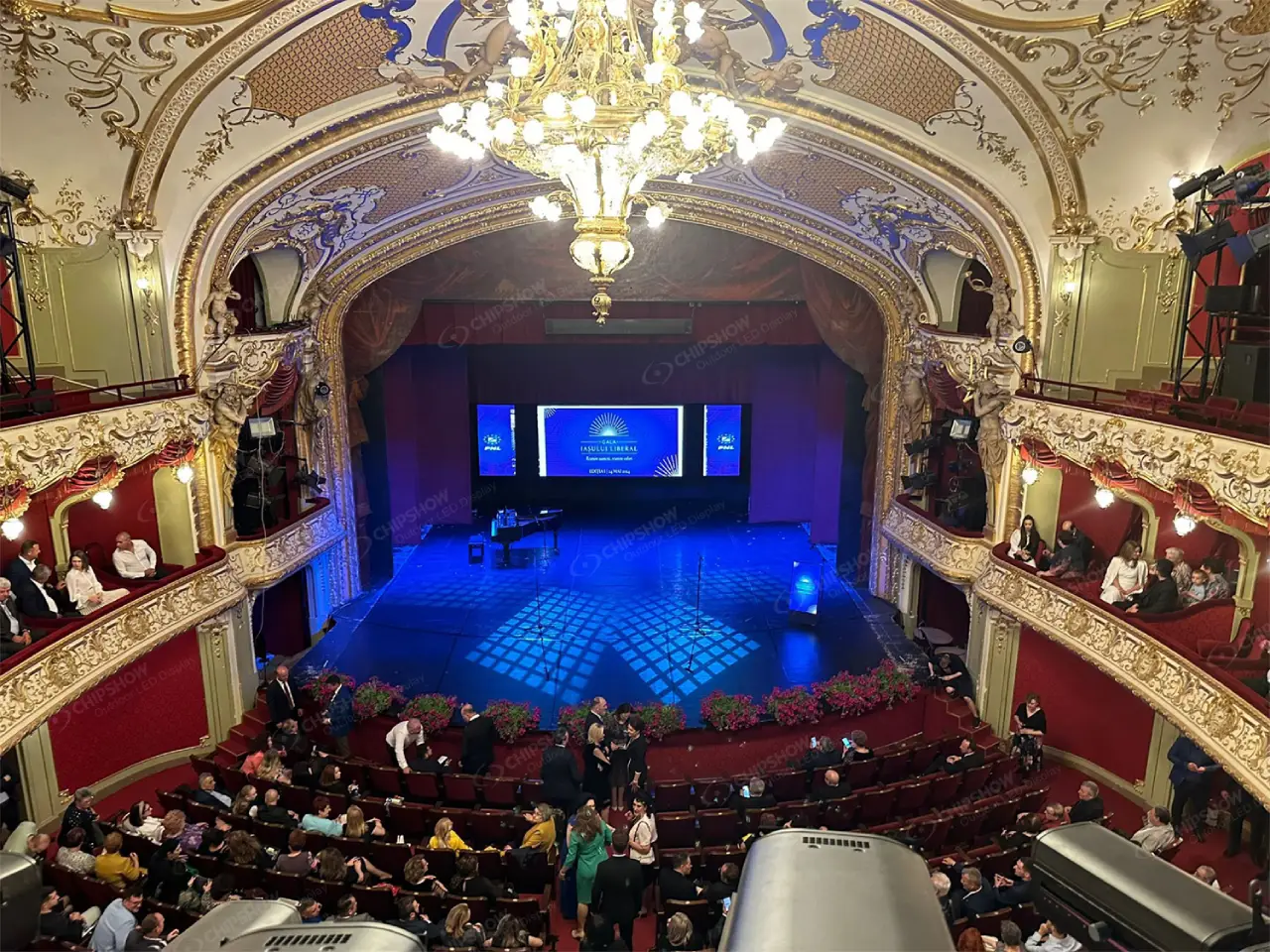
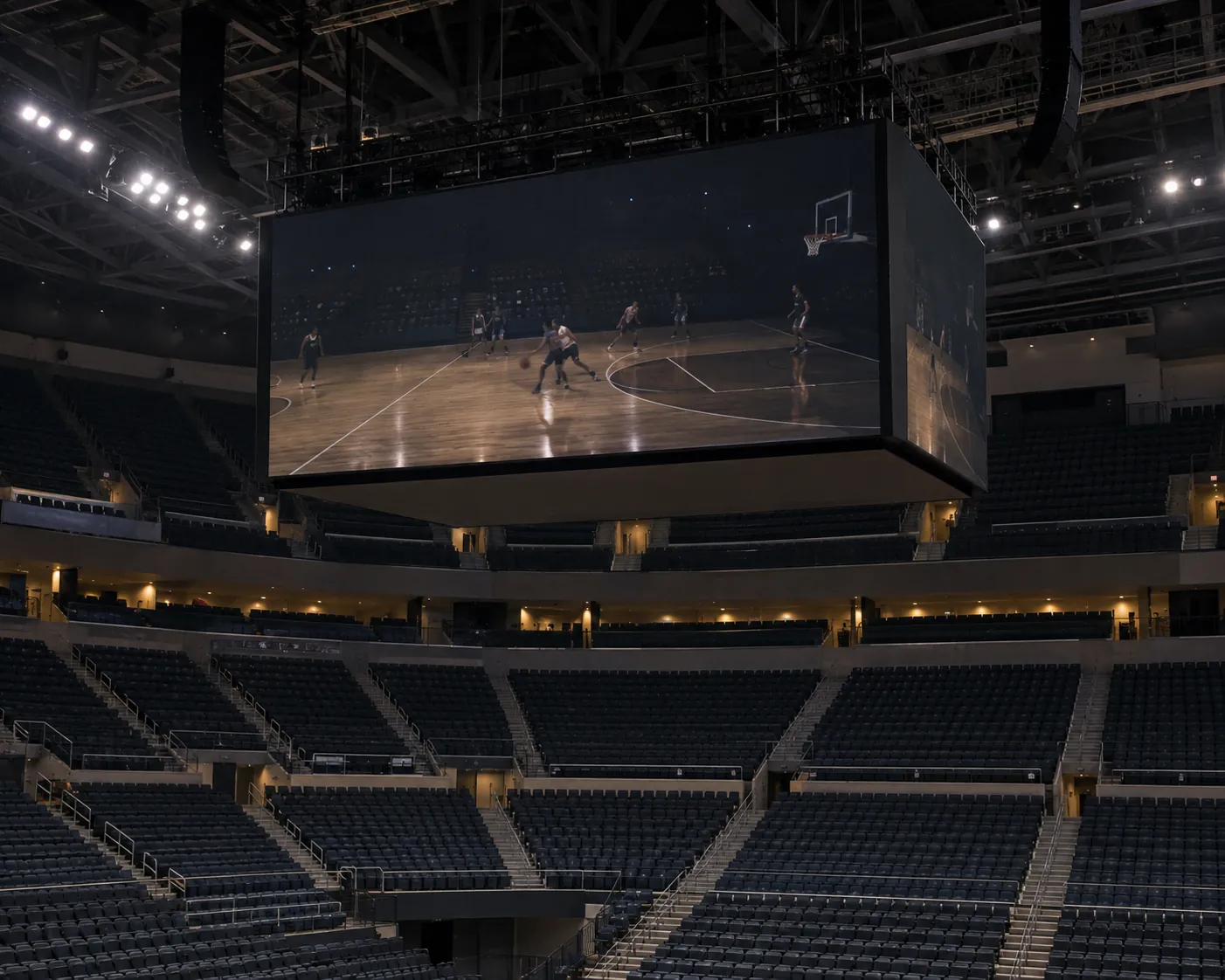
Halo boards are a large-format LED configuration providing 360-degree or near-360-degree visibility across all seating levels of a venue interior. Halo boards have seen renewed adoption in recent North American arena builds and renovations; verify current public examples when you plan a new build.
The key technical demands are seamless panel joining, consistent color calibration across the full span, and sufficient structural support for the continuous installation. Pixel pitch, refresh rate, and brightness uniformity are all critical because the screen is visible from many angles and distances at the same time.
Halo boards appear in both multi-purpose arenas and single-sport venues where immersive wide-angle viewing is a design priority.
Perimeter LED Displays
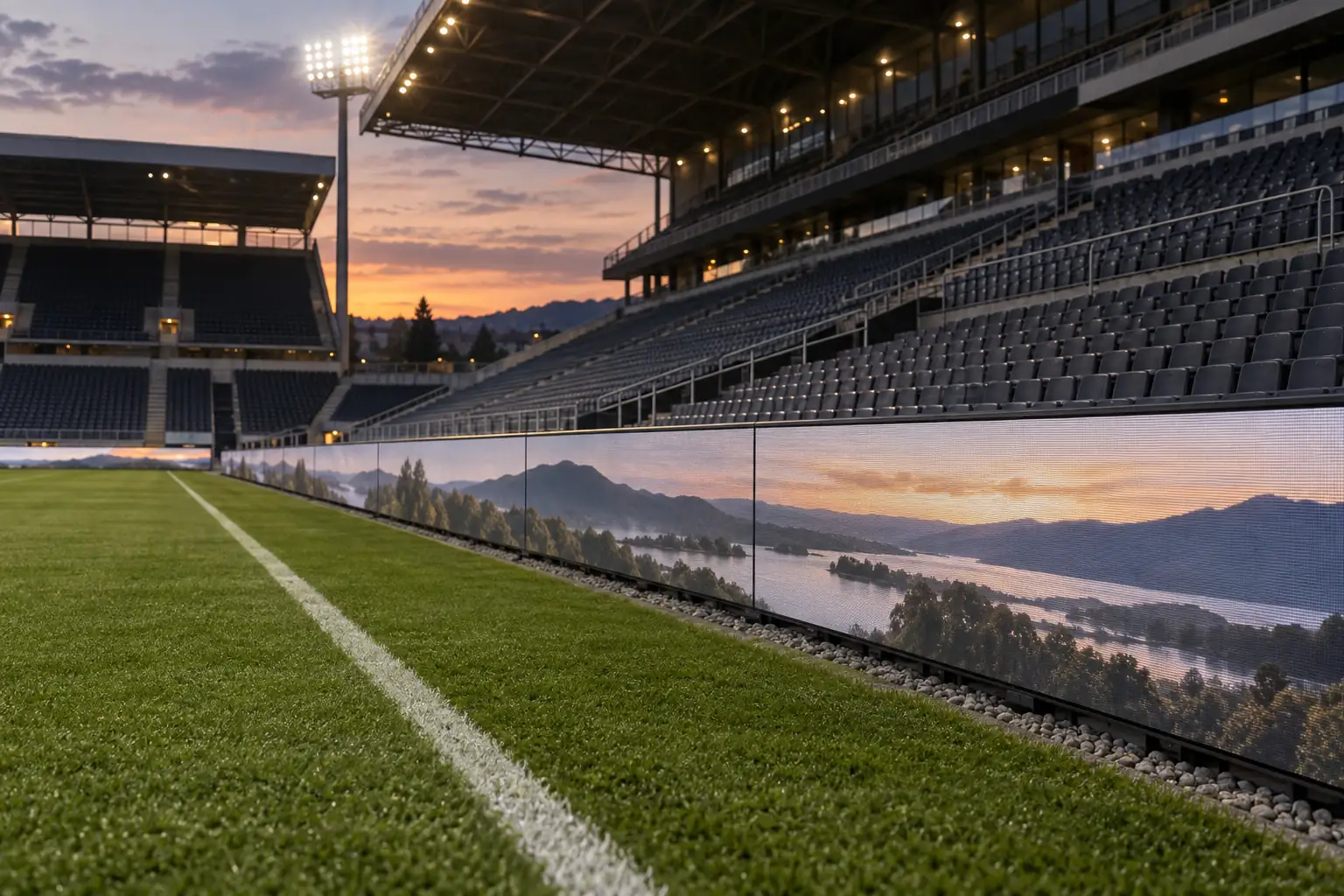
Perimeter LED displays are installed along the edges of the playing field, at the pitch level. They face the center of the field and toward broadcast cameras positioned around the field perimeter.
From a commercial standpoint, perimeter boards deliver the highest advertising exposure of any display type in the venue. Most broadcast camera angles capture them in frame, making them the most valuable ad inventory in the system.
Key technical requirements for perimeter boards:
- Many professional broadcast productions specify 3,840Hz or above to reduce scan lines and flicker; confirm the target against your camera frame rates and shutter settings.
- For broadcast-facing boards, coordinate genlock and processor timing with the camera package. Test the actual frame rates and shutter settings, especially for slow-motion coverage.
- Impact resistance at the front face is mandatory, with soft-edge protective materials and cushioned top covers to reduce athlete injury risk.
- Check the rated dust and water-ingress protection for the complete installation, including rear connections. Humidity, condensation and corrosion need their own environmental review.
Perimeter boards are standard in football, rugby, and ice hockey venues. Outdoor perimeter LED display installations require additional weatherproofing and thermal management compared to indoor equivalents.
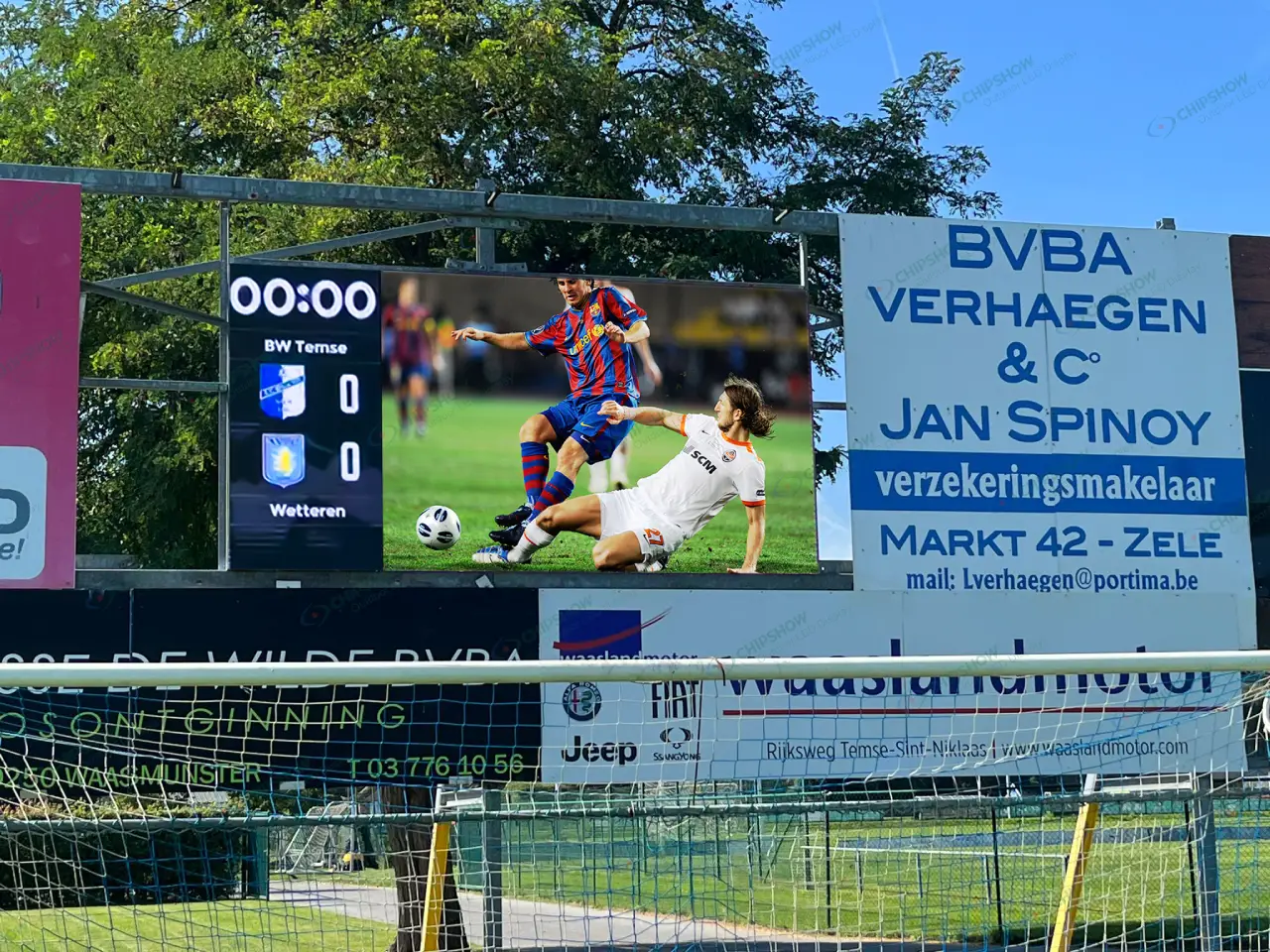
LED Sports Scoreboards
The LED sports scoreboard functions as the dedicated information hub for the venue. Its primary role is displaying scores, game clocks, period indicators, and player statistics, with content driven by live data feeds rather than video production.
Scoreboards integrate directly with referee timing systems and sports data APIs. Multi-sport template compatibility is important for venues hosting multiple disciplines across a season.
Resolution requirements are lower than main video boards, but reliability and data accuracy are non-negotiable. Scoreboard failure mid-match carries both operational and reputational consequences.
Ribbon and Fascia Displays
Ribbon displays run horizontally along the fascia of each seating tier, wrapping the interior of the bowl at mid-level. They carry a continuous flow of information: live scores from other matches, sponsor messaging, countdown timers, and crowd engagement prompts.
Their slim profile means they do not obstruct sightlines for fans seated behind them. Installation requires seamless cabinet joins across curved surfaces, and long continuous runs need effective thermal management to prevent hotspots.
Entryway and Concourse Displays
Entryway and concourse displays cover the gates, tunnels, and interior walkways of the venue. This type is often overlooked in system planning but represents a distinct commercial opportunity.
These screens capture fan attention during the arrival window, before fans reach their seats. Applications include sponsor takeovers, pre-match countdowns, retail promotions, wayfinding, and emergency messaging. Placing revenue-generating content at entry points extends the venue’s active advertising window beyond the match itself.
What Do Perimeter LED Displays Need to Perform at Pitch Level?
Perimeter boards face the harshest operating conditions of any display type in the venue, and their specifications reflect that.
Impact Resistance and Athlete Safety Standards
Pitch-side boards need a protection design suited to player contact: cushioned top edges, protected corners and stable mounting. Review the venue or competition requirements with the supplier, and check how damaged protective parts are replaced between matches.
Soft-edge protective framing and cushioned top covers are standard practice. Cabinet corners are the highest-wear point in active sports environments. Quick-replace front-access module design reduces repair time between matches.
Content Switching Speed for Real-Time Ad Rotation
Advertisers running time-sensitive campaigns need content to switch cleanly between slots. The display controller must handle rotation without visible frame drops or delay.
High refresh rates also help broadcast cameras capture ads cleanly across common frame rate settings. A screen running at 1,920Hz can produce visible artifacts on high-speed broadcast cameras, depending on frame rate, shutter angle, and how the refresh is implemented. Many broadcast productions treat 3,840Hz as the safe minimum for perimeter boards; verify it against your camera package. Dual redundancy on both signal and power paths prevents mid-match blackouts that carry direct commercial and reputational cost.
How Do LED Sports Scoreboards Differ from Main Video Walls?
Both types display content on large LED panels, but their architecture, content logic, and failure tolerance requirements are fundamentally different.
Resolution and Data Integration for Scoreboards
| Feature | LED Sports Scoreboard | Main Video Wall |
| Primary content | Live data (scores, clocks, stats) | Video, replays, graphics |
| Signal source | Data API, referee timing system | Multi-camera video processor |
| Pixel pitch typical | P6–P10 | P4–P8 (outdoor), P3–P6 (indoor) |
| Resolution priority | Legibility at distance | Image quality, color accuracy |
| Failure impact | Immediate operational consequence | Visual degradation, manageable |
| Multi-sport support | Template switching required | Content-agnostic |
Scoreboards are systems-integrated components. Video walls are content delivery surfaces. Both are necessary in a complete venue configuration, but they are not interchangeable.
Video Wall Configuration for Live Replays and Multi-Feed Broadcasts
Main video boards require video processors capable of handling multiple simultaneous input signals: broadcast feeds, camera cuts, graphic overlays, and sponsor content. HDR capability improves slow-motion replay quality, particularly for outdoor screens where ambient contrast varies throughout the day.
4K resolution is only effective when the viewing distance and pixel pitch justify it. Specifying 4K on a screen viewed primarily from a long distance delivers no perceptible improvement at standard viewing angles while significantly increasing cost.
What Are the Critical Specs for Any Stadium LED Display Screen?
Across all display types, three performance parameters determine real-world match-day reliability. The figures below are category planning references used to scope a specification — confirm the exact values, test reports and compliance status for the specific models and current product revision before relying on them.
Brightness for Open-Air vs. Indoor Environments
Outdoor stadium screens often start around a 6,000-nit specification for sunlit positions, with the final output chosen for the site and broadcast requirements. Ambient-light-based dimming adjusts output through the day to keep the image useful while reducing unnecessary power and heat. Ask for the brightness schedule and the control method in the proposal.
Indoor arena screens typically operate between 800 and 2,500 nits, depending on ambient lighting conditions and screen position. This range applies to large-venue arenas with long viewing distances, not to close-range environments such as meeting rooms or control rooms. Higher brightness in enclosed spaces creates glare for fans in lower tiers.
Refresh Rate for Broadcast-Compatible Performance
Professional broadcast productions commonly specify 3,840Hz or higher for sports LED displays, plus genlock and timing sync; confirm the target against your camera frame rates and shutter settings. Screens running at 1,920Hz can still be acceptable for non-broadcast positions in some venues, with the same verification applied. High-speed camera work, including super slow-motion replay production, often benefits from 7,680Hz or above.
Power Redundancy for Zero-Downtime Operation
For critical display runs, specify the desired behavior after a power-supply or signal-path failure and ask for a demonstration. Redundant paths can help keep unaffected sections operating. Front access makes servicing easier, but the permitted replacement procedure and isolation requirements come from the selected cabinet design.
Redundancy only protects uptime if parts and response are planned: venues should pair the power design with a spare-parts and repair-turnaround plan covering module, PSU and receiver spares before the season starts.
Which Stadium LED Screen Type Fits Which Venue?
No single configuration suits every sport or venue format. The right combination depends on the sport, the building structure, and the mix of live and broadcast audiences.
| Venue Type | Primary Screen | Perimeter Board | Scoreboard | Ribbon / Fascia |
| Outdoor football / soccer | Main video board | Required | Supporting | Optional |
| Outdoor American football | Main video board | Required | Required | Optional |
| Multi-purpose arena | Halo board | Flexible | Required | Standard |
| Temporary / touring event | Rental main screen | Rental perimeter | Optional | Optional |
Halo boards appear in both multi-purpose arenas and single-sport venues where wide-angle immersive viewing is a design priority. The combinations above reflect common configurations, not fixed rules.
Perimeter LED Displays as the Top Priority in Stadium Configurations
In many outdoor and mixed-use venues, the perimeter board is the first screen to generate advertising revenue. It appears in every broadcast camera angle, giving it the highest sponsor exposure of any display type in the system.
For venues with limited budgets, prioritizing perimeter LED displays before expanding to other screen types is a common phased buildout strategy. The ROI recovery cycle on perimeter boards is often shorter than on main video boards or ribbon displays, because broadcast-visible ad inventory commonly commands higher rates per impression — model payback with your own sponsorship rate card.
This makes perimeter LED displays the most commercially critical component in most stadium LED screen configurations, regardless of venue size.
Choose the Right Stadium LED Screen Configuration for Your Venue
Six types of displays address all requirements within the stadium or sporting arena context, ranging from the main video display to those found at entryways along the concourse level. Each display has a predetermined location, its own set of technical characteristics, and its own business purpose. The perimeter display, the halo display, and the concourse display indicate the greatest opportunities for growth in today’s efforts to improve facilities. The key to success lies in pairing display types with locations and specifications.
For outdoor stadium LED displays and sports venue perimeter solutions, Chipshow’s C-Sport series is positioned for permanent pitch-side installation; check its refresh, protection and masking details against the current model documentation and your broadcast requirements rather than treating any category label as verified.
FAQs About Stadium LED Screens
Q1. Can the Same LED Display System Work for Both Sports and Concerts?
Yes. Main boards and ribbon screens can carry sports or concert content when the processing and playback system supports the formats. For a concert, also check stage sightlines, camera feeds and any temporary screens needed around the production. Reusing the venue’s displays can reduce additional equipment needs.
Q2. What IP Rating Do Outdoor Stadium LED Screens Need?
IP65 is a common outdoor specification for dust and water-jet protection. Confirm the rating for the complete proposed assembly and the exposed faces, then check connectors, irrigation, cleaning and condensation separately. The IEC IP-rating overview explains the code; the venue determines the required installation conditions.
Q3. Does Pixel Pitch Matter the Same Way for a Scoreboard and a Main Video Board?
Not in the same way. A scoreboard prioritizes readable scores and timing from distant seats; P6–P10 can be a starting range for that task. A main video board may need finer pitch for close seats, detailed replays and sponsor creative. Check the smallest required text and actual viewing distance before choosing either.
Q4. How Long Do Stadium LED Displays Typically Last?
LED lifespan is usually discussed in tens of thousands of hours of rated use, but the practical number is model-, duty-cycle- and environment-specific. Ask for the rated lifespan and lumen-maintenance data for the exact configuration, and treat brightness decline, not sudden failure, as the real end-of-life signal.
Q5. What Is the Typical ROI Timeline for a Stadium LED Display Investment?
Calculate payback from the venue’s sponsorship inventory, expected sales, operating costs and investment. Perimeter boards are often a strong starting point because of broadcast exposure. Use the DOOH ROI and payback guide to separate an equipment-owner business case from an advertiser’s campaign return.
Q6. Can Stadium LED Displays Be Upgraded or Expanded After Initial Installation?
Yes, if expansion is planned around compatible modules, cabinet geometry, power capacity and controller loading. Ask how future panels will be color-matched and calibrated against the existing wall, and reserve capacity where expansion is likely. If matching stock is unavailable, compare replacing a complete visual zone with mixing unmatched panels.
Do All Stadium Screens Need the Same Refresh Rate?
No. Broadcast-facing surfaces — especially perimeter boards and main video boards captured by high-speed cameras — need the highest verified refresh performance to avoid scan lines and flicker. Concourse or wayfinding screens that are rarely on camera can be specified from different priorities. Ask for refresh and camera-test evidence for the exact model in each position.