

A variable message sign is a real-time electronic traffic control device that displays changing information to road users based on live conditions. It is an important part of all intelligent transport systems (ITS) around the world. This paper gives an outline of how VMS systems work, the different types of systems, their technical specs, and the needs that traffic authorities should think about before choosing a VMS system.
What Exactly Is a Variable Message Sign (VMS)
Before evaluating hardware or certifications, it helps to clarify what a VMS actually is and how it differs from related terms that appear in procurement documents.
VMS, CMS, and DMS
Three terms appear interchangeably in procurement documents, but they have distinct origins. VMS (Variable Message Sign) is the broadest international term, covering any sign that displays an unlimited number of messages via software control. CMS (Changeable Message Sign) is the term used in the U.S. Federal Highway Administration’s Manual on Uniform Traffic Control Devices (MUTCD). DMS (Dynamic Message Sign) is common in state-level DOT documentation and emphasizes automated, data-triggered updates.
In European markets, the equivalent device is called a Matrix Sign, and product compliance falls under the EN12966 certification framework.
One procurement risk worth noting: in the security industry, VMS stands for Video Management System. Tender documents should specify “Variable Message Sign” in full to avoid supplier confusion.
What Does a VMS Look Like in the Field
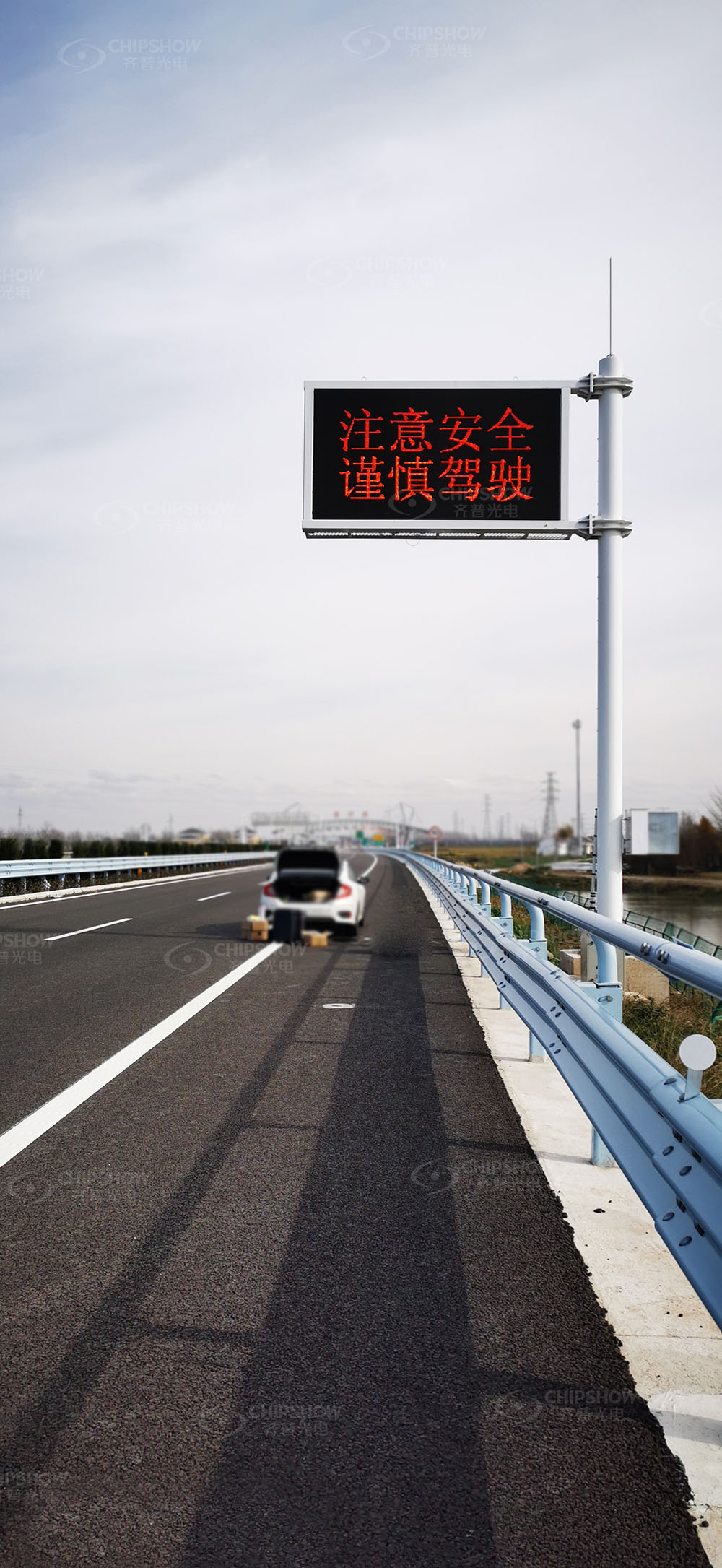
VMS units appear in three physical forms depending on deployment needs. Fixed gantry-mounted signs are permanently installed over carriageways on motorways and dual carriageways. Roadside pole-mounted signs serve arterial roads and urban networks. Trailer-mounted portable signs (PVMS or PCMS) are deployed for temporary conditions such as roadworks, events, or emergency response.
Standard configurations display three lines of text with eight to eighteen characters per line, depending on sign size.
How Does a Variable Message Sign Work
A VMS is not a standalone device. It is the visible output of a multi-layer data and communications system that runs continuously in the background.
The Data Sources Behind Every Displayed Message
A VMS does not generate its own content. It receives instructions from external systems based on live network conditions.
Traffic Management Centers (TMC) monitor flow, speed, and incidents across the network and push messages to signs in real time. Weather monitoring systems feed road surface temperature, visibility, and wind data to trigger weather-related alerts. Incident reporting platforms detect crashes, breakdowns, or debris and initiate message sequences automatically. Embedded road sensors and radar provide speed and density data used for queue warnings and travel time displays.
Pre-authorized message templates, such as Amber Alert or Missing Person Alert formats, are triggered via law enforcement notification channels under statutory authority.
From Traffic Center to Roadside Display: The Signal Flow
The message delivery process follows a defined sequence:
- Data is collected and aggregated at the TMC.
- The control system applies a ranks competing messages by priority to determine which message takes precedence when multiple events occur simultaneously.
- The approved message is transmitted to the sign via fiber optic cable, 4G cellular, or dedicated wireless link.
- The LED matrix renders the message according to preset character dimensions and display timing rules.
- The sign updates continuously as conditions change.
Message Priority and the Rules That Govern Display
Not all messages carry equal weight. Oregon DOT’s operational guidelines define a sixteen-level priority system. Emergency closures and imminent hazards sit at the top. Public service announcements sit at the bottom.
MUTCD compliance imposes strict display rules that directly affect hardware requirements. Each message phase must be displayed for at least 2 seconds, and a complete two-phase cycle must not exceed 8 seconds. Scrolling, flashing text, and animated transitions are prohibited, and all text must appear in uppercase, centered per line.
These restrictions are not aesthetic choices. They exist because automated vehicle OCR systems must be able to read static text reliably. Any sign that uses dynamic text effects fails this requirement.
What Are the Main Types of Variable Message Signs
VMS units are not one-size-fits-all. The right form factor and display technology depend on the infrastructure environment, deployment frequency, and budget structure.
Fixed VMS vs. Portable VMS
| Factor | Fixed VMS | Portable VMS (PVMS) |
| Installation | Permanent, on gantry or pole | Trailer-mounted, relocatable |
| Connectivity | Hardwired to TMC via fiber | Cellular or short-range wireless |
| Deployment time | Weeks to months (civil works required) | Hours |
| Typical use | Motorway network, tunnels, urban arterials | Roadworks, events, emergency response |
| TCO over 10 years | Higher initial cost, lower per-event cost | Lower initial cost, higher operational cost at scale |
Fixed signs deliver lower long-term cost per message display on high-frequency corridors. Portable signs offer flexibility for temporary or low-frequency needs.
VMS Classification by Display Technology
Four display technologies are in active use across global networks. Full-matrix LED is the current standard, supporting text, symbols, graphics, and multilingual messages. It is the specified technology in EN12966-compliant procurements. Line-matrix LED displays one or more fixed rows of text and suits simpler applications with lower message complexity.
A rotating prism (trilon) is a legacy mechanical technology. Some older installations remain in service, but it is no longer specified in new projects. Graphic signs display pre-programmed traffic symbols and lane control icons alongside text, primarily in tunnel and lane management applications.
Trailer-Mounted VMS Size Categories
Portable signs are classified by display size into three categories. Category A (small) has a compact footprint and is used at site entrances and low-speed urban roads. Category B (medium) is the standard roadworks deployment format with a three-line display. Category C (large) is designed for high-speed roads and motorways, with maximum character height for legibility at a distance.
Solar power is viable for PVMS in regions with sufficient daily irradiance. Reliable operation requires battery storage sized for at least three days without direct sunlight, along with a backup mains connection where available.
Where Are Variable Message Signs Used
VMS applications extend well beyond congestion warnings.
Core Applications in Highway and Urban Traffic Networks
VMS deployment spans several distinct infrastructure environments. On motorway and expressway networks, the primary functions are real-time congestion warnings, incident alerts, variable speed limits, travel time displays, and diversion routing. In tunnel environments, VMS handles lane control signals, speed limit enforcement, emergency evacuation messaging, and fire response coordination. Urban traffic management applications include parking availability guidance, event traffic routing, junction control, and air quality alerts.
Amber Alerts and Missing Person Alerts
When a child abduction alert is activated by law enforcement, TMC operators are required to post approved two-phase messages across the fixed VMS network. Missing Person Alert protocols apply to vulnerable adults operating vehicles on the highway system, subject to verification by a law enforcement agency.
Public Service Announcements (PSAs) are permitted on VMS but carry the lowest message priority. Overuse of PSA content produces message fatigue, reducing driver responsiveness to genuine alerts. Many state DOTs limit PSA display to no more than five days per month at any single sign location.
What Technical Specs Matter Most for a VMS LED Display
Hardware selection for a VMS project goes beyond choosing a display panel. Several interdependent specifications determine whether the system meets regulatory requirements and performs reliably over a 10- to 15-year operational lifespan.
Brightness and Auto-Dimming Requirements
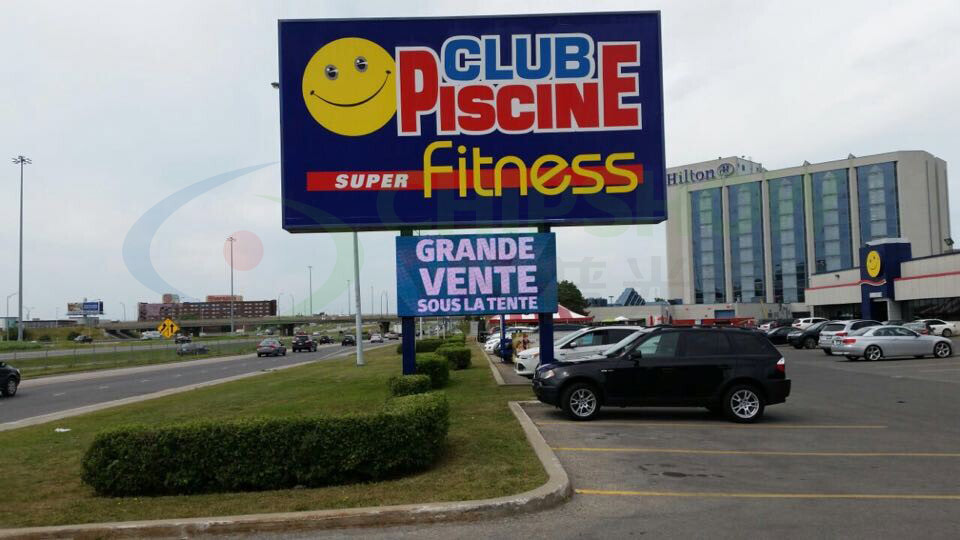
Highway VMS brightness requirements are driven by viewing distance, ambient light levels, and character legibility standards under EN12966. Fixed motorway signs typically require 6,000 nits or above to maintain legibility in direct sunlight at 150 meters (490 feet). Automatic brightness control (auto-dimming) is a standard requirement, as daytime brightness levels that remain active at night create glare and may violate regional light pollution regulations. Operating temperature range must cover -40°C to +75°C (-40°F to +167°F) for most European and North American deployments.
Refresh Rate and Display Stability
A refresh rate of 3,840Hz is the current industry benchmark for LED displays, effectively eliminating moiré patterns when captured by traffic enforcement cameras. This matters for both incident documentation and automated number plate recognition (ANPR) systems integrated with the VMS network.
Average power consumption under typical operating conditions runs approximately 180W per square meter (16.7W per square foot), significantly lower than rated peak figures. This is the relevant number for long-term energy cost planning and electrical load calculations, not the full-brightness peak rating.
IP Rating and Structural Durability
| Environment | Minimum IP Rating | Additional Requirements |
| Roadside, temperate climate | IP65 (front and rear) | Standard dust and water ingress protection |
| Coastal or salt air exposure | IP65 with anti-corrosion coating | Salt spray resistance testing required |
| Tunnel installation | IP65 front, IP54 rear | EMC compliance per EN50293 |
| High-vibration road surface | IP65 | Vibration resistance testing per EN12966 |
IP65 is the minimum standard for any outdoor fixed or portable VMS. Tunnel installations require additional electromagnetic compatibility compliance.
EN12966 and EN50293: Non-Negotiable for European Markets
EN12966 is the mandatory European product standard for road variable message signs. It covers photometric performance (luminance levels by class), climate resistance, mechanical durability, and electrical safety, and products must be third-party tested and certified. EN50293 covers electromagnetic compatibility for electrical equipment in road tunnels, ensuring VMS does not interfere with tunnel communication systems, fire detection equipment, or emergency lighting controls.
CE marking is required for European market access. For North American projects, UL listing applies. DOT project managers should require full third-party certification documentation at the tender stage, not self-declarations from suppliers.
Power Consumption and Operational Half-Life
LED operational half-life is defined as the point at which luminance output declines to 50% of the initial calibrated value, not total device failure. For quality LED displays, the operational half-life reaches 100,000 hours under normal operating conditions.
A sign operating 24 hours per day reaches 100,000 hours after approximately 11 years, at which point luminance may fall below EN12966 photometric minimums and panel replacement becomes necessary. This figure is the correct basis for replacement cycle planning in a TCO model, not an arbitrary warranty period.
LED panels built on a common cathode (CC) driver architecture run at lower current and generate less heat than common anode designs. This matters in roadside enclosures where active cooling is limited. Less heat means longer component life and fewer thermal failures.
Why VMS Cannot Be Replaced by In-Car Navigation
Satellite navigation and mobile route apps have changed how drivers plan routes, but they do not replicate what a VMS does at the infrastructure level.
First, VMS communicates with every road user regardless of device ownership, roaming status, or map data currency. Second, the driver receives the information without interacting with any device, eliminating the distraction risk that navigation apps carry. Third, speed limit and lane control messages displayed on gantry VMS carry legal enforcement weight in most jurisdictions. Navigation apps do not.
Fourth, in connected vehicle architectures, roadside VMS units function as V2I (Vehicle-to-Infrastructure) infrastructure nodes that transmit structured data to vehicle onboard systems. This role requires static, machine-readable text display, which is precisely why MUTCD prohibits animated effects.
Quick Reference
The table below consolidates the key specification thresholds by deployment environment.
| Application | Minimum Brightness | Recommended Refresh Rate | IP Rating | Key Certification |
| Rural highway, fixed gantry | 6,000 nits | 3,840Hz | IP65 front/rear | EN12966 |
| Urban arterial, pole-mounted | 4,000 nits | 3,840Hz | IP65 | EN12966 |
| Road tunnel, fixed | 3,000 nits | 3,840Hz | IP65 front, IP54 rear | EN12966 + EN50293 |
| Portable PVMS, roadworks | 4,500 nits | 3,840Hz | IP65 | EN12966 |
| ANPR or enforcement camera zone | 5,000 nits | 3,840Hz minimum | IP65 | EN12966 |
Specifications vary by national supplementary standards. Always confirm local authority requirements alongside European baseline standards.
Specify the Right Variable Message Sign for Your Traffic Infrastructure
VMS selection starts with three non-negotiable criteria: EN12966 and EN50293 certification, IP65 structural protection, and NTCIP-compatible communications. From there, brightness class, auto-dimming capability, and operational half-life determine long-term performance and TCO.
FAQs About Variable Message Signs
Q1: Can a Portable VMS Run on Solar Power?
Yes, but it depends on where you are. Power from the sun is good for PVMS in places that get daily sunshine, as long as the battery is big enough to power the sign for three days without any sun. In places where it clouds a lot, connecting to a mains power source is the better choice for any deployment that needs to keep running.
Q2: How Does a VMS Connect to a Traffic Management Center?
For fixed VMS units, the link is made through a fiber-optic cable. For portable VMS units, it is made through a cellular network (4G and 5G) and short-range communication. In important transportation corridors, it is normal to use multiple communication channels. When using VMS on Tier 1 highways and tunnels, it is best not to use just one communication route.
Q3: How Do Variable Message Signs Improve Road Safety?
Dangers include sudden traffic jams, weather alerts, and accidents that happen on the road ahead of time. The driver can move to a different lane or slow down before they are in any danger. Unlike mobile navigation software, the system can talk to all drivers, no matter what gadget they are using. The law makes sure that traffic lights from the gantry VMS are followed.
Q4: Can VMS Displays Be Read by Automated Vehicle Systems?
Yes. MUTCD rules say that messages that scroll or flash are not allowed. This is because it would mess up the OCR system in ADAS and self-driving cars, where a clear picture is important for understanding the message correctly. Because the LED signs are fixed and have a refresh rate of 3,840Hz, the camera in the car will be able to correctly understand everything it sees.
Q5: What Happens to a VMS During a Power Failure?
Fixed parts of VMS systems usually work with backup batteries or other power sources. If the communication link went down, most of the warning signs would either not go blank or flash a message that had already been set. This will keep texts from showing up on the screen that are out of date or not correct, which could confuse drivers and cause accidents.
Q6: Can a VMS Display Messages in Multiple Languages?
The full matrix LED VMS system can handle messages in more than one language because the whole matrix can be programmed as a single matrix. This is up to the TMC operator to decide which message language and text to use. In places where people speak more than one language, operators can set up alternate message phases to meet the needs of people who speak different languages during the two-message phase cycle.