

There is no single correct way to own a smart pole 5G deployment. The right structure depends on what the city must control directly, who controls physical access and power, who will operate the network and device layers day to day, and how maintenance, data, and end-of-life decisions get assigned. Most municipalities end up choosing among three broad directions: municipal-led, utility- or pole-owner-led, and third-party or shared arrangements.
Before comparing those directions, it helps to separate two questions that often get merged: who owns the asset, and who operates the service running on it. A city can hold title to a pole while a telecom partner operates the radio, or a utility can control the pole while the city retains public data rights. The comparison and responsibility matrix below give a starting framework for sorting that out before procurement.
Key Takeaways
- No ownership model is universally best; fit depends on control priorities, access authority, operating capacity, and lifecycle risk.
- Municipal-led structures suit cities that need direct control of assets or data and can staff or contract the operating layers.
- Utility- or pole-owner-led structures suit projects where physical access and power authority are the binding constraint.
- Third-party or shared models work when contracted lifecycle capacity matters most, provided data, audit, and exit rights stay explicit.
- Every deployment needs one named accountable party per responsibility, from the pole itself through retirement.
Choose the ownership model by control, capacity, and lifecycle risk
The three common directions differ mainly in who holds the non-negotiable control point: public assets, physical access, or operating capacity. None of them is a fixed legal category, and cities often layer elements of more than one.
| Model | Control & access | Operating burden & lifecycle | Tradeoff and question to verify |
|---|---|---|---|
| Municipal-led | City holds title and policy control; access decisions stay in-house | City staffs or contracts network, device, and software operations | Gives the most direct public accountability, but demands sustained staffing capacity; verify who backfills technical roles if staff turnover |
| Utility- or pole-owner-led | Utility or infrastructure owner controls attachment, power, and structural approval | City or telecom partner typically operates connectivity and devices separately from the pole itself | Simplifies access and power questions, but the city may not control the physical asset it depends on; verify attachment and change-control terms in writing |
| Third-party / shared | Vendor or consortium provides equipment, software, and field operations under contract | Lifecycle maintenance and upgrades are contracted; city retains oversight rights only if specified | Adds specialist capacity quickly, but risks vendor lock-in; verify data access, audit rights, and exit terms before signing |
A municipal-led structure fits a city that wants direct control over public assets or resident data and already has, or plans to fund, the staff to run daily operations. A utility- or pole-owner-led structure fits when the pole itself sits on infrastructure the city doesn’t control, making physical access and power arrangements the deciding factor rather than a policy preference. A third-party or shared model fits when the city values contracted operating capacity over direct control, as long as the contract locks in data access, audit rights, and a clear exit path. These directions can also be layered: a city might own the pole while a utility controls power access and a vendor operates the software platform.
Assign one accountable owner to every smart pole layer
Whichever direction a city chooses, each physical, network, software, data, and lifecycle responsibility needs exactly one accountable party, with supporting parties and evidence recorded separately. A row with several participants but no single owner is not ready for approval.
| Layer | Accountable party (to assign) | Access & dependency | Escalation / acceptance evidence |
|---|---|---|---|
| Pole and structure | Physical asset controller | Site access, structural approval | Installation sign-off, inspection record |
| Power | Power authority (often utility) | Power changes, metering | Written power-change approval |
| 5G radios | Network operator | Radio provisioning, spectrum coordination | Service-activation acceptance |
| Sensors / cameras | Device operator | Mounting access, data feed | Device commissioning log |
| Connectivity | Network operator | Backhaul, uptime monitoring | Outage escalation contact |
| Software / cloud | Platform administrator | Update authority, credentials | Change-log and patch record |
| Data / access | Public agency (default) | Export, retention rules | Data-access agreement |
| Permits | Permitting lead | Right-of-way, agency approvals | Permit issuance record |
| Inspections | Physical asset controller | Scheduled and post-incident checks | Inspection certificate |
| Repairs | Maintenance dispatch owner | Parts, field access | Repair-completion acceptance |
| Retirement | Asset controller at contract end | Removal, restoration | Site-restoration sign-off |
Two rules keep this matrix usable. First, physical control of the pole does not automatically transfer service-operation duties: a utility can own the structure while a telecom partner runs the radios. Second, public accountability for data and resident-facing services should default to the city unless a contract explicitly assigns it elsewhere, since an operator’s participation in a layer is not proof it owns that layer’s public accountability. Our data ownership guidance walks through governance terms to put around this matrix before an RFP goes out.
Treat 5G and IoT integration as an interface and handoff problem
Adding radios, sensors, cameras, or displays to one pole multiplies the number of access, update, and escalation decisions the matrix above has to cover, even when a single party still owns the physical structure. Each new device creates its own interface that needs an owner.
Physical and power interfaces
The party that approves attachment, provides site access, verifies installation, and signs off on completed work should be named before construction starts. Physical access to the pole is a separate question from who owns the radio, sensor, camera, or display mounted on it, and conflating the two is a common source of stalled projects.
Network, device, and software boundaries
Provisioning, monitoring, patching, hardware replacement, and cloud administration each need a named role, not a shared assumption. Telecom operations, device vendors, systems integrators, and public-works teams typically depend on each other for these tasks, so the contract should record who waits on whom before a change can happen.
Data, incident, and change handoffs
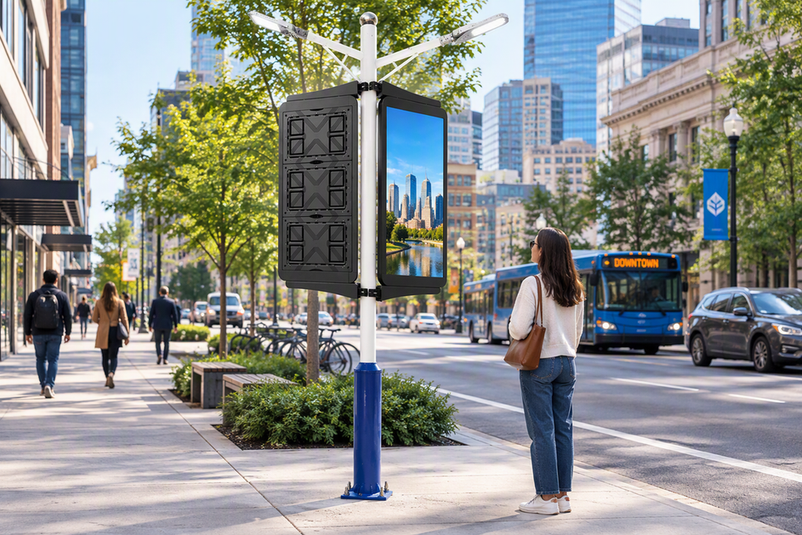
Data access, export rights, retention rules, and incident intake should be defined in writing rather than left to informal practice. Even when several parties provide technical support, the deployment works better with a single first point of escalation, so responders know where to call before ownership of the problem shifts back to the asset owner. Our smart pole 5G integration guide covers permit sequencing and design questions that feed into this interface map. Some display platforms, including our own pole-mounted display integration, are built with cloud management and space for added sensors or micro-cells; treating a platform like that as one more layer in the matrix, rather than as proof of local approval or network compatibility, keeps the ownership assignment honest.
Put permitting, maintenance, and retirement obligations in the deal
A workable ownership model still fails in practice if the contract is silent on permits, maintenance dispatch, or end-of-life responsibility. These items belong in the deal terms, not in a general assumption that someone will handle them.
Permitting and access
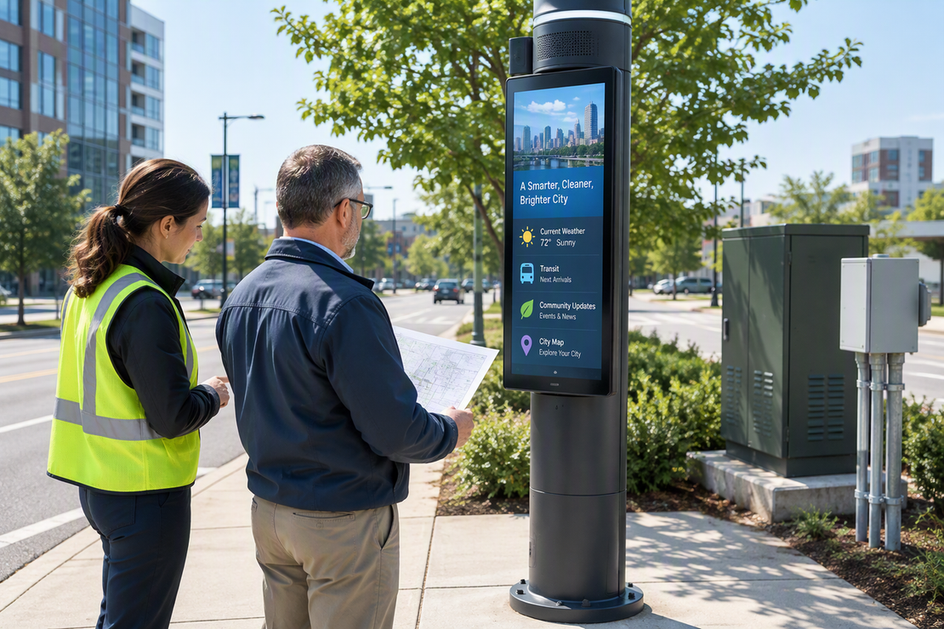
Identify every agency, utility, and right-of-way authority tied to the actual site, and request a written map of approvals, access rights, and inspection evidence for the proposed design. Requirements vary by jurisdiction and infrastructure owner, so this step should be confirmed locally rather than assumed from a general guide.
Maintenance, updates, and escalation
Name the dispatch owner for physical repairs, device failures, network outages, and firmware updates, and define the access windows and acceptance criteria for restoring service. A repair is not complete until the asset or service owner formally accepts the work back.
Transition, retirement, and restoration
Set out what happens when an operator changes, a device is removed or replaced, or the contract ends: credential handoff, data export or deletion, site restoration, and who pays for it. An accountable party for end-of-life should be named even if the original installer is long gone by the time removal happens. Our smart pole risk matrix gives a structured way to score vendor and supply-chain exposure before locking in these terms.
Turn the decision into an RFP-ready ownership matrix
Translating these requirements into an executable procurement package requires an explicit sequence of decisions. By resolving each operational handoff before issuing your solicitation, your project team ensures that bidders price real responsibilities rather than unknown risks.
- Inventory every component and external party: pole, power, radios, sensors, cameras, displays, connectivity, software, data, permits, inspections, repairs, and retirement.
- Identify the one control point the city cannot outsource, whether that is public data, service continuity, physical asset title, or change authority.
- Pick a provisional ownership direction from the comparison above, allowing hybrid arrangements where responsibilities are layered.
- Assign one accountable party to each row of the responsibility matrix, with supporting parties, access conditions, and acceptance evidence as separate fields.
- Turn every unresolved row into a specific procurement question, required evidence item, or contract term rather than leaving it as an assumption.
- Route the completed matrix through public works, IT, procurement, the utility or pole owner, telecom partners, and the relevant permitting authority for joint sign-off before treating the model as approved.
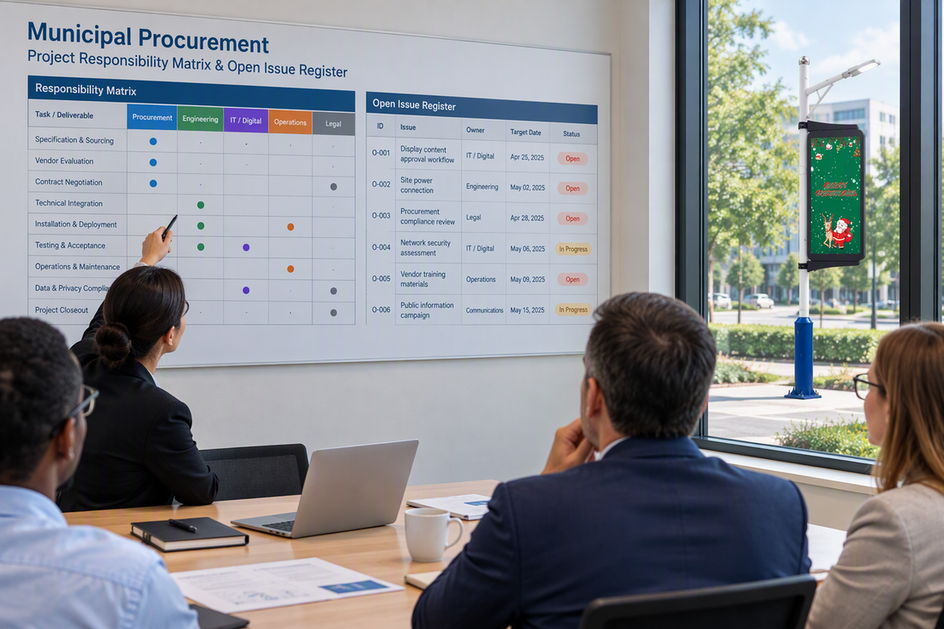
Before issuing the final procurement documentation, assemble the completed responsibility matrix alongside an open-issue register that logs all jurisdictional permits and access handoffs. Convene your cross-functional procurement and engineering leads to review any unassigned risks and formally baseline the ownership model prior to vendor solicitation.
FAQs
Can one organization own the pole while another owns the 5G radio or IoT device?
Yes, ownership layers can be split by contract. What matters is recording physical access, power, installation acceptance, operating authority, repair dispatch, and removal responsibility for each layer separately, then testing the proposed split against every row of the responsibility matrix before signing.
Does a shared operating model automatically give the city access to deployment data?
No, data access should never be assumed. The contract needs to specify what data is collected, who can access or export it, permitted uses, retention or deletion rules, security responsibilities, and what happens to that access at transition or termination.
What should change if the operator or ownership party changes during the contract?
Trigger a formal change-control process: update the responsibility matrix, verify asset and credential handoff, confirm data access is preserved, retest key interfaces, name an interim incident owner, and confirm removal or replacement obligations before the new arrangement takes effect.
Are smart pole permitting requirements uniform across the United States?
No, permitting varies by jurisdiction, infrastructure owner, and project design. Cities should identify the specific agencies and infrastructure owners tied to the actual site and confirm current approval requirements for the pole, right-of-way, power, and any attached communications equipment, cameras, or displays before finalizing a model.