

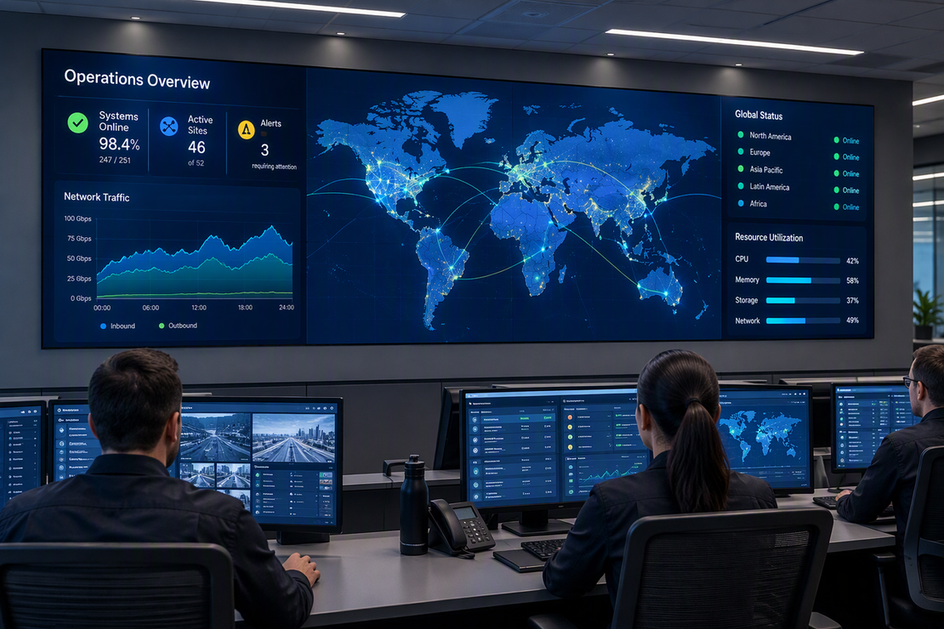
Evaluating true COB LED serviceability in a control room requires looking past marketing labels to examine verified engineering documentation. The practical decision rests on four physical factors: technician access direction, failed-area isolation, spare module compatibility, and post-repair calibration verification.
Without verifiable service procedures, terms like "modular" provide no operational guarantee for 24/7 facilities. Physical front access alone does not ensure rapid restoration or affordable long-term upkeep. This analysis models real-world maintenance workflows and quantifies complete repair-event economics for mission-critical video walls.
Can COB LED Be Repaired in a Control Room?
Yes, conditionally: COB LED serviceability in a control room depends entirely on whether the manufacturer supplies a verified front or rear access path, a defined field-replaceable service unit, matched batch spares, and a calibration routine. If any link in that operational chain is missing, treat field repairability as unproven regardless of the underlying packaging.
Installation geometry dictates physical constraints. When a video wall mounts directly against structural walls or equipment racks, lack of rear clearance makes front maintenance an absolute requirement rather than an optional feature. Specifiers must demand demonstrated module-level isolation rather than broad claims of modularity before shortlisting any vendor.
What a Serviceable COB Maintenance Path Looks Like
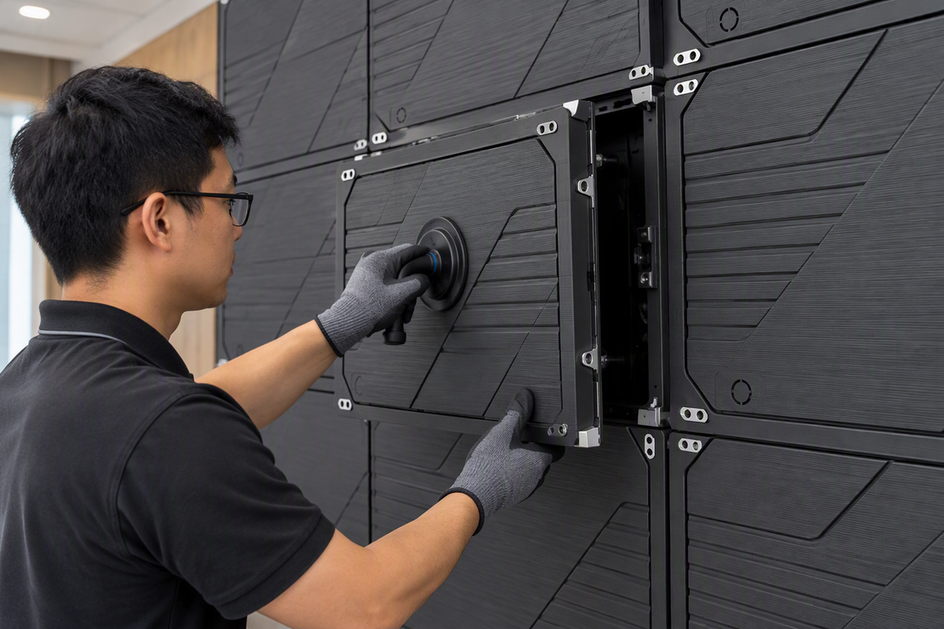
A viable COB maintenance workflow requires three integrated stages: unobstructed technician access to the damaged zone, clean removal and replacement of that specific sub-assembly, and optical calibration matching the rest of the display before sign-off.
Access Direction and Failed-Area Isolation
Evaluate whether the architectural environment mandates front access, rear access, or dual-side serviceability. When rear corridors are physically impossible, displays require magnetic extraction mechanisms operated entirely from the room side. Isolation capabilities must separate a single driver or pixel failure to a manageable module rather than forcing an entire structural cabinet removal. For example, our C-Pad Command display utilizes magnetic front service designed specifically for rooms lacking rear maintenance space, though operators must still verify local isolation procedures.
Replacement, Spares, and Technician Requirements
Once technicians isolate a faulted area, executing the replacement requires matched tools, appropriate technical skill, and compatible spare revisions. Swapping an integrated module differs dramatically from micro-soldering discrete surface components; your maintenance contract must explicitly define the replaceable unit scope. Maintain dedicated bin-matched spare modules on site to avoid batch color drift during emergency repairs.
Calibration and Return-to-Service Verification
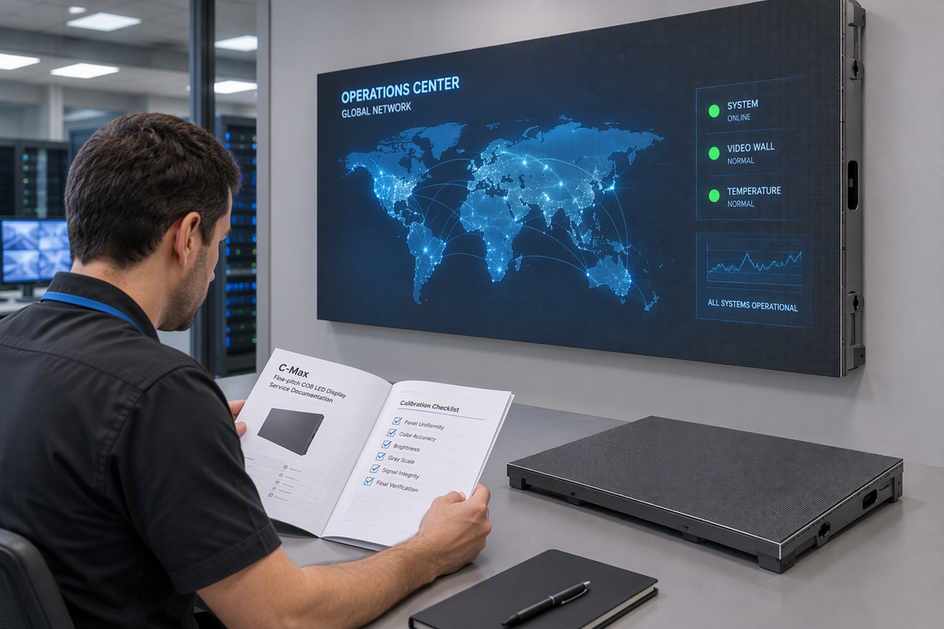
Physical mounting is only the midpoint of a service event. Technicians must load factory calibration coefficients and perform seam alignment, luminance leveling, and color uniformity checks across adjacent panels. Document the vendor’s realistic service window, from initial failure dispatch to verified handoff, as a baseline parameter for your operational downtime modeling.
COB vs. SMD: Which Maintenance Differences Change the Decision?
Neither packaging technology offers universal superiority across all maintenance criteria; the installed mechanical and control architecture determines real-world performance. While COB often supports robust front-service architectures, traditional SMD designs may allow component-level diode rework under specific bench conditions.
| Decision Dimension | COB System (when documented) | SMD System (when documented) | Control-Room Consequence |
|---|---|---|---|
| Access direction | Frequently supports front-only service tools | Often requires rear clearance for module release | Dictates architectural clearance behind wall |
| Smallest practical repair unit | Factory-sealed service module or panel | Individual diode, driver IC, or module | Determines direct material cost per incident |
| Tools and technician access | Specialized magnetic or vacuum extractors | Precision soldering stations or hand tools | Dictates on-site technician skill certification |
| Calibration/control dependence | Replacement module requires bin calibration | Component swap may avoid full module recalibration | Determines post-service visual alignment time |
| Spare strategy and outage exposure | Fewer total parts; module-level inventory | Multiple component SKUs; complex field stocking | Balances upfront spare cost against speed |
Use these parameters to match display architecture to site constraints. If an installation leaves zero rear clearance, a front-service COB system eliminates severe structural compromises. Conversely, if an operations team maintains internal electronics technicians who regularly perform board-level rework, an SMD architecture may leverage existing internal labor capabilities.
How to Model COB LED Repair Economics in a 24/7 Control Room
Initial capital expenditure represents only a fraction of total lifecycle display costs. The decisive economic metric is the total cost per repair event, which compiles labor, materials, staging equipment, logistics, recalibration, and operational disruption.
Build the Repair-Event Cost
Isolate every operational expense category using realistic site rates rather than vendor averages: technician labor hours, spare module amortized cost, lift or staging rentals, expedited courier logistics, post-replacement image calibration, and operational risk exposure during downtime.
As an illustrative scenario, consider a single repair event composed of 4 hours of technician labor at $85 per hour ($340), $150 for specialized access staging, a $600 replacement module, $100 in expedited shipping, $200 for recalibration engineering, and $1,000 in operational risk allocation during reduced monitoring capacity. This models an aggregate event cost of $2,390. Use this structure to evaluate candidate systems with your facility’s internal hourly and operational figures.
Turn the Event Model Into a Lifecycle Decision
Evaluate competing vendor bids against consistent site variables. A higher initial hardware cost can deliver lower total ownership expenditure if its mechanical design eliminates heavy staging equipment or shortens active service windows from hours to minutes. Conversely, a cheaper display requiring rear access or factory-depot module returns will rapidly accumulate severe labor and outage penalties over continuous 24/7 operational lifespans.
How Anti-Collision Durability Changes Maintenance Exposure
Hardened impact resistance reduces physical damage risks in high-traffic control rooms where operators, rolling chairs, or maintenance carts contact the display face. However, surface durability does not alter internal driver reliability, optical calibration needs, or component replacement workflows.
Surface hardness ratings such as 4H resin layers protect against accidental blunt impacts, but they cannot replace a comprehensive maintenance agreement. When evaluating displays, maintain distinct analytical categories for physical surface durability and internal electronics serviceability; surface impact resistance provides zero protection against power supply failures or signal distribution faults.
What to Verify Before You Specify a COB Display
Before issuing technical specifications or purchase orders, require manufacturers to submit an integrated operational support package verifying real-world maintainability.
Request Evidence for the Physical Service Path
Demand physical engineering drawings detailing extraction tooling, module isolation clearances, and specific technician certifications. For example, documentation for our C-Max fine-pitch COB display details front maintenance for modules, power units, and control cards; treat such records as relevant data points rather than proof that every scenario is covered. Verify whether magnetic extraction requires auxiliary power or specialized physical clearance envelopes.
Request Evidence for Commercial and Operational Support
Secure contractual terms detailing guaranteed spare module availability, factory bin-matching retention periods, localized field engineering response times, and post-repair sign-off criteria. Require vendors to detail explicit assumptions behind stated mean-time-to-repair figures rather than accepting unverified marketing summaries.
Approve the Service Architecture, Not the COB Label
Before approving display procurement, mandate a comprehensive maintenance dossier: confirmed access orientation, exact replaceable unit boundaries, written spare pricing schedules, and a total repair-event cost model grounded in your facility’s operational realities.
Approve the installation only when verified physical access procedures and lifecycle maintenance budgets align with your 24/7 operational mandate; place the project on hold if the supplier cannot provide documented extraction steps or spare commitments. Before finalizing your technical specification, request our model-specific serviceability data and spare planning models for C-Pad Command video wall systems to benchmark front-access repair windows against your room schedule.
FAQs
Does front service mean every COB LED fault can be repaired from the front?
No. Front service solves physical access constraints by eliminating rear corridor requirements, but it does not define the repairable unit boundary. Sub-module driver faults, internal frame misalignments, or primary power backbone failures may still demand specialized tools, cabinet-level access, or dedicated recalibration routines before full restoration.
How do spare batch variations affect COB display serviceability?
COB modules rely on proprietary resin encapsulation and calibrated LED binning. Installing a replacement module from an unmatched production batch can cause visible color shifts and seam boundaries. True field serviceability requires purchasing and storing original batch spare modules at initial commissioning to ensure optical uniformity during localized replacements.
What factors drive the total cost of a control room LED repair event?
Direct module replacement cost is typically secondary to labor, logistics, and operational downtime. A complete repair-event financial model must account for dispatch technician rates, expedited shipping for calibrated spares, optical recalibration time, and the potential operational risks incurred while operating critical control systems at degraded monitoring capacity.