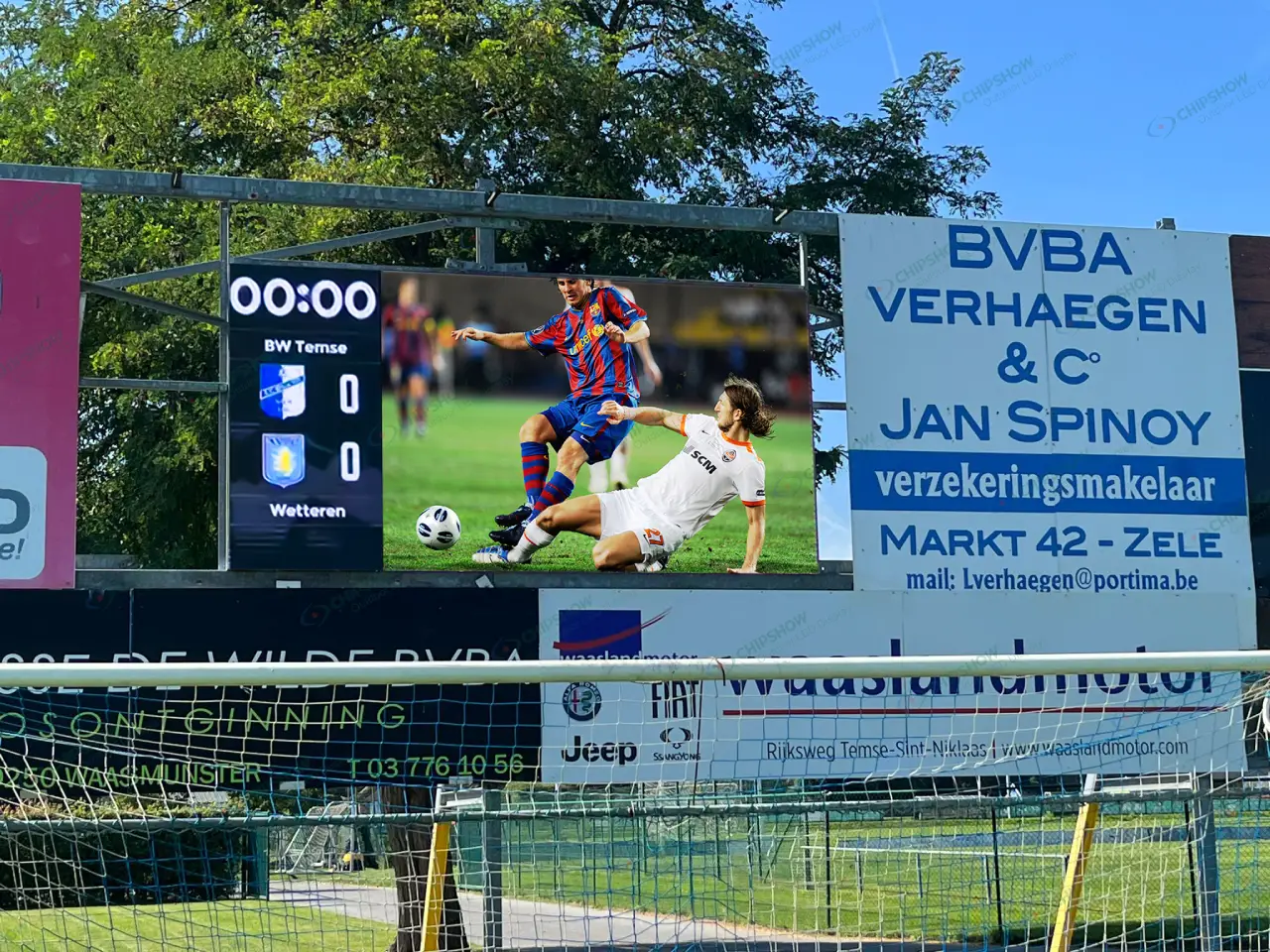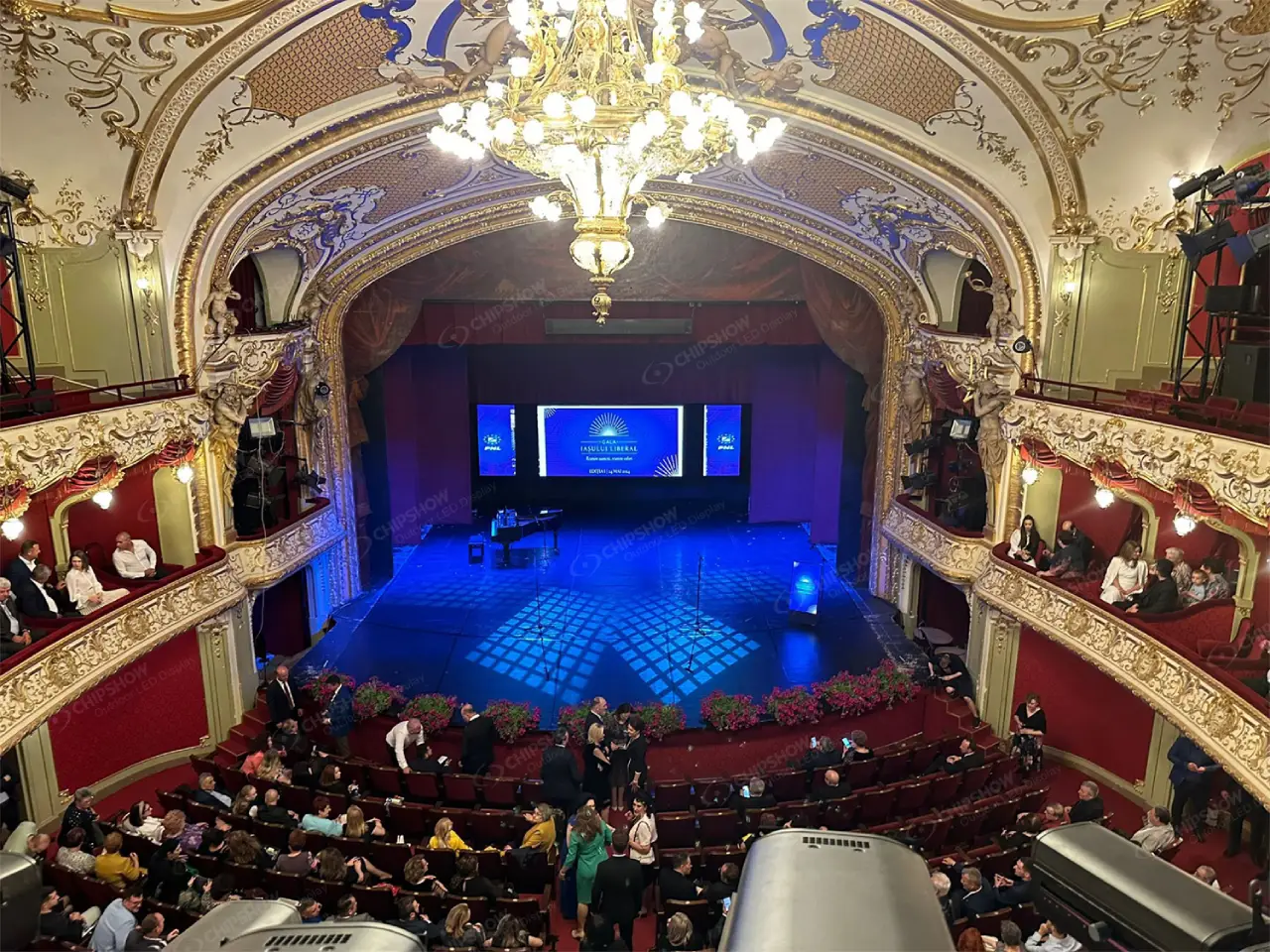


An LED wall’s native resolution is its physical pixel grid: columns × rows. For a preliminary estimate, divide the active width and height by pixel pitch using the same units. For a purchase specification, calculate from the actual module pixel matrix, modules per cabinet and cabinet layout. A “4K input” on the controller does not make the wall a native 4K display.
A good resolution decision connects three things: the wall you can physically build, the detail your content must show and the positions from which people will read it. This guide takes a worked wall from cabinet count to pixel count, shows what happens to a 1080p signal, and gives you a content acceptance test to use before ordering.
Pixel pitch, native resolution and input resolution are different
On a small screen, scroll the table horizontally to see every column.
| Term | What it describes | Question to ask a supplier |
|---|---|---|
| Pixel pitch | Centre-to-centre spacing of adjacent pixels, normally in millimetres | What is the exact design pitch, rather than only the rounded marketing label? |
| Native resolution | The wall’s physical number of pixel columns and rows | What are the module pixel matrix and the final wall grid? |
| Input resolution | The signal format accepted by the controller or processor | Can the proposed signal path accept our source at the required frame rate? |
| Mapped content area | Where and how the input image is placed on the physical grid | Will it be scaled, cropped, padded or mapped 1:1? |
An LED pixel can contain multiple colour-emitting elements. Pitch is therefore better described as pixel-to-pixel spacing, not simply the distance between individual LEDs.
Smaller pitch gives more pixels within the same active area. It does not automatically provide native 4K, make content legible at every distance or solve motion and camera problems. Those are separate design questions.
Calculate resolution in two stages
Stage 1: estimate from active size and pitch
For an approximately rectangular wall with square pixel spacing:
Estimated pixel columns = active width (mm) ÷ pitch (mm).
Estimated pixel rows = active height (mm) ÷ pitch (mm).
For example, a 4,000 mm × 2,500 mm canvas at P2.5 gives 1,600 × 1,000 pixels. The arithmetic is exact for those inputs, but a supplier still needs to show a module and cabinet arrangement that produces that canvas.
Do not round a result such as 1,333.33 rows to 1,333 and call it a buildable specification. Fractional results are a signal to check the grid, exact pitch and achievable dimensions.
Stage 2: confirm from modules and cabinets
Use the manufacturer’s dimensional drawing and module data to calculate:
- Cabinet pixel width = module pixel width × module columns per cabinet.
- Cabinet pixel height = module pixel height × module rows per cabinet.
- Wall pixel width = cabinet pixel width × cabinet columns in the wall.
- Wall pixel height = cabinet pixel height × cabinet rows in the wall.
Check active dimensions separately from external cabinet dimensions, borders and any installation gaps. Also confirm module orientation; rotating a rectangular module changes which dimension is horizontal.
Worked example: the same wall at P2 and P2.5
The following is a hypothetical square-module system created to demonstrate the calculation, not a Chipshow model specification or a claim that these two products are available.
Assume 250 × 250 mm active modules, arranged 2 × 2 in each 500 × 500 mm active cabinet. Build the wall 8 cabinets wide and 5 cabinets high.
On a small screen, scroll the table horizontally to see every column.
| Quantity | P2 example | P2.5 example |
|---|---|---|
| Module active size | 250 × 250 mm | 250 × 250 mm |
| Module pixel matrix | 125 × 125 | 100 × 100 |
| Cabinet module layout | 2 × 2 | 2 × 2 |
| Cabinet pixel matrix | 250 × 250 | 200 × 200 |
| Wall cabinet layout | 8 × 5 = 40 cabinets | 8 × 5 = 40 cabinets |
| Wall active size | 4,000 × 2,500 mm | 4,000 × 2,500 mm |
| Native wall resolution | 2,000 × 1,250 | 1,600 × 1,000 |
| Total pixels | 2,500,000 | 1,600,000 |
The P2 example has 56.25% more pixels than the P2.5 example at the same active size: 2,500,000 ÷ 1,600,000 − 1 = 0.5625. That is not a 56.25% image-quality guarantee or a 56.25% price increase. The value of the extra pixels depends on the content and viewing conditions; the price depends on the actual offered systems.
This is the information a quote should make visible. “Fine pitch,” “HD” or “supports 4K” is not an adequate replacement for the final grid and dimensions.
Download the worked grid and a supplier specification worksheet.
What happens to a 1920 × 1080 source on that wall?
The P2.5 example is 1,600 × 1,000 pixels: an 8:5 canvas, not 16:9. A 1920 × 1080 source therefore needs a mapping decision.
- Fit without cropping: scale the source to 1,600 × 900, leaving 100 unused rows. If centred, that is 50 rows above and below the image.
- Fill without distortion: scale to the full 1,000-row height and crop horizontally. The exact implementation depends on the processor, but some source image will be lost because the aspect ratios differ.
- Stretch: use the entire canvas by changing horizontal and vertical scale differently. Circles and people can look distorted, so do not treat this as a neutral default.
- Create a native 1,600 × 1,000 composition: place text, graphics and video regions in a design made for the wall. This often makes better use of a non-standard canvas than forcing every asset into one full-screen video.
The P2 example contains more total pixels than 1920 × 1080, but it is still an 8:5 grid. Total megapixels do not resolve the aspect-ratio mismatch. A processor may support a 1:1 region, scaling or other mapping options; verify the intended workflow rather than claiming the source must always match the wall exactly.
How large must a wall be for native Full HD or 4K?
At a specified exact pitch, the target pixel grid implies an active size. The dimensions below are arithmetic targets, not confirmed cabinet layouts.
On a small screen, scroll the table horizontally to see every column.
| Target native grid | At P2 | At P2.5 |
|---|---|---|
| Full HD: 1920 × 1080 | 3.84 × 2.16 m | 4.80 × 2.70 m |
| UHD: 3840 × 2160 | 7.68 × 4.32 m | 9.60 × 5.40 m |
A chosen cabinet family may not assemble to these exact dimensions. In the hypothetical 500 mm cabinet system above, for example, a 4.80 × 2.70 m wall is not an integer number of cabinets. You would need a different grid, a different active size, or a different content-mapping decision.
Do not buy extra physical area merely to obtain a familiar resolution label if the space and content do not need it. Conversely, if a control-room workflow requires a particular native grid for small text, establish that requirement before selecting cabinets.
Choose pitch by testing the smallest important detail
A rough viewing-distance heuristic may help shortlist pitches, but it is not a universal visual-acuity threshold. The nearest viewer, the most distant person who must read critical information, the viewing angle, ambient light and actual content all matter.
Use a content test that is more specific than “play a nice demo video”:
- Select the difficult material. Include your smallest spreadsheet labels, thin chart lines, multilingual text, logos and any fine-detail footage that matters to the job.
- Prepare the proposed native canvas and mapping. Do not test a different scaling workflow and assume it represents the final installation.
- Define what must be readable and from where. Name the labels, values or symbols viewers must correctly identify at each important position. Use actual intended users where possible.
- Test under representative conditions. Record brightness, ambient light, viewing angle, wall settings and the content version. A sample cabinet can help assess pixel structure, but it cannot by itself demonstrate the entire wall’s content layout or system capacity.
- Record a decision. Accept, revise the typography/mapping, compare a finer pitch, or increase the image area. Keep screenshots or photographs as a record, not as a substitute for the direct viewing test.
A simple calculation exposes why small details matter. A 20 mm-high text element spans approximately eight pixel rows at P2.5 and ten at P2. That difference is useful to inspect, but neither number alone guarantees legibility: font shape, stroke width, contrast and the viewer all affect the result.
For outdoor projects, choosing P6 or P10 for outdoor signage is a more focused application of this trade-off. The general method remains the same: check the actual content at the relevant viewing positions, rather than treating a pitch label as a complete viewing specification.
Check the signal chain before approving the grid
A wall can have the right pixel count and still be paired with an unsuitable control system. Ask the integrator to confirm:
- Supported input format and frame rate from your source device.
- Total pixel capacity and any maximum width/height constraints.
- Output-port allocation, receiving-card configuration and the intended cabinet mapping.
- Scaling, cropping and multi-window requirements.
- Any reduction in supported capacity at the requested operating settings.
- Redundancy and recovery behaviour if continuity matters to the application.
Spatial resolution, content frame rate and LED refresh/scan behaviour describe different things. Motion blur, camera banding or flicker should be investigated in the complete signal and display chain—not diagnosed simply as “insufficient resolution.” If cameras will record the screen, include the intended camera settings in a separate capture test.
Frequently asked questions
Can software turn a P2.5 wall into a P2 wall?
No. Software can change scaling, processing and content layout, but it cannot add physical pixels to the same active surface. A hardware change may be possible in some systems; confirm the mechanical, electrical and control compatibility rather than assuming an entire wall must always be replaced.
Is native 4K always worth buying?
No. It is useful when the project benefits from that physical grid and the rest of the system can use it. Large viewing distances, simpler content or a constrained wall size can make a different grid a better purchase. Do not confuse support for a 4K input with a requirement for a 4K wall.
Does finer pitch automatically mean more weight or higher power?
No. Neither follows from pitch alone. Compare mass, measured power and installation requirements for the exact offered systems. The resolution calculation should not invent structural or energy specifications.
Request the grid, not just the label
For a Chipshow enquiry, send the available active width and height, important viewing positions, representative content and source-system details. Request the module and cabinet pixel matrices, final layout, exact active dimensions and proposed mapping as part of the offer.
Those details let you compare an indoor LED display or outdoor LED display on what your audience will actually see. The right purchase is the grid that performs the required job—not the largest resolution label in the brochure.