

The decision to choose a P6 or a P10 resolution for an outdoor LED display screen is not only a resolution decision. It is a total cost decision based on where your audience is, how they are moving, and what you are showing.
What Is the Core Difference Between P6 and P10 Outdoor LED Displays
Pixel pitch sets the foundation for every other spec decision. Getting this number wrong means overspending on hardware your audience cannot perceive, or underspecifying a screen that looks grainy at your installation distance.
Pixel Density and Resolution Compared
P6 outdoor LED displays carry approximately 27,778 pixels per square meter. P10 displays carry approximately 10,000 pixels per square meter. That is a 2.8x difference in pixel count across the same screen area.
Module dimensions and pixel counts vary by product. Compare the actual module drawing and pixel matrix for each proposed configuration. A coarser pitch uses fewer pixels over the same area, but cost and long-term reliability also depend on component quality, cabinet design and operating conditions.
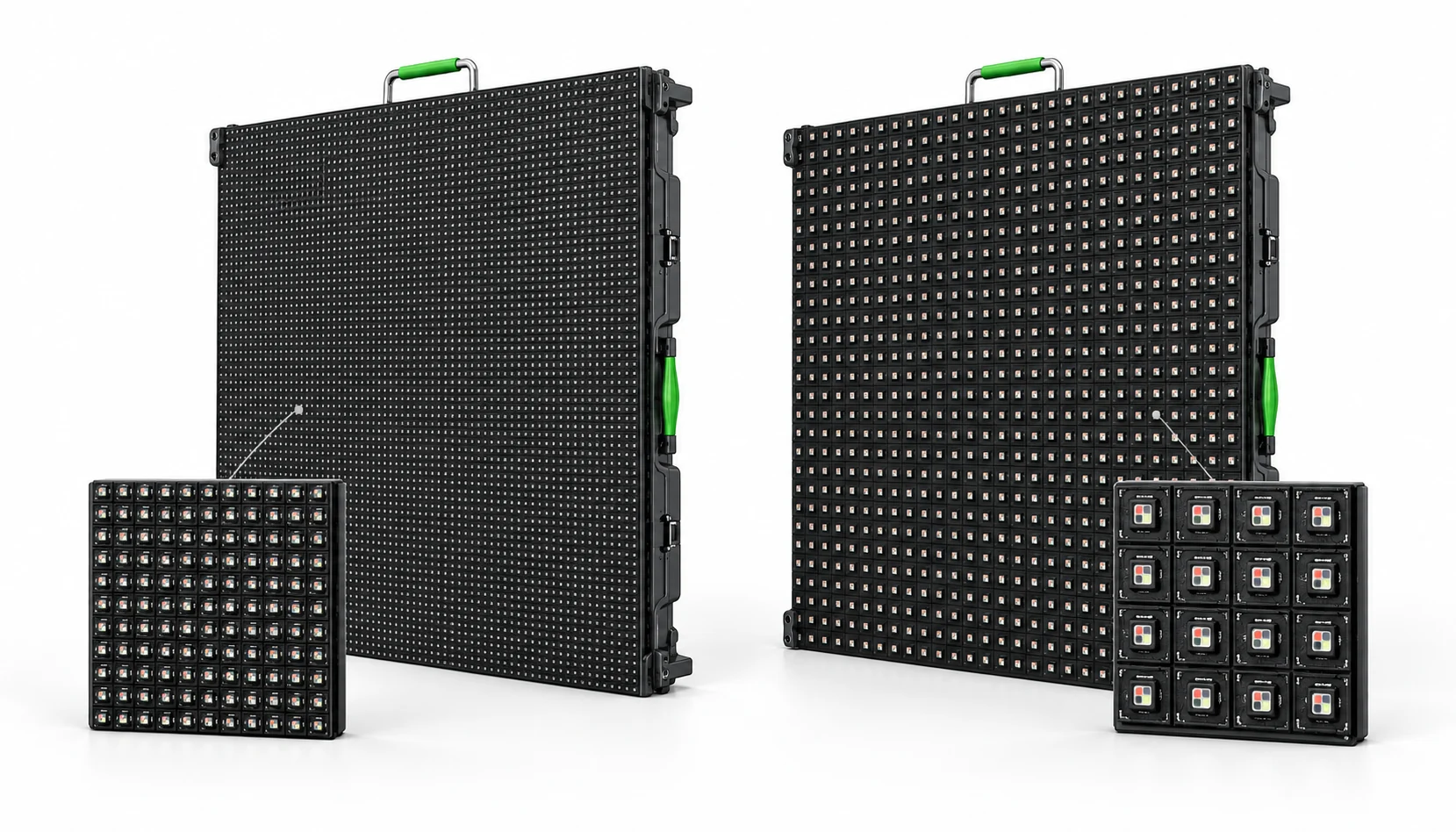
Conceptual illustration; panels and magnified details are not a measured P6/P10 layout.
Minimum Viewing Distance vs. Optimal Viewing Distance
Pixel pitch is one input to viewing-distance selection. Text size, screen dimensions, content, lighting and the audience’s line of sight also affect readability. Use the proposed P6 and P10 configurations to compare the same content from the actual viewing positions.
| Viewing position | What to check |
|---|---|
| Nearest intended viewer | Visible pixel structure, image detail and comfort at the proposed screen size. |
| Farthest intended viewer | Legibility of the smallest important text, prices and logos. |
| Side and moving viewers | Viewing angle, obstructions and the time available to read the message. |
Confirm the choice with sample content and the site layout. A rule of thumb is a starting estimate, not a guarantee that either pitch is suitable for every viewer at a fixed distance.
How Does Billboard Location Affect Which Outdoor LED Display You Need
Location determines your actual audience behavior. A spec sheet cannot tell you whether your viewers are walking slowly or passing at 105 km/h (65 mph). That context changes the entire pixel pitch decision.
Locations That Suit a P6 Outdoor Advertising LED Display Screen:
- Commercial retail streets
- Shopping center exteriors
- Transit concourses
- City plazas with mixed dwell times
Foot traffic audiences stop, read, and look twice. Viewing distances in pedestrian zones typically run 6 – 15 m (20 – 50 ft). At those distances, P6 delivers sharper text, cleaner product imagery, and more accurate color gradients on video content.
Locations That Suit a P10 Outdoor Advertising LED Display Screen:
- Rooftop digital billboards
- Highway corridor signs
- Elevated wall displays above 9 m (30 ft) installation height
Drivers at 100 km/h (60 mph) have roughly two to three seconds of useful viewing time. At 30 m (100 ft) or more, neither their eyes nor their vehicle speed allows them to perceive the resolution difference between P6 and P10. Spending on P6 density at those distances adds hardware cost with no visible improvement for your audience.
Does Content Type Change Which Outdoor LED Billboard Spec You Need
Most pixel pitch comparisons skip this entirely. The content you run on your digital billboard matters as much as the distance your audience stands from it.
Content Types That Suit a P6 Outdoor LED Billboard:
- Video content with gradients and fast motion
- Motion graphics
- Fine and detailed typography
- Product close-ups and high-detail imagery
- Human faces and skin tones
These elements expose pixel density differences more readily than static graphics. P6 handles these content types with noticeably better fidelity at distances under 15 m (50 ft). DOOH (Digital Out-of-Home) network operators running automated, data-driven video ad campaigns on street-level or low-elevation screens will see a measurable quality difference with P6.
Content Types That Suit a P10 Outdoor LED Billboard:
- Bold sans-serif text
- Single-color brand marks
- Simple graphic compositions
- Rotational static ad campaigns
At 12 m (40 ft) and beyond, P10 renders these content types cleanly. The gap between P6 and P10 becomes imperceptible to most viewers when the content is graphically simple. P10 is the cost-optimal choice for operators running rotational static ad campaigns on large-format outdoor LED billboards.
What Is the Real Cost Difference Between P6 and P10 Outdoor LED Display Screens
The hardware price gap between P6 and P10 is real but incomplete. The number that matters for billboard operators is the total cost of ownership across the installation lifecycle.
Hardware Cost Per Square Meter
Compare dated written quotations for the same active screen area, target brightness, control system and delivery scope. A price per square meter is useful only when the included equipment and terms are comparable.
| Quote item | Check for both P6 and P10 |
|---|---|
| Display hardware | Cabinet and module models, active area, control equipment and calibration scope. |
| Project work | Structure, power distribution, lifting, installation and commissioning. |
| Other costs | Spares, freight, duties, taxes and the quotation’s validity period. |
Divide the quoted display-hardware amount by the active display area to compare that component. Keep installation and other project costs visible as separate line items.
Power Consumption and Annual Energy Cost
Pixel count alone does not establish power consumption. Request maximum power and measured average power for each proposed configuration at comparable brightness and content settings.
Estimate annual energy use from average power per square meter, active screen area and operating hours. Convert watt-hours to kilowatt-hours and apply the local electricity tariff. Record the operating assumptions beside the comparison so a change in schedule or brightness can be recalculated.
Installation Efficiency and Long-Term Maintenance
Installation effort depends on cabinet dimensions, weight, mounting details and cable routing. Compare the actual installation drawings rather than inferring cabinet count or labor time from pixel pitch.
For the same screen area, nominal P6 has more pixels than nominal P10. Estimate maintenance from the selected system’s service access, component quality, spares plan and operating conditions. Pixel density alone does not establish a failure rate or service life.
Evaluate the total cost of ownership (TCO) across a full operational cycle, not just the purchase order. For large-format highway digital billboards, P10 frequently delivers lower total spend even when the per-unit hardware cost is comparable.
Which Outdoor LED Display Screen Fits Your Billboard Project
The decision comes down to four inputs: viewing distance, audience behavior, content type, and total operational budget. Run these four against your specific installation and the answer becomes clear.
Conditions That Favor a P6 Outdoor LED Display
- Primary viewing distance falls between 5.5 m and 15 m (18 – 50 ft).
- Audience moves on foot with dwell times above 5 seconds.
- Content includes video, product photography, or fine text.
- Installation location is a retail street, mall exterior, transit hub, or city plaza.
Conditions That Favor a P10 Outdoor LED Display
- Primary viewing distance exceeds 20 m (65 ft), or the screen is mounted above 6 m (20 ft) elevation.
- The audience consists primarily of vehicle traffic.
- Content is brand-focused with bold graphics and large type.
- Screen area exceeds 50 m² (540 sq ft) and operational budget is a primary constraint.
Common Mistakes to Avoid When Specifying an Outdoor LED Display Screen
Over-specifying is the most common and expensive mistake in outdoor LED display procurement. It adds cost with no audience benefit.
Over-Specifying Pixel Pitch for the Actual Viewing Condition
At long viewing distances, differences between P6 and P10 may be less visible for some content. Mounting height alone does not establish viewing distance or advertising performance. Compare the proposed screen size and content from the actual audience positions before paying for a finer pitch.
Specify pixel pitch to match the closest viewer at your specific site, not the tightest pitch available in the product catalog.
Evaluating Price Without a Full TCO Model
Hardware cost is one line in a multi-year operating budget. Power consumption, installation labor, maintenance frequency, and spare parts availability all contribute to the real cost of running an outdoor advertising LED display screen over its operational life.
Request power consumption data and expected maintenance intervals from your supplier before finalizing specifications. Build a 5-year or 10-year TCO model before comparing quotes.
Spec Your Outdoor LED Display for Maximum Billboard ROI
Even though screen sizes might not ensure immersion by themselves, immersion is the result of aligning screen specs with content, designing content well, and setting up a strong system. To set your pixel pitch, it’s a good idea to start by figuring out how far away people are from the screen, comparing the brightness to the amount of light in the room, and checking high refresh rates for broadcast stability. Share the viewing layout, screen dimensions and sample content with the supplier so the proposed configuration can be checked against the project.
FAQs About Outdoor LED Display Screens for Billboards
Q1. What Brightness Does an Outdoor LED Display Need for Direct Sunlight?
It is important for outdoor LED screens to have at least 5,000 nits of brightness in full sunlight. Brightness of 7,000 nits or more might be needed in places with a lot of light, like those facing west or south. 5,500 to 6,000 nits might be more than enough for places that get some shade or face north. It’s important to think about how bright the screen is in relation to how bright the room is in general.
Q2. How Long Does an Outdoor LED Display Last?
The standard term used in the industry to refer to this is operational half-life, which is the point at which the brightness of the LED display decreases to 50% of the initial brightness, or calibration. The operational half-life of quality outdoor LED display screens can reach up to 100,000 hours. The operational half-life of an LED display screen varies depending on the average hours of operation per day, the temperature, and whether the thermal management system has been maintained during the entire life of the screen.
Q3. Is P6.67 the Same as P6 in Outdoor LED Displays?
Not exactly. P6 stands for a pixel pitch of 6 mm (0.24 in), and P6.67 for a pixel pitch of 6.67 mm (0.26 in). Both are in the same performing class and can be used in the same way. P6.67 is more often used in fixed outdoor LED display cabinets because it has a slightly larger pixel pitch that works better with standard cabinet sizes. This lowers the cost per cabinet without affecting the quality of the picture at normal viewing distances.
Q4. What IP Rating Does an Outdoor LED Billboard Need?
The basic standard for outdoor LED screens is IP65, which means they can handle rain, dust, and humidity. If your screen is fully visible, you should get IP65 protection on both the front and back. For some systems, front and back security of IP65 and IP54 may be used together. People who run screens near the coast or in places with a lot of humidity should also make sure that the connectors and power supplies have an IP65 grade.
Q5. Does Pixel Pitch Affect Brightness on an Outdoor LED Display?
In a roundabout way, pixel pitch affects light potential. For instance, there is more room between each LED in pixel pitches that are bigger, like P10. This makes it possible for more power to be sent to each pixel and for heat to be removed more efficiently. One reason P10 displays often have a higher peak brightness rating than P6 screens in the same size cabinet is because of this. This can actually make P10 a good choice in places with a lot of natural light, and not just because it’s cheaper.
Q6. Is a P10 Display More Durable Than a P6 in High-heat or Direct Sunlight Environments?
Yes. The P10 displays can handle heat much better than the high-density P6 displays because there is more space between each LED. This lowers the chance of “dead pixels” caused by too much heat. When used outside in harsh conditions without cooling, the P10 loses light more slowly and has a lower rate of hardware failure.