

A properly specified outdoor LED billboard delivers 8 to 10 years of commercial-grade performance. A poorly specified one costs more in repairs and replacements than the original purchase price. Durability is not a single rating on a spec sheet. It results from component quality, weatherproofing design, thermal management, and serviceability working together.
What Does “Durable” Actually Mean for an Outdoor LED Billboard?
For advertising operators, durable means a screen maintains contractual brightness and color standards long enough to deliver the ROI the investment requires.
A screen that still turns on after six years is not the same as a screen that still meets the brightness and color standards your advertisers contracted for. Lumen depreciation is the real long-term risk. LEDs do not burn out suddenly. They dim gradually, and a screen can still function while failing to deliver contracted visibility. The industry defines LED operational half-life as the point at which brightness drops to 50% of initial output, not total device failure.
For commercial-grade outdoor LED displays, the benchmark is up to 100,000 hours, measured under controlled lab conditions, not real-world heat or continuous full-brightness load. When evaluating suppliers, ask for MTBF (Mean Time Between Failure) figures for power supplies and control systems specifically, as these are the two most common failure points in outdoor installations.
What Weatherproofing Standards Does a Waterproof Outdoor LED Screen Need?
Protection ratings and structural certifications determine whether a screen holds up in the specific conditions of your installation site.
IP Rating Requirements for Outdoor Advertising Screens
IP65 is the accepted baseline for outdoor LED displays, providing full dust protection and resistance to low-pressure water from any direction. For coastal installations, high-humidity climates, or sites subject to maintenance pressure washing, IP66 on both the front and rear cabinet panels is the more appropriate specification. Always request third-party certification documentation. Self-declared IP ratings are not a reliable basis for procurement decisions in long-term commercial installations.
Wind Load Resistance and Structural Certification
Wind load ratings must align with local building codes at the installation site, not just the manufacturer’s default figures. Structural engineering documentation specific to your region is a standard part of any credible supplier’s technical submission. Inadequate wind load ratings create safety liability and insurance exposure for site operators. Verify this before installation approval.
Conformal Coating for Coastal and High-Humidity Deployments
Conformal coating is a transparent protective layer applied to internal PCBs. It is one of the most effective and most frequently omitted protections for outdoor LED electronics. In coastal environments, salt air accelerates PCB corrosion. In tropical or high-humidity climates, moisture ingress into uncoated boards is among the most common causes of premature electronics failure. For installations within 10 miles of a coastline, treat conformal coating as a baseline requirement, not an optional upgrade.
Which Specs Have the Biggest Impact on Long-Term Ad Revenue?
Display specifications set at the point of purchase determine whether a billboard keeps delivering advertiser-visible performance year after year.
Brightness Output and Auto-Dimming for Sustained Operation
Outdoor advertising screens require a minimum of 5,000 nits to remain legible in direct sunlight. Standard urban commercial placements typically operate at 5,500 nits and above. Sun-facing billboards and city landmark facades may require up to 14,000 nits for full daylight readability. Screens with sufficient brightness headroom can run at reduced output during off-peak hours, lowering LED stress and extending operational half-life without sacrificing daytime visibility. Screens that must run at full capacity continuously to meet daylight requirements degrade faster and consume more power. When requesting specs, ask for average power consumption under typical operating conditions, not peak rated figures, which reflect maximum load rather than real-world draw.
For sun-facing billboards and city landmark facades where sustained brightness output is a commercial contract requirement, Chipshow’s C-Slim series is engineered for this operating profile, reaching up to 14,000 nits.
Pixel Pitch for Roadside Billboard Applications
Pixel pitch selection affects image readability at viewing distance, power draw, and thermal load, all of which influence component longevity and operating cost.
| Pixel Pitch | Typical Minimum Viewing Distance | Common Application |
| P4 to P5 | 13 to 16 ft (4 to 5 m) | Urban street-level signage |
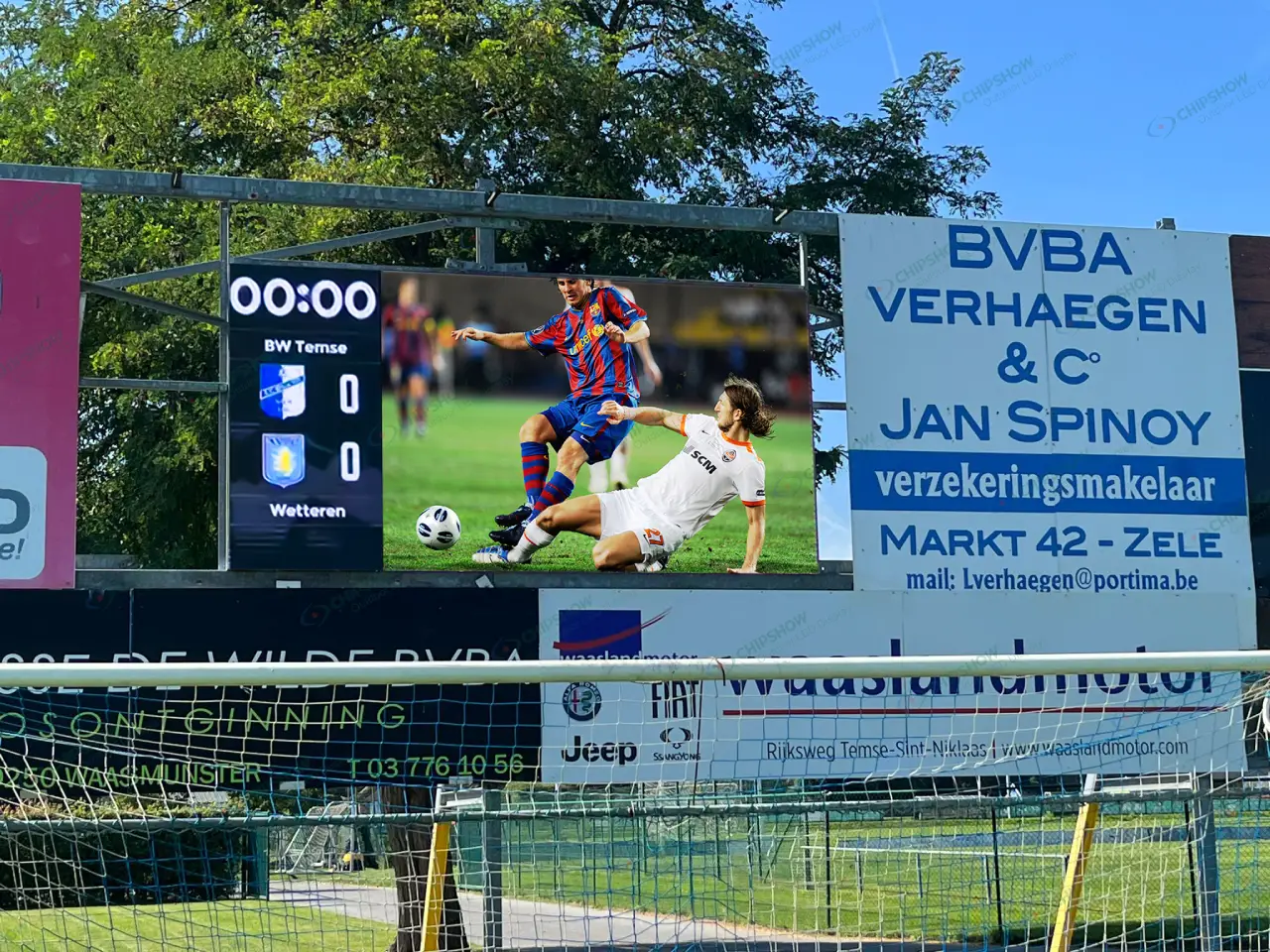
| P6 to P6.67 | 20 to 22 ft (6 to 6.7 m) | Urban roadside, stadium scoreboards |
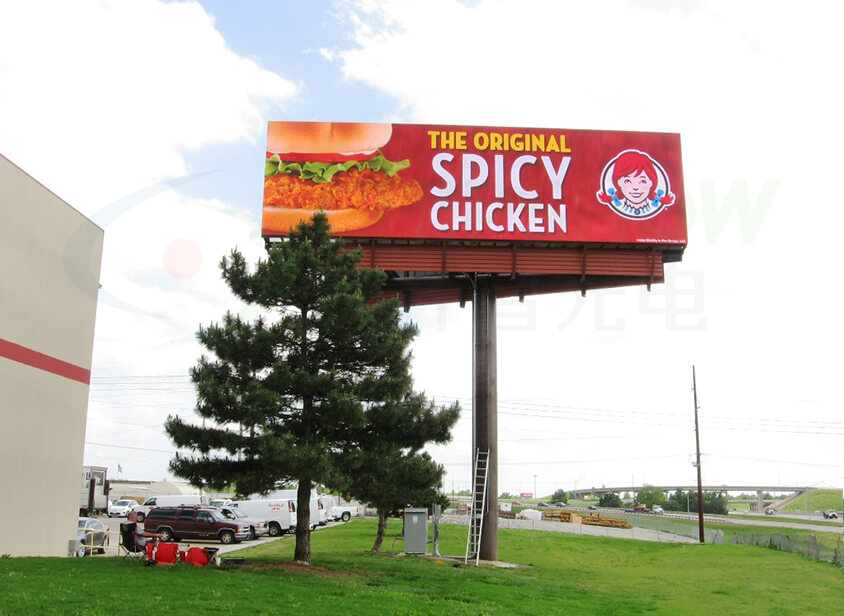
| P8 to P10 | 26 to 33 ft (8 to 10 m) | Highway billboards, elevated signage |
| P16 | 52 ft+ (16 m+) | Giant-format highway monopoles, rooftop signs |
Matching pixel pitch to your primary viewing distance avoids overpaying for resolution that viewers at highway speed cannot perceive, and reduces unnecessary power draw in the process.
Operating Temperature Range in Extreme Climates
Commercial-grade outdoor LED displays are typically rated from -4°F to 122°F (-20°C to +50°C). Deployments outside this window require additional thermal management. For extreme heat, passive or active heat dissipation keeps internal component temperatures within safe operating range, which is the primary factor controlling how fast LEDs dim over time. Always request operating temperature certification matched to your specific installation region, not a generic rated range.
What Does Long-Term Outdoor LED Display Maintenance Actually Require?
Cabinet design determines how much routine upkeep costs over the life of the installation, not just whether it can be done.
Routine Inspection Points
Monthly inspections should cover LED module condition, power supply output, antenna and controller connectivity, and wiring integrity. In cold climates, ice and water ingress are leading causes of wiring damage. Power supply failure and module degradation account for the majority of repair calls across outdoor billboard installations. Early detection eliminates the cost of emergency service visits.
Remote Monitoring and Smart Diagnostics
Commercial-grade outdoor LED displays use integrated temperature sensors, power status monitoring, and remote diagnostic tools to flag developing issues before they cause visible failure. For operators managing multiple billboard sites, remote diagnostics reduce undetected faults that translate into advertiser complaints and contract penalties.
Front-Access Cabinet Design and Its Effect on Service Costs
Front-serviceable cabinet designs allow module and power supply replacement from the front of the display without rear scaffolding or crane equipment. For roadside billboard installations where rear access is restricted, front serviceability reduces per-service labor costs significantly, and that reduction compounds over a 10-year deployment. Confirm whether the cabinet architecture supports front access, rear access, or both before committing to a structural design. For outdoor signage and roadside installations, Chipshow’s C-Smart cabinet-free design eliminates the traditional cabinet structure entirely, requiring only a simple frame, which reduces installation cost and simplifies front-access maintenance without the weight and complexity of conventional cabinet systems.
What Is the Real 10-Year Cost of Owning an Outdoor Advertising LED Display Screen?
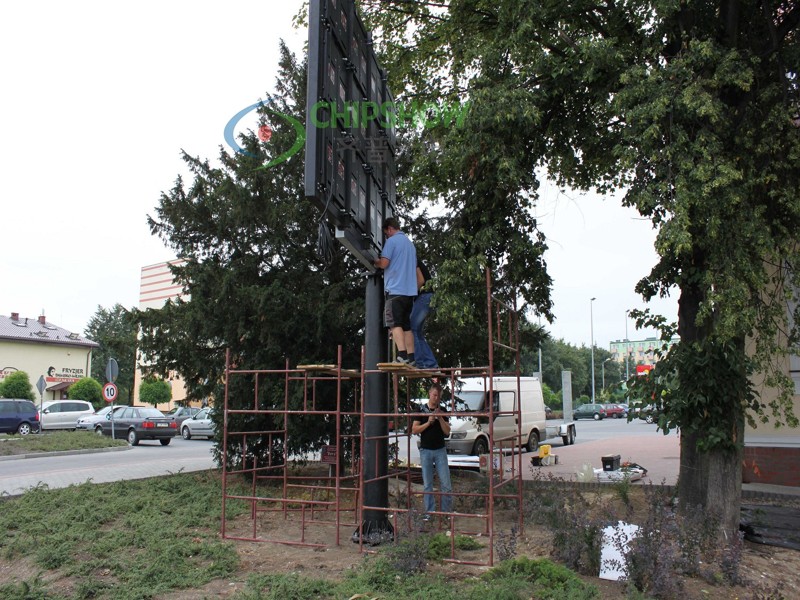
Purchase price covers roughly 60 to 70% of total investment over a billboard’s operational life. The remainder accumulates through service visits, infrastructure upgrades, and end-of-life costs that most operators do not budget for at purchase.
Hidden Costs Most Operators Do Not Budget For
| Cost Item | Typical Range |
| Crane and labor per service visit | $3,000 to $5,000 |
| Electrical infrastructure upgrade at installation | $1,200 to $3,000 |
| Electronic waste disposal at end of life | Varies by region and jurisdiction |
| Software or CMS licensing (if charged separately) | Ongoing annual cost |
Factor these costs into any supplier comparison from the outset.
Budget Screen vs. Quality Screen: A 10-Year TCO Comparison
A lower-cost outdoor LED billboard that requires a full replacement and multiple emergency service visits over 10 years frequently costs more in total than a premium modular screen serviced through component-level repairs. A full replacement carries not just the hardware cost but crane labor, disposal fees, installation labor, and potential site disruption.
Quality screens with modular architecture allow individual module or power supply replacement without full teardown.
This is where long-term cost separation between budget and premium products becomes most visible.
Warranty Coverage as a Risk Management Tool
This means that the warranty should cover parts, workmanship, and even weather-related damage, as well as post-warranty spares availability. The spares availability for years after year 5 is the critical but least asked question when procuring LED outdoor signage equipment. An inability by the vendor to provide spares after the initial warranty period poses great danger.
How to Evaluate Supplier Durability Claims for an Outdoor LED Billboard
Most outdoor LED spec sheets look similar. The difference between a durable installation and an expensive liability comes down to questions most buyers do not think to ask.
10 Procurement Questions to Ask Any Supplier
- Third-party IP rating test reports: are they available, or self-declared?
- MTBF figures for power supply units and control systems: what are the documented values?
- Wind load structural engineering documentation: is it specific to your installation region?
- Conformal coating process: is it standard or an add-on, and how many treatment layers are applied?
- Power supply configuration: redundant or single-path?
- Local service and spare parts network: where is the nearest stocking point?
- Parts availability commitment: how long beyond the warranty period?
- Reference installations in comparable climates: can they be verified independently?
- Average power consumption per square meter (sq ft) under typical operating conditions: what is the figure?
- Cabinet serviceability: front-access, rear-access, or dual-access?
Climate-to-Specification Matching Guide
Matching specification to deployment environment at the point of purchase eliminates the majority of preventable failures in outdoor LED billboard installations.
| Deployment Environment | Critical Specification |
| Coastal or salt-air | Conformal coating on all PCBs, IP66 front and rear |
| Extreme cold (below -4°F / -20°C) | Integrated heating system, temperature sensors |
| High-wind zones | Wind load certification matched to local building code |
| Desert or high-UV | Louver systems, UV-resistant surface coatings |
| High-humidity tropical | Conformal coating, sealed cabinet construction |

Specify the Right Outdoor LED Display Before You Commit Capital
With proper specifications, an outdoor LED billboard can withstand the rigors of long-term advertising. Meeting the criterion of a 100,000-hour operating life half-life is possible with appropriate weather-proofing, adequate margin of brightness, modularity, and a vendor with MTBF data. Cost is not the factor to consider when buying an LED billboard. It is ten-year TCO.
For outdoor advertising operators evaluating fixed installation solutions, Chipshow’s C-Slim series reaches up to 14,000 nits for sun-facing billboards and landmark facades. For outdoor signage and roadside deployments, the C-Smart cabinet-free design reduces structural cost and simplifies front-access maintenance by eliminating the traditional cabinet entirely.
FAQs About Outdoor LED Billboards
Q1. How Often Does an Outdoor LED Billboard Need Maintenance?
Monthly inspections should be planned, as well as quarterly or semi-annual comprehensive checks for the system’s power cables, cooling ports, and modules’ interconnections. Proper maintenance will prevent small problems from accumulating into complete module replacement or downtime.
Q2. Can an Outdoor LED Billboard Be Repaired Without Full Replacement?
Yes. Each LED module, power unit, or control card can be switched out on its own because the cabinets are built to be flexible. If a bad LED module shows up on a working screen, you don’t have to take the whole system apart. This is the exact reason why modularity stops being a choice and becomes a condition for buying.
Q3. Does an Outdoor LED Billboard Lose Image Quality Over Time?
Yes, gradually. The brightness gradually decreases over time due to light depreciation. Colors may not appear consistently due to the uneven aging of LED chips inside the modules. It is possible for a good screen from a reputable maker to keep its picture quality for most of its half life. Per-pixel tuning lets the person running the screen make the colors and brightness of each module look the same.
Q4. What Happens to an Outdoor LED Billboard in Extreme Weather?
Any commercial screen that can handle temperatures between -4°F and 122°F (-20°C and +50°C) doesn’t need any extra help. If the temperature falls outside of this range, you need a way to heat or cool it down. When electronics are in places with wet and salty air, conformal coated PCBs and sealed boxes keep them safe until the screen’s operational half-life is up.
Q5. What Permits Are Required to Install an Outdoor LED Billboard?
For most projects, you need both the city zoning permit and the state permit. The Highway Beautification Act must also be taken into account if the land can be seen from a federal or interstate highway. Some of these are the building’s size, its lighting, and the material that can be shown.
Q6. What Return on Investment Can an Outdoor LED Billboard Deliver?
When you look at the cost per thousand, billboards are one of the most affordable ways to advertise. A digital LED board that changes ads four to six times a month might be able to make several times as much money each month as a standard billboard that only changes ads once a month. Most of the time, you can expect to get your money back within three to five years.