Outdoor music festival LED selection involves balancing five specific factors: brightness, IP protection, wind load, weight, and deployment speed. Accurate specification is critical to maintaining site safety standards and visual quality.
How Do You Match LED Screen Roles to Different Festival Zones?
Different zones within a festival site require specific hardware configurations. Identifying the exact role of each display prevents over-specifying equipment and helps manage the total cost of ownership.
Main Stage Background Screens: Maximum Surface Area
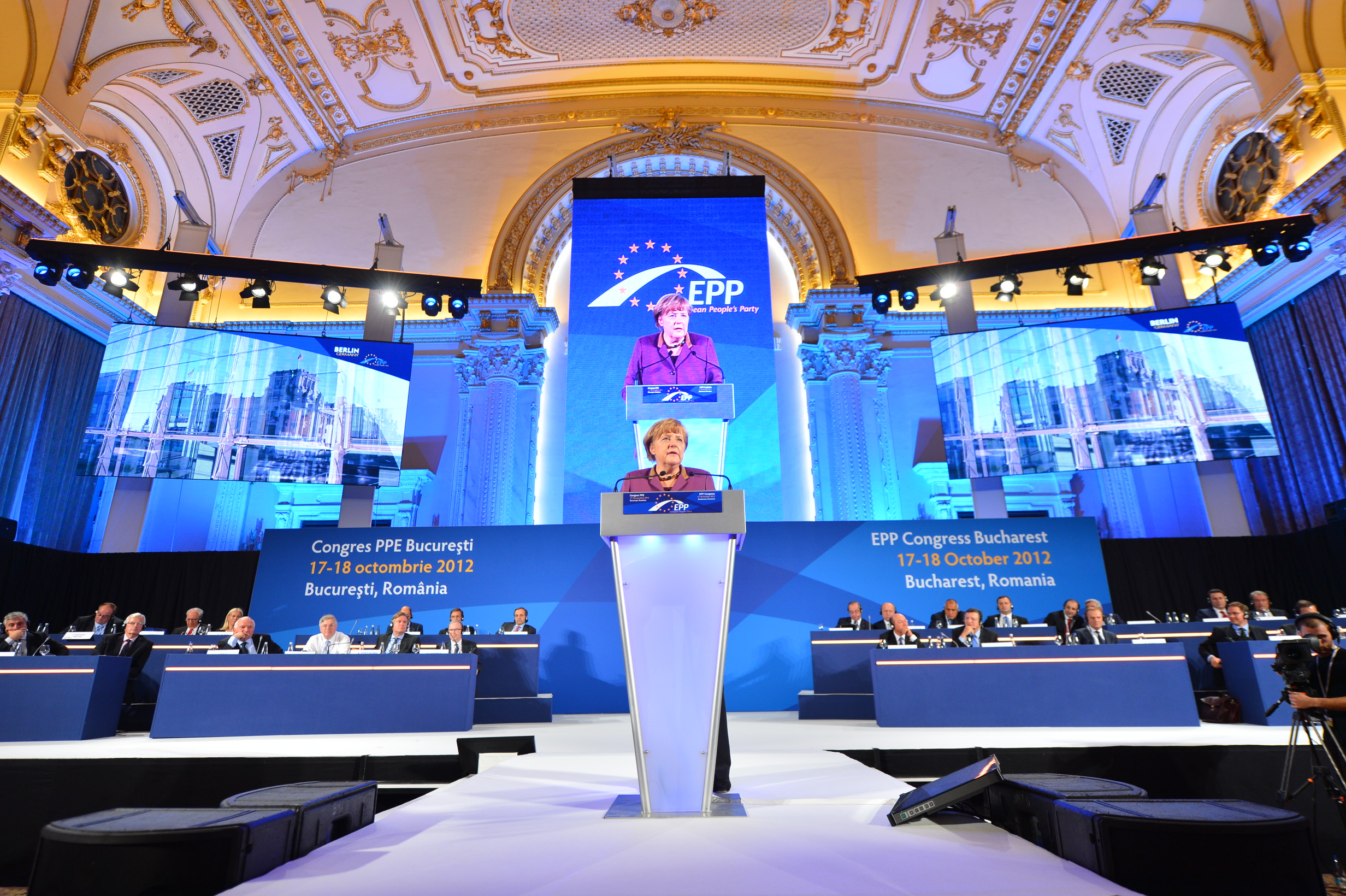
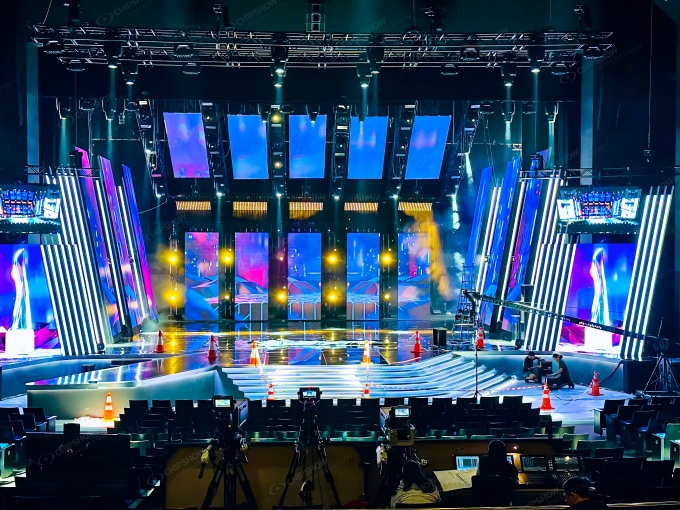
The main stage backdrop serves as the visual center, often facing direct sunlight. These screens require a pixel pitch (the distance in millimeters between the center of one LED pixel and the next) between P3.9 and P5.9 to maintain clarity for audiences 20 m (65 ft) away or further. Brightness levels must reach up to 5,500 nits or higher, depending on the product configuration. Cabinets must carry an IP65 rating on the front panel, with IP54 or above on the rear, to protect against sudden weather shifts.
Driving Camera-Ready Visuals: Scan Rates and Premium IC Models
For outdoor festival IMAG (Image Magnification) side screens, camera-readiness is non-negotiable. However, many industry articles wrongly claim that a high refresh rate eliminates Moiré patterns. Staging professionals understand that rolling black scan lines and camera flicker are strictly a function of the driver IC model and the board’s scan rate architecture, whereas Moiré is a physical optical grid conflict. If an outdoor wall uses low-scan, budget-tier ICs, it will stutter and show dark horizontal bands when captured by smartphones or broadcast cameras at fast shutter speeds. Chipshow designs its festival-grade panels with high-scan driving methods and premium ICs (such as the 2153S), ensuring stable, broadcast-grade, flicker-free image captures even during direct sunlight live-streaming.
Satellite Delay Screens: Serving the Deep Crowd
Delay screens are placed at Front of House (FOH) towers to provide visual extension for distant attendees. These displays are often mounted on temporary scaffolding and face high wind exposure. Choosing lightweight panels reduces the structural load on remote towers and simplifies power routing at distant audience positions.
Creative and Architectural LED: Transparency and Design
Stage designers use transparent mesh panels to create depth without blocking lighting effects. Mesh panels provide high visual impact while significantly reducing wind resistance. Certain models offer transparency up to 65%, allowing air to pass through the rig safely.
Spec 1: Managing Brightness Requirements for Outdoor Festival Stages
Sunlight intensity determines the success of an outdoor display. Proper brightness management ensures content remains legible from noon until the final headlining set.
| Environment Type | Typical Brightness (Minimum) | Purpose |
| Direct Mid-day Sun | 5,500 nits | Overpowering ambient light on main stage backdrops |
| Semi-Shaded / Side Stage | 4,500 – 5,000 nits | Maintaining contrast for IMAG and relay screens |
| Evening / Night Sets | 1,000 – 2,000 nits | Protecting audience vision and power budgets |
Direct Sun vs. Ambient Light Control
Daylight viewing requires a baseline of 4,500 nits. Premium outdoor touring panels can reach 5,500 nits or above, depending on the model. High brightness output generates heat, which can lead to brightness degradation over a multi-day festival.
Managing Night-time Transitions
Efficient thermal management and driver design help maintain consistent output. Automatic brightness control sensors reduce power consumption during night-time transitions. This feature maintains audience comfort and visual quality as ambient light decreases.
Spec 2: Specifying IP Rating and Weather Protection
A festival site is a harsh environment. Rain, dust, and low-pressure cleaning during load-out put every component under constant stress. Professional touring stock must meet strict ingress protection standards for 24/7 reliability.
Front and Rear Enclosure Sealing
IP65 on the front panel is the professional baseline for outdoor festivals, ensuring the cabinet is dust-tight and protected against low-pressure water jets from any direction. Rear-panel ratings vary by product line: some touring cabinets carry IP65 on both faces, while others are rated IP54 at the rear. Rental companies should confirm the IP rating of both the front and rear panels for each product, and select based on the specific weather exposure conditions of each deployment.
Corrosion Resistance for Coastal Venues
For coastal sites, aluminum-magnesium cabinets and gold-plated connectors provide necessary corrosion resistance. These materials prevent long-term degradation caused by salt mist exposure.
Spec 3: Evaluating Wind Load Engineering for Outdoor Stage LED Walls
Wind load is the critical safety factor for outdoor production teams. Large LED walls act as wind collectors, transferring significant force to the supporting steel or truss.
Calculating Surface Area Resistance
Solid LED panels have a wind pressure coefficient, or drag coefficient (Cd), of approximately 1.3. Mesh panels with high porosity can reduce this coefficient to 0.5 or 0.6. This reduction allows for smaller counterweight (ballast) requirements and less expensive rigging. The simplified wind force formula is:
F = ½ · ρ · v² · Cd · A
where ρ is air density (approximately 1.225 kg/m³ at sea level), v is wind speed in meters per second, Cd is the drag coefficient defined above, and A is the surface area of the screen.
Structural Safety Limits
Engineers must account for the unit weight per square meter and maximum panel surface area. When wind speed doubles, the force on the LED wall increases by four times. Structural engineers and riggers must confirm the maximum safe wind speed for every hanging or elevated screen setup.
Spec 4: Optimizing Power and Signal Infrastructure for Remote Sites
Remote festival locations often rely on portable generators. Power efficiency and signal redundancy are the two pillars of a stable technical production.
Core Components of a Complete LED System
- Video Processors handle signal scaling and distribution across multiple screen sections.
- Signal Redundancy Loops use dual fiber paths to prevent a single cable failure from causing a total blackout.
- Power Distribution Units (PDU) manage the electrical load and protect against surges.
- Media Servers drive high-resolution creative content and keep video playback locked to the same clock signal as live audio.
Efficiency and Redundancy
Calculating generator size requires a clear understanding of average power draw. For outdoor festival panels, average power consumption typically runs around 180W per square meter under real operating conditions, significantly lower than rated peak figures. As a planning baseline, a 100 m² (1,076 sq ft) screen drawing an average of 180W per square meter needs roughly 30 kilovolt-amperes (kVA) of generator capacity, plus a 20% overhead buffer. Confirm the exact average draw from the product specification sheet before finalizing generator size. Common-cathode power architecture (a wiring design that shares a single negative power rail across LEDs, reducing energy waste) can lower power consumption by up to 30% compared to traditional designs.
Preventing Staging Power Failure: The 15-Panel Cascading Rule
An immediate breaker trip upon powering up an outdoor festival LED rig is one of the most frustrating field issues. Staging engineers know this is rarely a faulty breaker, but rather a power cascading overload causing a massive surge current. As a strict engineering rule of thumb, a single main power cable run should never daisy-chain more than 15 standard rental cabinets (the exact threshold varies based on specific panel peak consumption and local voltage). Exceeding this limit triggers immediate breaker trips.
Spec 5: Streamlining Logistics and Turnaround for Multi-Festival Touring
The economics of touring are driven by weight and setup speed. Heavy equipment increases fuel costs and labor hours.
Comparing Touring Platforms
| Feature | C-Rock Outdoor | C-Carbon P3.91 |
| IP Rating | IP65 front / IP54 rear | IP65 front / IP65 rear |
| Brightness | Up to 5,500 nits | Up to 6,000 nits |
| Refresh Rate | Up to 7,680 Hz | 3,840 Hz |
| Wind Resistance | Wind-bracing support system | Standard (solid panel) |
| Cabinet Format | 500×500 / 500×1000 mm | 1000×1000 mm |
Contact Chipshow for exact weight-per-square-meter figures for each configuration.
Switching to carbon fiber cabinets reduces truss loading across a large rig. The C-Carbon P3.91’s 1000×1000 mm format covers more area with fewer seams and rigging points, speeding up large-scale builds. Maintaining a standardized inventory simplifies cross-show interoperability.
Product Spotlight: Chipshow Outdoor Festival Solutions
Based on typical production requirements, here is how the main outdoor touring platforms align with common deployment scenarios.
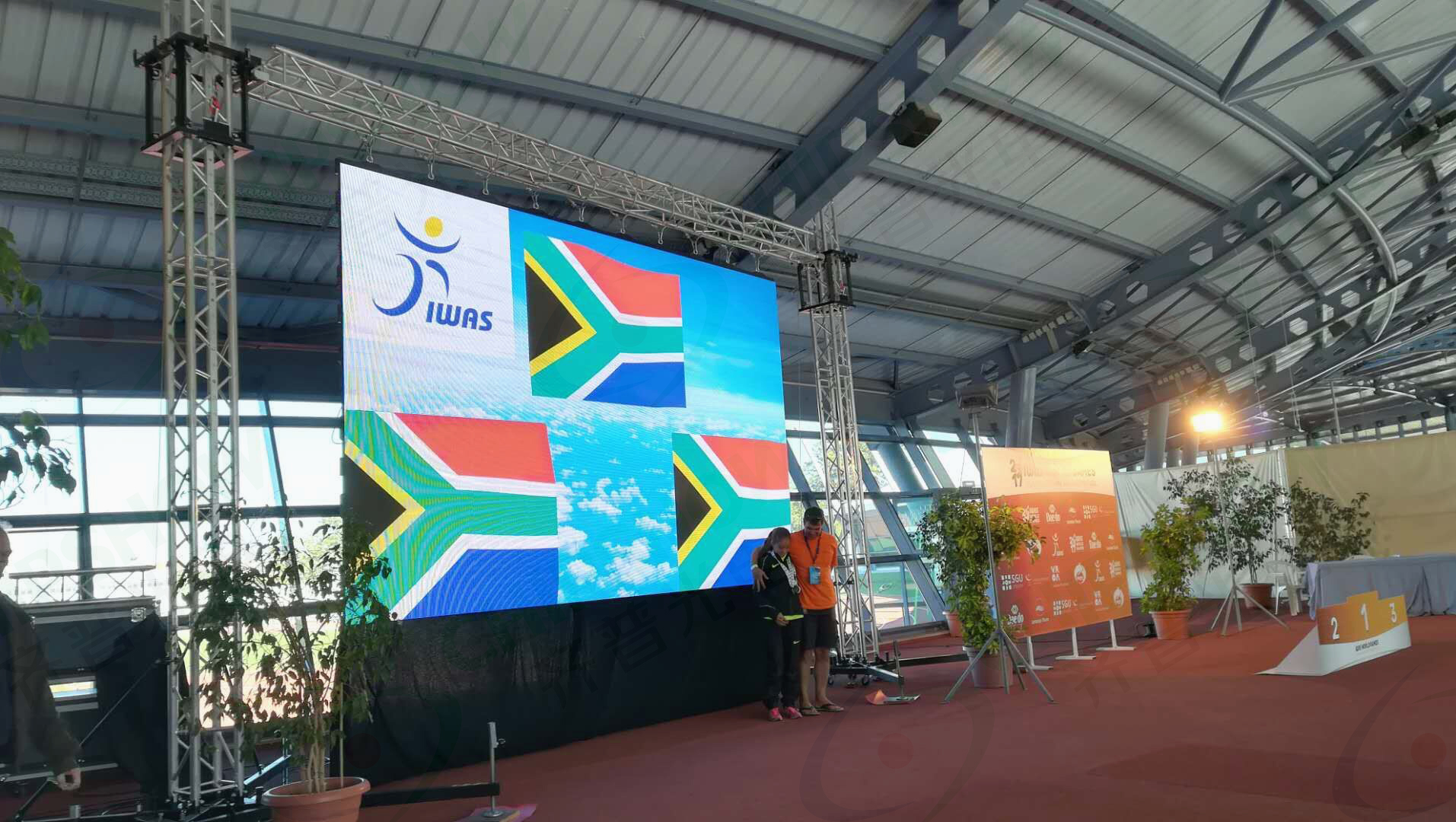
- C-Rock Outdoor (P2.6 / P2.97 / P3.91, 500×500 / 500×1000 mm) is well suited to main stage backdrops requiring daylight-readable brightness (up to 5,500 nits), IP65 front / IP54 rear protection, and a wind-bracing support system. The 7,680 Hz refresh rate and high-scan IC design make it a reliable choice for IMAG screens where broadcast capture is a priority.
- C-Carbon P3.91 (1000×1000 mm, 20 kg per cabinet) addresses weight-sensitive touring scenarios where truss loading is a design constraint. It delivers up to 6,000 nits, IP65 front and rear protection, 3,840 Hz refresh, and magnetic front/rear service access.
- C-Carbon P8.93 Mesh (1000×1000 mm, 12.5 kg per panel, up to 65% transparency) is the appropriate choice when wind load is the primary engineering constraint. The open mesh structure significantly reduces the drag coefficient on elevated rigs where structural load and wind safety are critical design factors.
Specify the Right Outdoor LED Screen for Music Festivals
Outdoor festival production requires a systematic approach to screen selection. Categorizing displays by role and addressing brightness, IP rating, wind load, and logistics allows rental companies to build a dependable inventory. Lightweight materials and high-refresh-rate electronics help the rig meet the requirements of both live audiences and broadcast crews.
Contact Chipshow to discuss your specific project requirements and get exact specifications for each product line.
FAQs About Outdoor Stage LED Screens
Q1: How Bright Does an LED Screen Need to Be for an Outdoor Festival?
For main stages that will be in direct sunlight, 5,500 nits is the minimum threshold. For screens that are in shaded or semi-covered areas, 4,500 nits will be enough. To protect audience comfort and save power from generators, evening performances generally only need 1,000 to 2,000 nits.
Q2: What IP Rating Does an Outdoor Stage LED Display Need?
Front rating of IP65 is the acceptable minimum for professional touring outdoors. The rear ratings are dependent on individual products: the C-Carbon P3.91 has an IP65 rating for both the front and rear ends, whereas the C-Rock Outdoor model has IP65 at the front end and IP54 at the rear end, which is generally accepted.
Q3: What Is the Best Pixel Pitch for a Festival Main Stage Screen?
The price range is usually between P3.9 and P5.9 for events where the screen is at least 20m (65ft) away from the main stage crowd. Most of the time, IMAG side screens need a finer pitch of P2.6 to P3.9.
Q4: How Do I Size a Generator for an Outdoor Festival LED Rig?
To find out how much power your generator needs to hold, multiply the total screen area by the panel’s average power use per square meter and add 20% to both sides. For instance, if your screen is 100 square meters and uses 180W per square meter on average, you’ll need a generator that can produce 30kVA. Always verify the average draw from the manufacturer’s specification sheet to get the average power usage. Peak values can lead to wrong estimates.
Q5: What Is the Difference Between Solid and Mesh LED Panels for Outdoor Festival Wind Load?
Since solid panels don’t let air flow through them, all of the wind’s force is passed to the structure that holds them up, which means it needs greater ballast. On the other hand, mesh panels like the C-Carbon P8.93 let air flow through the cabinet because they are up to 65% clear. The drag factor and the load on the frame go down.
Q6: Does a Festival LED Screen Need to Be Broadcast-Ready?
Yes. Rolling scan lines and camera flicker visible in smartphone and broadcast footage are determined by the driver IC model and board scan rate architecture, not the refresh rate alone. Panels built with low-scan, budget-tier ICs will show dark horizontal bands at fast shutter speeds regardless of their stated refresh rate. For broadcast-grade capture, specify panels with high-scan driving methods and premium IC configurations, such as the Chipshow festival-grade series.