


For most fixed outdoor LED display installations, IP65 is a proven and sufficient standard. IP66 is the correct specification for coastal salt-air environments, sites where high-pressure cleaning is part of the maintenance routine, and select infrastructure applications where project specifications require it. The decision depends on installation conditions and maintenance workflow.
IP65 vs IP66 Outdoor LED Displays: A Decision Framework
The table below summarizes the selection logic. The sections that follow explain the reasoning behind each condition.
| Installation Condition | IP65 | IP66 |
|---|---|---|
| Temperate climate, standard rainfall | Adequate | Not required |
| Partial structural shelter (canopy, facade recess) | Adequate | Not required |
| Freestanding structure, no shelter, temperate climate | Adequate | Optional for additional margin |
| Tropical or monsoon climate, high annual rainfall | Marginal | Recommended |
| Coastal location, salt air exposure | Insufficient alone | Required + salt spray cert |
| High-pressure cleaning in maintenance SOP (standard operating procedure) | Not suitable | Required |
| VMS tender specifying IP66 enclosure protection | Does not meet spec | Required |
| Cleaning by low-pressure hose or soft cloth | Adequate | Not required |
IP65 covers the majority of fixed DOOH and outdoor advertising installations in temperate climates. IP66 is the correct default for coastal sites and any installation where high-pressure cleaning is a routine operation. For VMS and traffic infrastructure, check the tender specification directly, as IP requirements vary by procuring authority.
Beyond the IP rating, long-term outdoor LED screen failure prevention depends on gasket material quality, thermal management design, corrosion-resistant materials, and full-assembly certification.
What Do IP65 and IP66 Mean for Outdoor LED Display Weather Resistance?
The outdoor LED screen’s waterproof rating on a spec sheet defines enclosure protection under controlled test conditions. It does not account for every real-world variable, and knowing what each rating actually measures is the starting point for a sound specification decision.
How the IP Rating System Works
The IP (Ingress Protection) system is defined by IEC 60529. The two digits cover separate parameters: the first digit rates protection against solids (0 to 6), and the second rates protection against water (0 to 9).
For any outdoor LED display, the first digit should be 6, confirming the enclosure is fully dust-tight. The selection decision is entirely determined by the second digit.
The Real Difference Between IP65 and IP66
| Specification | IP65 | IP66 |
|---|---|---|
| Nozzle diameter | 6.3 mm | 12.5 mm |
| Water flow rate | 12.5 L/min | 100 L/min |
| Test pressure | 30 kPa | 100 kPa |
| Min. test duration | 3 minutes | 3 minutes |
| Equivalent real-world condition | Sustained heavy rainfall | High-pressure water jet |
| Typical application | Fixed DOOH billboards, building facades | Coastal sites, washdown environments, select infrastructure |
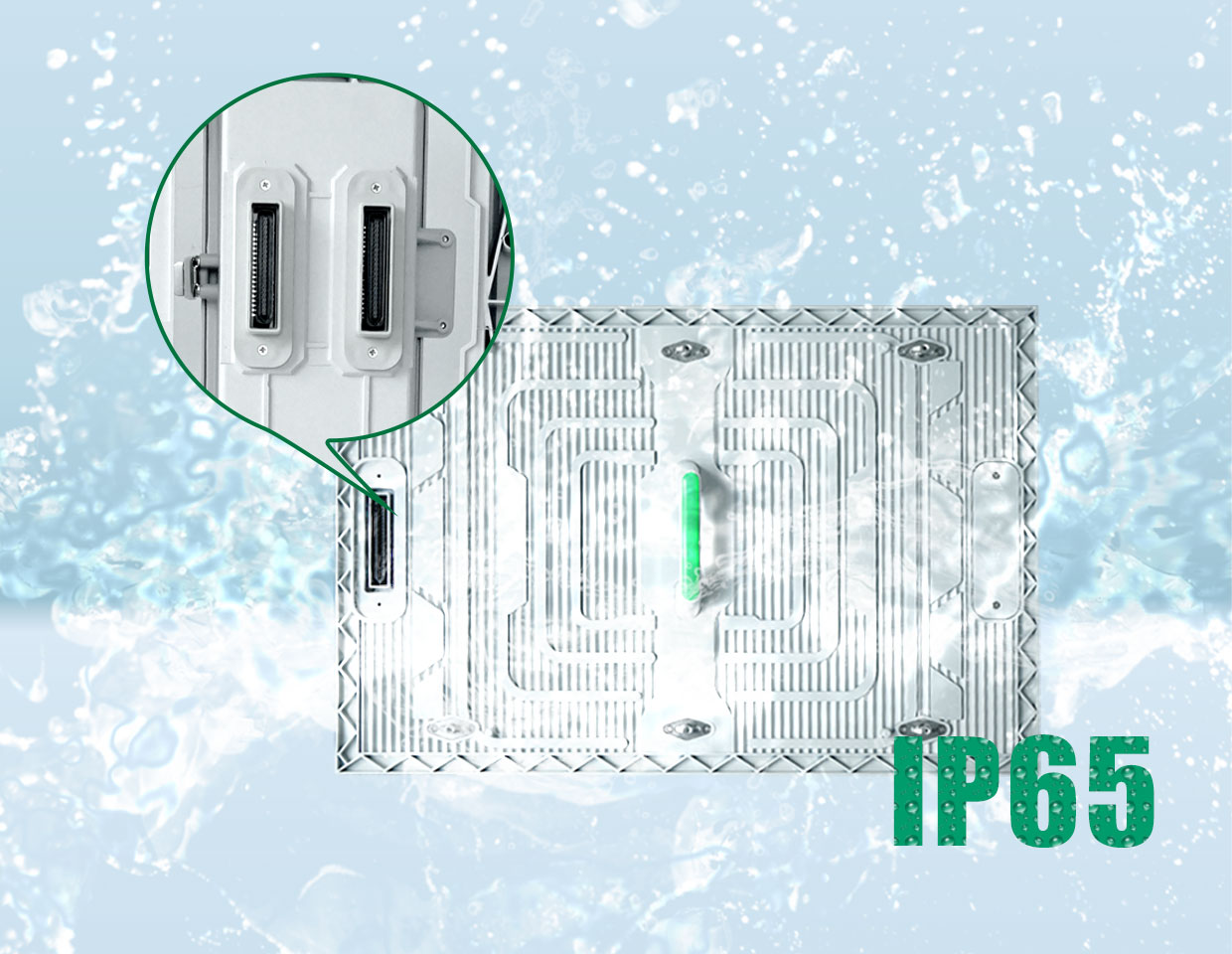
IP66 is tested against water jets at eight times the volume used in IP65 testing. For standard rainfall and dust exposure, IP65 handles both without compromise. IP66 addresses conditions that exceed typical weather exposure.
Three Things IP Ratings Do Not Cover
Three protection gaps apply regardless of whether a display is rated IP65 or IP66.
- Salt spray corrosion is not included in IP testing. Coastal installations require separate IEC 60068-2-52 salt spray certification, and an IP66 rating does not protect aluminum frames or PCBs from chloride-driven oxidation without additional material specifications.
- UV aging of seals is not tested. Gasket degradation over time reduces effective IP protection regardless of the original rating.
- Condensation from thermal cycling is not covered by any IP rating. Internal moisture buildup is a thermal management issue, not a waterproofing failure.
Is IP65 Reliable Enough for Permanent Outdoor LED Billboard Installations?
IP65 is the established global baseline for fixed outdoor LED displays. Whether it is sufficient depends entirely on the conditions specific to your installation.
Where IP65 Delivers Consistent Long-Term Performance
IP65 performs reliably under the following conditions:
- Partial structural shelter is present, such as a building facade recess, a canopy overhang, or a wall-mount configuration where the rear panel faces a structure rather than open weather.
- The installation is in a temperate climate with predictable rainfall patterns and no sustained extreme weather.
- Cleaning is performed with low-pressure hoses or soft cloths, keeping water jet exposure within IP65 tested limits.
Full-cabinet IP65 certification covering both front and rear panels is the correct specification to request. Module-level IP65 does not guarantee the same protection for the assembled display, including its connectors, cable entry points, and power supply housings.
Where IP65 Reaches Its Tested Limits
IP65 becomes less reliable in the following scenarios:
- Freestanding billboard structures with no shelter expose both panel faces and all cabinet joints to direct wind-driven rain, making gasket material quality and cabinet assembly tolerances critical differentiators.
- Tropical and monsoon climates with sustained extreme rainfall push IP65 closer to its tested water flow limits, and IP66 provides a more conservative safety margin in these regions.
- Coastal environments expose gaskets to salt air, which degrades seals faster than fresh water regardless of the initial IP rating, leading to accelerated deterioration over the display’s operational half-life.
When Does an Outdoor LED Display Actually Require IP66?
IP66 is not a universal upgrade. It is the correct specification for three installation types.
Coastal and High-Humidity Environments
Coastal projects require IP66 as a starting point. A complete coastal-grade specification includes:
- IEC 60068-2-52 salt spray test certification from a recognized third-party laboratory.
- 316-grade stainless steel fasteners throughout the cabinet assembly.
- PCB conformal coating to protect circuit boards from salt-induced corrosion.
IP66 alone does not constitute a coastal-grade specification without these additional material requirements.
Infrastructure Applications with High-Pressure Maintenance Requirements
Variable Message Signs on highway gantries and urban traffic guidance displays are subject to infrastructure-grade maintenance schedules that frequently include pressure washing. Where project specifications explicitly require IP66 enclosure protection, that requirement takes precedence over general climate-based selection logic.
Note that EN12966, the European standard governing VMS optical and mechanical performance, does not prescribe a mandatory IP rating. IP requirements for specific VMS tenders are defined by the procuring authority. IP65 meets EN12966 compliance requirements in a wide range of deployed VMS configurations.
Sites Where High-Pressure Cleaning Is in the Maintenance Schedule
If a maintenance contract, facility management SOP, or internal operations procedure includes pressure washing for the display, IP66 is the appropriate specification. This applies regardless of climate, geography, or installation type.
Confirming the cleaning method before purchase significantly reduces the most common single cause of IP-related field failures in fixed outdoor LED installations.
Outdoor LED Display Failures Beyond IP Rating: Causes and Prevention
Most outdoor LED display failures in the field are traceable to factors that IP ratings do not measure. Selecting the correct IP rating reduces one category of risk. The following failure modes require separate attention.
Water Ingress at Connector and Cable Entry Points
Connector joints and cable entry points are the most common ingress paths in any assembled display. A cabinet with IP65-rated panels can still admit water if connectors are not sealed to the same standard or if cable entry fittings degrade over time.
Prevention: Request the IP test certificate for the complete assembled unit, referencing IEC 60529, from a recognized third-party laboratory such as TÜV, SGS, or Intertek. Manufacturer self-declaration is not an independent verification.
Condensation Driven by Thermal Cycling
Enclosures that are sealed in environments where there are big temperature differences between day and night tend to generate moisture inside through condensation. This is not an issue related to waterproofing but thermal management; thus, IP ratings will not cover this.
Prevention: In case of very continental or mountainous environments, determine if the display has a pressure-balancing valve and/or a system for managing humidity.
UV Degradation of Gasket Materials
Gasket materials have a finite service life under UV exposure. The rate of hardening and compression loss depends on silicone grade, climate UV intensity, and panel orientation.
Prevention: Ask for the gasket material grade before purchase. High-UV environments benefit from UV-stabilized silicone or EPDM (ethylene propylene diene monomer) seals. Regular gasket inspection and replacement sustains effective IP protection over time. Scheduled maintenance delivers more reliable results than upgrading from IP65 to IP66 at the point of purchase.
High-Pressure Cleaning Applied to IP65-Rated Displays
IP65 is tested at 30 kPa. Commercial pressure washers operate at pressures far above this threshold. If a maintenance contract or internal cleaning procedure specifies high-pressure equipment, the installed display requires IP66 protection, regardless of climate or location.
Prevention: Confirm the cleaning method with the maintenance team before finalizing the IP specification. Aligning these two decisions at the procurement stage addresses the most common avoidable cause of IP-related field failures.
Specify the Right IP Rating for Your Outdoor LED Display Installation
IP65 is a reliable, globally deployed standard for outdoor LED display weather resistance across most DOOH and fixed advertising applications. IP66 is the correct specification for coastal environments, sites where pressure washing is part of the maintenance routine, and tenders that explicitly require it.
Before finalizing any outdoor LED display specification, confirm full-assembly IP certification from a third-party laboratory, check gasket material grade for your climate and UV exposure level, and align the IP rating with your actual cleaning procedure. Those three steps address the majority of preventable field failures.
FAQs About Outdoor LED Display Weather Resistance and IP Ratings
Q1: What Are the Most Common Causes of LED Billboard Black Screen Failures?
Moisture getting in through connections and cable holes, condensation because of changes in temperature, gasket seals breaking down due to UV radiation, and cleaning IP65-rated equipment under high pressure are all common reasons why things don’t work right. Most of these problems can be avoided by making sure that the IP ratings are right for the cleaning process and the weather, and by requesting full-assembly certification.
Q2: Does IP66 Protect Against Salt Spray Corrosion on Coastal LED Displays?
No. The IP grade only applies to water jet tests; salt spray tests are not done. Coastal LED displays need a special test certificate for the Salt Spray Test, which is IEC 60068-2-52. IP66 needs to be paired with corrosion-resistant cabinet materials, marine-grade hardware, and PCB coating.
Q3: What Is the Difference Between a Module IP Rating and a Full-Assembly IP Rating?
For each LED module that is checked on its own, the IP rating only applies to that module. There are cabinets, power supplies, connectors, and cable entry points that are part of the assembly, but they are not listed under this module classification. It is important to get a certificate from a recognized lab for the complete installed unit.
Q4: Does a Higher IP Rating Always Mean Better Outdoor LED Display Performance?
Not automatically. In specific lab tests, an IP rating shows how well protection against ingress is working. The IP rating doesn’t take into account how strong the building is, how salt fog corrosion affects seals, or how well heat is dissipated. A properly designed IP65 display will last longer in most outdoor situations than an incorrectly designed IP66 display because it has better sealing materials, better temperature design, and more corrosion-resistant materials.
Q5: Can an Outdoor LED Display Lose Its IP Rating Over Time?
Yes. An IP rating tells you how much security the case provides at the time it was made and tested. Loss of IP rating over time can be caused by gaskets breaking down because of UV damage, thermal cycling that causes compression set, and the breaking down of connections that create entry points that were sealed during manufacturing.
Q6: How Often Should Gaskets on Outdoor LED Displays Be Inspected and Replaced?
As part of the yearly maintenance, the seals need to be checked. No matter what the display’s original IP rating was, the seal will break down when it is exposed to UV light, when the temperature changes, or when it is compressed. Every six months, the outdoor LED display should be checked if it is in a place that gets a lot of UV light or is close to the water.





