


LED wall maintenance is a support-and-contract decision, not just a repair topic. Before you buy, check the model, region, and service terms that govern response time, spare parts, escalation, and on-site coverage. In command-center projects, the difference between a clear support path and a vague promise can decide how much downtime risk you are actually accepting.

What Buyers Should Expect From LED Wall Support
For most enterprise and government buyers, the right starting point is not "How long is the warranty?" but "What happens when something fails at 2 a.m.?" AVIXA’s performance verification and documentation framework is useful context because it reinforces a simple procurement idea: support works best when the system is documented, scoped, and easy to verify.
That means LED wall maintenance should be read as a service plan, a logistics plan, and a room-design question at the same time. Local support, spare-parts access, response windows, and escalation ownership all shape downtime risk. A fast promise is only useful if the vendor can actually dispatch help in your region and replace the failed part.
A practical decision sentence is this: if the room is mission-critical, treat support clarity as part of the purchase decision; if the vendor cannot show region-specific coverage and escalation steps, the offer is weaker than it looks. Another useful boundary is that warranty coverage and SLA coverage are different things, so do not assume one automatically includes the other.
For procurement teams comparing bids, the first filter is usually simple: verify support by model, region, and contract, then compare the actual service path instead of the marketing language.
The Service Terms That Matter Most
Response Time and Escalation Path
A good SLA starts with response time, but response time alone does not tell you much. Standard SLA structures for digital signage often use a P1 to P4 style framework, but the actual response and resolution targets are contract-specific. That means you should read the SLA as a service map, not as a universal standard.
The most useful question is who answers first, who owns escalation, and how urgent cases are tracked. A promise that sounds fast on paper can still be weak if it applies only during limited hours or if the handoff path is unclear. For command-center LED walls, that distinction matters because a delayed handoff can add hours before any real recovery starts.

In practical terms, compare the clock, the coverage window, and the geography together. If a vendor offers a fast response number but only during local business hours, the promise may not match the site’s real operating risk. If you want a mission-critical benchmark for comparison, 24x7x4 is a common reference point for high-tier support, but it should be read as a comparison anchor, not a universal requirement.
On-Site Service Scope
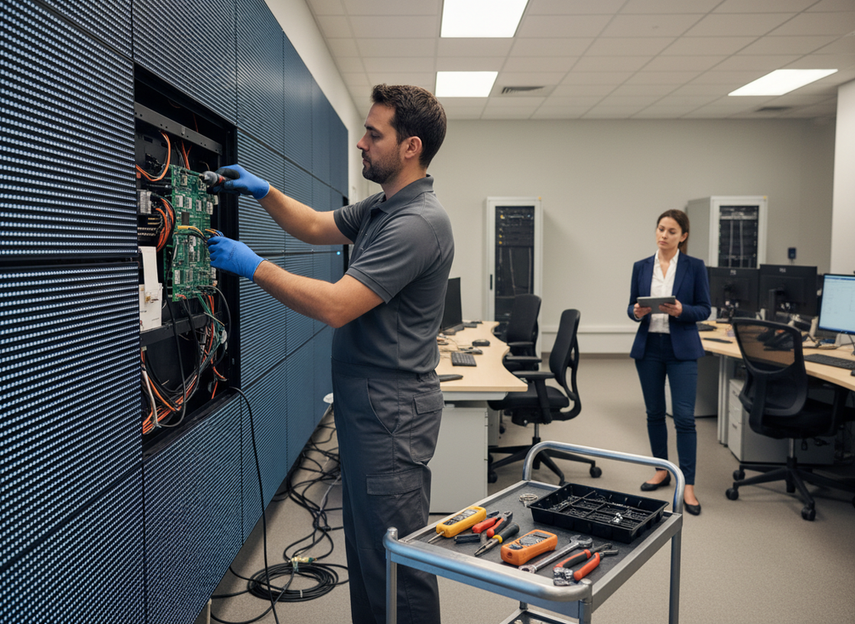
On-site service is not the same as remote support. Remote diagnosis can identify a fault quickly, but it does not replace field labor when a module, cable, power component, or cabinet needs physical work. That difference is easy to miss during procurement because both services may be described as "support."
A good contract should say whether onsite work includes labor, travel, and replacement handling, or whether those are billed separately. It should also distinguish preventive visits from break-fix visits. In a large control room, the best-looking SLA can still leave you exposed if onsite service is limited by region or channel.
A useful decision sentence here is: if the display is embedded in a tightly scheduled operations room, onsite scope matters as much as response time; if the field service path is unclear, the offer can create more delay than protection. That is why remote triage and onsite repair should be compared separately, not blended into one support score.
Remote Support and Diagnostics
Remote support is valuable when it speeds diagnosis, validates whether the issue is software, signal, or hardware, and helps you decide whether a dispatch is actually needed. It can shorten downtime if the fault is simple and the buyer has a clear contact path.
But remote help is only a partial answer when the failed component still has to be swapped in the room. A buyer can easily overrate "remote-first" support if the contract does not also explain how field repair happens afterward. For that reason, remote diagnosis should be read as a front end to service, not as a substitute for it.
What this means in practice is straightforward: use remote support to reduce guesswork, but do not let it stand in for real restoration terms. If a vendor says the issue will be triaged remotely, ask what happens next if the fix requires a part that is not already on site.
Spare Parts and Replacement Terms
Spare-parts language is one of the most important parts of LED wall maintenance contracts because it often determines how fast a fix can happen. The key questions are whether parts are stocked locally, shipped from a regional hub, or simply listed as available. Those are not the same thing.
A common planning heuristic is to reserve roughly 5% to 10% of initial hardware cost for spare parts, but that is only a budgeting guide, not a rule. Use it to estimate the ownership reserve you may need for a mission-critical room, then adjust based on the complexity of the install and the downtime tolerance.
The most important boundary is this: local support can reduce downtime risk only when the needed parts and dispatch path are actually available. If the vendor has no verified stock, no clear replacement trigger, or no stated handoff path, the "local" label is weaker than it sounds.
| Support Model | Parts Access | Response Expectation | Downtime-Risk Takeaway For A Command-Center LED Wall |
|---|---|---|---|
| Remote-first support with no local parts stock | Dependent on shipping and remote diagnosis | Can work for troubleshooting, but onsite recovery is not immediate | Higher downtime risk if a failed module or cable cannot be replaced locally |
| Remote support plus local spare parts on hand | Faster swap path if the fault is a known replaceable part | Remote triage first; onsite repair can follow local parts availability | Lower downtime risk than remote-only, because the most common replacement path is already on site |
| Local onsite support with stocked spare parts | Onsite access and immediate part replacement are both available | Best fit when fast restoration matters most | Lowest downtime risk among the listed models for a command-center LED wall |
| Local support available only conditionally | Depends on contract scope, geography, and service window | Good when availability is guaranteed; weaker when it is not | Risk sits between stocked local support and remote-only support, depending on whether onsite help is truly available |
Local Support and Parts Logistics
Local support only matters when it is real. Buyers should separate three things: local warehouse language, actual stocking depth, and dispatch path. A vendor may be able to ship quickly without truly holding the parts you need, and that distinction matters when the wall is part of a 24/7 operation.
In command centers, shipping distance, customs, and regional service reach can all affect recovery time. If the site cannot tolerate a long repair window, ask whether the vendor stocks the likely failure parts locally or only promises a regional order process. That is the kind of detail that changes risk, not just pricing.
A practical rule of thumb is to ask for the parts list that would be used for your exact model or configuration, then compare it with the service footprint. If the answer is vague, treat local support as a planning advantage rather than a guaranteed downtime reducer.
Command Center solutions can be useful as a navigation path when you are comparing mission-critical display families, but the support questions still need to be confirmed in the quote and service documents. The collection page name alone is not proof of local stocking or repair speed.
Value-Premium Versus Premium Support Tradeoffs
Higher price does not automatically mean better support, but it often reflects more explicit service design. For buyers comparing value-premium LED wall maintenance contracts with premium offers, the right question is not "Which brand is better?" It is "Which service package is clearer, faster to execute, and more realistic for this site?"
What usually drives support price differences is coverage depth, field labor, spare-parts readiness, and how much is actually included in the response path. A mission-critical benchmark such as 24x7x4 is useful here because it gives you a comparison point for high-tier support, but it does not tell you whether a given vendor can meet that promise in your region. Premium pricing may buy broader coverage or better logistics, yet it still does not guarantee local responsiveness.
This is the cleanest decision split: value-premium can make sense when the service path is documented, the parts plan is realistic, and the escalation chain is clear; premium is more defensible when the room cannot absorb long delays or when the owner wants stronger support clarity baked into the contract. In both cases, the real comparison is total ownership cost, not just panel price.
Mission-critical LED wall options are worth reviewing if you are comparing support packages for 24/7 spaces, but keep the buying decision tied to the service documents rather than the collection headline.
Warranty and Contract Checks Before Purchase
Before you sign, use a short contract checklist and force every vendor to answer the same questions. This is where LED wall warranty and service evaluation becomes practical: you are checking who pays, who responds, and who owns the next step when something fails.
- What is the coverage period, and does it match the deployment life you expect?
- Does the warranty cover labor, parts, or both?
- What response window is written into the SLA, and what hours does it actually cover?
- Are spare parts owned, stocked, or only orderable through a regional process?
- What exclusions would leave the owner paying for common repairs?
- Who owns escalation, and who is the direct contact after the first call?
- What happens at renewal, and how much can the service cost change over time?
Also check the physical design. Front or rear access changes maintenance labor and disruption risk in tight control rooms, so service terms should match the room layout front or rear access impact on maintenance. If the display is hard to reach, a weak service clause becomes a bigger problem.
A practical buyer sentence to keep in mind: if the contract does not clearly separate warranty, SLA, and parts ownership, pause before award and ask for a cleaner service definition.
A Practical Buyer Checklist
Before you award the project, ask for the response hours, local parts stock, onsite coverage, escalation contacts, and renewal costs in writing. Then compare each offer against the same operating-risk question: how quickly can this room actually recover if the wall fails?
FAQs
How Should We Compare LED Wall Maintenance Contracts in the U.S.?
Compare them on response timing, coverage hours, onsite scope, spare-parts access, escalation ownership, and renewal cost. The best contract is usually the one that matches your operating hours and geography, not the one with the most polished summary language.
What Does Local Spare-Parts Availability Really Mean?
It can mean stocked on site, stocked in a local warehouse, stocked in a regional hub, or simply available to order. Those are very different downtime outcomes. Ask which replacement parts are physically held, which are shipped, and which are only promised in general terms.
How Fast Should SLA Response Times Be for a Command Center LED Wall?
There is no universal number. The right target depends on whether the room is 24/7, how far the service team is from the site, and how much downtime the operation can absorb. Use the contract to compare response time with coverage hours and field-service reach.
What Warranty and Service Terms Need the Most Attention Before Purchase?
Focus on labor versus parts, exclusions, response windows, escalation contacts, and renewal terms. Buyers often assume the warranty covers operational recovery speed, but that is usually an SLA question. Keep those clauses separate so you know what is actually protected.
Can Value-Premium LED Walls Make Sense for 24/7 Operations?
Yes, if the support model is clear, the parts plan is realistic, and the escalation path is written down. They become a weaker fit when the site needs rapid restoration, local stocking, or a highly predictable field-service process. The support contract matters more than the tier label.





