


A highway variable message sign (VMS) needs to do more than display a clear message. It must receive the right instruction from the traffic management center, behave predictably when communications fail and remain accessible for maintenance. Start the procurement brief with those operating needs, then define the standards, site, control interface and acceptance tests before comparing display hardware.

What Buyers Need From a Highway VMS Program
For most buyers, the first mistake is treating the sign as the whole project. A deployable highway VMS program also includes site constraints, controls, communications, installation scope, acceptance criteria, and lifecycle support. If those pieces are not defined early, procurement becomes a series of late clarifications.
That is why a highway VMS procurement guide should be read as a planning framework. Start by inventorying where the sign will live, who will operate it, what message behavior is needed, how power and connectivity will reach it, and what maintenance access looks like after commissioning. Smart poles can be part of a corridor strategy, but they are not a universal substitute for a message sign.
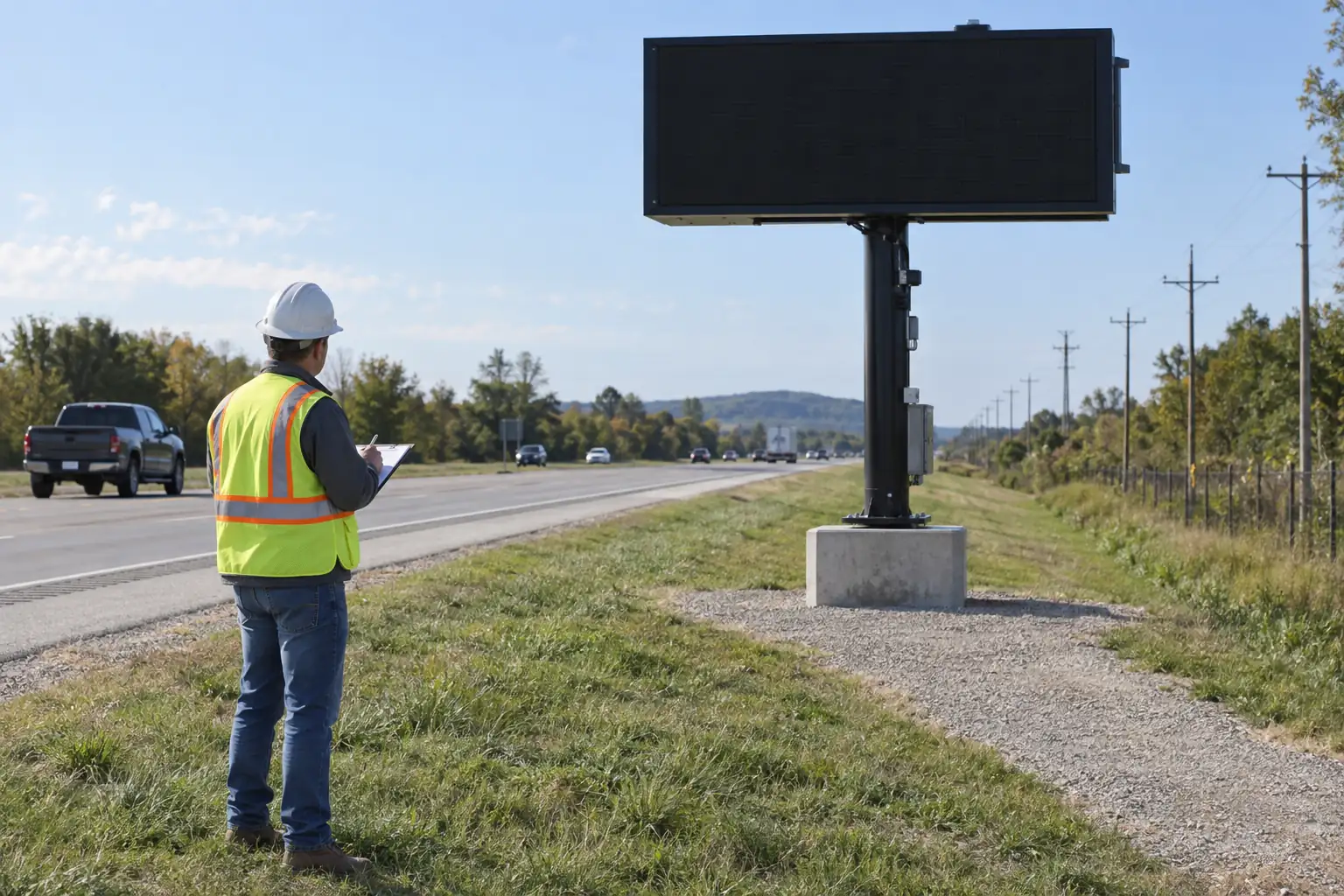
Build the brief around a short set of operating scenarios: a routine travel-time message, an urgent incident update, loss of communications and return to normal service. Ask who authorizes each message and what the sign should show in each state. These scenarios give the integrator and agency a shared basis for testing.
Standards and Agency Checks to Verify
For U.S. highway projects, the first check is the current FHWA traffic control standard: the current MUTCD edition — confirm the 11th Edition and any published revisions at fhwa.dot.gov at solicitation time. The commonly cited two-year adoption window for the 11th Edition runs from its January 18, 2024 effective date; verify the current window and state-by-state adoption status, because state review still matters even when the national manual is current state MUTCD adoption timing.
For VMS integration, the key question is not just whether the display powers up. It is whether the device can talk to the host system in a predictable way. The VMS interoperability standard for that purpose is NTCIP 1203 (v03 in recent releases), which defines the logical interface between dynamic message signs and central host systems; confirm the currently published version at ntcip.org when you write the solicitation.

That means compliance review should separate three things: the traffic-control rule set, the communication interface, and the hardware package. NEMA TS 4 is the hardware standard for DMS, while structural supports for highway signs should be checked against AASHTO requirements. The Best Value procurement approach also matters because FHWA systems-engineering guidance pushes agencies to verify requirements, not just compare prices.
A practical way to use this section is simple: verify the current MUTCD, confirm state adoption status, map the NTCIP interface, and make sure the submittal package shows how the hardware and support structure will be accepted. If any of those items are vague, the RFQ is not ready yet.
Traffic Sign Standards and Visibility Checks
Check the sign’s intended roadway use first, then verify the agency’s acceptance path. Buyers often ask about brightness or viewing distance too early, but those questions only help once the legal and submittal framework is clear. On a highway project, a display that seems suitable can still fail review if the documentation does not line up with the agency’s standard and the site’s mounting conditions.
For procurement language, it is safer to ask for the required standard, submittals, and acceptance method than to assume a compliance label solves the issue. That is especially important when project teams are comparing vendors, because a catalog claim does not replace current agency verification. Standard editions and state adoption statuses also move between project cycles, so re-verify the controlling edition and adoption date at the time of the solicitation rather than reusing a prior project’s conclusion.
Controller, Communications, and Data Interface Checks
For integrators and traffic engineers, the control question is usually the one that changes project risk the fastest. If the VMS will be supervised from an existing traffic management platform, ask which NTCIP objects or host interfaces are supported, how message formatting is handled, and what the agency expects for testing. In plain terms, interoperability is the difference between a display that can be managed and a display that requires custom work every time it changes.
For NTCIP acceptance, list the required objects and functions, then demonstrate them against the intended host: message download, activation, status reporting, alarms and the agreed behavior after a connection loss. Record the firmware and host versions used in the test so the result can be reproduced.
Documentation, Submittals, and Acceptance Criteria
Before award, define what the agency wants to see in drawings, manuals, test records, and commissioning documents. That reduces change-order risk later, especially on projects that involve gantries, retrofit structures, or shared corridor controls. A clean submittal package also makes it easier to compare bids on the same terms.
The decision sentence here is straightforward: if the submittal package cannot show how the sign, controller, support structure, and verification plan fit together, the project should pause until those gaps are closed. That is a procurement issue, not a minor paperwork issue.
How VMS and Smart Poles Fit Different Jobs
The best choice depends on the job, not on which asset sounds more modern. A highway VMS is built to deliver direct roadway messages where drivers need immediate guidance, while a smart pole is usually a multi-function corridor asset that may support lighting, sensors, or communications in a broader smart infrastructure plan.
Here is the cleanest way to separate them: choose a highway VMS when the main requirement is a visible, controller-managed message on a roadway or gantry. Consider a smart pole when the project is really about corridor integration, sensor placement, or distributed infrastructure ownership. The recommendation flips when messaging is only one small part of a larger streetscape or corridor package.
Deployment-by-Job Matrix
| Deployment Type | Best-Fit Job | Where It Fits Best | Main Constraint To Check |
|---|---|---|---|
| Fixed highway VMS | Driver-facing messages for incidents, lane control, or travel guidance | Mainline highways, interchanges, and managed lanes | Standards, mounting, control integration, and maintenance access |
| Gantry VMS | Overhead messaging with clear sightlines and central control | High-volume corridors and multi-lane roadways | Structural support, span geometry, and service planning |
| Mobile VMS | Temporary roadway messaging and short-term traffic management | Work zones, event detours, and incident response | Power, towing, setup speed, and deployment logistics |
| Retrofit VMS | Replacement or upgrade on existing structures | Sites with limited right-of-way or existing support assets | Compatibility with the existing structure and site conditions |
| Smart pole / corridor asset | Multi-use corridor infrastructure | Smart city or streetscape programs with sensors and connectivity | Ownership model, integration scope, and whether messaging is actually required |
Use the matrix to choose the lead asset for the job. A driver-facing message system needs the roadway visibility and control workflow of a VMS; a multi-use streetscape may also need the smart-pole deployment checklist for lighting, sensors and shared-service responsibilities.
Procurement Specs That Reduce Project Risk
Good specs reduce surprises. The most common failure mode in a highway VMS procurement guide is an RFQ that names a product type but leaves the site, structure, controls, and service obligations too loose. That pushes risk into change orders, not into the bid package where it belongs.
FHWA’s systems-engineering guidance supports a systems-engineering procurement plan that includes a Concept of Operations, requirements, and a verification plan. Use that structure to force clarity on what the agency needs, how it will be tested, and who is responsible at each stage.
Structure, Mounting, and Site Conditions
Start with the site, not the cabinet. Existing foundations, gantries, and right-of-way limits can change the project more than the display model does. If the site is a retrofit, write the existing structure into the spec instead of assuming a new-build installation path.
Also confirm wind, access, and maintenance constraints early. The AASHTO structural support requirement is not a box to check at the end; it is part of the procurement language that protects the agency from a mismatch between the support structure and the installation environment.
Power, Controls, and Environmental Requirements
Specify the power source, control interface, cabinet access and environmental exposure together. For cold or coastal sites, use the VMS enclosure thermal-management guide to compare moisture control, startup and resealing requirements. That gives vendors the same site conditions to price.
The practical test is simple: if the wrong power or control assumption would force a redesign after award, it belongs in the RFQ now. That is how you avoid a late project delay that looks like a hardware problem but is really a spec problem.
Service Access, Warranty, and Lifecycle Planning
Service access affects total cost more than many buyers expect. Front-service access, spare parts planning, and maintenance intervals all change how the asset performs over its life. If the sign is hard to reach, every service call becomes more expensive.
Write warranty expectations and support terms into the bid package, then ask vendors to show how their maintenance model works over time. The lowest initial price is not the lowest ownership cost if the agency needs repeated access work, replacement modules, or awkward support arrangements later.
Where the agency operates more than one sign, pair the service section with a spare-parts and repair-turnaround plan so parts holdings and response expectations are written down before, not after, the first failure.
Cybersecurity and Control-System Planning
Cybersecurity should be treated as a deployment requirement, not an IT add-on. For roadway devices, the question is not only whether the sign works today, but whether accounts, updates, access paths, and incident responsibilities are defined before the system goes live.
NEMA TS 40008-2023 (confirm the current title and version at nema.org before citing it in a bid) provides a cyber and physical security framework for ITS planning. Use that framework to make security a normal part of project setup, not a special exception after procurement.
A practical sequence looks like this:
- Define who can access the device, the controller, and the management platform.
- Map the data path and control path so the team knows what is connected to what.
- Assign update, patch, and maintenance responsibility before deployment.
- Document incident contacts and escalation steps for the agency and integrator.
- Confirm what the agency IT team wants reviewed before release.
The decision sentence is simple: if no one can explain access, update responsibility, and incident response in plain language, the project is not ready for field deployment. That is a risk boundary, not a preference.
What to Do Before Issuing an RFQ or RFP
Before the sourcing package goes out, check whether the agency can answer these questions without guessing: Is the application fit clear? Has the site been surveyed? Are the compliance documents and acceptance criteria defined? Have control integration and cybersecurity review been assigned? Are installation responsibilities, warranty terms, and service expectations written down?
Send the site brief, operating scenarios and acceptance requirements with the RFQ. Compare traffic and VMS solutions against that package, then use the supplier evaluation scorecard to review documentation, delivery and support on the same basis.
Final Takeaway
A strong highway VMS procurement guide helps buyers separate standards, controls, cybersecurity, and deployment before anyone writes a purchase order. That keeps the project grounded in the real job, not just the hardware category. If you are building an RFQ or RFP now, verify the site, document the standards, and map the control path first. Then compare the traffic/VMS path that best fits the corridor, the structure, and the maintenance plan.
FAQs
How Do Buyers Verify Highway VMS Compliance Before Purchase?
Start with the current MUTCD edition, then ask for the agency’s submittal and acceptance requirements, the control interface details, and the structural support basis. A product name alone does not prove compliance. For public projects, the safest approach is to verify the standard, the state adoption status, and the documentation package before award.
What Is the Difference Between a Highway VMS and a Smart Pole?
A highway VMS is mainly a message device for direct roadway communication. A smart pole is a broader corridor asset that may support lighting, sensors, or communications. They can work together, but they are not interchangeable. If the core job is driver messaging, a VMS remains the clearer primary asset.
Why Do Procurement Teams Ask for Control and Communications Details Early?
Because control and communications choices affect interoperability, testing, agency review, and maintenance responsibility. If those details stay vague until late in the process, the project can drift into custom integration work or delayed acceptance. Early definition makes it easier to compare bids and avoid scope creep.
Can a Retrofit Project Use the Same Spec as a New Highway Build?
Usually not. Retrofit sites often have different structural, access, and power constraints than new builds, so the spec should match the site instead of copying a new-construction template. The project may still use the same standards framework, but the installation and maintenance assumptions are often different.
What Should Be in a Highway VMS RFQ or RFP?
Include application fit, site survey results, standards verification, control integration requirements, cybersecurity review, installation responsibilities, warranty terms, and service expectations. If the package also defines acceptance tests and submittal requirements, vendors can quote the same scope and the agency can compare bids more cleanly.
When Does a Smart Pole Stop Being the Right Choice?
When the project needs a primary driver-facing message system, not just corridor infrastructure. If message visibility, control simplicity, or roadway sign acceptance is the main goal, a smart pole is usually the wrong lead asset. It may still support the corridor, but it should not be forced into a job it was not planned to carry.
Do NTCIP Object Support Claims Prove Interoperability?
No. Treat protocol support as a verification point, not proof of success. A device can advertise communications support and still need site-specific testing, agency approval and integration work before it is ready for service, so the acceptance plan should include interface testing against the host system before award of full deployment.





