

An LED Crystal Film Screen works well for permanent glass advertising with minimal visual obstruction. An LED holographic screen suits campaigns that need stronger floating visuals and faster deployment. Product names often overlap across suppliers. Buyers should compare the actual structure, transparency, brightness, pixel pitch, service method, content needs, and total operating cost.
How Do LED Crystal Film Screens and LED Holographic Screens Differ
These names usually describe two different construction styles and display goals.
| Decision Factor | LED Crystal Film Screen | LED Holographic Screen |
| Typical construction | Thin LED film bonded or laminated onto glass | Spaced LED strips, mesh, or an all-in-one transparent poster |
| Position near the glass | Follows the glass surface closely | Hangs, stands, or mounts near the glass |
| Display goal | Keeps sightlines open and limits visible framing | Creates floating graphics with stronger visual impact |
| Content style | Logos, text, product footage, and transparent motion graphics | Isolated objects, dark backgrounds, and layered motion |
| Service method | Varies by film section, edge circuit, and supplier design | Often uses replaceable strips, modules, or poster components |
| Common uses | Permanent windows, partitions, and interior glazing | Campaign windows, showrooms, launches, and pop-up displays |
LED Crystal Film Screen Focuses on Glass Integration
An LED Crystal Film Screen places the emitting layer close to the glass. The screen stays shallow and has little visible framing.
The glass surface needs careful inspection. Film zoning, edge wiring, coatings, and adhesive compatibility all affect installation.
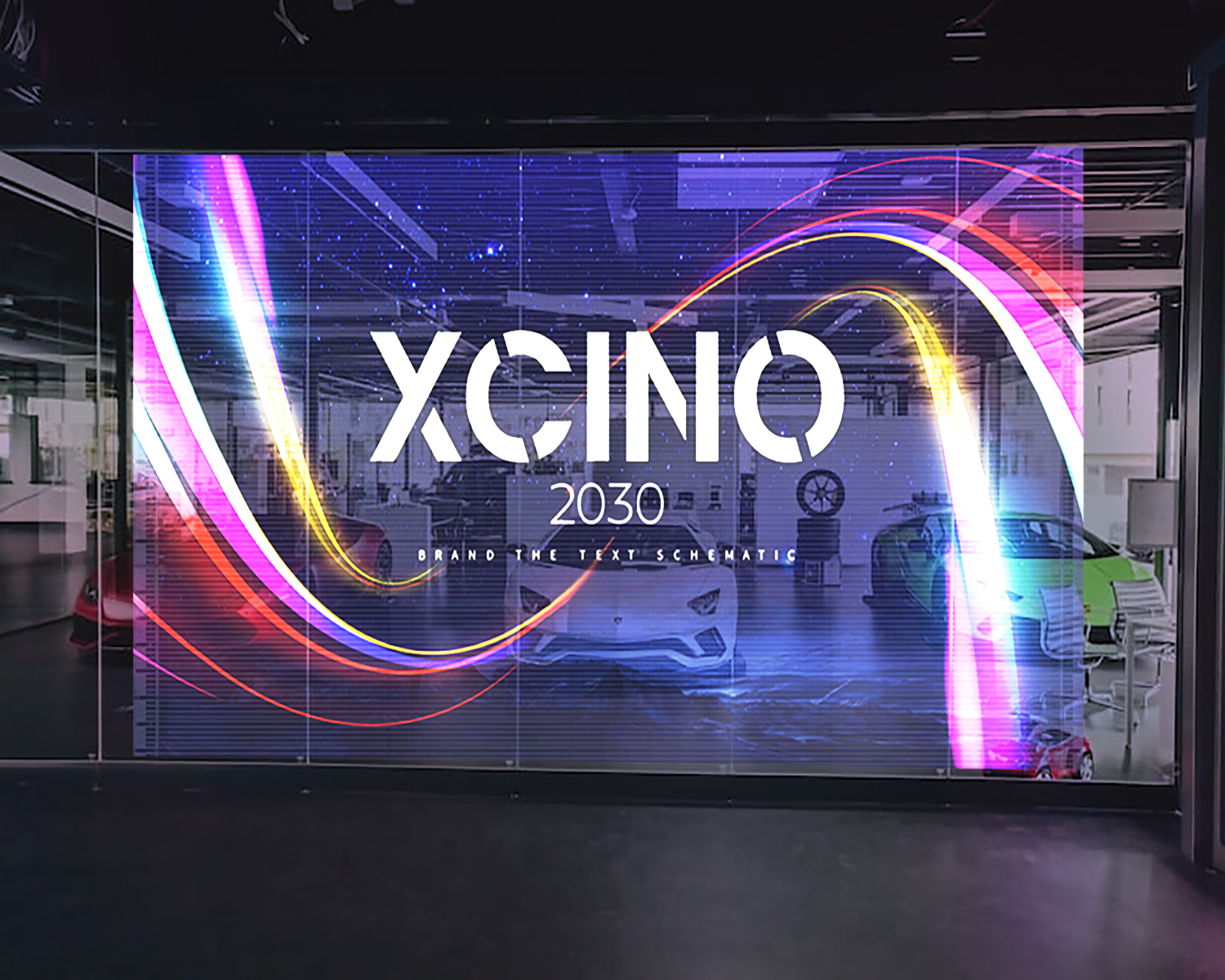
You can see how a transparent film screen sits against the glass, including the close-fitting structure and limited installation depth.
LED Holographic Screen Focuses on Floating Visuals
An LED holographic screen often uses open spaces between LED strips or pixels. Unlit areas remain transparent from the main viewing position.
Floating visuals work better with isolated products, bright outlines, dark backgrounds, and limited background detail. Viewing angle also affects the result.
See how holographic content appears on a transparent LED display. The video shows how simple graphics and darker backgrounds create a clearer floating effect.
Holographic Effects Are Usually Not True 3D Holography
Commercial “holographic screen” usually refers to a transparent LED effect.
True holography records light information through optical interference. The image is later reconstructed through diffraction. Transparent LED displays still create images with physical pixels.
Which Screen Suits Retail Windows and Glass Facades
Project duration, content plans, daylight exposure, and maintenance access shape the final specification.
| Project Scenario | Suggested Starting Point | Reason |
| Permanent boutique window | LED Crystal Film Screen | Low-profile installation and clear merchandise views |
| Repeated chain-store campaigns | All-in-one holographic poster | Easier relocation and consistent display formats |
| Shopping mall entrance | LED Holographic Screen | Stronger visual impact from planned viewing zones |
| Brand showroom | Either format | Content style and installation depth decide the fit |
| Large indoor atrium glass | Transparent mesh or strip system | Service zones can be planned across larger areas |
| Exterior glass facade | Outdoor-rated transparent mesh or curtain system | Weather protection and structural planning are required |
Retail Storefronts and Chain Store Rollouts
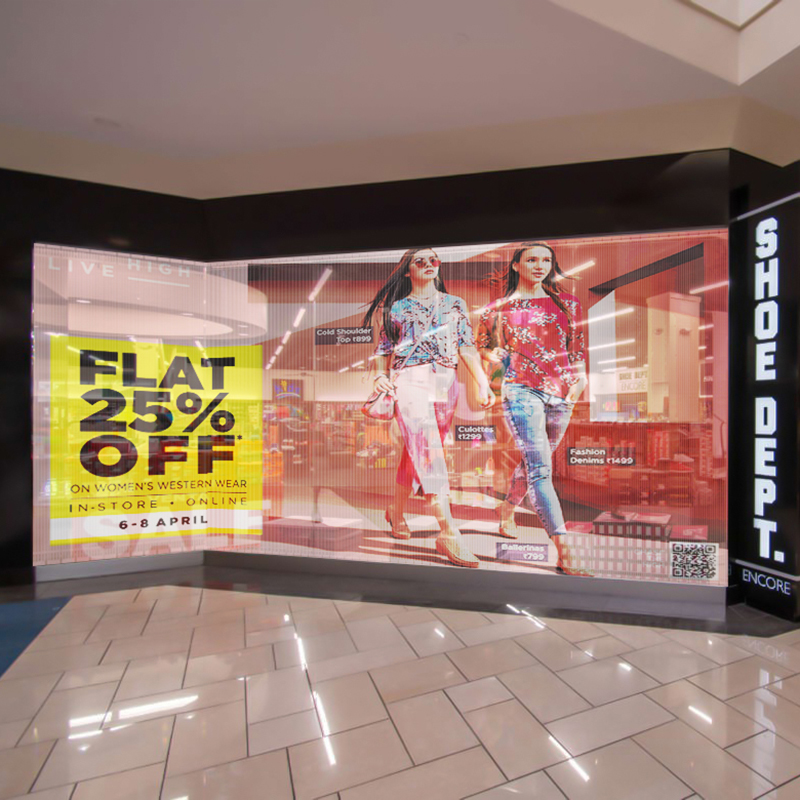
Film suits permanent storefronts with stable glazing and fixed advertising zones. Merchandise remains visible behind the screen.
Portable holographic posters fit seasonal campaigns and short promotional periods. Standardized units can also simplify multi-store rollouts.
Shopping Mall Entrances and Brand Showrooms
Holographic displays suit launches near planned walking routes. Controlled lighting and darker surroundings improve perceived contrast.
Crystal film fits longer-term branding across doors, partitions, and showcase glass. Content density should stay suitable for the selected pixel pitch.
Large Glass Facades and Architectural Media Walls
Large facades need engineering review. Project teams must assess wind, rain, temperature, structure, cabling, fire rules, and service access.
Modular transparent systems can divide the facade into smaller maintenance zones. Outdoor systems also need verified enclosure protection.
IEC 60529 classifies enclosure protection against dust and water. An IP rating does not cover wind loads or facade structure.
How Do Transparency, Brightness, and Viewing Distance Affect Image Quality
The final result comes from several connected specifications. One headline number cannot predict real performance.
| Parameter | Information to Request | Why It Matters |
| Transparency | Installed value including rails, boxes, and wiring | Product-only figures may overstate open sightlines |
| Brightness | Output at the planned operating level | Reflections and daylight reduce visible contrast |
| Pixel pitch | Pitch matched to the nearest regular viewer | Extra pixel density may raise costs without visible gains |
| Refresh rate | Camera testing with planned shutter settings | Phone and camera footage may reveal flicker or scan lines |
| Moiré testing | Footage using the planned lens, angle, and distance | Refresh rate alone cannot remove spatial patterns |
Transparency and Daylight Preservation
Higher transparency keeps more daylight and interior visibility. The trade-off may include lower pixel density or reduced image coverage.
Ask for transparency figures covering the full installation. Frames, rails, power boxes, and cable routes affect the actual open area.
Brightness for Indoor, Window, and Semi-Outdoor Use
Brightness should match measured ambient light and glass orientation. A sun-facing storefront needs higher output than an interior partition.
Daytime testing gives a clearer result than specification sheets alone. Scheduled dimming can lower brightness during evenings and darker periods.
Pixel Pitch Based on Viewing Distance
Use the nearest regular viewer for early planning. Customers may stand close to storefront glass.
Early estimates can use these formulas:
Minimum viewing distance in meters ≈ 0.9 × pixel pitch in millimeters.
Minimum viewing distance in feet ≈ 3 × pixel pitch in millimeters.
| Pixel Pitch | Early Planning Distance |
| P3.91, 3.91 mm (0.154 in) | About 3.6 m (11.8 ft) |
| P4.81, 4.81 mm (0.189 in) | About 4.4 m (14.4 ft) |
| P6.25, 6.25 mm (0.246 in) | About 5.7 m (18.8 ft) |
These figures support budgeting and sample selection. Content style and transparency still affect perceived clarity.
Refresh Rate, Camera Flicker, and Moiré Control
Camera-facing retail projects often specify 3,840 Hz or higher. Driver ICs, scan configuration, controllers, and camera settings also affect recorded footage.
Higher refresh rates can reduce visible flicker and scan lines. Moiré comes from the interaction between repeating LED patterns and camera sensors.
A camera test should use the planned lens, shutter speed, angle, and viewing distance.
What Installation Details Need Review
Installation planning should cover the glass, supporting structure, electrical route, and maintenance process.
| Site Check | Required Information |
| Glass construction | Tempered, laminated, insulated, tinted, coated, or ceramic-fritted glass |
| Surface condition | Flatness, cleanliness, damage, sealant, and bonding compatibility |
| Mullion layout | Active image zones, joints, cable routes, and strip alignment |
| Structural load | Display, rails, controllers, power supplies, cables, and safety hardware |
| Electrical plan | Circuit capacity, grounding, isolation, heat paths, and controller location |
| Service access | Replaceable zones, safe reach, lifting access, and spare components |
| Exposure level | Indoor, protected window, semi-outdoor, or exposed outdoor conditions |
Glass Surface, Mullions, and Mounting Conditions
Existing glass may support a Transparent LED Film Screen after technical approval. Coatings, fritting, sealants, and uneven surfaces can affect bonding.
Every mullion and glass joint should appear on the installation drawing. Poor alignment may interrupt graphics or expose wiring.
Weight, Power, and Hidden Wiring
Installed load includes rails, controllers, power supplies, cables, and safety hardware. Screen weight covers only part of the total load.
Power and signal routes often sit near mullions or glass edges. Qualified contractors should confirm grounding, circuits, isolation, and local electrical requirements.
Maintenance Access and Replacement Zones
Service methods vary across film, strip, mesh, and cabinet systems. “Front access” does not describe the same process for every product.
Request a service drawing for the selected structure. It should show the smallest replaceable section, removal path, connector access, and working space.
Spare parts should match the original brightness and color calibration.
Which Option Offers Better ROI
Return on investment comes from campaign value, operating hours, content costs, service work, and hardware reuse.
| Cost Area | LED Crystal Film Screen | LED Holographic Screen |
| Initial site work | Glass preparation and careful alignment may be needed | Posters need less construction, while custom mesh needs support planning |
| Campaign changes | Content updates are simple, but hardware remains fixed | Portable formats can move between locations |
| Content production | Standard transparent graphics can control creative costs | Floating effects often need purpose-built assets |
| Maintenance | Repair scope follows film zoning and circuit layout | Strip or module replacement may limit the affected area |
| Asset use | Fits stable, long-term window advertising | Fits launches, seasonal campaigns, and repeated activations |
Upfront Cost and Long-Term Operating Value
A low hardware quote may still lead to higher operating costs. Budgets should include access equipment, installation labor, spares, content, and downtime.
Film can reduce visible supporting structures. Portable holographic formats can serve several stores or campaigns.
Average Power Consumption and Daily Operating Hours
Ask for average power at the planned brightness. Peak power does not represent normal retail use.
Use the approved product value in either formula:
Daily energy in kWh = area in m² × average W/m² × operating hours ÷ 1,000.
Daily energy in kWh = area in ft² × average W/ft² × operating hours ÷ 1,000.
Supplier comparisons should use the same brightness, content type, operating schedule, and ambient conditions.
Content Costs for Transparent and Floating Visuals
Transparent film can display logos, product videos, simple text, and standard motion graphics. Small text may lose clarity on wider pixel pitches.
Holographic content works better with dark backgrounds, isolated objects, bright edges, and short loops.
Three-dimensional assets can add depth, but they usually require more production time and a larger content budget.
Match the Display to Your Glass Project
Screen construction should match the site, content plan, and maintenance workflow.
Use LED Crystal Film Screen for Low-Interference Glass Advertising
Film suits permanent installations that need open sightlines, natural light, and shallow mounting depth.
Use LED Holographic Screen for Campaign-Driven Displays
Launches, seasonal promotions, and movable retail displays may suit our C-Mesh F Smart Poster.
The display offers around 80% transparency and at least 3,500 cd/m². Its all-in-one structure can reduce site work during repeat campaigns.
Confirm Site Conditions and Request a Project Review
Share your glass drawings, viewing distance, ambient light, service access, power plan, and content needs before finalizing the screen. Request a project review and site mockup to confirm whether an LED Crystal Film Screen or holographic display fits the space, viewing conditions, and long-term operating plan.
FAQs
Q1: Is an LED Crystal Film Screen Suitable for Curved Glass?
It depends. Some film systems can follow gentle, single-axis curves, while tight radii and compound curves need supplier approval. A full-size sample on matching glass can confirm bonding, image alignment, edge wiring, and maintenance access before production.
Q2: How Long Does It Take to Install a Transparent LED Film Screen?
Most prepared storefront installations take several hours to two working days. The schedule varies with screen size, glass cleaning, alignment, wiring, controller setup, access equipment, inspection, and testing. Final drawings and approved electrical routes are needed for a reliable timeline.
Q3: Can a Transparent LED Film Screen Be Cut to Fit a Window?
Not always. Some products allow cutting only along approved lines or factory-defined sections. Cutting outside those areas may damage conductors, pixels, or signal paths. Final glass dimensions and mullion drawings should be confirmed before the screen sections are produced.
Q4: Can an LED Crystal Film Screen Be Removed and Reused?
Usually not. Adhesive-backed film may lose clarity or bonding strength after removal. Framed or non-adhesive systems may support relocation, depending on their design. Temporary projects should confirm the mounting method, removal process, replacement cost, and warranty terms before ordering.
Q5: How Should an LED Transparent Film Screen Be Cleaned?
Use a clean, lint-free microfiber cloth and light pressure after powering down the display. Apply approved cleaning liquid to the cloth rather than directly onto the film. Strong solvents, abrasive tools, and excess moisture near electrical edges may damage the screen.