


Choosing between a church LED wall and a physical backdrop depends on congregation size, worship style, budget, and building constraints. A 120-seat chapel in a heritage building operates under different parameters than an 800-seat contemporary worship center with a capital plan. Both options serve a church well at the right point in its growth. The five decision dimensions below cover functional need, camera performance, acoustics, installation constraints, and cost.
What Does a Church Stage Backdrop Need to Deliver?
Three functional requirements govern every backdrop decision: atmosphere, information delivery, and camera performance. Clarifying which requirements apply to your church eliminates most selection uncertainty before any cost comparison begins.
Atmosphere vs. Information Display: Two Distinct Functional Goals
Atmosphere creation and information display are separate goals. A church projecting lyrics, scripture references, and sermon graphics every Sunday has different requirements than a liturgical congregation using printed orders of service.
Many congregations under 150 seats operate in atmosphere-only mode. For those churches, a well-designed physical backdrop fully meets the functional need, and the cost of a church LED wall may not be justified at this point in their growth.
Livestream and IMAG: What the Camera Records Matters
Physical backdrops with fine repeating grid patterns create moiré interference in camera lenses. This is a spatial optical problem that refresh rate cannot resolve; the only fix is avoiding fine repeating patterns in material selection. Physical fabrics can also produce color shift and glare under stage lighting, both of which look worse on camera than to the live congregation.
LED walls present a different challenge: scan-line artifacts caused by insufficient panel scan count and driver IC (integrated circuit) configuration. A refresh rate of 3,840 Hz or higher aligns the panel’s output cycle with typical broadcast camera shutter speeds, eliminating visible banding in footage. For churches where online ministry is a growing priority, verifying both refresh rate and panel scan configuration before purchase is the correct technical step.
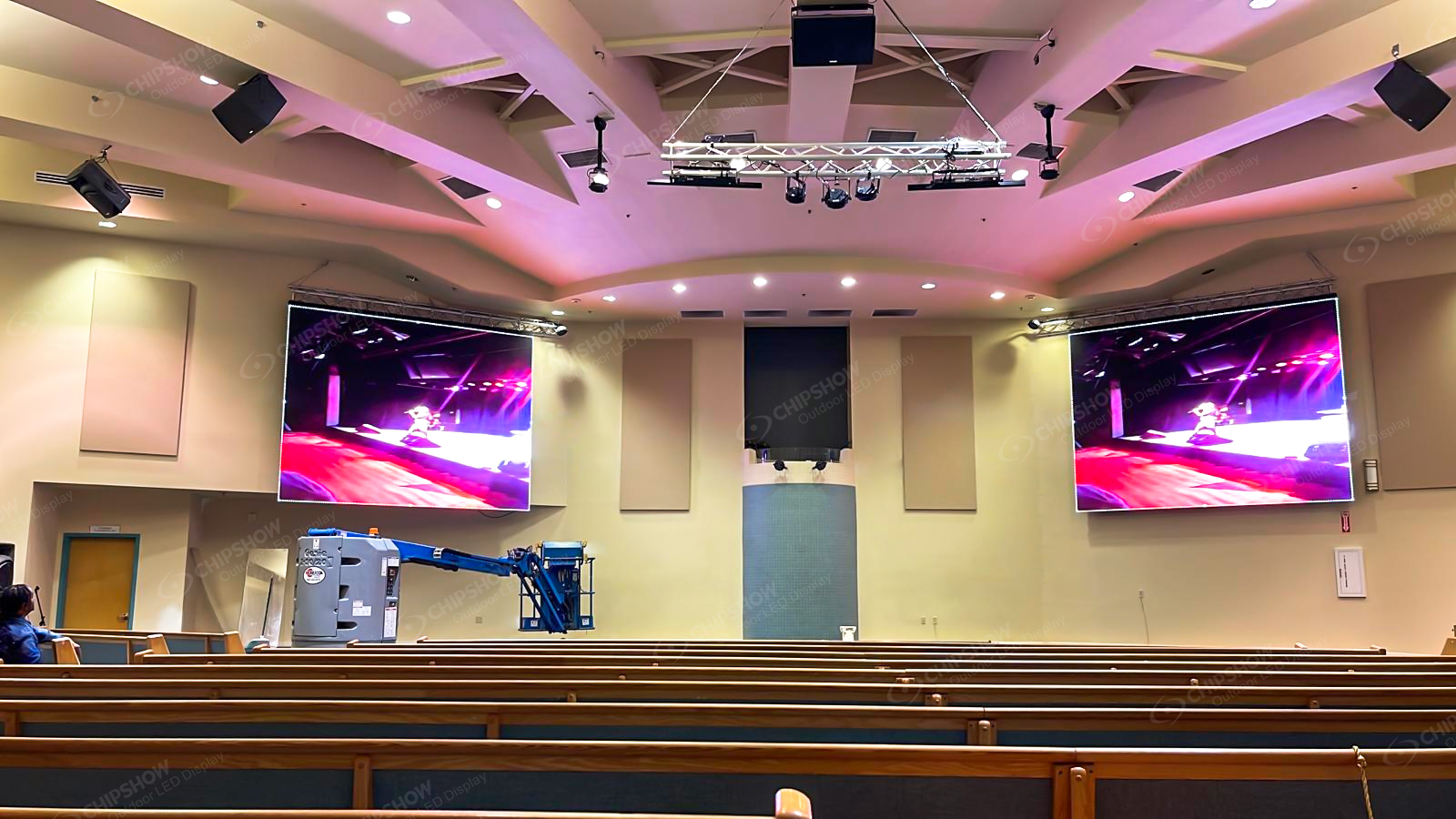
How Your Backdrop Choice Affects Sanctuary Sound
Fabric physical backdrops provide light mid-frequency sound absorption, which can modestly reduce reverberation in hard-surface sanctuaries.
Solid metal LED cabinets are acoustically reflective. In stone, brick, or concrete rooms with existing echo, a large LED wall can worsen high-frequency reflection. Before specifying an LED wall in a reverberant sanctuary, evaluate whether supplemental absorption panels beside the cabinet array are needed to maintain speech intelligibility.
Physical Backdrops for Church Stages: Types, Strengths, and Limitations
Church stage backdrop ideas span six distinct construction types, each with different cost ranges, aesthetic outcomes, and practical constraints. Knowing where physical backdrops perform well, and where they fall short, clarifies the decision before any LED comparison applies.
Six Physical Backdrop Types and Their Cost Ranges
| Backdrop Type | Approximate Installed Cost | Best Fit |
| Pipe-and-drape fabric systems | $500–$2,000 (DIY) | Temporary or rented venues |
| Printed fabric backdrops | $1,500–$5,000 | Seasonal imagery, no structural work |
| Acrylic or translucent geometric panels | $3,000–$8,000 | Contemporary visual style with backlighting |
| Timber frame decorative structures | $4,000–$10,000 | Architectural warmth in traditional sanctuaries |
| Painted or textured vinyl murals | $2,000–$6,000 | Permanent wall aesthetic at lower cost |
| Modular geometric tile systems | $5,000–$15,000 | Reconfigurable installations |
Note: The cost ranges above are intended for early planning only. Final pricing may vary based on material selection, stage size, local labor rates, installation complexity, and whether additional lighting, rigging, or structural work is required.
No type requires electrical infrastructure, and most do not require structural engineering, making them the default starting point for budget-constrained or heritage-restricted installations.
Where Physical Backdrops Perform Well
Physical backdrops carry genuine advantages an LED wall cannot replicate: no electrical infrastructure, no structural engineering in most cases, and full compatibility with heritage building preservation covenants. They also create material warmth and spatial texture that a flat luminous panel cannot provide.
For churches in protected historic buildings, operating from temporary venues, or with budgets under $5,000, a physical backdrop is the correct tool for the current situation, not a compromise.
The Core Limitation: Static Content and Long-Term Inflexibility
- The functional ceiling of a physical backdrop is fixed from installation day. There is no lyrics display, no scripture, no video content, and no seasonal updates without a complete physical reset.
- Fine-grid or repeating geometric patterns create moiré interference in camera lenses, a direct technical liability for livestream applications.
- Over a 10-year horizon, recurring theme-change labor costs and the inability to support online ministry visual standards typically erode the initial cost advantage.
What Does a Church LED Wall Add to Worship?
A church LED wall changes what is operationally possible, not only how the stage looks. Knowing what it adds, and what it does not replace, prevents both over-specification and unmet expectations.
For churches considering an LED-based backdrop, key specifications usually include fine pixel pitch, low-brightness grayscale performance, silent operation, and front-service maintenance. Chipshow’s church LED solutions are designed around these requirements for sanctuary, IMAG, lobby, and livestream applications.
Dynamic Content for Every Worship Element
A church LED wall integrates directly with worship software to deliver real-time content: lyrics, scripture references, sermon graphics, countdown timers, and video. Seasonal themes switch without any physical reset. This functions as an operational tool for worship leaders and technical directors managing every service element, not only a visual upgrade.
Brightness: Operating Level Matters More Than Peak Specification
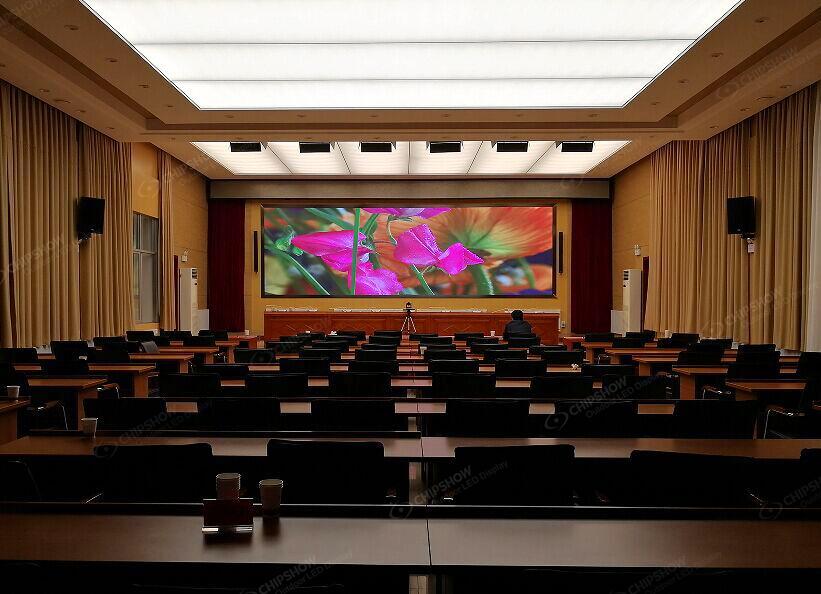
Indoor LED walls for sanctuary use are typically specified in the 600–1,200 nits range depending on room conditions. The technical factor worth evaluating is not peak brightness but high grayscale at low brightness: the ability to maintain color depth, contrast, and tonal range when the display is dimmed to a comfortable operating level. A screen that goes flat or muddy at 30–40% output is a more common real-world problem than insufficient peak brightness. Specify operating brightness based on actual ambient light conditions in the room, not the panel’s rated maximum.
IMAG and Livestream: Broadcast-Ready Refresh Rates
- A refresh rate of 3,840 Hz or higher eliminates scan-line artifacts in camera footage. For churches running high-frame-rate broadcast cameras or extended reality (XR) production setups, 7,680 Hz is the recommended specification.
- IMAG side screens at P2.6–P3.9 allow back-row congregants to see facial expressions clearly during sermons and performances. Online ministry visual quality directly affects viewer retention, and a camera-ready LED wall removes the technical friction that degrades livestream production.
What LED Walls Cannot Replace
A flat luminous panel does not replicate the spatial depth, material warmth, or architectural presence of physical stage elements. In a heritage stone sanctuary or a liturgically oriented worship space, a single LED screen as the sole backdrop can read as incongruous with the building character.
This gap is what hybrid configurations address: LED for content delivery, physical elements for depth and texture.
How to Make a Church Stage Look Good With LED and Physical Elements Combined
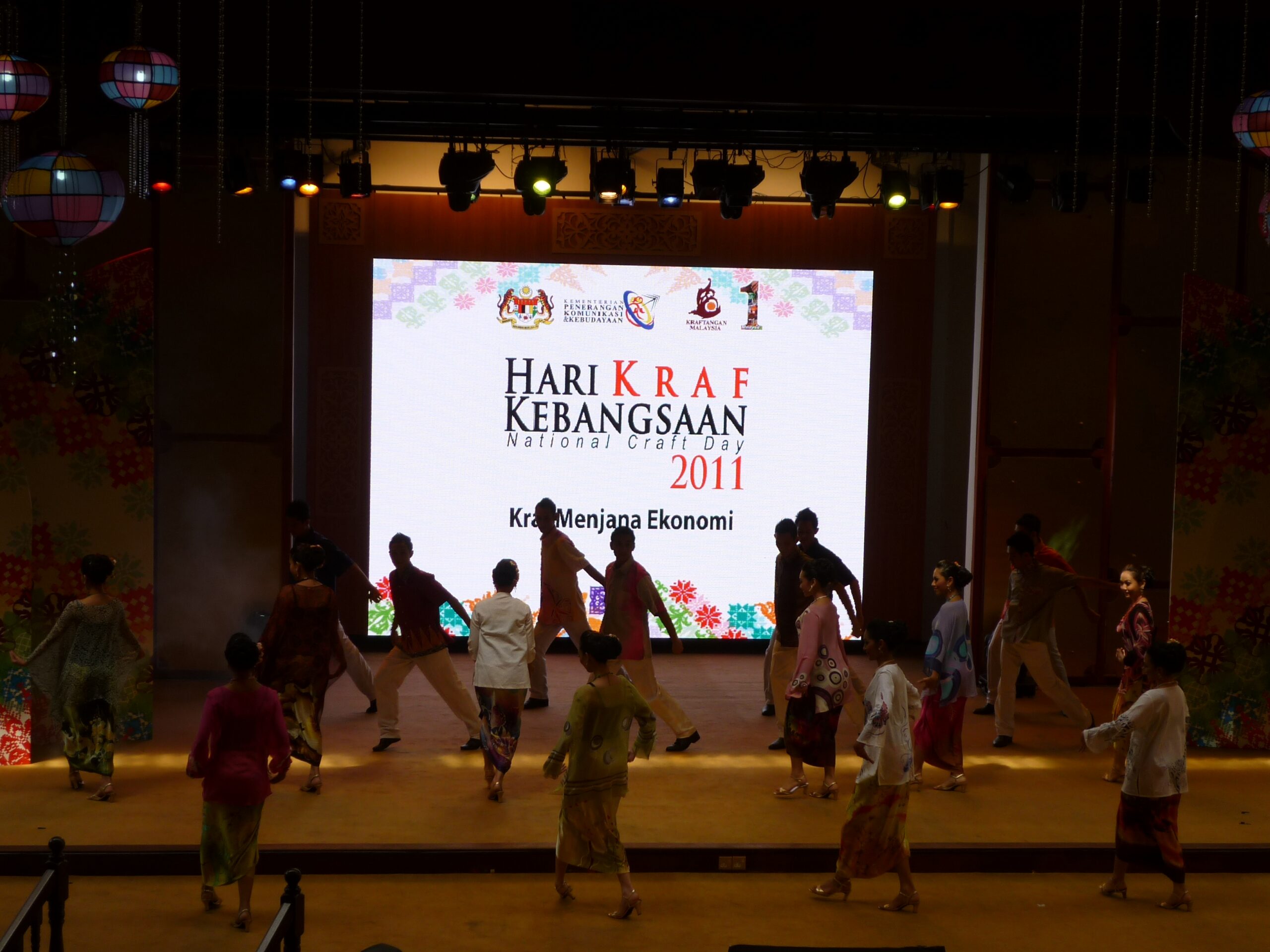
The most effective church stage design does not require choosing between LED and physical elements. Each format can be assigned a distinct functional role, and the combined result addresses the most common AV committee concern: whether the finished stage will look like a performance venue rather than a place of worship.
Using LED as the Content Core With Physical Flanking Elements
Position the LED wall at center stage to handle all dynamic content. Timber panels, fabric drapes, or geometric columns on either side supply visual depth, warmth, and architectural scale that a flat screen cannot provide independently. This configuration is common in large contemporary churches, with the two formats operating in parallel rather than in competition.
Four Design Decisions That Determine How the Stage Reads
Content tone, frame integration, ambient light balance, and physical flanking elements determine how a church LED wall reads in the room.
- Content tone: Warm color palettes, natural imagery, and understated typography suited to scripture and liturgical text replace high-contrast performance graphics.
- Frame integration: Recessing the screen into a custom timber or drywall surround eliminates the visible industrial cabinet edge.
- Ambient light balance: Maintaining warm house lighting at medium intensity ensures the screen is one light source among several rather than the dominant one.
- Physical flanking elements: Timber panels, fabric drapes, or geometric columns add compositional depth so the screen reads as one component of a larger designed stage environment.
Budget Allocation in a Hybrid Configuration
The LED wall typically absorbs the majority of the total backdrop budget as the core content infrastructure. Physical flanking elements can be sourced from local millwork or modular panel systems to manage cost. A phased installation, LED wall first with physical elements added over the following year or two, is a practical path for mid-size churches managing a capital plan in stages.
Architecture, Lighting, and Installation Constraints
Building and environmental conditions often determine feasibility before cost comparisons apply. Three constraints consistently affect church LED installations that general-purpose AV guidance does not address.
How Church Lighting Conditions Affect Both Options
Stained glass produces colored ambient light that shifts the perceived hue of physical backdrops during daylight services. Skylights reduce LED screen contrast at midday. Any assessment should cover the full service day, not only evening or low-light rehearsal hours. Candle point sources create glare on smooth reflective backdrop materials regardless of type.
Heritage Buildings and Load-Bearing Constraints
Historic building restrictions can limit or prohibit LED installation. Four factors to evaluate before specifying a church LED wall in a heritage building:
- Floor load capacity: Confirm the structure can support cabinet weight without reinforcement.
- Structural anchor points: Verify availability of rigging or wall-mount attachment points.
- Electrical capacity: Assess whether existing supply supports the additional load without infrastructure upgrades.
- Preservation covenant restrictions: Check whether permanent wall modification is permitted under heritage protection terms.
Providing an engineering assessment alongside the AV specification document strengthens the approval case with church boards and heritage authorities.
Front-Service Installation: Why Maintenance Access Is Non-Negotiable
Most church stage configurations have zero rear clearance behind the back wall, with no maintenance corridor and no access panel. For most wall-mounted church installations with limited rear clearance, front-service LED cabinet design should be treated as a key technical requirement. Confirm 100% front serviceability before finalizing any LED wall specification for a church stage.
Church Stage Backdrop Cost: What Each Option Actually Costs
Cost comparison must account for both initial spend and total cost of ownership over a realistic operational horizon, not upfront price alone.
| Dimension | Physical Backdrop | Church LED Wall |
| Upfront Cost | $500–$15,000 | $15,000–$80,000+ |
| Content Flexibility | Static; physical reset required for all changes | Dynamic; software-controlled per service |
| Livestream Performance | Pattern-dependent; moiré risk | Clean at 3,840 Hz or higher |
| Acoustic Effect | Fabric types absorb mid-frequency sound | Hard cabinets reflect sound |
| Installation Requirements | Minimal; no electrical work in most cases | Requires electrical, structural, and load assessment |
| Heritage Building Compatibility | High; no permanent modification needed | Conditional; requires engineering verification |
| 10-Year Total Cost of Ownership | Cumulative reset and replacement costs add up | Higher initial spend; lower long-term per-service cost at sufficient frequency |
Physical Backdrop Cost Ranges
Pipe-and-drape DIY systems run $500–$2,000. Professionally installed printed fabric backdrops are $1,500–$5,000. Custom modular geometric panel installations reach $5,000–$15,000. The primary hidden cost is recurring labor and material for theme resets, typically needed every 12–36 months.
Church LED Wall Cost Ranges
Small sanctuary installations under 300 seats run $15,000–$30,000 including installation. Mid-to-large sanctuaries of 300–800 seats run $30,000–$80,000 depending on screen area and pixel pitch selection. The choice between P1.9 and P2.6 pixel pitch carries a notable cost differential; correct selection depends on primary viewing distance, not maximum resolution. These figures reflect typical total installed costs in the North American market. Actual pricing varies by screen area, pixel pitch, and installation scope.
The Phased Approach: Physical Backdrop as Stage 0
Churches with current budgets under $10,000 and a longer capital plan can begin with a $2,000–$5,000 physical backdrop while pre-routing electrical conduit and specifying structural anchor points for future LED installation. This avoids double construction costs when the LED wall phase begins.
LED display panels are rated at approximately 100,000 hours to half-brightness under standard operating conditions. In churches with frequent weekly use, the long-term per-service cost of an LED wall may become more favorable than repeated physical backdrop replacement and reset costs.
Which Church Stage Backdrop Option Fits Your Worship Space Right Now?
Match the solution to the current situation and building constraints, not to a theoretical ideal. Congregation size, worship style, and budget resolve most decisions before any specification work begins.
By Congregation Size and Viewing Distance
The industry-standard formula for minimum comfortable viewing distance is: distance in meters approximately equals pixel pitch in millimeters. Use this to match pixel pitch to your front-row distance, not your back-row distance.
| Sanctuary Size | Viewing Distance | Recommended Pixel Pitch | Recommended Brightness |
| Under 150 seats | 5–8 m (16–26 ft) | P1.9–P2.6 | 600–1,000 nits |
| 150–500 seats | 8–15 m (26–49 ft) | P2.6–P3.9 | 600–1,200 nits |
| 500+ seats / IMAG screens | 15–25 m (49–82 ft) | P2.6–P3.9 | 800–1,200 nits |
Actual operating brightness should be calibrated to sanctuary ambient light. In controlled environments with stage lighting, most installations run comfortably at 600–1,000 nits.
By Worship Style
Liturgical congregations typically prioritize architectural integration and atmosphere over dynamic content delivery.
- A physical backdrop or a deeply recessed LED wall with warm content palettes serves these spaces better than a prominent center-screen installation.
- Contemporary worship centers with high song-set and media intensity benefit most from a full LED content platform.
- Multi-use sanctuaries hosting worship, community events, conferences, and performances gain the most from an LED wall with a hybrid physical surround for maximum programming flexibility.
By Budget
- Immediate need with no capital plan: a well-designed physical backdrop in the $2,000–$5,000 range is the appropriate tool.
- Confirmed budget and timeline: specify the LED wall and pre-install infrastructure now to avoid future rework costs.
- Longer phased plan: physical backdrop as Stage 0, LED wall as Stage 1, hybrid physical flanking elements as Stage 2.
Select the Right Church Stage Backdrop for Your Worship Space
Physical backdrops and church LED walls serve different situations, not different quality tiers. A physical backdrop remains the correct choice for atmosphere-only ministry, heritage building constraints, and early-stage budgets. A church LED wall becomes the right investment when livestream quality, dynamic content delivery, and long-term total cost of ownership are the primary evaluation criteria. For many growing congregations, a hybrid configuration can offer a practical balance between content flexibility and architectural warmth.
Chipshow Church LED Solution covers the full sanctuary portfolio. For close-range main stage backdrops where visual clarity and architectural integration are the priority, the C-Max Fine Pitch COB (P1.25–P1.86) delivers fine-pitch resolution, consistent color depth at low brightness levels, and 100% front-service wall-mount installation in a fanless, silent design. For IMAG side screens, lobby displays, and livestream-critical applications requiring broadcast-ready refresh rates, the C-Shine Plus Indoor (P1.9–P3.9, fanless, under 40 dB, up to 7,680 Hz) provides camera-ready performance and a shared 500 x 500 mm / 500 x 1000 mm (approx. 20″ x 20″ / 20″ x 40″) cabinet platform that simplifies long-term spare-part management. Contact Chipshow to discuss sanctuary-specific pixel pitch selection, front-service installation options, and the full church LED solution.
FAQs About Church Stage LED Walls and Physical Backdrops
Q1. Is a Church LED Wall Compatible With ProPresenter and Other Worship Software?
Yes. LED walls function as standard display outputs. ProPresenter, EasyWorship, MediaShout, and other worship presentation platforms send content to the LED wall through HDMI or NDI (Network Device Interface) connections the same way they send to any monitor or projector. No proprietary software is required on the display side.
Q2. How Long Does a Church LED Wall Last Before It Needs Replacement?
Quality LED panels are rated at approximately 100,000 hours to half-brightness. For a church running 20 to 30 hours per week, that translates to roughly 10 to 15 years of service before brightness drops below acceptable levels. Front-service modular design allows individual panel replacement without taking down the entire wall.
Q3. Can a Church LED Wall Replace a Projector System?
In most permanent sanctuaries, yes. LED walls maintain full image clarity under stage lighting and ambient daylight conditions where projectors wash out. Projectors remain practical for portable churches in rented venues or multi-purpose rooms where a retractable screen is needed. The deciding factors are room lighting, permanence of installation, and budget.
Q4. How Do I Know When My Church Is Ready to Upgrade to a Church LED Wall?
Three indicators point toward readiness: online ministry has grown to the point where camera image quality affects viewer retention; the current system requires recurring maintenance that disrupts worship planning; and the church budget supports a capital commitment with a realistic timeline.
Q5. Does a Church LED Wall Require Genlock for Broadcast Camera Integration?
For broadcast-grade multi-camera production, yes. Genlock synchronization locks the LED wall’s output timing to the broadcast camera’s frame rate, eliminating rolling banding that refresh rate alignment alone cannot fully resolve. For churches producing broadcast-grade livestreams or multi-camera recordings, confirm genlock support in the LED controller specification before purchase.
Q6. Can Volunteers Install a Church LED Wall, or Is Professional Installation Required?
Modular LED panels with quick-lock mounting systems can be physically assembled by a trained volunteer team. However, structural load assessment, electrical connection, and video processor configuration require qualified professionals. A practical approach is to hire professionals for structural mounting, electrical work, and system calibration, then train volunteers on routine front-service module swaps for ongoing maintenance.





