


VMS remote access security is not just a software feature check. For highway projects, it means deciding whether remote users are clearly identified, sessions are protected in transit, the remote path is contained, and every important action can be reviewed later. This checklist is written for procurement, ITS, and public-sector IT teams that need to approve or reject a proposal based on evidence, not marketing language.
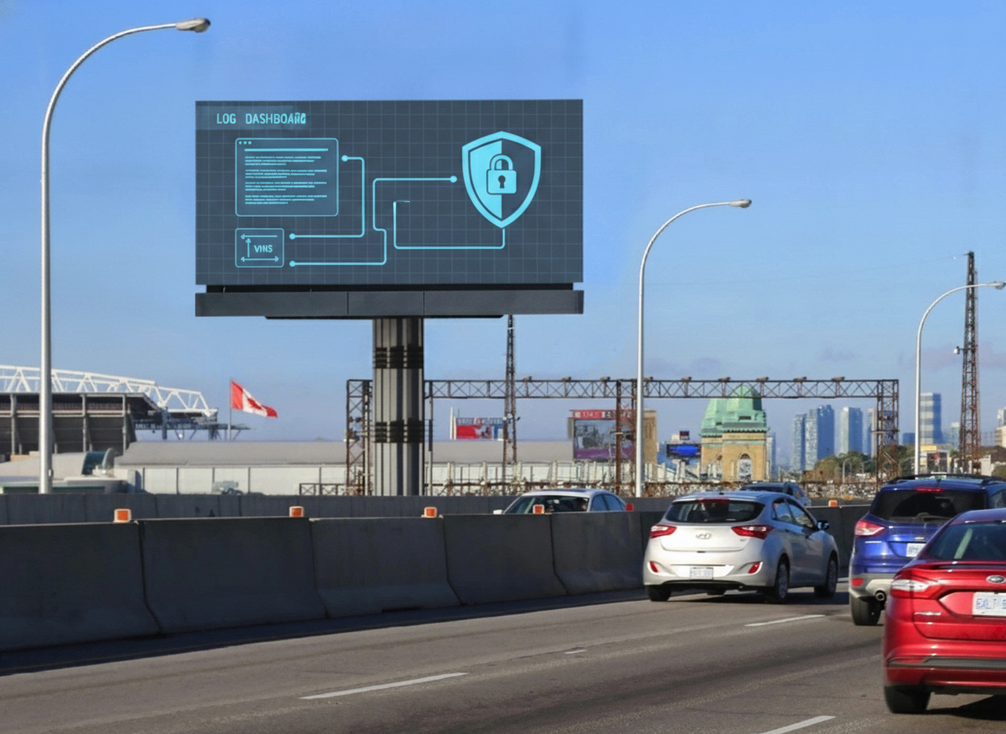
What Secure Remote Access Means
In a highway VMS procurement context, secure remote access means four things working together: named user identity, protected communication, network containment, and auditable activity. The federal remote-access baseline from NIST AC-17 Remote Access describes remote access as authorized access that uses cryptographic protection for the session, while FHWA guidance for DMS and TMC environments translates that idea into buyer checks for access control, segmentation, and logging. For most buyers, the key question is simple: can a vendor show how remote access is controlled without opening a broad path into the field network?
That distinction matters because a system can sound secure and still rely on vague shared credentials, weak transport, or incomplete logs. Treat this as a procurement checklist, not a product spec sheet. If a vendor mentions NTCIP, protocol compatibility, or a security standard, treat that as a verification item unless the project documents actually show how it is supported.
Check Authentication Before Anything Else
Start with identity, because weak login control makes every other safeguard less useful. FHWA’s DMS requirements call for access control with unique credentials so managers can assign operators and maintainers their own access instead of sharing logins. If the proposal cannot show named accounts, role separation, and account removal when staff leave, it is not a strong fit for a public highway VMS environment.
A good buyer-side question is whether the proposal separates operator, administrator, vendor, and emergency access. Role separation is not just a nice-to-have. It limits who can change message content, scheduling, and device settings. That matters most when the sign system is shared across multiple teams or vendors, because one broad account can turn a small mistake into a larger operational issue.
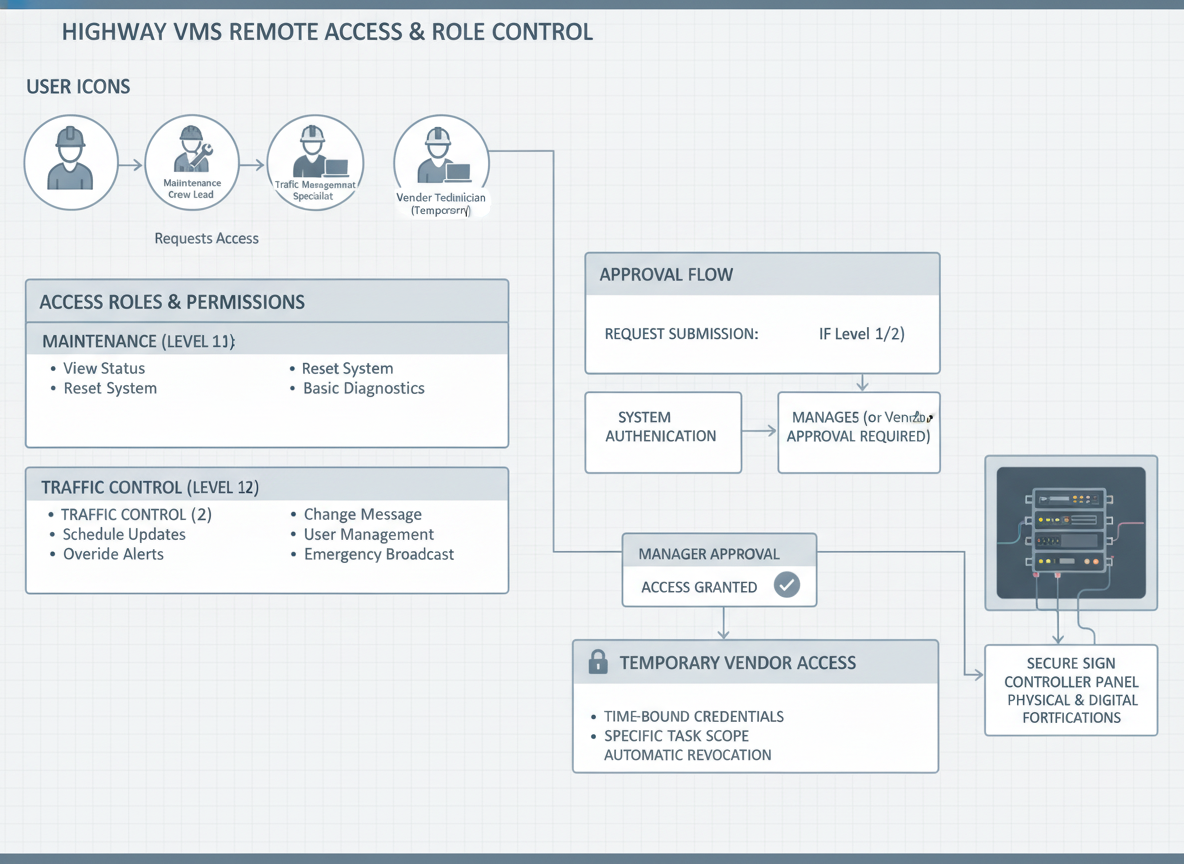
For vendor and temporary access, ask how approval and revocation work in practice. Remote maintenance should be time-limited, documented, and easy to remove after the work window ends. If contractor access can remain open indefinitely, the design starts to look like a standing backdoor rather than a controlled service path.
Password policy and multi-step login should also be visible in the documentation. Do not assume a specific method is included just because the vendor says the system is secure. What you want is proof that login protections match the site risk, that privileged access is harder to abuse than ordinary access, and that failed logins are visible to the team that reviews security events.
Emergency access is the last part of this check, not the first. A reasonable proposal will explain how urgent access is granted, how it is logged, and how the event is reviewed afterward. If emergency access is not time-limited and reviewable, it can become a permanent exception that weakens the whole control set.
Protect Sessions and Data in Transit
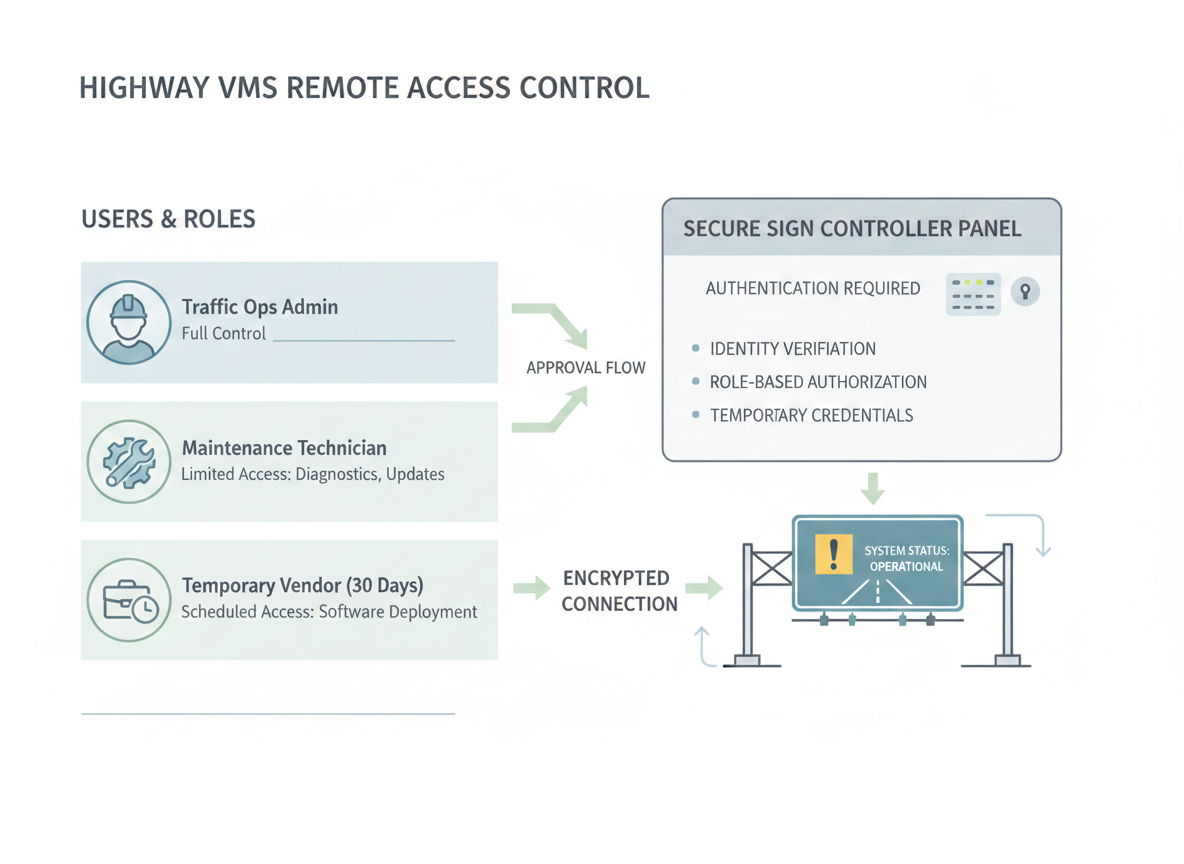
Authentication tells you who can get in. Encryption tells you whether the session and its commands are protected while they move between the user and the system. FHWA procurement language for ITS equipment says agencies should require modern encryption and disable deprecated protocols such as SSLv3, TLS 1.0, and TLS 1.1. That gives buyers a concrete rejection test: if a proposal depends on outdated transport protection, it should not move forward as-is.
| Remote-access protection | Procurement approval status | Why it matters for approval |
|---|---|---|
| Unique credentials for each user | Essential | FHWA access control requires unique credentials. |
| Role separation / least-privilege access | Essential | FHWA access control requires role separation. |
| Modern encryption | Essential | FHWA procurement language requires modern encryption. |
| SSLv3 disabled | Essential | FHWA procurement language requires SSLv3 to be disabled. |
| TLS 1.0 disabled | Essential | FHWA procurement language requires TLS 1.0 to be disabled. |
| TLS 1.1 disabled | Essential | FHWA procurement language requires TLS 1.1 to be disabled. |
| DMZ isolation | Essential | FHWA TMC guidance recommends isolating access in a DMZ. |
| VPN-restricted remote vendor support | Essential | FHWA TMC guidance recommends VPN-restricted remote vendor support. |
| Logging of user, time, action, and successful/failed attempts | Essential | FHWA logging guidance requires these audit details. |
| Procurement documentation requests | Essential | FHWA procurement documentation requests support review and approval. |
Use that matrix as a pass/fail screen, not as a scoring game. Encryption alone does not make a remote-access design safe if the network path is too broad or if privileged sessions are not handled carefully. Buyers should ask whether the login path, maintenance path, and management traffic are all protected, and whether the vendor can show how credentials are handled during the session.
If the answer is only "encrypted," keep pressing. Ask what is protected, where it is protected, and what happens when a session ends. For procurement review, the best response is a plain description of the remote session path plus supporting documentation, not a vague security claim.
Separate Remote Access From the Field Network
Network controls decide how far a compromise can spread. FHWA TMC best practices recommend isolating vendor-supported software within a demilitarized zone so remote support through VPN is limited to that segment instead of the broader enterprise network. In plain terms, the remote path should be narrow enough that one service account or vendor session does not expose the whole field environment.
Here is the buyer checklist for the network side:
- Ask where the VPN terminates and which segment it reaches.
- Confirm whether remote support goes through a DMZ or an equivalent isolated zone.
- Verify that the remote path does not provide broad routing into controllers, signs, and operator workstations.
- Check whether the management plane is separated from ordinary field traffic.
- Confirm that firewall rules are limited to the access that is actually needed.
- Treat any NTCIP-related compatibility claim as something to verify in the project documentation, not something to assume from the sales deck.
For municipal buyers, the main decision point is whether the architecture contains risk or spreads it. A design with narrow entry points and limited routing is usually easier to defend in review than one that mixes maintenance traffic with general network access. The Traffic & VMS LED Display category is only a navigation path here; the real approval question is whether the proposed remote path stays contained.
If the proposal leans on a single firewall or a generic VPN claim, do not stop there. Ask what the remote session can reach, what it cannot reach, and how the system keeps vendor support from becoming blanket access to the field network.
Require Logs, Alerts, and Reviewable Records
Logging is what turns remote access from an invisible risk into something the owner can review. FHWA’s TMC technical guidance says audit logs should record both successful and failed access attempts, identify the user, record the time, and show the action taken. That is the minimum evidence buyers should expect when evaluating a highway VMS remote-access design.
The useful distinction is between activity that is merely recorded and activity that can actually be reviewed. Access logs, change logs, alarm logs, and administrative events should be easy to separate. If the logs are complete but no one reviews them after incidents or unusual sessions, the control exists on paper but not in practice.
Ask who receives alerts for failed logins, unusual vendor sessions, and emergency access. Then ask how those alerts are handled. A noisy system that nobody trusts is less useful than a smaller log set that the operations or cybersecurity team really reviews.
Retention is important, but it is also easy to overstate. Unless the project documents specify a retention period, keep the question focused on whether the logs are complete, time-stamped, exportable, and suitable for incident review. The approval goal is reviewable records, not a vague promise of forensic readiness.
Ask for Evidence Before You Approve
When vendors describe secure remote access broadly, ask for documents that prove the claim. FHWA procurement language recommends manufacturer cybersecurity documentation that explains secure configuration methods and shows how the specific component was configured for the project. That is the right standard for a bid package: not "trust us," but "show us the setup."
Use this evidence-request sequence before award:
- Ask for an architecture diagram that shows the remote-access path, termination point, and network segment boundaries.
- Request the identity controls in writing, including named accounts, roles, and revocation steps.
- Ask how encryption is handled in transit and which legacy protocols are disabled.
- Request a sample of the logs or a logging description that shows user, time, action, and success or failure.
- Ask for the access-governance process, including temporary, vendor, and emergency access.
- Request the support and incident contacts that will handle remote-access events after commissioning.
If one vendor gives broad claims and another gives project-specific proof, the second package is usually easier to approve. The difference is not just paperwork. It tells you whether the remote-access design was actually thought through for this project or copied from a generic brochure.
Use This Procurement Checklist
Before you approve highway VMS remote access, verify the essentials, not just the headline features. Approve systems that show named accounts, role separation, protected sessions, a segmented remote path, and logs that can support review. Verify any NTCIP or protocol claim in the project documents before treating it as a requirement or compatibility promise. Revise or reject proposals that rely on shared logins, vague encryption language, broad network reach, or logs no one plans to review.
If you are comparing bids now, use the checklist above as your pass/fail filter. If you are auditing an installed system, start with the logs and the remote path, then work backward to identity and access rules.
FAQs
What Network Controls Are Needed for Highway VMS Remote Access?
The minimum checks are segmentation, restricted routing, and a clear termination point for remote support. Buyers should confirm that vendor access does not expose the broader field network and that the management plane is separated from routine traffic. If the architecture cannot explain those boundaries clearly, it needs revision before approval.
How Do You Verify That Remote VMS Access Is Encrypted?
Ask for written details on transport protection, not just a one-word claim that the system is encrypted. The proposal should show how login traffic, control commands, and maintenance sessions are protected and which outdated protocols are disabled. If the vendor cannot show that level of detail, treat the claim as incomplete.
Why Does Logging Matter for Highway VMS Security Reviews?
Logs make remote access reviewable. They support accountability, incident review, and follow-up when something unexpected happens. The most useful logs identify the user, time, action, and whether access succeeded or failed. Without that detail, it is hard to reconstruct what happened during a maintenance session or security event.
Can Vendors Use Temporary Remote Access for Maintenance?
Yes, temporary access can be acceptable when it is approved, time-limited, and logged. The problem is not short-term access itself; it is access that never gets removed. Buyers should ask how the vendor revokes access, who approves it, and how the session is reviewed after the work window closes.
What Evidence Should Be in the Bid Package Before Approval?
Ask for an architecture diagram, identity and access details, encryption and session handling notes, a logging sample or logging description, and the access-governance process. Also request the support and incident contacts tied to remote access. If a bidder cannot produce project-specific documentation, the security claim is not ready for award.
Sources
- Model Systems Engineering Documents for Dynamic Message Sign (DMS) Systems – Appendix B: System Requirements Table
- Cybersecurity Language for the Procurement of Intelligent Transportation System Equipment
- Transportation Management Center Information Technology Security – Best Practices
- Transportation Management Center Information Technology Security – Technical Guidelines
- NIST SP 800-53 Rev. 5 – AC-17 Remote Access





