


Command center LED walls often need TAA screening, but a TAA compliant LED display depends on the procurement path, funding source, and line items in the solicitation. For federal buyers, the first check is simple: does the solicitation or contract actually trigger TAA? If it does, confirm the vehicle, verify the threshold, and ask for origin support before award. GSA says TAA applies to GSA Schedule contracts unless stated otherwise, and Trade.gov’s federal procurement overview explains that origin turns on substantial transformation or U.S./designated-country manufacture, not marketing language or shipping point.
When TAA Actually Applies
For command center LED walls, TAA is most likely to apply when the purchase is made through a GSA Schedule or another covered federal procurement path. GSA’s Vendor Support Center says the Trade Agreements Act applies to all GSA Schedule contracts unless the solicitation or contract says otherwise. In practice, that means a schedule-offered LED wall, controller, processor, mounting package, or related accessory may need TAA review even if the item is commercially available.
Start with this sequence:

- Read the solicitation and contract clauses.
- Confirm the funding path and procurement vehicle.
- Check whether the line item is a covered supply, service, or mixed package.
- Ask for a vendor declaration tied to the exact model and configuration.
That sequence matters because mixed scopes need line-item review. A command center project can include LED walls, control software, installation labor, AV integration, furniture, or construction-related work. One line item may be covered while another follows a different rule.
A quick screen helps buyers sort the first pass:
| Screen first | What it means for command center LED walls | TAA screen result |
|---|---|---|
| GSA Schedule | Generally subject to TAA | Screen for TAA early |
| Federal supply above the WTO GPA threshold | Threshold is about $183,000 for 2026 | Screen for TAA early if the procurement path is covered |
| Mixed-scope procurement | Different line items may have different rules | Review each line item separately |
| Other federal procurement paths | TAA may depend on the specific procurement path | Do not assume TAA applies automatically |
| Buy America coverage | Separate rule set from TAA | Do not treat Buy America as a proxy for TAA |
The 2026 threshold matters because trade-agreement coverage is value-based. Official USTR notices and the FAR remain the better source for the controlling number in a specific case, but a public summary from US Made Supply places the 2026 supply threshold at about $183,000. When in doubt, screen early if the path looks covered.
A TAA compliant LED display also turns on origin, not just final assembly. Trade.gov explains that substantial transformation requires a new and different article of commerce with a distinct name, character, or use. For an LED wall, that means buyers should not rely on "assembled in" language alone.
Where TAA Does Not Automatically Follow
TAA does not automatically follow every government-funded purchase. That distinction matters for command center LED walls because the same hardware can sit in different buying channels with different rules. If the procurement is not under a covered federal path, or if the solicitation expressly uses a different domestic-content framework, TAA should not be assumed.
A common misconception is that any federally related project is automatically TAA-covered. It is not. For example, Buy America is a separate concept, usually tied to federally funded infrastructure or transit-related programs, while TAA is a federal procurement rule for covered acquisitions. If a project is grant-funded rather than directly procured under a covered FAR path, the buyer may need to assess a different domestic preference regime entirely.
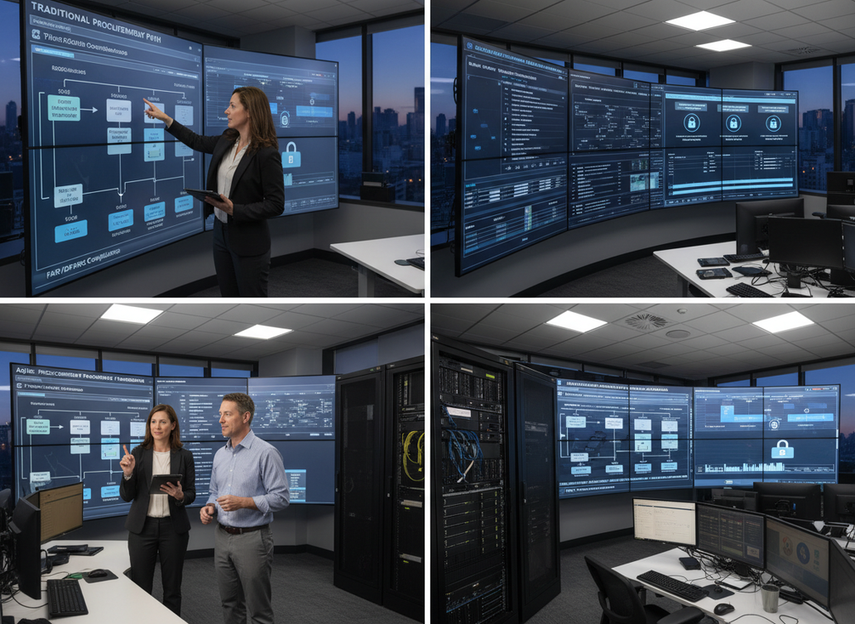
TAA also may not follow every component in a mixed-scope procurement. A command center project can include LED walls, control software, installation labor, AV integration, furniture, or construction-related work. One line item may be a covered supply while another may be a service or construction element with different treatment.
For navigation only, buyers who are scoping wall formats can review our mission-critical LED wall options, the C-Pad collection, or the C-Max collection. Those pages can help align form factor and layout choices, but they do not replace contract-specific compliance review.
TAA vs. Buy America
TAA and Buy America are often confused, but they are not interchangeable. Trade.gov’s federal procurement overview explains that TAA is a trade-agreement rule for covered procurement, while Buy America is a separate domestic-content framework often attached to infrastructure funding and agency-specific programs. In short: TAA is not a proxy for Buy America, and Buy America is not a proxy for TAA.
That distinction matters in command center LED wall projects because the buyer may see "American-made" references, domestic-preference clauses, or grant conditions and assume one rule settles the question. It usually does not. A product can be relevant under one framework and still fail another.
From a procurement standpoint, the safer model is to identify the funding path, identify the clause set, confirm whether the acquisition is direct federal procurement or grant-funded, and then evaluate the origin standard that actually applies.
If the team needs broader recordkeeping context, a secondary CE audit blog can help with general documentation habits. Use it for process context only, not as proof of compliance.
What Documents Buyers Should Request
For command center LED walls, the buyer should ask for documents that support both applicability and origin. The goal is to avoid relying on labels that sound compliant but are not traceable.
Request, at minimum:
- a written TAA applicability statement tied to the specific procurement path;
- country-of-origin documentation for the LED wall system and major components;
- a substantial transformation narrative when the supply chain is multi-country;
- manufacturer certifications or letters of origin;
- part numbers or BOM excerpts that map the quoted item to the delivered item;
- and confirmation that any substitutions will be pre-approved before shipment.
GSA emphasizes that contractors are responsible for accurate product information throughout the life of the contract. That makes ongoing documentation as important as the initial quote. Buyers should also request revision control: if the panel source, controller source, or assembly location changes, the file should show it.
A practical procurement file should show how the vendor got from component origin to the final offered product.
Common Procurement Mistakes
The most common mistake is treating "U.S.-based seller" as the same thing as TAA compliance. It is not. TAA focuses on where the product was made or substantially transformed, not where the reseller is headquartered.
Other frequent errors include:
- Assuming every GSA order is automatically covered without checking the contract clause set.
- Using Buy America language to justify a TAA conclusion.
- Accepting vendor self-certification with no backup documents.
- Overlooking that LED walls can be built from multi-country components.
- Ignoring mixed-scope packages where hardware and services follow different rules.
Another mistake is assuming final assembly solves everything. Trade.gov’s substantial-transformation guidance indicates that packaging or simple assembly is not enough. For command center LED walls, buyers should look for evidence that the country of origin decision was based on the actual manufacturing process, not the sales narrative.
A Safer Pre-Award Checklist
Before award, buyers can reduce risk by asking these questions in order:
- Is this a direct federal procurement, a GSA Schedule buy, or a grant-funded project?
- Does the path trigger TAA, Buy America, or another domestic-content rule?
- Is the item a supply, service, construction element, or a mixed package?
- Does the quoted LED wall system include origin support for panels, controllers, processors, and final assembly?
- If origin is mixed, is there a substantial-transformation analysis?
If any answer is unclear, pause the award and request clarification. That is usually faster than cleaning up a problematic order later.
For the final decision, confirm the procurement vehicle, collect origin evidence, and match the exact LED wall configuration to the rule that actually applies. If the solicitation does not clearly say whether TAA or Buy America applies, stop there and verify before award.
FAQs
Does TAA Apply to Every Command Center LED Wall Sold to the Federal Government?
No. TAA often applies to GSA Schedule buys and some other covered procurements, but it depends on the specific acquisition path and contract terms. Buyers should confirm applicability before assuming the rule applies.
If a Command Center LED Wall Is Assembled in the United States, Is It Automatically TAA Compliant?
Not automatically. For TAA purposes, the key question is whether the product was wholly manufactured in, or substantially transformed in, the U.S. or a designated country. Simple final assembly may not be enough.
How Does a Mixed Package Affect TAA Screening?
Mixed packages can create mixed rules. Hardware, software, installation, and construction-related work may not all follow the same standard, so each line item should be reviewed separately.
Why Can’t We Use Buy America as a Shortcut for TAA?
Because they are different regimes. Buy America usually applies in grant or infrastructure contexts, while TAA governs covered federal procurement. One does not prove the other.
What Is the Most Useful Document to Request First From a Vendor?
Start with a written applicability and origin statement tied to the exact configuration being quoted, then ask for supporting origin documents if the answer is not already clear. That gives the fastest path to a defensible file.





