

Choosing the right stage LED screen comes down to three choices: which panel meets your needs the best, what screen size you need based on the space you have, and whether you should rent one or buy it outright. When you make a bad choice in these three areas, it’s clear right away: startup time is wasted, power is wasted, and footage doesn’t show up right on the camera.
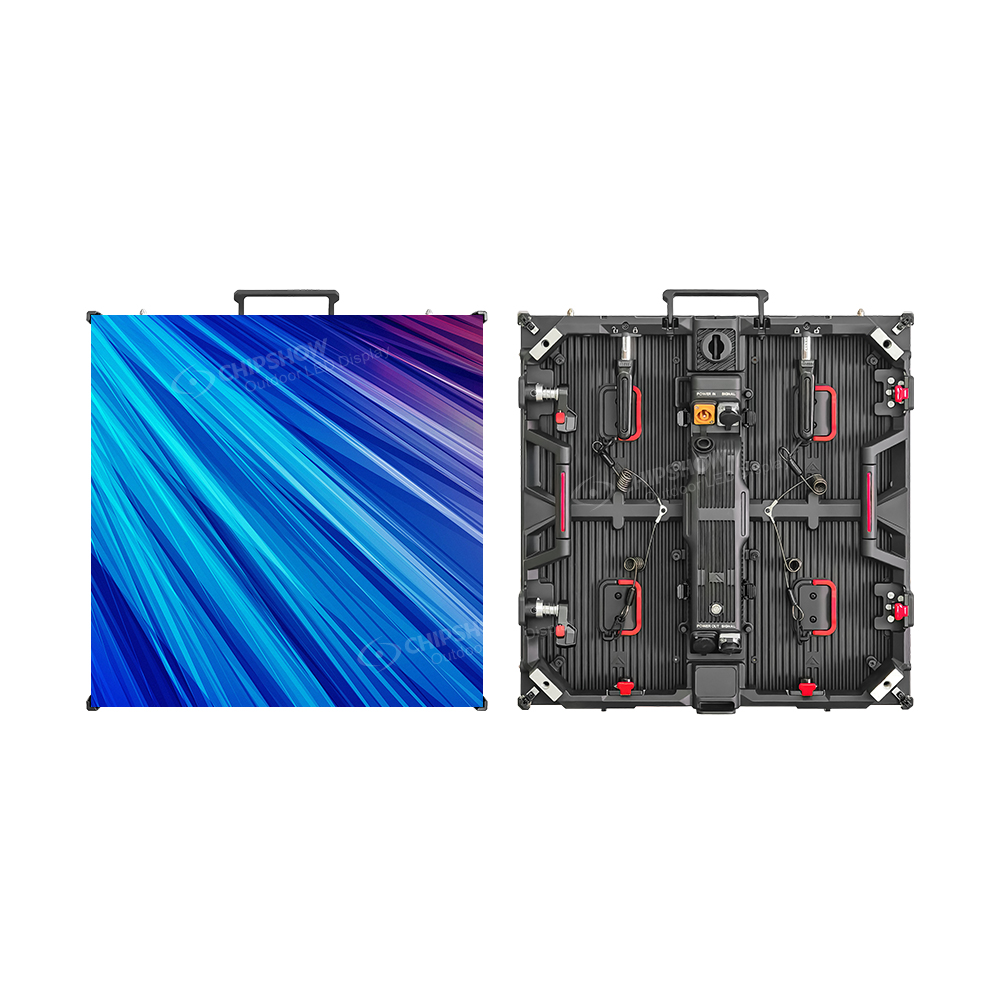
What Types of Stage LED Screens Are Available
The type of cabinet you choose will have implications in terms of weight, rigging time, and operational half-life of the screen for dozens of events.
Standard Rental Video Wall Panels
Modular panels are the backbone of most touring and event setups. Cabinet sizes of 500×500 mm (19.7×19.7 in) are the industry standard for rental: they are lightweight, stackable, and compatible with most truss and ground-support systems.
Larger 1000×1000 mm (39.4×39.4 in) cabinets are gaining ground for big outdoor builds. Fewer panels mean fewer cable connections, fewer rigging points, and faster load-in on wide-format stages.
SMD (surface-mount device) is the standard panel technology across all common pixel pitches in stage and touring applications. COB technology, with its impact-resistant, sealed surface, is more relevant to fixed close-viewing installations where the screen is viewed from under 2 m (6.6 ft), rather than typical stage deployment distances.
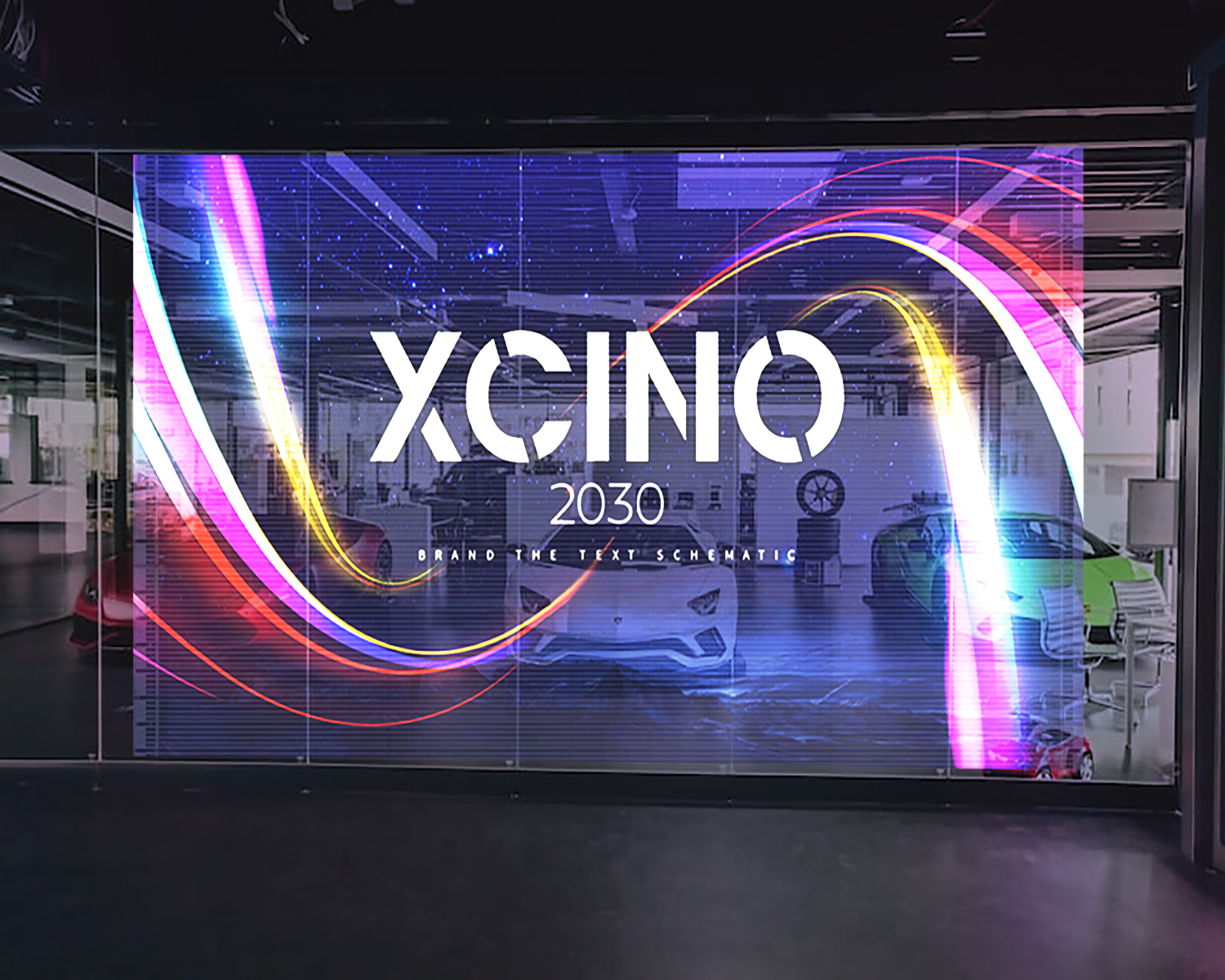
Transparent and Curtain LED Panels
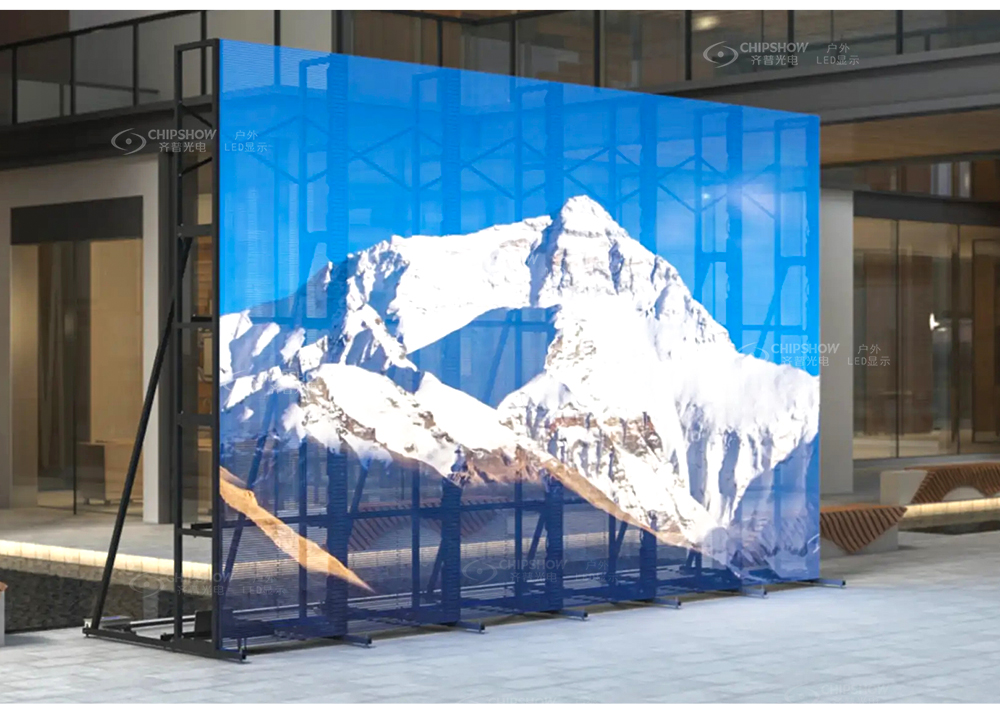
Transparent screens have a transparency range of 35% up to 65%. They enable the passage of stage lighting through the display screen, thus allowing a layering effect without obscuring the background. They have a weight range of 12 to 15 kg/m² (2.46 to 3.07 lb/ft²), thus suitable for truss suspension.
These panels suit high-end concerts, brand launch events, and XR (extended reality) virtual production setups where the screen is part of the visual design rather than just a backdrop.
Rental Cabinets vs. Fixed Installation Cabinets
|
Feature |
Rental Cabinet |
Fixed Installation Cabinet |
|
Frame material |
Carbon fiber or magnesium alloy |
Standard aluminum |
|
Weight (500×500 mm / 19.7×19.7 in) |
Approximately 3 to 7 kg (6.6 to 15.4 lb) |
As low as 7.5 kg (16.5 lb) with latest magnesium alloy cabinets (traditional aluminum models are heavier) |
|
Lock system |
Quick-lock, tool-free |
Bolt-mounted |
|
Maintenance access |
Front and rear |
Front or rear |
|
Best for |
Touring, multi-event deployment |
Theaters, churches, conference centers |
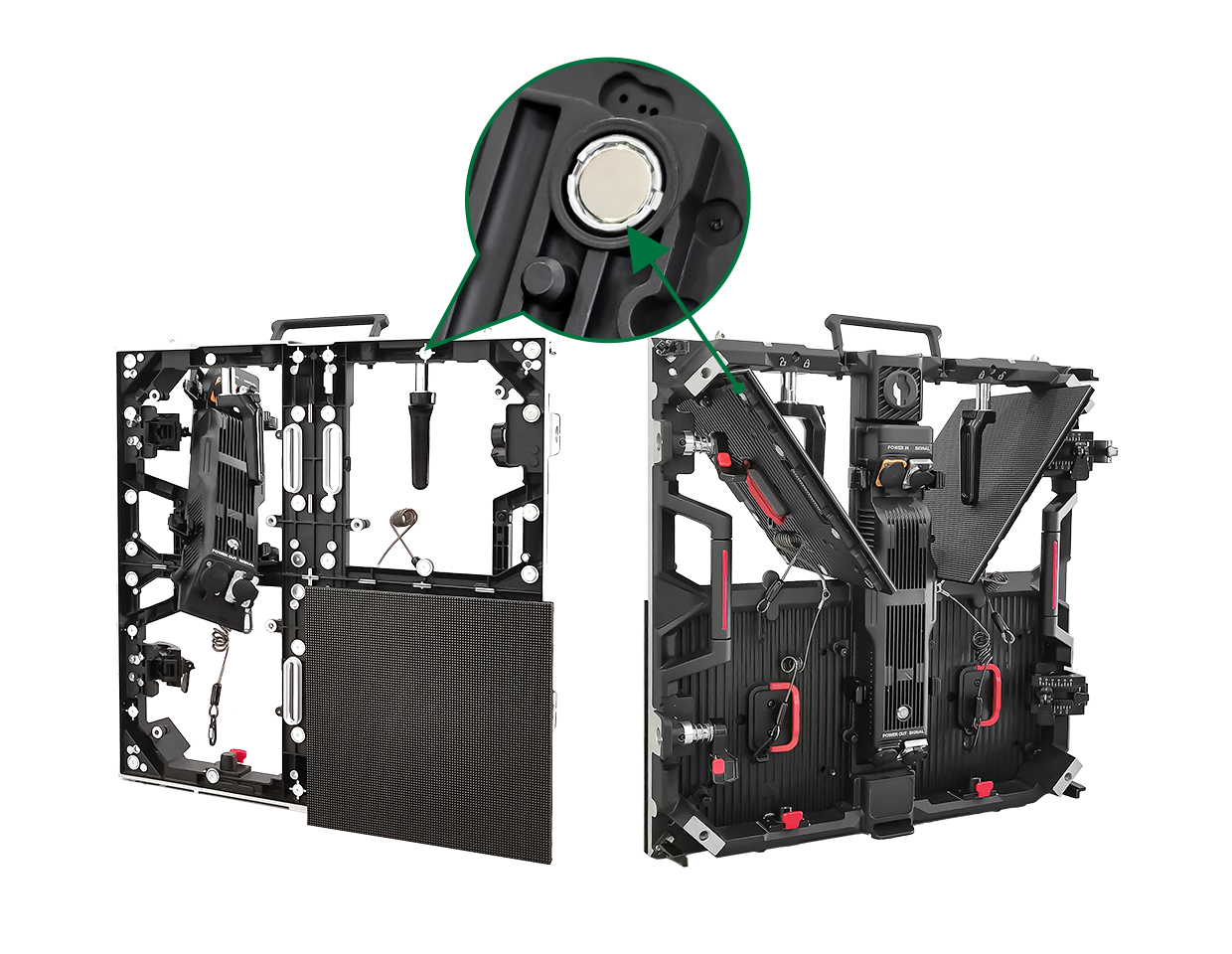
Rental cabinets absorb the mechanical stress of repeated setup and teardown. Fixed cabinets cost less per unit but require more installation time. Match the cabinet type to how often you move the screen.
How Do You Choose the Right Pixel Pitch for a Stage Background LED Screen
Pixel pitch is the space, in millimeters, between the centers of two LED pixels that are next to each other. A low pixel pitch makes the sharpness high and lets people see things from closer.
Pixel Pitch and Minimum Viewing Distance
The following are practical rules for quick decision-making:
- Minimum viewing distance (meters) ≈ Pixel Pitch (mm)
- Minimum viewing distance (ft) ≈ 3 × Pixel Pitch (mm)
Typical examples using the 3× feet rule:
- P1.9: minimum viewing distance ≈ 1.9 m (5.7 ft)
- P2.6: minimum viewing distance ≈ 2.6 m (7.8 ft)
- P2.97: minimum viewing distance ≈ 3.0 m (8.9 ft)
- P3.91: minimum viewing distance ≈ 3.9 m (11.7 ft)
Pixel Pitch by Event Type
|
Event Type |
Recommended Pixel Pitch |
Typical Viewing Distance |
|
Corporate conference, church |
P1.9 to P2.6 |
3 to 6 m (10 to 20 ft) |
|
Theater, touring indoor show |
P2.6 to P3.91 |
4.5 to 12 m (15 to 40 ft) |
|
Outdoor festival, concert |
P3.91 to P4.81 |
7.5 m (25 ft) and beyond |
What Refresh Rate Do You Need for Camera Coverage
For events with live broadcast, multi-camera recording, or audience smartphones, refresh rate matters as much as resolution.
A refresh rate of 3840 Hz or above is now the industry standard for stage LED displays. This level effectively eliminates visible flicker and moiré patterns (the distracting wavy lines seen on camera) in camera footage.
For broadcast-quality stage shows, panels with refresh rates lower than 3840 Hz are usually not a good idea because flicker artifacts that happen at lower refresh rates can’t be fixed after the fact.
How Do You Size a Stage LED Screen for Your Venue
Screen sizing involves three inputs: physical constraints of the space, cabinet count calculation, and aspect ratio alignment with your content format.
Step 1: Map the Physical Constraints
Before calculating screen size, confirm these four numbers:
- Ceiling height or available hanging clearance: This sets the maximum screen height for overhead-suspended installations.
- Stage width: sets the practical upper limit for screen width
- Distance from screen to front row: This is your minimum viewing distance and feeds directly into pixel pitch selection.
- Venue power capacity: Average power consumption runs around 180 W/m² (16.7 W/ft²) under typical operating conditions. Confirm the venue can support your total draw before finalizing the screen size.
Step 2: Calculate Cabinet Count
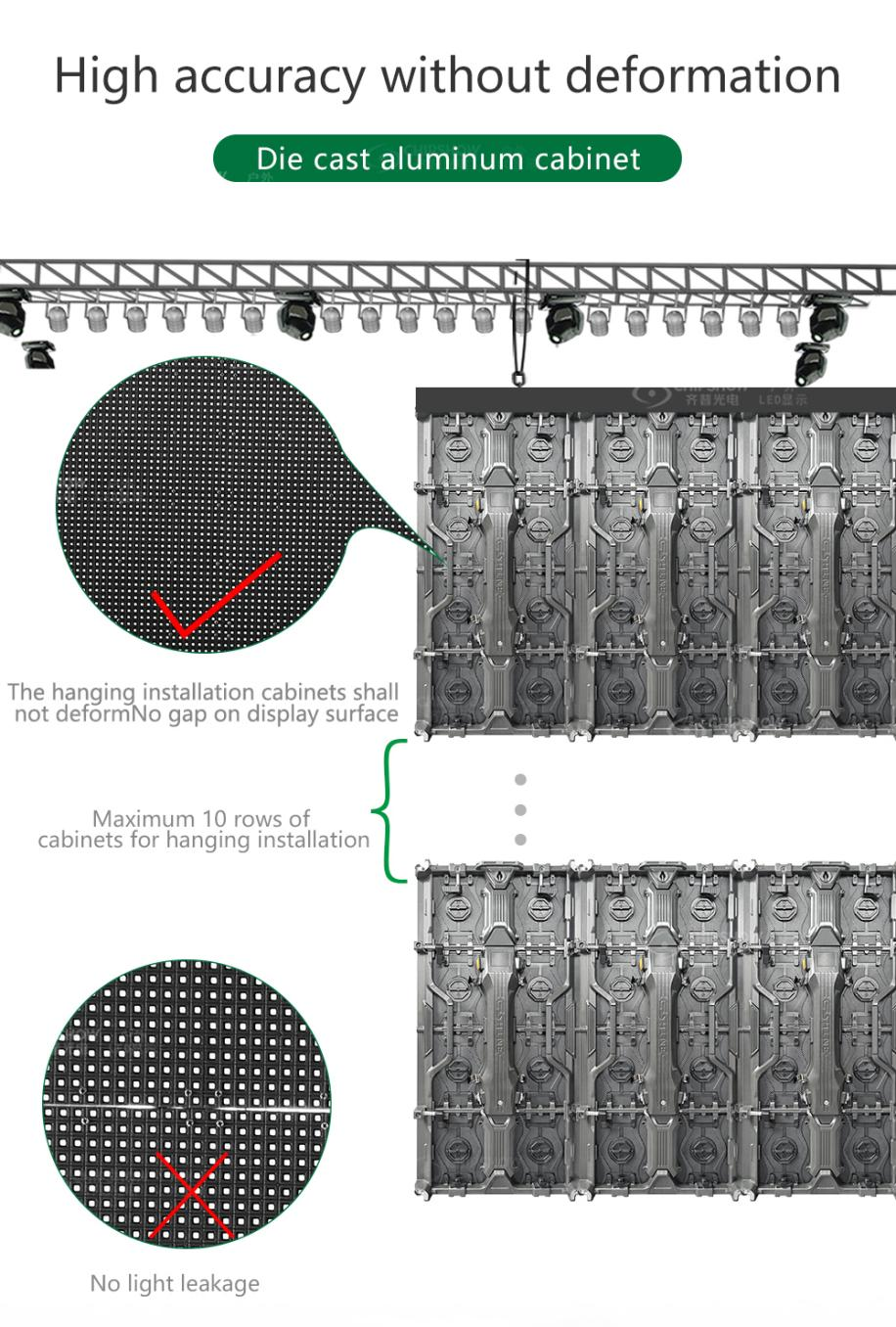
You can calculate the panel count in three simple steps.
Target width (mm) divided by cabinet width (mm) = number of columns. Target height (mm) divided by cabinet height (mm) = number of rows. Columns multiplied by rows = total panel count.
Example: a 6 m (20 ft) wide by 3 m (10 ft) tall screen using 500 mm (19.7 in) cabinets requires 12 columns and 6 rows, for a total of 72 panels. The same screen built with 1000 mm (39.4 in) cabinets requires only 18 panels, which reduces cable runs and rigging time on large builds.
Step 3: Match Aspect Ratio to Content Format
|
Aspect Ratio |
Best Use Case |
|
16:9 |
Standard video playback, presentations, live feeds |
|
4:3 |
Legacy content formats |
|
Ultra-wide (4:1 or wider) |
Concert backdrops, panoramic stage design |
|
Portrait (vertical) |
Side screens, sponsor towers |
Once the aspect ratio is confirmed, provide the exact pixel dimensions (total width in pixels by total height in pixels) to your content team. If content is not built to match the screen resolution, you will see stretching or black bars on the day of the show.
Screen Size Reference by Event Scale
|
Audience Size |
Recommended Screen Width |
Pixel Pitch Range |
|
Under 200, indoor |
3 to 5 m (10 to 16 ft) |
P1.9 to P2.6 |
|
200 to 500, indoor or semi-outdoor |
5 to 8 m (16 to 26 ft) |
P2.97 to P3.91 |
|
500 to 2,000, outdoor concert |
8 to 16 m (26 to 52 ft) |
P3.91 to P4.81 |
|
Over 2,000, large festival |
16 m+ (52 ft+), multi-screen |
P3.91 or larger |
Should You Rent or Buy a Complete LED Wall System
The answer depends on how often you use the screen and what your total cost of ownership looks like over three to five years.
When Renting Makes More Sense
Renting is the right call when annual usage falls below approximately 20 to 30 event days per year. It also makes sense when you lack storage space, lack a crew trained to maintain panels, or need a one-time solution for a non-recurring event.
Factor in more than the rental day rate. Transportation, damage deposits, operator fees, and insurance add up. Get a full itemized quote before comparing rental cost against purchase cost.
When Buying a Stage LED Screen for Sale Is the Better Decision
For rental companies and production teams running 30 or more event days per year, purchasing builds equity and lowers per-event cost over time. Permanent venues such as theaters, churches, and conference centers almost always reach payback within two to three years compared to ongoing rental expenditures.
Cabinet weight is a factor that is often underestimated in total cost calculations. Lighter panels (carbon fiber or magnesium alloy frames) reduce truss load, cut labor time during setup, and lower freight costs per tour leg. Over 50 events per year, the weight difference between panel formats translates into a measurable cost gap.
What a Complete LED Wall System Quote Should Include
A quote that covers only the panels is incomplete. A full system requires:
- LED panels (with pixel pitch and cabinet format specified)
- Video processor and signal distribution hardware
- Power distribution cabinet
- Rigging hardware: truss, ground support, or wall-mount structure
- Flight cases for transportation
- Spare modules (5% of the total panel count is the standard recommendation)
- Installation and commissioning service
- Warranty terms, including response time and parts coverage
Red flags in any quote: brightness listed as peak value only (working brightness can be 30 to 50% lower), no CE or UL certification documentation, and no local technical support contact.
What Specs Matter Most When Comparing LED Screens for Sale
Brightness by Installation Environment
|
Environment |
Recommended Brightness |
|
Indoor, controlled lighting |
600–800 nits (calibrated working brightness); higher values can cause eye strain in conference or stage environments |
|
Semi-outdoor, covered venue |
2,500 to 4,000 nits |
|
Outdoor, direct sunlight |
4,000 to 6,000 nits |
Always ask for the calibrated working brightness, not the peak specification. The difference matters in direct sunlight.
IP Rating for Stage Use
- IP65 (front and rear): required for all-weather outdoor deployment
- IP54: adequate for semi-outdoor or indoor use with incidental moisture exposure
- IP43 or below: indoor fixed installation only
For rental panels that move between indoor and outdoor events, IP54 is the practical minimum. IP65 on both faces eliminates risk across all deployment scenarios.
Cabinet Weight and Structural Build Quality
For rental operations, weight per panel determines truss load limits, crew requirements, and freight cost. The difference between a 10 kg (22 lb) panel and a 15 kg (33 lb) panel is marginal for a single cabinet but adds up to hundreds of kilograms (pounds) on a large touring build.
Quick-lock systems and magnetic module alignment reduce setup time and minimize damage from repeated handling. Edge corner protection and anti-collision design on the cabinet face extend the service life of panels that take constant physical contact each time the screen is set up and packed down.
Front Serviceability
Front-access maintenance allows technicians to replace a failed module without dismantling the screen structure from the rear. On a live event day, that capability is the difference between a five-minute fix and a forty-minute teardown. For permanent installations where rear access is blocked by a wall, front serviceability is not optional.
Quick Reference: Best Stage LED Screen Specs by Use Case
|
Use Case |
Pixel Pitch |
Brightness |
Cabinet Format |
|
|
Indoor corporate / church |
P1.9 to P2.6 |
600 to 800 nits |
IP43 to IP54 |
500 mm (19.7 in) fixed or rental |
|
Touring indoor show |
P2.6 to P3.91 |
boek800 to 1,200 nits |
IP54 |
500 mm (19.7 in) rental |
|
Outdoor festival / concert |
P3.91 to P4.81 |
4,000 to 6,000 nits |
IP65 |
500 mm (19.7 in) or 1000 mm (39.4 in) rental |
|
Permanent theater / venue |
P1.9 to P2.97 |
600 to 1,200 nits |
IP43 to IP54 |
Fixed installation |
Use this table as your starting point, then adjust based on your front-row distance and venue power supply.
Buy the Right Stage LED Screen for Your Next Build
There are three questions that come first in the choice of panel type: How far away is the front row? How many event days will this screen be shown each year? Also, does your content team know the exact number of pixels that your screen has? By taking care of these basic problems, you will be able to balance the cost of the investment with the cost of running the business, and you will also get perfect visual performance. Once you’ve made sure that these methods work with your specific limitations, you’ll find that the rest of the tech spec is easy and gives you confidence.
FAQs About Stage LED Screens
Q1: How to Determine if a Venue Has Sufficient Power for an LED Wall?
Plan for an average draw of 180 W/m² (16.7 W/ft²) when everything is working as it should. This number will tell you how much it really costs to run your business. When scenes are all white, the peak draw can be quite a bit higher. Of late, only loading the circuits to 80% of their value has been done. Before the event, check with the electrician at your venue that the power source can handle the peak load for a standard 6 m (20 ft) wide wall.
Q2: Is Cabinet Weight Significant for Permanent Stage Installations?
Yes. Even though it’s not as important as it is in rental markets, weight does have a direct effect on the cost of structural engineering. When you use lighter magnesium alloy cabinets, you don’t have to use expensive strengthened wall mounting or heavy-duty steel trussing. When you choose lightweight panels, you can save a lot of money on work and building materials, especially for bigger projects.
Q3: Should Resolution or Brightness Take Priority for Outdoor Festivals?
When used outside, brightness (5,000+ nits) is much more important than a high pixel pitch. It doesn’t matter how high-resolution the P2.6 screen is if you can’t see the picture because it’s in full sunlight. It is more important to know the “Calibrated Working Brightness” specification than the device’s possible highest output.
Q4: What Is the Most Common Error When Purchasing a Complete LED Wall System?
Many people make the mistake of not thinking about the “hidden” parts and pieces of infrastructure. When someone buys a control panel, they might only think about how much it costs, not how much high-end video processors, flight cases, and rigging systems cost. The cost of these important parts of a video control system is usually between 20% and 30% of the total cost.
Q5: Can I Use Indoor LED Panels for a Covered Outdoor Stage?
Not at all. Even if it doesn’t rain on them, they won’t be bright enough to see outside because the sun will wash them out. To be seen outside, they will need to be at least 4,000 nits bright. There is also a problem with “caterpillar” failures, which happen when certain types of SMD lamps stop working when they come into contact with moisture. This damages many pixels, especially in rows of LEDs. Most covered stages outside need to be IP54.
Q6: How Do You Calculate the Weight Load for a Hanging LED Wall?
All cabinets, fly bars, and cables will add up to the total weight. Before any overhead work is done, this number must be split with a certified rigger. This is because motor points, truss ratings, and safety factors are all controlled locally and will be different from one venue to the next. You should never try to figure them out on your own.
Motor points are usually rated many times higher than this number for planning reasons, but safety factors vary and must be checked by a qualified professional in each area.