


A solar VMS battery sizing guide should start with runtime, not hardware. For portable and off-grid message signs, the first question is how long the unit must operate without recharge, then whether the site can recover that energy in real conditions. That order helps buyers avoid underbuilt systems, but it also avoids paying for reserve they do not need. If you are comparing bids, focus on autonomy, recovery, maintenance access, and the assumptions behind the vendor’s claim rather than on the panel or battery label alone.
What Drives Solar VMS Power Needs
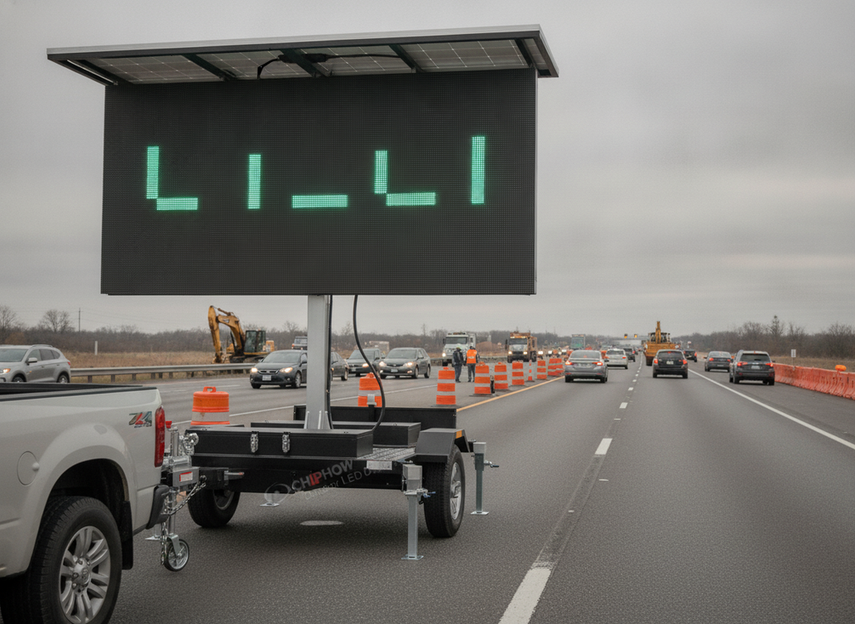
For most buyers, solar VMS demand is a mix of display load, controller draw, brightness behavior, and how long the sign must stay up without outside power. The sign face is only part of the budget. Automatic dimming, for example, can help manage battery use while keeping the sign readable in changing light, which is why some agencies build automatic dimming and power budget language into their guidance.
The bigger mistake is treating the answer as panel-first instead of runtime-first. Sunlight, shading, trailer orientation, season, dirt, and temperature all change how much solar energy actually reaches the battery bank. A sign that looks well sized on paper can still underperform in winter or on a partly shaded roadside shoulder.
If the deployment is year-round or remote, the sizing conversation should begin with the longest expected gap between reliable recharge opportunities. If the deployment is short-term and service access is easy, the design can usually be lighter. The core question is not "How big can the system be?" It is "What operating gap must it survive, and what field conditions will slow recovery?"
Size the Battery Bank Around Runtime
The most useful solar VMS battery sizing guide starts with autonomy, then translates that autonomy into usable battery capacity. The benchmark many procurement teams recognize is the 21-day autonomy requirement used in a major New York DOT portable VMS specification. That does not mean every agency uses the same threshold, but it is a strong comparison point when you are reviewing claims about continuous operation.
Estimate Daily Energy Use
Start by listing every load that draws from the system: the display, controller, radios, message storage, and any auxiliary equipment. The display’s brightness behavior matters too, because the same sign can use less power at night than in direct sun if it dims automatically. For sizing, that means you should ask vendors which loads are included in their runtime math, and whether the number assumes aggressive dimming or a fixed output level.
Choose an Autonomy Target
Autonomy is the time the sign must keep operating before solar recovery is expected to catch up. A longer target is usually the safer choice for roadside work with poor access, weather swings, or high downtime cost. A shorter target may be acceptable for seasonal or closely managed deployments, but only if maintenance is dependable and the outage risk is tolerable.
Account for Battery Usable Capacity
Nominal battery capacity is not the same as usable capacity. Depth of discharge, aging, and temperature all reduce what is actually available in the field, so a battery that looks adequate on a spec sheet can still leave too little reserve in real use. That is why proposal review should compare usable capacity assumptions, reserve margin, and replacement planning instead of just comparing nameplate size.
In practical terms, a system sized for the advertised number without reserve is usually the one that fails first when weather turns or service access slips. If a bid does not state the autonomy assumption, the load basis, and the usable-capacity logic, it is not really comparable.
Estimate Solar Input in Real Conditions
Solar sizing is the other half of the reliability problem. The important question is not whether the panel can generate power on a clear day. It is whether the array can refill the battery bank quickly enough after cloudy periods and seasonal lows. In some DOT-style specifications, the planning target is a solar recovery benchmark that requires the system to recover at least the previous day’s energy use in a single peak-sun day.
Translate Sunlight Into Energy
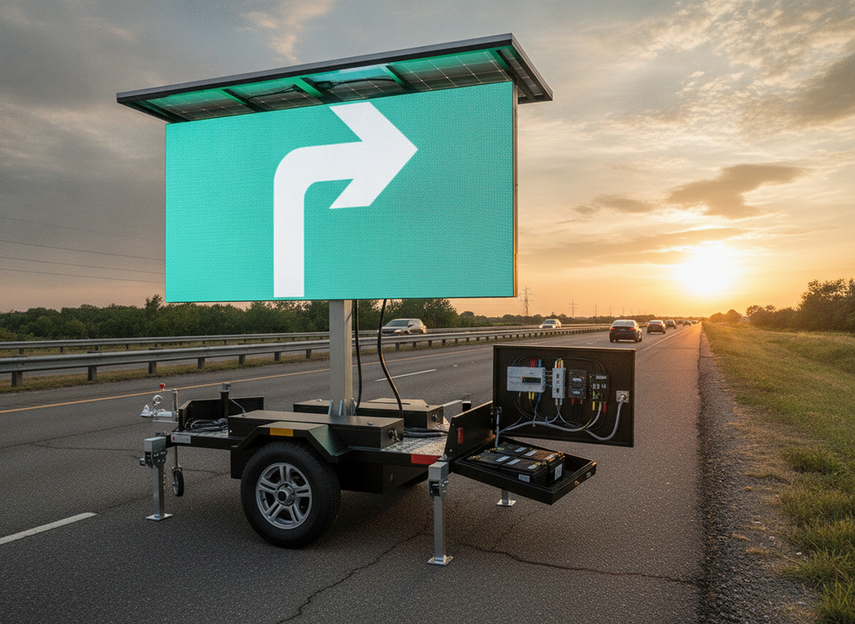
Panel nameplate rating is only a starting point. Real production changes with tilt, orientation, heat, dust, and shading, so a trailer-mounted unit rarely performs like an ideal lab setup. For off-grid highway sign planning, the useful question is how much energy the site can expect to harvest on an ordinary day, not how high the panel rating looks in a catalog.
Plan for Seasonal Weakness
Winter and shoulder seasons often create the tightest design window. In many US roadside deployments, the conservative case is not summer but the period when daylight is shorter, clouds are more common, and the sun angle is less favorable. If the sign still needs to stay up then, the solar VMS battery sizing guide has to assume that weaker period, not the most flattering month.
Check Recovery Time After Cloudy Periods
A system can look fine on average and still fall behind after several low-sun days. That is why recovery time matters as much as daily output. If the array cannot restore reserve quickly enough, the sign can drift into a rolling shortfall even though the battery bank seemed large enough at the start.
A good bid comparison asks for both numbers: how long the system lasts without recharge, and how quickly it recovers once sun returns. One test does not replace the other. A sign can meet an autonomy target and still be a poor fit if recovery is too slow for the local weather pattern.
Match Uptime, Cost, and Maintenance
Different deployments justify different sizing bias. The table below helps show where reserve margin matters most and where lower upfront cost is more defensible.
Reserve Margin vs. Upfront Cost by Deployment Profile
A conservative planning aid for portable solar VMS deployments. Profiles with longer unattended periods or harder maintenance access justify more reserve margin; shorter-duration or seasonally reused deployments can often prioritize lower upfront cost if maintenance access is dependable.
View planning table
| Deployment profile | Reserve margin need | Upfront-cost pressure | Maintenance burden |
|---|---|---|---|
| Short-duration work zones | Lower | Higher | Lower |
| Seasonal deployments | Lower | Medium | Medium |
| Year-round roadside use | Medium | Medium | Higher |
| Remote sites with limited service access | Higher | Higher | Higher |
What this means in practice is simple. Short-duration jobs can often accept a leaner system if service access is reliable. Year-round roadside use usually needs more reserve and a tighter maintenance plan. Remote sites raise both the cost of an outage and the cost of a service trip, so undersizing is more likely to become expensive than oversizing.
If the proposal does not spell out service access, replacement planning, and acceptable downtime, the buyer is not comparing total cost of ownership. That is why procurement language matters as much as the hardware list.
Build a Year-Round Maintenance Checklist
Routine maintenance is often the difference between a well-sized system and a system that only looks well sized. The FHWA PCMS handbook recommends monthly cleaning of the screen, door panels, and solar panels, plus battery checks several times per year. Monthly cleaning and battery checks are not glamorous, but they keep dirt, corrosion, and weak connections from masquerading as design failures.
- Clean the solar panels and sign face on a monthly schedule.
- Inspect battery terminals for corrosion and looseness several times per year.
- Check cables, mounts, and cabinet seals for wear or water intrusion.
- Review controller readings so low charge, dimming behavior, and fault patterns are visible early.
- Recheck the system after storms, winter weather, or long idle periods.
- Document service dates so repeat issues can be separated from one-off events.
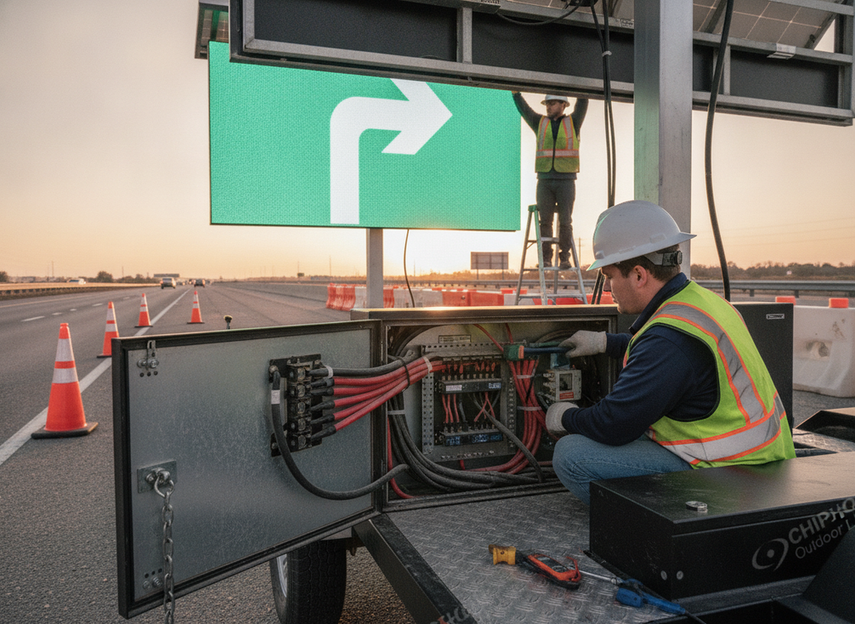
The practical rule is to troubleshoot upkeep first when the failure looks gradual. Dirt, corrosion, or loose hardware can reduce output just enough to feel like an undersized battery bank. If the power loss persists after cleaning and inspection, then the sizing assumptions deserve a closer look.
Procurement Checklist for Solar VMS Selection
DOT-style specs are useful because they turn power-system expectations into verifiable language. TxDOT’s procurement item language is a good example of how a bid can define battery protection, solar mounting, and operating requirements without relying on marketing copy. That is the right way to compare portable solar VMS offers.
- Confirm the autonomy target and the load basis behind it.
- Ask how the vendor defines usable battery capacity, not just nominal capacity.
- Check whether recovery assumptions are tied to local sun conditions or to an ideal case.
- Verify how the proposal handles cloudy periods, seasonal lows, and recharge timing.
- Review service access, battery replacement planning, and maintenance intervals.
- Make sure dimming, controller logic, and any auxiliary charging are described clearly.
- Translate compliance language into a specific check, not a vague promise.
- Compare bids on the same assumptions so the cheapest option is not just the most optimistic one.
If a proposal will not state its assumptions, it is safer to treat the quote as incomplete. For a solar VMS battery sizing guide, that is usually the clearest sign that the buyer still needs more detail before approval.
Final Takeaway
Solar VMS buying decisions are easiest to get wrong when the conversation starts with panel size instead of runtime, recovery, and maintenance access. A conservative design checks autonomy first, then solar recovery, then the field conditions that will change both. If you are reviewing bids, compare assumptions, not optimism. If you are planning a new deployment, treat service access and seasonal weather as part of the power system, not as afterthoughts.
FAQs
How Do You Size a Battery Bank for a Solar VMS?
Start with the load, then define the autonomy target, then add reserve for usable-capacity loss, aging, and temperature. The key is to compare proposals on the same runtime assumption. Without that, a larger-looking battery may still deliver less practical uptime than a smaller system with better reserve planning.
What Site Conditions Change Solar VMS Runtime the Most?
Sun exposure, shading, season, trailer orientation, dirt, and temperature usually move the result more than buyers expect. Duty cycle matters too, especially when brightness changes through the day. A site that looks fine in summer can behave very differently in winter or after a few cloudy days.
Can a Solar-Powered VMS Run Year-Round?
Sometimes, yes, but only when the autonomy target, solar recovery margin, and maintenance plan are conservative enough for local conditions. Year-round use is much more demanding than a short event deployment, so the system should be judged on the weakest expected season, not the easiest one.
Why Does Oversizing the Battery or Solar Array Matter?
Oversizing can improve reliability margin, but it can also raise cost, weight, and installation complexity. The right balance depends on how expensive downtime is and how often the unit can be serviced. Remote sites usually justify more margin than short-duration jobs with regular maintenance access.
What Should Buyers Verify in a Vendor Proposal?
Ask for the autonomy target, the load basis, the usable-capacity assumption, the recovery assumption, the service plan, and any battery replacement expectations. If the proposal also references item-coded procurement language, that is helpful because it makes the requirements easier to compare across bids.





