

A smart city pole LED display is a pole-mounted digital display used in a city corridor, downtown, or civic district project. For municipal teams, the main questions are the permit path, utility coordination, 5G integration scope, and RFP language you set before bids go out.

What a Smart Pole LED Display Does
In municipal planning terms, a smart pole LED display is a communication asset mounted on a pole or street-furniture structure. It may sit near power, communications gear, sensors, or cameras, but those elements are project choices, not automatic features.
That distinction matters because the planning question is different from the product question. The team needs to know what approvals, drawings, owners, and reviewers are involved before anyone assumes a given pole can carry display hardware, network equipment, or add-on devices. First confirm the site path, then confirm the hardware fit.
Permit and Right-Of-Way Basics
For a smart city pole LED display permit, the approval path usually starts with jurisdiction, ownership, and right-of-way control. Federal small wireless rules can matter if the project includes 5G equipment, because the FCC’s Small Wireless Facilities Declaratory Ruling and Third Report and Order limits certain fees and sets shot clocks for review. That does not erase local review, but it does change how cities should frame timing and cost assumptions.
Local oversight can still exist, especially for aesthetics and spacing, as long as the rules are reasonable and published in advance. A city should not write an RFP as if it has unlimited discretion over every detail, but it also should not assume federal rules leave no room for design review.
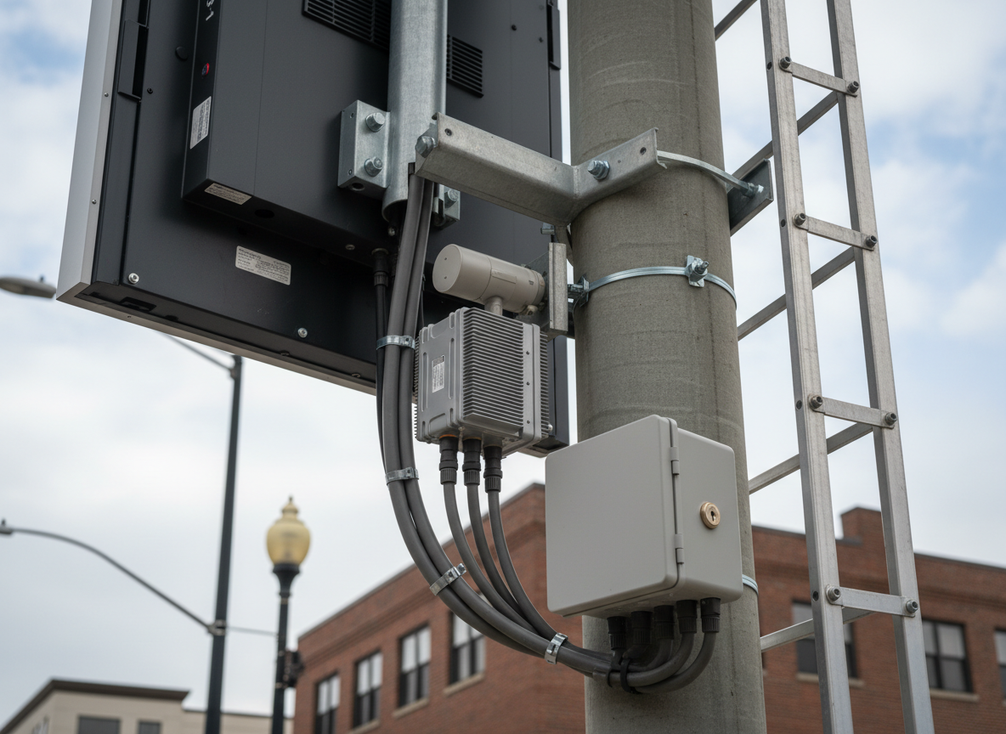
Common Approval Buckets
Most projects touch several review lanes at once: zoning or land use, right-of-way use, electrical, structural, and signage or display review. In some cases, utility attachment rules or street-furniture standards add another layer before procurement can move forward.
The exact sequence depends on who owns the pole, who controls the corridor, and whether the display sits on an existing support or a new installation. Federal siting rules can affect timing, while local code can still shape the aesthetic and physical fit. That is why the question is usually not "Do we need a permit?" but "Which permits, in what order, and who signs off first?"
Where Delays Usually Start
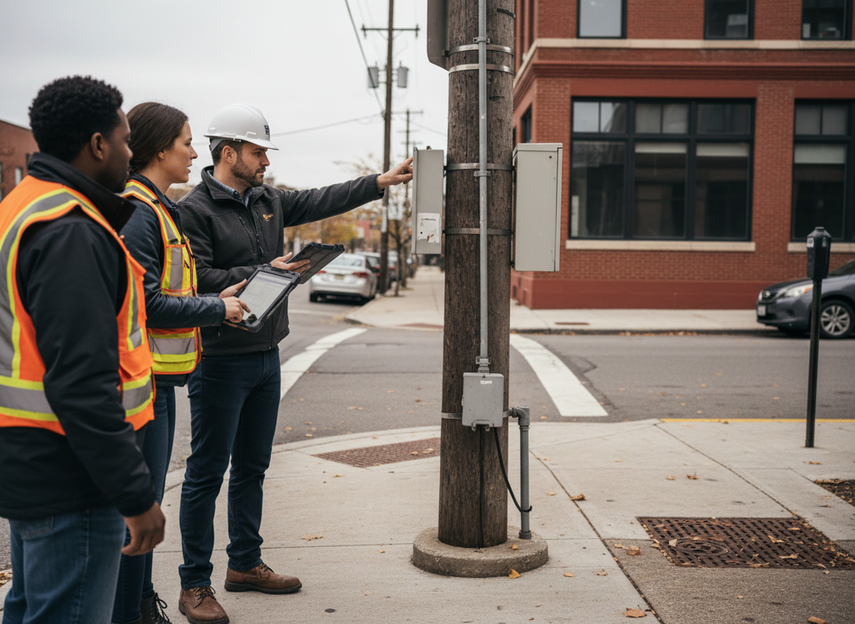
The slowdowns usually come from unclear ownership, missing utility coordination, or incomplete drawings. A city can also lose time when planning, public works, transportation, IT, and legal review in separate tracks with no single coordinator.
For a pre-RFP review, the key checks are simple: who controls the pole, who approves attachments, what drawings are required, and whether any height, setback, lighting, or messaging limits apply at that site. If those items are still fuzzy, the bid package will likely overstate certainty and understate risk.
What to Ask Before the RFP
Before procurement, ask for the exact approval path, the reviewing department, and the code basis for any pole-mounted equipment. The city should also verify whether the proposal needs internal wiring space or room for future municipal devices. A real ordinance example shows that internal wiring and enclosure space can matter in small wireless and smart pole rules, not just the visible display face eCode360 example ordinance.
If the local site has pedestrian crowding or tight curb space, confirm whether the pole layout leaves enough clearance for maintenance and public access. That is a practical planning check, not a legal conclusion.
Utility Coordination and Cross-Department Review
A smart pole project often stalls before the RFP because the utility, not the vendor, becomes the gating issue. The National League of Cities’ small cell action guide is useful here because it treats rollout as a cross-department process rather than a single-office approval.
For a smart city pole LED display project, the review usually works best when one team owns the coordination and the other departments supply inputs early. That reduces rework later.
- Planning checks land-use fit and corridor compatibility.
- Public works checks maintenance access and field conditions.
- Transportation checks curb space, pedestrian flow, and street-furniture conflicts.
- IT checks data path, device policy, and network assumptions.
- Legal or procurement checks the review sequence and RFP language.
The practical handoff inputs are usually site maps, power needs, data routing, maintenance access, and any local restrictions on visibility, access, or equipment placement. If those inputs are not gathered before solicitation, the city may end up pricing a project that still has unresolved design questions.
5G and Connected-Device Integration
Can a smart pole LED display support 5G and other connected devices? Sometimes, but only if the site design supports it. The main checks are power, backhaul, equipment space, and maintenance access. For pole-mounted equipment, structural review also matters; the AASHTO LRFD specifications for structural supports are the right kind of authority to anchor wind load, vibration, and fatigue concerns.
That means 5G integration is not just a product feature. It is a site-specific engineering question.
Power, Backhaul, and Cabinet Space
If the pole has display hardware, the city still needs to know where power comes from, where data goes, and whether the enclosure has enough room for the components the project actually needs. Maintenance access also matters, because a compact pole that looks clean on paper can become expensive if every service visit requires traffic control or a lift truck.
What changes the decision is not whether the vendor says "5G ready," but whether the proposal states the power, backhaul, and service assumptions in writing. If those assumptions are missing, the city should treat the claim as incomplete.
CCTV, Sensors, and IoT Checks
Cameras, sensors, and other IoT devices should be reviewed separately rather than assumed to come bundled with the display. A smart city pole LED display may be part of a multi-device platform, but the city still needs to verify mounting space, privacy rules, network requirements, and maintenance obligations for each device class.
That is especially important in civic districts where IT policy and public safety review may set different standards for video, telemetry, and signage. One device can be compatible while another is not.
What to Verify in Vendor Claims
Use a written verification checklist before the RFP goes live. Confirm which functions are standard, which are optional, and which require custom engineering. Ask vendors to state the power, network, and maintenance assumptions behind any 5G, CCTV, or IoT claim.
This is where the category can break down. A product page may suggest broad smart-city capability, but your site still needs proof of fit. The Chipshow C-Pole smart city display can serve as a fit example only after the neutral planning criteria are established, not as proof that every municipal site can support the same configuration.
How to Shape the RFP and Vendor Review
The RFP should translate planning risk into checkable requirements, not broad promises. The table below shows how to turn common planning issues into bid language and reviewer questions.
| Planning issue | RFP language to include | Reviewer question to ask |
|---|---|---|
| FCC timing and fee limits | State that the vendor must account for applicable FCC shot clocks and any fee constraints in the proposed schedule and compliance plan. | Does the proposal show a compliance path that respects FCC timing and fee limits without assuming extra review time? |
| Local aesthetic oversight | Require the vendor to address local aesthetic review criteria and identify any design elements likely to trigger appearance-related feedback. | Has the vendor shown how the design will satisfy local aesthetic expectations and avoid avoidable redesign? |
| AASHTO structural support | Require conformance with applicable AASHTO structural support standards and submission of the supporting design documentation. | Does the proposal demonstrate a structural approach that aligns with AASHTO support standards and the needed documentation? |
| Internal wiring or code compliance | Require coordination with internal wiring rules and cite the applicable code basis, using the local code example as the model for review readiness. | Has the vendor identified wiring compliance steps and the code references needed to verify the installation approach? |
For procurement review, keep must-have conditions separate from nice-to-have features. That helps the city compare vendors on the same basis and avoids paying for features that are not compatible with the site or the approval path.
RFP Readiness Checklist
Before you issue the RFP, confirm these items are settled:
- The pole owner, right-of-way authority, and lead reviewer are identified.
- The permit path is mapped for zoning, right-of-way, electrical, structural, and display review.
- Utility coordination has started and any power or attachment issues are documented.
- The city has written assumptions for 5G, backhaul, cabinet space, and maintenance access.
- Structural and clearance concerns are checked against the site conditions.
- The RFP requires drawings, load assumptions, and integration scope in writing.
If any of those answers are still open, pause before solicitation. Once the unknowns are closed, the project is ready for a cleaner bid process and fewer change orders.
Final Planning Check
For a municipal rollout, validate the site conditions, permit path, and integration scope before you issue the RFP. If you need a smart-pole display starting point, review the Chipshow C-Pole line after those checks are defined, not before them. That keeps the procurement conversation grounded in the site, not just the brochure.
FAQs
What Is a Smart Pole LED Display?
It is a pole-mounted digital display used in a smart city or corridor project. The key planning point is that the display may be only one part of a larger system, so cities should verify any added sensors, cameras, or network gear separately before treating them as built-in features.
What Permit Requirements Usually Apply to Smart Pole LED Displays?
They usually involve right-of-way, zoning or land use, electrical, structural, and display review, but the exact path depends on jurisdiction and pole ownership. If the site is in the public right-of-way, the approval sequence often changes based on who controls the pole and who signs off on attachments.
Can Smart Poles Support CCTV and 5G?
They can, but only if the site design supports the added load, power, backhaul, enclosure space, and department approvals. A useful check is whether the vendor can show those assumptions in writing for the exact site, rather than describing the platform in general terms.
What Should Be Included in the RFP Scope?
Include site assumptions, drawings, maintenance access, power and data needs, and any integration expectations for 5G, CCTV, or IoT. The stronger RFPs also separate required documentation from optional features so bidders are priced on the same scope.
Why Do Smart Pole Projects Get Delayed?
The most common delay points are unclear ownership, incomplete drawings, unresolved utility coordination, and review ownership that is split across departments. A simple way to reduce delay is to name one coordinator early and get the permit and integration questions answered before bids are due.