


Smart city pole LED displays are best treated as a public infrastructure decision, not just a signage purchase. For municipalities, the real work is balancing power availability, pole loading, permitting, accessibility, and security review so the smart city pole display fits the site without creating avoidable risk.
Why Pole Displays Trigger Extra Review
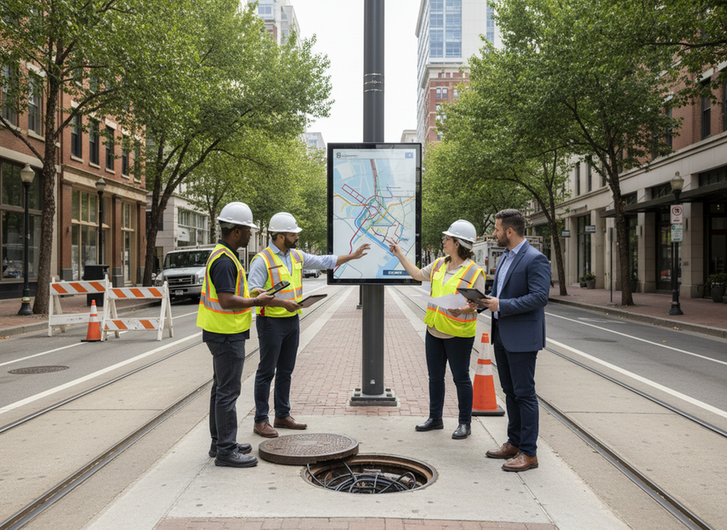
Pole-mounted LED displays combine electrical work, street attachment, public-right-of-way concerns, and connected-device oversight in one project. That is why a smart city pole display often gets more scrutiny than a standard sign. In practice, the friction usually comes from visibility, maintenance ownership, and security exposure, not from display size alone.
For planners, the useful shift is to treat the project as an infrastructure change. NIST’s smart city framework work reinforces that these deployments work best when cities think about governance and control, not only the media surface.
Permitting Pathways and Approval Friction
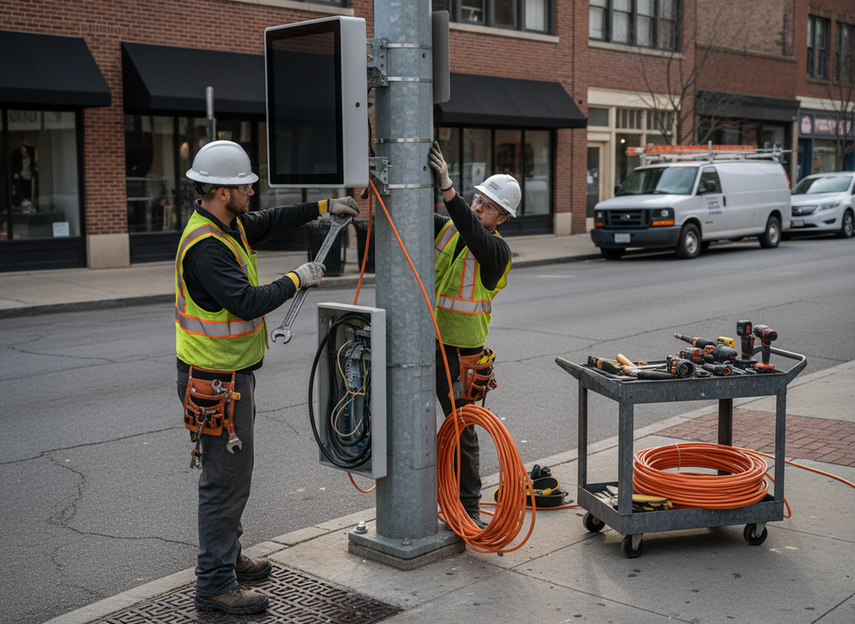
Permitting usually spans more than one office. Depending on the site, the project may involve public works, transportation, planning, building, utility coordination, and right-of-way review. The city should first confirm who controls the pole and who controls the space where the display will sit. That is more reliable than guessing at a universal sequence.
If the installation reaches into the public right-of-way, FHWA guidance on public-right-of-way and utility coordination is a useful anchor for the review logic. The key point is not a fixed permit list. It is that attachments, access, and clearances often require coordination between roadway authorities and utility owners.

Accessibility can also affect approval. The 2010 ADA Standards for Accessible Design include protrusion limits that matter when a pole-mounted device sits near pedestrian routes. If the display changes a sidewalk path, sightline, or usable clearance, the project may need redesign before it can move forward.
What Usually Slows Submittals
- Unclear pole ownership or consent path
- Missing electrical or attachment details
- Design review concerns about corridor character or brightness perception
- Maintenance access questions
- Public-comment or stakeholder concerns about street clutter
A practical way to reduce friction is to hold a pre-submittal meeting before product selection hardens the design. If the city cannot agree on the basic site path, the next step is a clarified review path, not a quote.
Power Planning for Pole Installations
Power planning should happen before procurement, not after. A pole may already have service for lighting or other street equipment, but that does not mean it has spare capacity for a display. Site-specific load calculations and utility coordination are the right starting point, because power needs vary by site, control method, and operating schedule.
Energy Star’s signage efficiency context is useful background, but it does not replace a field review. Scenic America’s discussion of digital signage energy consumption points to the same practical lesson: do not assume the category tells you the load. The site does.
| Site Factor | Why It Matters | Who Usually Verifies It | What To Document |
|---|---|---|---|
| Pole ownership | Determines who can approve attachment and access | Public works, utilities, asset owner | Ownership record and consent path |
| Available service | Shows whether the site has enough headroom | Electrical engineer or utility reviewer | Load assumptions and service notes |
| Conduit and routing | Affects installation cost and disruption | Engineer, contractor, utility team | Route plan and access points |
| Disconnect access | Matters for service and safety | Facilities or electrical reviewer | Shutoff location and service plan |
| Continuity expectations | Clarifies outage behavior and operating limits | Project owner and operations team | Backup or recovery assumptions |
The most useful output is a documented feasibility review, not a guess about wattage. If that review is incomplete, the smart city pole display should stay in discovery rather than moving into final design.
Municipal Security Review for Connected Displays
Once a pole display is networked, it becomes a managed endpoint and possibly an operational dependency. That means municipal smart city pole cybersecurity review should focus on access control, segmentation, remote management, logging, and vendor support. CISA’s smart city cybersecurity best practices are the right starting point for that conversation.
For cities, the main question is exposure reduction. Who can log in, who can change content, how are credentials protected, and how is the device isolated from more sensitive systems? A display does not need to be treated as dangerous to deserve a careful review. It just needs to be treated like any other connected municipal asset that can create problems if access is sloppy.
Security Review Checklist
- Who can publish or schedule content?
- Are default credentials removed or changed?
- Is remote access restricted to approved users and devices?
- Does the vendor provide a supported update path?
- Is the display segmented from critical operational systems?
- Are logs retained for troubleshooting and incident review?
- What is the process for disabling content during an emergency or compromise?
This is also where buyer expectations should stay realistic. CISA guidance supports better practice, not guaranteed safety. If a vendor presents the system as inherently secure, the city should still verify how access and updates actually work.
Ownership, Maintenance, and Procurement Terms
The easiest way to create an orphaned device is to buy hardware before assigning responsibility. A pole display needs clear ownership for cleaning, access, repairs, firmware or content updates, and response times. It also needs a written answer to who takes over if the original integrator exits the project.
A practical procurement package should spell out warranty boundaries, spare parts access, escalation contacts, and outage response expectations. That matters even more when the display is tied to public messaging or a corridor that cannot afford long downtime. If the city wants emergency messaging, the contract should say so before award, not after installation.
For a broader planning path, the Outdoor DOOH options page is useful only after the site and approval questions are defined. It should not drive the decision before those constraints are settled.
A Practical Evaluation Checklist
Use this sequence in a pre-submittal meeting or internal review:
- Confirm the use case. Is the display for wayfinding, civic notices, transit updates, or another defined function?
- Confirm site control. Who owns the pole, and who has authority over the right-of-way or frontage?
- Confirm the approval path. Which offices need to review structure, electrical work, content operation, or placement?
- Confirm the power path. Can the site support the load, routing, and access requirements?
- Confirm accessibility impacts. Will the installation affect pedestrian clearance, visibility, or public use?
- Confirm security controls. Who can manage the device, and how is access limited?
- Confirm maintenance ownership. Who repairs the display, restores service, and handles updates?
- Confirm contract terms. Are warranty, service escalation, and spare parts responsibilities written down?
- Confirm stakeholder sign-off. Do public works, IT, procurement, and operations agree on the next step?
If several of those answers are still open, the project is still in discovery. If site control, power, security, and maintenance are settled, the city may be ready for submittal or vendor selection.
Common Objections and Why They Matter
The most common objections are not random. They usually fall into four buckets: aesthetics, maintenance access, security exposure, and unclear long-term ownership. That is why connected street pole display objections often show up before procurement finishes. If the city has not answered who maintains the display or who approves content, the project can stall even if the hardware itself looks suitable.
A second common problem is treating the display as if it can be added after the fact. That approach often leads to redesigns when power, mounting, or accessibility issues surface late. A better path is to resolve the decision order early: use case, site ownership, power, permitting, accessibility, security, then procurement details.
Final Readiness Check
Before you move a smart city pole display to submittal or quote comparison, verify four things: site control, power feasibility, municipal security review, and maintenance ownership. If any one of those is still vague, slow down and finish the review first. That is usually cheaper than redesigning after the project is already in motion.
FAQs
What Permits Are Usually Needed for a Smart City Pole LED Display?
The exact path depends on pole ownership, right-of-way rules, electrical work, and local sign review. In many cities, the faster way to get clarity is a pre-submittal meeting that separates structural, electrical, and operational review questions.
How Should a City Review Cybersecurity for a Connected Pole Display?
Start with access control, remote management, logging, update responsibility, and network segmentation. The key question is not whether the system is secure, but who can control it and how the city limits exposure if credentials or software are mishandled.
Can a Pole Mounted LED Display Share Existing Power?
Sometimes, but that answer depends on the actual site. Existing service does not automatically mean spare capacity, so the city should verify load, routing, and utility coordination before locking in a design.
Who Usually Owns Maintenance for Municipal Pole Displays?
The city should assign that before procurement closes. Maintenance scope should cover cleaning, repairs, updates, access, and escalation so the project does not become an orphaned asset after installation.
Why Do Connected Street Pole Displays Face Objections?
Because they combine visible street furniture, maintenance responsibility, and networked control. Aesthetics, accessibility, security exposure, and unclear ownership are the objections that most often slow approval.





