


Smart city LED maintenance is the disciplined way to keep connected lighting reliable, safe, and cost-effective across streets, parks, campuses, and civic districts. It is not a fit for every deployment, and it breaks down when teams treat software alerts as a substitute for field verification, asset records, or weather-proof hardware planning. The best programs use monitoring to find problems earlier, then rely on triage, parts readiness, and field work to resolve issues that remote tools cannot fix alone.

Remote Monitoring
Remote monitoring is the starting point for smart city LED maintenance because it helps operators see patterns that would otherwise hide until residents complain. Typical signals include device connectivity, energy use, dimming behavior, scheduler status, circuit-level anomalies, and repeated fault codes. The value is not just in seeing more; it is in narrowing the question before anyone drives to the site. A blinking node, a missed heartbeat, and a pole-wide outage suggest very different next steps.
That said, remote monitoring is not a complete substitute for field visits. Some issues are physical from the start, such as loose connections, water ingress, vandalism, or fixture damage. Others become visible only when a technician inspects the luminaire, controller, enclosure, or power path in person. For that reason, the decision layer should be built early: if the issue is a network communication problem, a single fixture glitch, or a sensor misread, monitoring may be enough to identify the likely zone; if the problem affects safety, presents an immediate outage, or repeats after a reset, the case should move quickly into field triage.
Monitoring is also most useful when the asset inventory is current. Without accurate pole IDs, circuit maps, firmware versions, and service history, the system can produce alerts that are technically true but operationally unhelpful. That is why many programs treat monitoring as one part of a broader maintenance model rather than the model itself. The U.S. Department of Energy’s connected streetlighting systems guidance emphasizes systems thinking around connected infrastructure and operational data, not isolated device checking.
A practical way to decide whether a problem is a monitoring-only event or a field event is to use a qualitative matrix like the one below.
| Situation | Monitoring Value | Field Need | Practical Read |
|---|---|---|---|
| Single fixture reports a communication loss but light output appears normal | High | Low to Moderate | Check network health, controller status, and recent history first |
| Multiple fixtures fail on the same circuit or block | Moderate | High | Likely upstream power, controls, or environmental issue |
| Intermittent fault repeats after reset | Moderate | High | Suspect wiring, water intrusion, or hardware degradation |
| Dimming or scheduling error appears in software only | High | Low to Moderate | Validate configuration before dispatching |
| Safety-related outage in a busy public area | Moderate | High | Escalate quickly and verify onsite |
The U.S. General Services Administration’s smart lighting overview also supports the idea that connected systems can improve operational insight, but they still depend on sound installation, commissioning, and upkeep. That is the right framing for maintenance: monitoring informs action; it does not replace it.
Triage
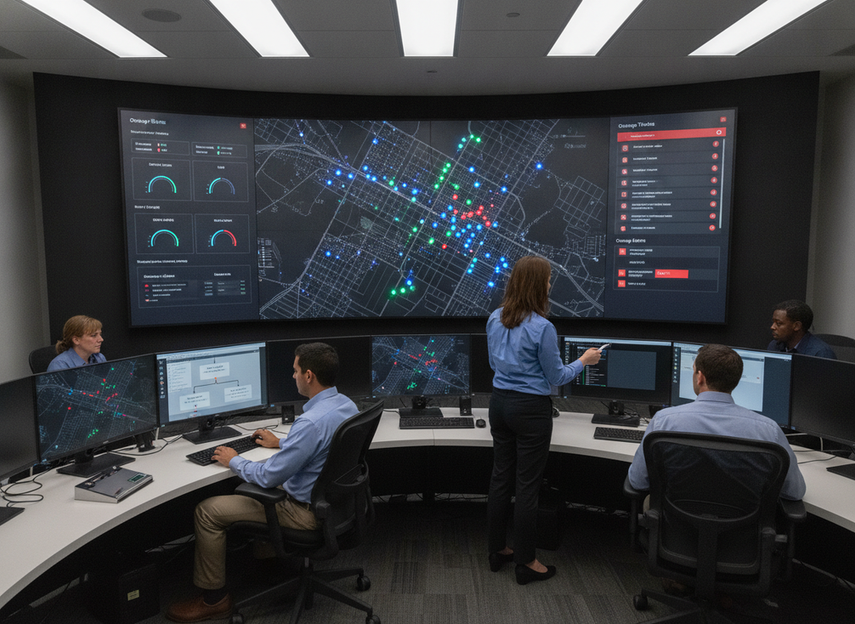
Triage is the step that prevents smart city LED maintenance from becoming either overreaction or delay. Once an alert or complaint arrives, teams should sort it by impact, scope, and likely cause. A single noncritical fixture with a transient data gap is not the same as a corridor outage near a transit stop. Likewise, repeated flicker reports in one neighborhood should be grouped before dispatch so crews can inspect shared circuits, controllers, and environmental exposure instead of chasing each lamp as a separate incident.
Good triage starts with three questions: Is public safety affected? Is the issue isolated or clustered? Is there evidence of a hardware, communications, power, or configuration problem? Those questions create a strong decision layer early in the process. If the answer points to a shared failure mode, the best next step may be to inspect the upstream element first. If the issue appears isolated and noncritical, remote checks, log review, and a scheduled visit may be sufficient.
The U.S. Department of Energy’s lighting guidance for connected systems is useful here because it treats lighting as part of an integrated system with controls, sensors, and operations, not as a set of standalone fixtures. In maintenance terms, that means one alert can reflect a deeper system issue. A dimming schedule conflict, a misconfigured node, or a network dropout may look like a luminaire failure until the team traces the chain.
Triage also benefits from standard language. Instead of vague labels like "bad light," use categories such as communication loss, power loss, output degradation, control mismatch, physical damage, or environmental stress. This helps dispatchers, technicians, and analysts stay aligned. It also supports better trend analysis later, because repeated labels reveal recurring failure modes.
When triage breaks down, it is usually because the organization lacks either enough data or enough authority at the first response layer. If every ticket requires escalation before anyone can classify it, the queue slows down. If alerts are overly sensitive, teams get false urgency and stop trusting the system. The goal is not to rush every issue. The goal is to separate actionable problems from background noise quickly and consistently.
Spare Parts
Spare parts planning is where smart city LED maintenance becomes operationally realistic. Without the right inventory, even a well-diagnosed issue can stay open longer than necessary because the crew is missing a controller, driver, fuse, connector, photocell, or mounting component. This is especially true in connected networks, where older fixtures, mixed vintages, and vendor-specific components may coexist across the same district.
The best approach is to hold parts based on failure history, install population, lead time risk, and how disruptive a missing component would be if a unit goes dark. That does not mean stocking everything equally. It means identifying the parts that are most likely to stop a repair from being completed in one trip. In practice, these are often the components tied to common field failures: connectors, power supplies, controllers, sensor modules, and weather seals.
A useful planning rule is to match parts to asset classes, not just to individual sites. If several corridors use the same luminaire family, common components should be grouped so crews can support them efficiently. If a district has older units with constrained replacement options, those parts deserve more attention because they can turn a small outage into a long delay. This is one reason asset records matter so much: inventory decisions are only as strong as the map they are based on.
Spare parts strategy also affects how well monitoring data can be acted on. If the system identifies a likely controller issue but no compatible replacement is available, the alert still helps, but it does not end the outage. That is a good example of why smart city LED maintenance should be treated as an end-to-end process, not just a software layer.
The Lighting Controls Association notes that connected lighting systems rely on proper integration of devices and controls, which makes lifecycle planning and component compatibility a practical necessity rather than a nice-to-have. For maintenance teams, that translates to one simple principle: the parts room should reflect the installed system, not an idealized one.
Thermal and Weather Stress
Environmental stress is a major reason smart city LED maintenance has to be seasonal and location-aware. Heat, cold, wind, moisture, UV exposure, and repeated freeze-thaw cycles can affect housings, seals, drivers, cabling, enclosures, and mounting hardware. In many cities, weather does not create a sudden failure so much as it speeds up a weak point that was already there.
Thermal stress can show up as premature driver issues, shortened component life, or intermittent behavior when parts expand and contract. Weather stress can also affect controls and communications equipment, especially when moisture gets into connectors or enclosures. The result may not be a complete outage. It may be flicker, a reset loop, sensor drift, or inconsistent dimming that only appears under certain conditions.
Because those effects are location-specific, maintenance teams should watch for clusters rather than isolated events. A handful of failures on a wind-exposed corridor, a waterfront district, or a shaded area with condensation issues may point to the environment rather than the lighting model itself. That is why field notes matter. If crews document exposure, enclosure condition, and visible wear each time they visit, the organization can distinguish random failures from repeated stress patterns.
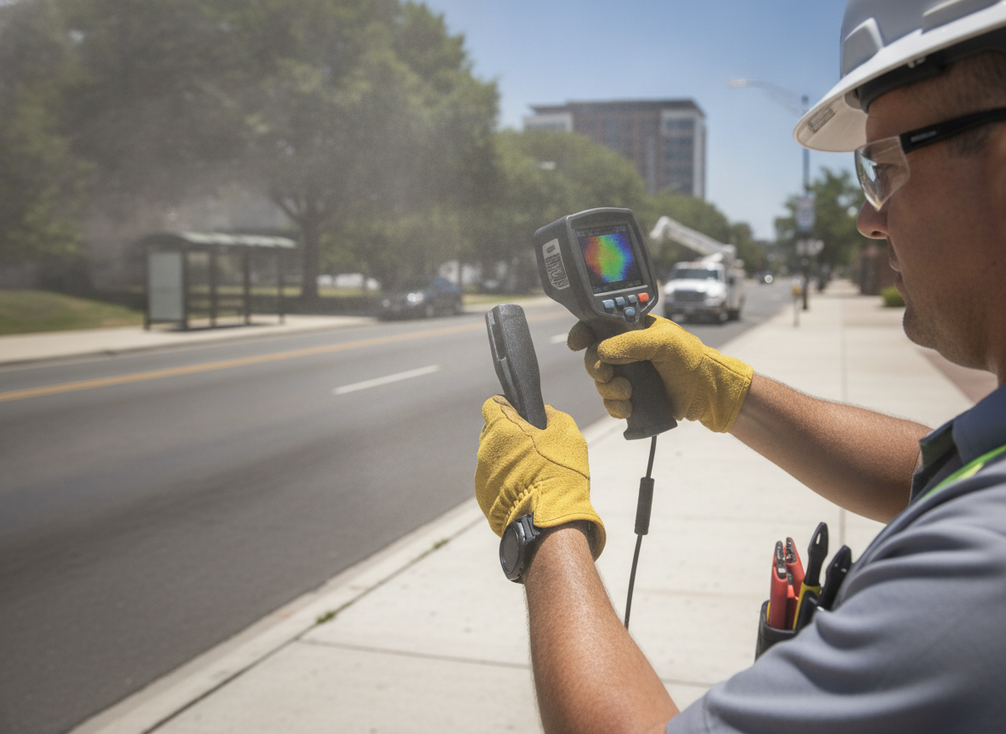
Weather-aware maintenance also means planning inspections and repairs around local conditions rather than assuming a universal schedule. The U.S. Department of Energy’s materials on connected outdoor lighting support this broader operational view, where system performance, controls, and environment interact over time. The practical takeaway is simple: a strong maintenance plan does not wait for failure; it anticipates the kinds of stress that make failure more likely.
That said, there is a limit to preventive planning. No team can eliminate all weather-driven issues, and no remote dashboard can prove that a unit is mechanically sound after a severe event. When storms, heat waves, or prolonged moisture exposure hit, the safest approach is to recheck the highest-risk assets, validate alerts against field conditions, and inspect any clusters that appear abnormal.
Workflow
A workable workflow for smart city LED maintenance usually moves from alert to validation to dispatch to closure. First, the system or user report identifies a possible issue. Second, the team validates the problem with available data: logs, timestamps, location, asset history, and any pattern that suggests whether the problem is electrical, mechanical, or configuration-related. Third, dispatch decides whether the issue needs an immediate visit or can wait for a bundled route. Fourth, the crew performs the repair, verifies restoration, and records what changed.
This workflow is strongest when it includes a clear handoff between operations and field staff. The person reviewing the alert should not have to guess what the technician needs to know. The ticket should carry location, equipment type, probable fault category, and any relevant notes on repeat behavior or nearby incidents. That reduces wasted travel and improves first-visit effectiveness.
It also helps to close the loop after repair. If the issue was a network misconfiguration, a water-damaged connector, or a failed power component, the record should say so in plain language. Over time, those notes create a maintenance history that can influence triage, spare parts, and future design decisions. If one corridor keeps generating similar faults, the city may need a better enclosure, revised mounting practice, or a different commissioning standard.
In mature programs, workflow is not just about speed. It is about making each step informative for the next one. That is why smart city LED maintenance succeeds when monitoring, triage, inventory, and weather response are linked by a shared record of what happened and what fixed it.
Final Takeaway
Smart city LED maintenance works best as a connected process, not a single tool or a promise of constant visibility. Remote monitoring helps teams spot anomalies earlier, but it does not eliminate field visits. Triage keeps the response focused on what matters most. Spare parts planning prevents avoidable delays. Weather-aware inspection catches the kinds of stress that software cannot fully see.
If you need a simple decision rule, use this: when the issue is isolated, low risk, and explainable from the data, start with monitoring and triage; when the issue is repeated, clustered, safety-related, or physically suspect, move to a field visit and verify it onsite. That balanced approach keeps the network reliable without pretending that every problem can be solved from a screen.
FAQs
What Is Smart City LED Network Maintenance?
Smart city LED network maintenance is the ongoing process of monitoring, diagnosing, repairing, and documenting connected lighting assets across a city or district. It includes both remote tools and field work.
Can Remote Monitoring Replace Field Inspections?
No. Remote monitoring can help identify patterns, prioritize issues, and reduce guesswork, but it cannot verify every physical condition. Some failures require onsite inspection to confirm the cause.
What Should Be Triaged First in a Lighting Network?
Safety-related outages, clustered failures, repeated faults, and issues affecting major public routes should generally rise to the top. The exact priority depends on the site, context, and operational risk.
How Should Spare Parts Be Chosen?
Choose parts based on the installed equipment, common failure history, replacement lead time, and how much a missing component would delay repair. Compatibility matters as much as quantity.
Why Does Weather Matter So Much?
Heat, moisture, wind, UV exposure, and freeze-thaw cycles can all shorten component life or trigger intermittent problems. Weather often exposes weaknesses that were already developing in the hardware or enclosure.





