Before you issue an RFP or purchase order, use the US LED display compliance checklist to verify the exact model, the shipped control stack, and the installation plan. For LED display compliance US, the key rule is simple: compliance is document-based, not brochure-based, and the right checks depend on whether the display is going into a lobby, a control room, or a federal procurement.

What Buyers Need to Verify First
Start with the project, not the product. A public lobby, a command-and-control room, and a federal buy can look similar on paper, but they do not carry the same compliance risk. The first job is to decide which rules apply to the exact installation, then ask for evidence tied to that exact configuration.
Think in four buckets: product safety, emissions, accessibility, and sourcing eligibility. That keeps the request list focused and prevents a vendor from answering one issue while leaving another unresolved. For example, the FCC digital light display rules affect emissions and labeling, while ADA concerns can depend on where the wall lands in the room.
A useful decision sentence is this: if the vendor cannot match the compliance packet to the quoted model and install plan, the purchase is not ready for award. Another useful check is this: if the display will sit in a circulation path or include touch controls, ADA review belongs in the room plan before you buy, not after installation.
That is the safest way to scope LED display compliance US before the RFP stage. It also keeps the buyer focused on the current project instead of relying on a general family claim that may not fit the actual room or sourcing path.
Which Standards Matter in US Procurement
UL and ETL answer the safety question, FCC Part 15 addresses emissions and labeling, ADA controls access and placement issues, and TAA only matters when the solicitation or agency says it matters. The mistake buyers make most often is treating those as one generic "compliance" claim. They are separate checks, and each one calls for different evidence.

UL and ETL Safety Documentation
For safety, ask for the exact model’s listing or test documentation, not a family-level claim. The document should match the configuration you are actually buying, including cabinet format, power hardware, and any control components that ship with the system. If the paperwork only proves that a related product line passed testing, that is not enough for a high-risk procurement review.
If the vendor points you to a test report or certificate for another series, treat it as a navigation lead, not proof for your own purchase. Use it only if the underlying model, configuration, and intended use match your project.
A practical rule in LED display compliance US reviews is to compare the safety document line by line with the quote. If the model number, power path, or controller differs, ask for the corrected file before the review moves forward.
FCC Part 15 Emissions Verification
FCC matters because digital light displays and LED signs sold in the U.S. must follow FCC rules, including technical standards and labeling requirements, as the FCC enforcement notice makes clear. In buyer language, that means you should request the compliance statement and the testing data tied to the exact shipped system.
Do not accept a logo, brochure, or sales email as proof. A better request is: show me the FCC-related test data for the quoted configuration, including the control components that ship with it. The International Sign Association guidance is useful here because it translates the verification step into a procurement action.
For a procurement team, that means FCC review is less about whether the display looks compliant and more about whether the exact configuration can be documented. If the quote changes, the proof should change with it.
ADA Access and Placement Checks
ADA is mostly an installation question, not a hardware-only question. For wall-mounted displays in circulation paths, the Access Board says objects mounted between 27 and 80 inches above the floor must not protrude more than 4 inches into the path. That means mounting height, wall depth, and surrounding furniture all matter, not just the display cabinet.
If the display is interactive or has operable parts, the ADA reach-range rules also matter. In practical terms, you should check whether users can reach the controls from the intended approach path without creating a barrier in the room layout. For a lobby or public-facing installation, that room plan is part of the compliance packet.
A quick way to keep LED display compliance US on track is to treat the room drawing as evidence, not decoration. If the wall, counters, and paths are not shown clearly, the accessibility check is incomplete.
TAA Eligibility for Federal Procurement
TAA is not a universal LED-display requirement. It is solicitation- and agency-dependent, so buyers should only treat it as required when the bid, contract, or purchasing policy says so. If TAA applies, ask for origin or sourcing documentation that matches the final offer, not a generic statement about selling into government projects.
A simple rule works here: if the procurement is federal or public-sector and the sourcing language is unclear, pause before award. TAA issues are easy to miss when the rest of the packet looks complete.
That is why LED display compliance US for government buying should stay conditional. The source of truth is the solicitation, not the vendor’s general marketing language.
What Documents Should Vendors Provide
Ask for a packet that lets you verify the exact quote, not a marketing summary. The document set should answer four questions: what was tested, what is being shipped, what the install looks like, and whether sourcing eligibility applies.
- Model-specific safety document: proves the exact model or configuration, not just the product family.
- FCC test data and compliance statement: shows the shipped system was reviewed against the relevant emissions requirements.
- Installation notes or layout notes: help confirm ADA implications when the screen is mounted in a circulation path or has touch controls.
- Origin or sourcing documentation: becomes relevant when TAA or another federal sourcing rule is part of the solicitation.
A compliance packet is useful only if the identifiers match. Check the model number, quantity, control components, and any accessory hardware against the quote and the room plan. If those details do not line up, the packet does not close the loop.
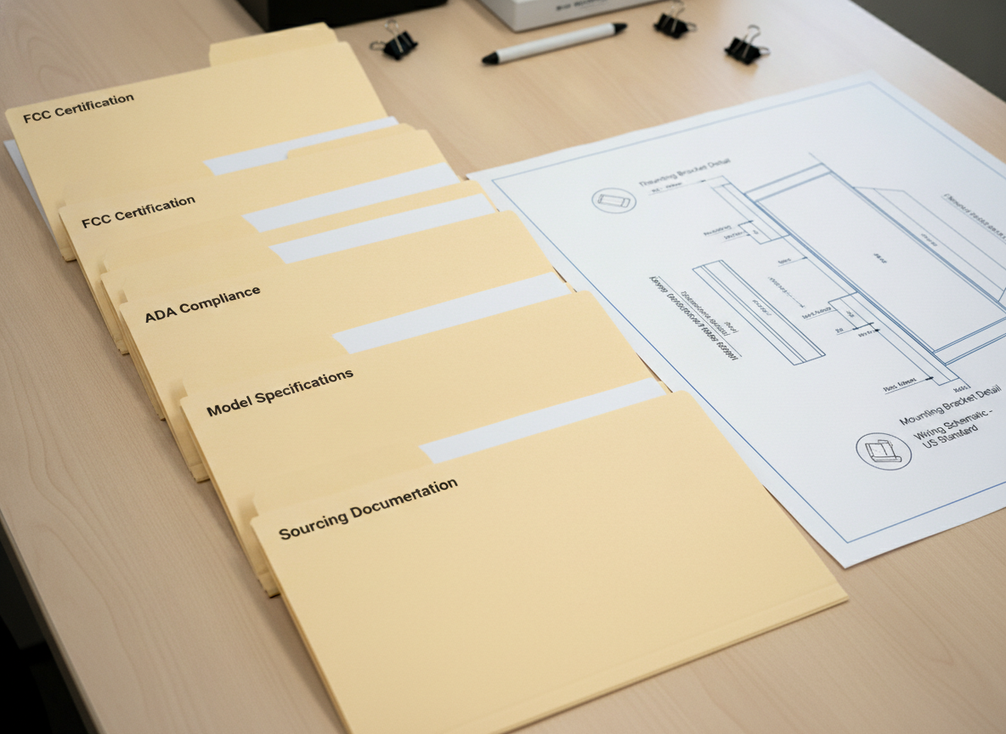
A buyer should also keep the document packet separate from the sales deck. One proves the exact build and installation context; the other may only describe the product family in general terms.
How the Checklist Changes by Project Type
Different projects shift the order of operations. A lobby asks the most from accessibility and layout. A command room asks the most from documentation and system traceability. A federal buy asks the most from sourcing eligibility and exact-model proof.
| Project Type | Highest-Priority Checks | Key Document To Request | Common Failure Point |
|---|---|---|---|
| Public lobby or reception | ADA placement, protrusion, and reach checks | Room layout notes plus model documentation | Hardware looks fine, but the installed wall blocks circulation or creates reach issues |
| Command-and-control room | FCC emissions evidence and full packet traceability | FCC test data, compliance statement, and model-specific safety docs | The vendor packet is incomplete or does not match the shipped control stack |
| Federal or public-sector procurement | TAA or other solicitation-specific sourcing rules | Origin or sourcing documentation tied to the final offer | Buyers assume public-sector eligibility without checking the bid language |
That table is most useful as a screening tool. It tells you where the risk sits first, which document should come next, and which mistake usually causes the award to stall.
A second decision sentence is worth keeping: if the room design changes after the quote, rerun the accessibility check before approval. A third is this: if federal sourcing language is absent from the solicitation, do not invent a TAA requirement, but do verify whether agency policy adds one.
For teams comparing several sites at once, this is where LED display compliance US becomes a project-management issue as much as a document review. The standard may not change, but the priority order does.
Final Procurement Review Before Award
Use a stop-or-go review before the PO is issued. First, match every document to the exact model, quantity, and installation configuration. Second, confirm the FCC and safety paperwork is current and tied to the shipped system. Third, verify the room plan for ADA issues if the wall is public-facing or interactive. Fourth, check whether TAA or another sourcing rule applies to the solicitation. If any of those are unclear, pause the award and get the missing document before proceeding.
That final pass should be evidence-completeness review, not a guess. If the packet still depends on brochure language, the buyer has not finished the checklist.
FAQs
How Do I Verify UL or ETL Status for a Specific LED Display?
Request the full safety listing or test report for the exact model and configuration, then confirm the identifiers match the quote. A logo alone is not enough for a high-risk review. If the document only covers a related product line, ask for the model-specific file before you approve the purchase.
What Documents Should Be in a Compliance Packet Before Award?
At minimum, ask for model-specific safety evidence, FCC-related test data and compliance statements, installation notes when ADA is in play, and sourcing documentation if the solicitation requires it. The packet should be traceable to the final quote, not to a brochure or generic family claim.
Can ADA Compliance Be Determined From the Display Alone?
Usually no. ADA depends on the installed environment, including mounting height, protrusion into circulation paths, reach range, and nearby furniture or counters. For that reason, the room plan matters as much as the display itself, especially in lobbies and interactive spaces.
Why Does FCC Part 15 Matter for LED Displays?
Because the display and its control components may be subject to emissions and labeling rules before they can be marketed in the U.S. Buyers should ask for test data and a compliance statement tied to the exact shipped configuration, not a broad product-family declaration.
Can I Treat TAA as Required for Every US Project?
No. TAA is solicitation- and agency-dependent, so it only becomes a must-have when the bid, contract, or purchasing policy says so. If it does apply, ask for origin or sourcing documentation that matches the final offer before you treat the display as eligible.