


Portable VMS LED signs for highway work zones have to do four jobs at once: stay readable, stay stable, fit the crew’s deployment workflow, and keep message control tight enough for road use. The right unit depends less on a brand name than on lane-closure duration, site exposure, and how much editing and towing the crew can support. For buyers comparing portable VMS options or broader traffic and VMS systems, the first question is fit, not features.

What Buyers Need From Portable VMS Units
For highway work zones, the baseline is driver readability and safe placement, not just a bright screen. The MUTCD says portable changeable message signs should be legible from at least 650 feet under day and night conditions, and for high-speed highway applications it specifies an 18-inch standard character height for portable message signs. Those two checks tell buyers a lot: if the sign cannot be read early enough, the rest of the spec sheet matters less. See the MUTCD 11th Edition and the portable message sign chapter for the federal baseline.
In procurement terms, that means a portable VMS is a work-zone device first and a display second. Buyers should ask whether the unit fits lane closures, incident response, and recurring maintenance runs, because those use cases change how often it moves and how long it stays in place. A short incident setup may reward quick deployment, while a multi-day closure puts more weight on stability and power planning. If the project is exposed, crowded, or frequently reconfigured, a "portable" unit that is awkward to secure can create more risk than it removes.
A practical decision sentence: if the message has to be read at highway speed, prioritize readable character size and clear message logic before asking about advanced controls. If the unit will live on the shoulder or in a median, treat placement and securing as part of the purchase decision, not a field detail to solve later.
Engineering Priorities for Highway Work Zones
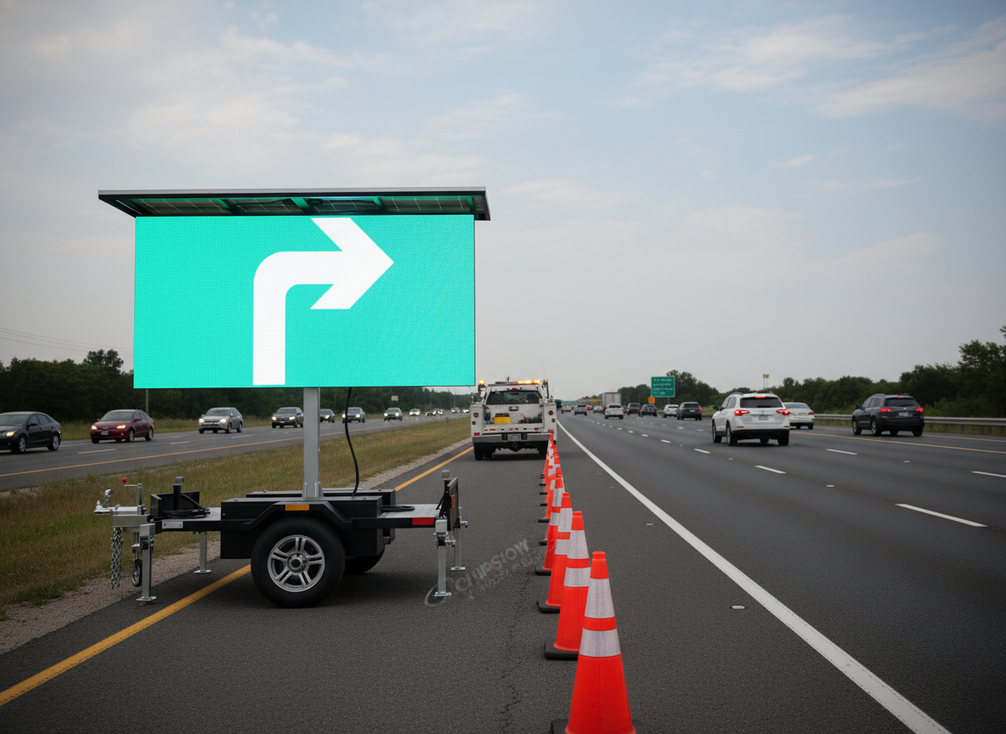
The most useful way to compare portable VMS LED signs for highway work zones is by the conditions that stress them. Visibility, stability, power, and service access each change the fit in a different way.
Visibility and Message Readability
Readable messaging matters more than raw display claims. In practice, that means buyers should check font size, contrast, viewing angle, and how much text the crew expects to send at once. The MUTCD legibility and character-height rules are the safe starting point; anything beyond that should be confirmed in product documentation or agency guidance before it is treated as a buying criterion.
For most highway uses, short and direct messages are safer than dense ones. If a unit encourages long text, it may be flexible in theory but harder for a driver to process at speed. That is why message length is a control issue, not only a content issue.
Stability and Wind Exposure
Portable VMS trailers are stability-sensitive equipment in wind and vibration exposure, especially on open shoulders, medians, and ramps. Industry safety guidance emphasizes leveling jacks and a sturdy frame as part of keeping the unit stable under roadside conditions. That does not mean every trailer is equally wind resistant. It means buyers should verify the structure, anchoring approach, and deployment limits before assuming a format will hold up in all highway settings. See the work-zone PCMS guidance for the general stability concern.
Power and Deployment Flexibility
Power is a site-condition check, not a universal promise. Solar-powered units can work well for longer deployments, but buyers should confirm battery autonomy across several days without sun exposure if the work zone is extended or weather is unreliable. NYSDOT’s VMS operating guidance is a good reminder that solar support still needs a real duty-cycle review.
That matters because a unit may look ideal on paper and still be a poor fit if the crew cannot recharge, tow, or service it reliably. For recurring maintenance, the best choice is often the one that reduces setup friction without creating a battery-management burden.
Service Access and Uptime
A unit that is easy to service is often the one that stays useful in the field. Front access, modular repair points, and simple diagnostics can reduce downtime when the sign is active in a live work zone. Buyers should pay attention to whether service can happen without blocking lanes or pulling the unit into a difficult recovery position.
For procurement teams, uptime is not just a maintenance KPI. It is a traffic-control issue, because a failed sign can force message changes, rewrites, or repositioning under pressure.
DOT Compliance and Message Control
Compliance starts with message rules, visibility, placement, and workflow. Hardware is only one part of that. FHWA guidance recommends portable message signs use no more than two phases, with no more than three lines per phase, which helps keep the message readable and reduces the risk of overloading drivers. The FHWA handbook is the cleanest authority for that message-control limit.
For shoulder deployments, placement matters as much as the message itself. The VMS operations manual says signs should not interfere with the sight distance of other critical traffic control devices or road features. In plain terms, a sign that blocks the view of something more important is not a good deployment choice, even if the display itself is compliant.
Use this as a buyer filter: if the crew needs frequent edits, ask who approves them and how quickly they can be made in the field. If the project depends on a narrow shoulder, curved approach, or heavy device density, verify placement rules before you lock in the spec. The safest approach is to treat any "compatible" or "compliant" language from a vendor as a claim to verify, not a conclusion to assume.
If you are narrowing the field, a solar trailer option can be a useful navigation point for long-duration, self-powered deployments, while a vehicle-mounted option is more relevant when mobility and quick repositioning matter more than stationary endurance. In both cases, confirm that the unit matches your agency’s message rules and the site layout before purchase.
Portable VMS Formats and Trade-Offs
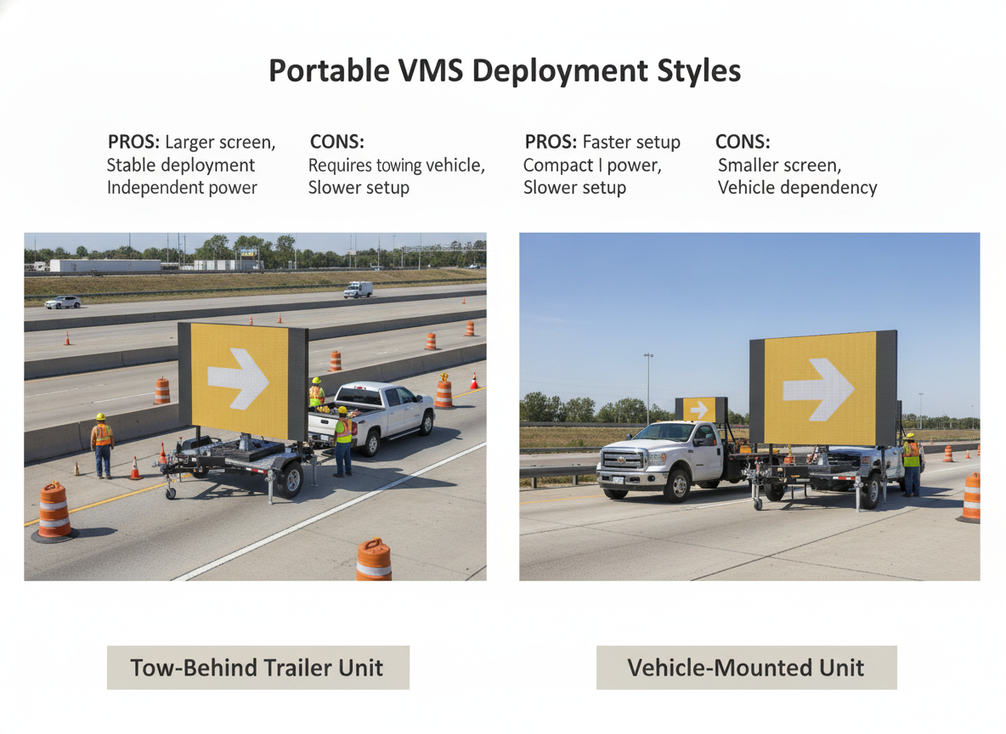
The best format depends on the job, not on a universal hierarchy. A tow-behind solar trailer, a vehicle-mounted unit, and a larger fixed roadside installation each solve a different procurement problem.
| Deployment mode | Likely better fit | Main strengths | Main trade-offs | What to verify |
|---|---|---|---|---|
| Tow-behind solar trailer | Multi-day lane closures, maintenance staging, recurring roadside work | Good for longer dwell time and standalone use | Needs towing, space, and site security planning | Battery autonomy, stability, setup access |
| Vehicle-mounted VMS | Fast-moving crews, short incidents, frequent relocation | Quick repositioning and simpler mobility | Less like a long-stay roadside asset | Power source, mounting, crew workflow |
| Larger roadside installation | Longer-lived or more fixed traffic management needs | Stronger site permanence | Less portable and usually less flexible | Permits, placement, and project duration |
This is the section where many buyers make the wrong call. If the job is short and changing, speed matters more. If the work zone stays open for days or weeks, endurance and service access matter more. If the site is exposed, the unit’s stability becomes the deciding factor before display size or screen family does.
For buyers comparing product families, the C-Tra-VMS series is a reasonable place to review the tow-behind and vehicle-based split in one place, but it should still be checked against the actual job conditions. A category page can help with browsing; it cannot prove that a specific setup fits your project.
Choosing a Unit for Your Work Zone
Use a simple shortlist process instead of starting with the display itself.
- Match the project duration to the power model. Short incidents and long closures do not need the same autonomy.
- Check site exposure. Open shoulders, medians, and ramps raise the importance of stability and secure placement.
- Decide how often the message will change. More changes mean more need for clear approvals and field discipline.
- Confirm towing, mounting, or vehicle support. A portable sign that is hard to move or stage is not truly easy to deploy.
- Verify the agency spec and job plan before purchase. Vendor language is not a substitute for project requirements.
A practical boundary: if your team cannot manage edits cleanly in the field, do not buy extra message flexibility just because it looks more capable. If your project is long-running and exposed, do not treat power as an afterthought. The right portable VMS LED signs for highway work zones are the ones that fit the duty cycle first and the wish list second.
When the project is recurring and the crew wants a compact, roadway-oriented display family, the Traffic & VMS LED Display category can help you review the broader lineup before you request quotes.
Final Takeaway
Portable VMS LED signs for highway work zones should be chosen as deployment tools, not as generic displays. Start with readability, then check stability, power, and message control, and only then compare formats like trailer-mounted or vehicle-mounted. If you are building a bid package, verify the agency rules, site layout, and service expectations first. That order helps reduce surprises in the field.





