

For Digital Out-of-Home (DOOH) media operators, infrastructure contractors, and network owners, an outdoor LED screen is a physical revenue engine. In high-traffic shopping plazas, highway corridors, and premium building facades—from the extreme heat zones of Dubai to the strict environmental compliance zones of Berlin and the high-humidity coastal corridors of São Paulo—visual consistency and uncompromised daylight contrast are your financial currency. To command premium rates from global brands, your media network must deliver uncompromised daylight visibility, flawless alignment, and near-zero downtime.
Yet, many network operators fall into a costly procurement trap by evaluating hardware solely through the lens of initial Capital Expenditure (CAPEX). The real battle for profitability is fought in Operational Expenditure (OPEX). Rising utility grids, structural steel enforcement overheads, and frequent emergency maintenance can quietly erode an asset’s lifetime yield.
To maximize the financial performance of your media asset, the long-term economic logic of your hardware follows a clear formula:
DOOH Screen ROI = Advertising Revenue − Power Cost − Maintenance Cost − Downtime Loss − Structural Cost
This model comprehensively accounts for both CAPEX depreciation and long-term OPEX reduction, ensuring a disciplined assessment of your asset’s total financial performance.
To safeguard your long-term margins, Chipshow’s flagship C-Slim (MA) Series shifts the conversation from generic hardware parameters to disciplined, value-forward asset management. As a direct manufacturer with over a decade of LED display engineering experience and a facility spanning thousands of square meters, Chipshow designs, manufactures, and certifies every C-Slim (MA) unit in-house—from diode-level circuit architecture to final IP66 cabinet sealing. Here is how a single product platform single-handedly optimizes every variable of the DOOH ROI formula.
Common Cathode Driving: Taming the Utility Bill with 30% Energy Savings
The most predictable threat to an operator’s bottom line is the monthly electricity bill. A standard outdoor billboard running 18 to 24 hours a day consumes massive amounts of power. Dimming the display to save energy is a self-defeating compromise; it dampens the visual punch under direct sunlight, degrades campaign impact, and drives away premium advertisers who demand maximum daytime presence.
Operational efficiency must be engineered at the diode level. Traditional outdoor screens utilize a Common Anode architecture, supplying a constant, maximum voltage to Red, Green, and Blue LED chips uniformly. Because Red diodes naturally require lower operating voltage than Green and Blue ones, the excess voltage is dissipated as heat across the Printed Circuit Board (PCB). This thermal build-up accelerates pixel degradation and increases energy draw.
The Chipshow C-Slim (MA) Series solves this utility overhead crisis through an advanced Common Cathode driving architecture. By separating the electrical grounds and supplying dedicated dual-voltage lines directly tailored to the individual color dies, the circuit strips away thermal accumulation and unnecessary power waste, offering a highly disciplined energy-saving engineering solution.
This targeted layout achieves a documented 30% energy saving compared with traditional Common Anode LED displays. Backed by a dual-voltage power supply system, the screen maintains an optimized average consumption of just 150–205 W/m² (configuration dependent). The C-Slim (MA) ensures your billboard runs cooler and costs less—protecting your operational profit without forcing you to compromise on luminance.

High Brightness Without Overdriving: Protecting Ad Visibility and LED Lifespan
In prime city intersections or south-facing highway placements, direct solar glare competes heavily with your ad loops. Standard outdoor panels running at maximum capacity often experience extreme heat spikes. This thermal stress degrades the epoxy layers of the diodes, leading to rapid color deviation, white-balance drift, and premature dead pixels—visual flaws that major brands will not tolerate, resulting in costly contract disputes or make-good penalties.
The C-Slim (MA) Series addresses this through high-efficiency ICE LED technology integrated into the platform. The architecture allows operators to deliver standard configurations starting at 5,500 nits, or scale up to an ultra-bright 12,000 to 14,000 cd/m² white-balance threshold to pierce through the harshest direct sunlight.
The C-Slim (MA) features 5 distinct brightness and power modes mapped to automatic light sensors. Instead of locked, overdriven hardware, the display behaves like a dynamic financial asset. Operators can scale output profiles seamlessly between a cloudy morning, a punishing midday sun, and local evening environmental compliance zones—ensuring your screen stays vivid when it matters most while actively minimizing unnecessary component wear and extending the operational lifespan of the LEDs.

Lightweight Magnesium Cabinet: Reducing Steel Structure and Retrofit Costs
For rooftop, pole-mounted, or historic building envelope claddings, structural weight represents an intense engineering, financial, and legal liability. Heavy iron or sheet-metal cabinets add massive static dead-weight, forcing operators into costly secondary steel reinforcement, prolonged municipal permit approvals, and heavy foundation excavation costs before a single ad can even be scheduled.
The C-Slim (MA) platform bypasses this structural friction by utilizing a high-precision, die-cast Magnesium Alloy Cabinet. Engineered via CNC processing, the magnesium structure balances extreme mechanical rigidity with an incredibly light footprint to pass strict wind-load and structural safety calculations.
Depending on your exact pixel pitch and module configuration, the C-Slim (MA) standard 960×960 mm frame maintains an ultra-light framework profile of ≤29 kg (≤63.9 lbs). At only 94 mm in thickness, it cuts the structural weight burden significantly compared to traditional steel configurations. This dramatic mass reduction allows operators to lower upfront steel infrastructure investment, minimize freight expenses, and unlock premium retrofit locations that were previously inaccessible due to load-bearing restrictions.
Front and Rear Maintenance: Cutting Downtime from Hours to Minutes
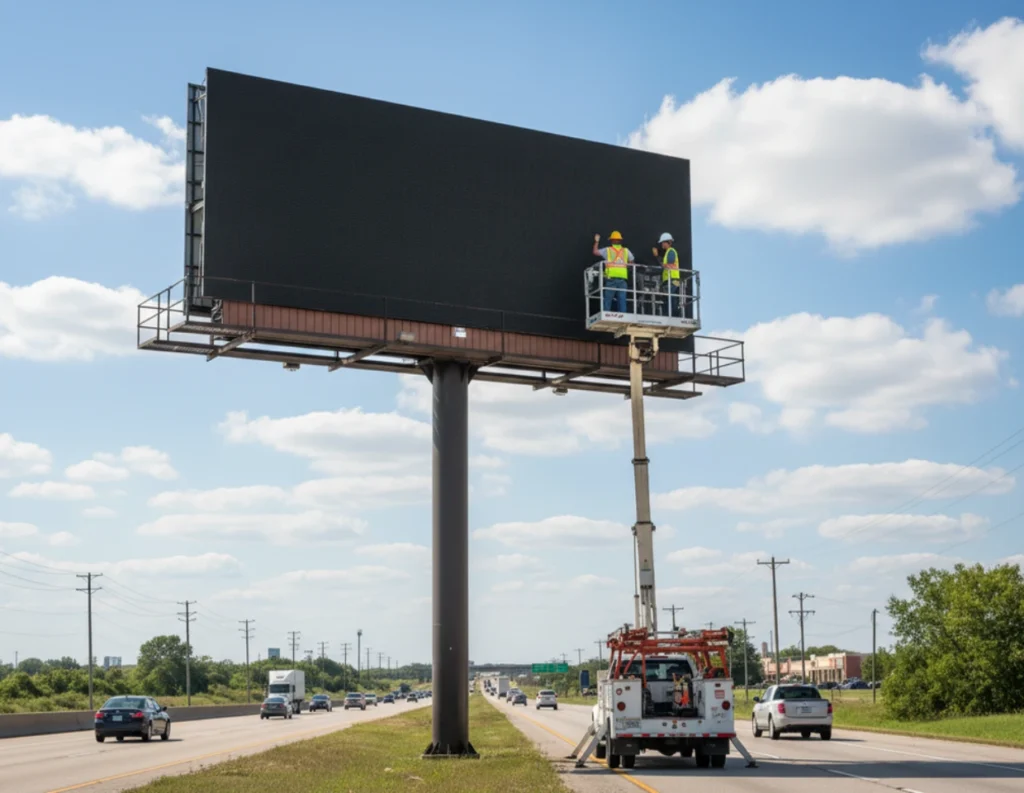
In dense urban environments, space is premium real estate. Many building facades, storefront canopies, and narrow highway pylons leave zero room for technicians to access the back of a display wall. If your screen forces maintenance crews to dismantle hardware strictly from behind, a simple component fault can result in prolonged dark screens, expensive crane rentals, and municipal lane-closure penalties.
The C-Slim (MA) is intentionally laid out with a complete dual-access service framework to insulate operators from emergency maintenance bottlenecks.
Front-Service Efficiency: Modules, power supply units, receiving cards, and internal wiring harnesses can be completely detached from the display face in seconds using a simple magnetic tool. This keeps the screen running without disrupting interior building spaces.
Hidden Internal Cabling Channels: All power and data jumper lines are directed through hidden internal cabling routes via an interlocking hub system. This wireless interior layout prevents connection degradation caused by moisture tracking, corrosion, or wind friction, providing a clean, architect-friendly side profile that seamlessly integrates into street furniture, canopies, and high-street shopping mall retrofits.
This flexible layout shortens on-site service interventions from hours to minutes, keeping your network’s uptime metrics intact while protecting technical crews working adjacent to high-speed road networks or complex elevations.
IP66 Front and Rear: Full Protection Against Climate Failure
Outdoor DOOH hardware faces continuous exposure to extreme elements—from driving rain and heavy sea mist to fine sand dust and high traffic pollution. Standard outdoor panels often rely on external cabinet doors for protection, leaving individual components vulnerable to moisture condensation when cold nights transition into hot days.
The C-Slim (MA) Series eliminates this vulnerability by employing a fully enclosed module pod design. Rather than depending solely on outer housing doors, each individual module features an independent, rear-sealed protective case that acts as an isolated internal compartment.
Coupled with specialty waterproof sealing rings lining the cabinet interlocks, the C-Slim (MA) achieves a certified IP66 protection rating across both the front and rear of the system. Backed by an established outdoor operating threshold of −20°C to +50°C, the driver electronics, copper wiring, and connectors remain completely sealed against corrosion, sand, and humidity. This advanced ingress shielding keeps your visual asset running reliably through freezing winters, tropical downpours, and intense desert deployments year after year.
Value Engineering Matrix: C-Slim (MA) Strategic Performance Summary
| Engineering Feature | Operational Challenge Solved | Direct Financial Impact |
|---|---|---|
| Common Cathode (30% energy saving) | High monthly utility bills eroding margin | Significant annual OPEX reduction per billboard |
| ICE LED Brightness (5,500–14,000 nits) | Solar glare washing out ad visibility at noon | Premium ad rate retention; zero make-good penalties |
| Magnesium Alloy Cabinet (≤29 kg) | Steel reinforcement and permit overheads | Lower structural engineering costs; faster municipal approval |
| Dual-Access Maintenance | Emergency service bottlenecks in dense urban sites | Reduced crane rental costs; minimized ad revenue downtime |
| IP66 Front & Rear Sealing | Corrosion, humidity, and dust ingress failures | Lower component failure rates; extended 100,000-hour design life |
| CE, RoHS, FCC, ETL Certified | Regional market access and compliance | Fully licensed for global deployment |
Submit Your Project Parameters for a Custom TCO Analysis
Selecting the right outdoor display is about balancing your specific environment with your financial goals. Upfront cabinet pricing ignores the operational realities of lifetime energy consumption and structural maintenance.
Send us your screen size, intended operating hours, brightness requirements, and local electricity costs. Chipshow’s project engineering team will estimate the long-term power, structural, and maintenance impact of a C-Slim (MA) outdoor LED display for your DOOH project, providing a customized TCO and ROI analysis tailored to your site conditions.
Frequently Asked Questions
Q1: How much energy does the C-Slim (MA) save compared to standard outdoor LED displays?
The C-Slim (MA) Series delivers a documented 30% energy saving over traditional Common Anode outdoor LED displays. Its optimized average power draw of 150–205 W/m² means a standard 100 m² billboard operating 18 hours daily saves thousands of dollars per year in electricity costs, depending on local utility rates.
Q2: What certifications does the C-Slim (MA) hold for global deployment?
The C-Slim (MA) Series is certified under CE, RoHS, FCC, and ETL standards, meeting regulatory requirements for commercial outdoor LED display deployment across major global markets. EN12966 certification is also available for traffic and VMS applications.
Q3: Is IP66 protection necessary for outdoor LED displays?
Yes, for installations exposed to heavy rain, coastal salt spray, desert sand, or extreme temperature swings. While IP65 on the front face is the industry minimum, the C-Slim (MA) provides IP66 on both front and rear surfaces through fully enclosed module pods—protecting internal electronics from condensation, corrosion, and particulate ingress that standard IP54 rear-rated cabinets cannot withstand.
Q4: What is the design life of the C-Slim (MA) outdoor LED display?
The C-Slim (MA) holds a typical design life of 100,000 operating hours—approximately 8 to 10 years of continuous service. Common Cathode driving and fully enclosed IP66 module pods extend this runtime by reducing internal thermal stress and protecting components from environmental degradation.
Q5: How does the magnesium alloy cabinet reduce total project cost?
The magnesium alloy cabinet weighs ≤29 kg per 960×960 mm frame—significantly lighter than traditional steel cabinets. This reduces upfront structural steel and foundation costs, lowers freight expenses, and unlocks installation on load-restricted structures such as historic building façades and rooftop mounts that would otherwise require costly reinforcement.