

Investing in an outdoor LED display for Digital Out-of-Home (DOOH) advertising, traffic management, sports stadium scoring, or commercial storefront infrastructure is a high-stakes capital decision. Unlike indoor displays, an outdoor screen must function as a structural installation that operates continuously under severe weather cycles, relentless UV radiation, and high-wind loads.
To maximize the long-term return on your media asset and ensure absolute structural safety, your procurement process must balance initial Capital Expenditure (CAPEX) with ongoing Operational Expenditure (OPEX). Uncontrolled utility power consumption, uncalibrated pixel setups, and complex on-site maintenance can quietly erode your profitability.
This 2026 buying guide breaks down the core engineering variables of outdoor displays, maps out cost-driving metrics, and provides a structured evaluation framework to align your project’s specific environmental parameters with the optimized hardware solution—all backed by Chipshow’s in-house manufacturing expertise and globally certified product lines including the C-Slim (MA) and C-Fit Series.
Quick Selection Matrix: What Type of Outdoor LED Display Do You Need?
Cross-reference your specific location profile against the prioritized hardware recommendations below:
| Project Type | Typical Location | Recommended Pixel Pitch | Primary Selection Priority |
|---|---|---|---|
| Premium DOOH Billboard | Highway corridor, urban plaza, airport | P6.67–P16 | Ultra-high brightness (10,000+ nits), IP66 sealing, energy efficiency |
| Urban Retail / Storefront | High street, shopping mall façade, pedestrian zone | P2.5–P6.67 | Fine pitch clarity, wide viewing angles, slim architectural profile |
| Traffic / VMS Display | Motorway gantry, tunnel entrance, junction | P8–P16 | 24/7 reliability, EN12966 compliance, IP66 front+rear |
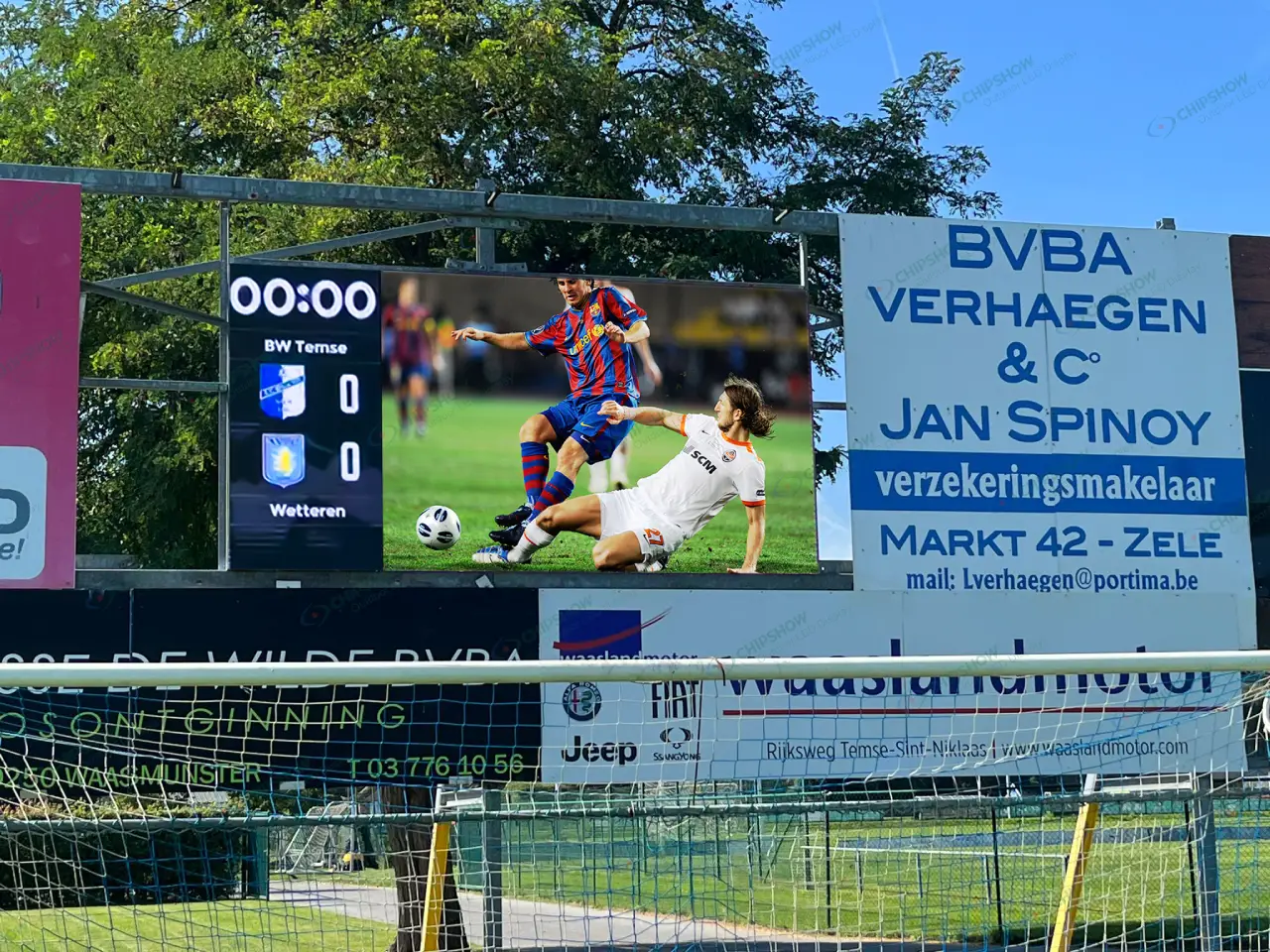
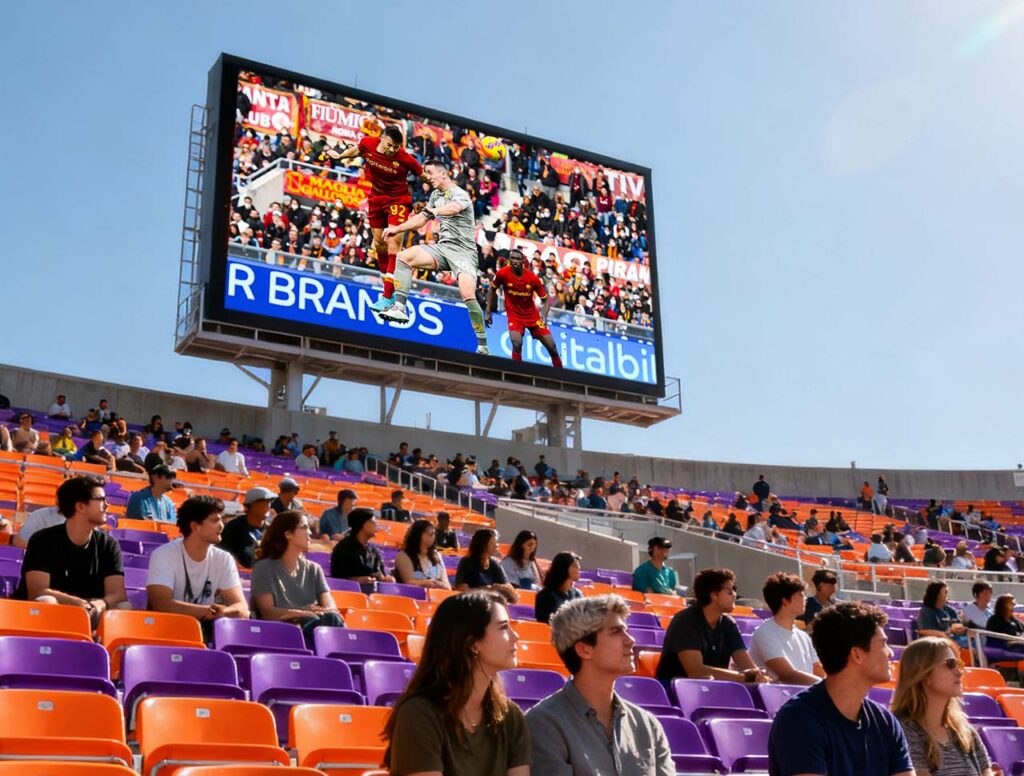
| Sports Stadium Perimeter | Stadium fascia, arena ribbon board, scoreboard | P6.67–P10 | High refresh rate, extreme brightness, wide viewing angles |
| Public Information Display | Town square, transport hub, municipal plaza | P4–P8 | Front service access, dual IP65+, vandal-resistant |
Technical Selection Factors: The Core Variables of Screen Architecture
To build a durable outdoor visual network, engineering and procurement teams must evaluate the underlying technical variables that directly control structural integrity and video quality.
Common Cathode (CC) vs. Common Anode Layouts
Traditional outdoor displays utilize a Common Anode circuit design. In this legacy configuration, a single voltage line feeds power to the Red, Green, and Blue LED chips simultaneously. Because Red diodes naturally require lower operating voltage than Green and Blue ones, the excess voltage is dissipated as heat across the PCB. This thermal build-up accelerates pixel degradation and increases your electric bill.
Advanced industrial platforms—such as the Chipshow C-Slim (MA) and C-Fit Series—standardize on specialized Common Cathode engineering. This targeted circuit design separates the electrical grounds and routes dedicated, dual-voltage supply lines directly to the separate color dies. The structural outcome is a documented 30% energy saving compared with traditional Common Anode LED displays, maintaining an optimized average power draw of just 150–205 W/m² (configuration dependent). The display runs significantly cooler, eliminates the need for expensive HVAC air conditioning, and minimizes ongoing monthly OPEX.
Pixel Encapsulation: SMD vs. DIP Technology
SMD (Surface Mount Device): SMD layout binds the Red, Green, and Blue dies into a single, compact surface-soldered package. This profile delivers excellent color blending, smooth gradients, and wide viewing coordinates (up to 120° H / 120° V), making it the optimal baseline for high-street retail, shopping mall exteriors, and storefront signage where fine pitches from P2.5 to P10 are required.
DIP (Dual In-line Package): DIP technology uses bullet-molded epoxy lenses to house individual color lamp bulbs separated across the frame. DIP arrays provide outstanding long-distance contrast. Because the lamps dissipate heat efficiently and offer extreme resistance to UV yellowing, they remain the trusted workhorse for highway gantries, long-view roadside billboards, and variable message signs (VMS) where P10 to P16 configurations dominate.
True Daylight Contrast vs. Overdriven Luminance
Commanding premium ad rates requires legibility under direct, harsh noon sunlight. However, chasing raw nit metrics by forcing standard driving ICs to run at peak capacity creates severe thermal stress. True daytime performance relies on optical efficiency and smart brightness management.
Advanced setups, like Chipshow’s high-output ICE LED configurations, achieve extreme luminance indices up to 12,000–14,000 cd/m² while maintaining a disciplined power footprint. By mapping the screen to automated light sensors, operators can dynamically scale output profiles between a cloudy morning, a punishing midday sun, and local evening environmental compliance zones—ensuring your screen stays vivid when it matters most while actively minimizing unnecessary component wear.
Ingress Sealing and Ingress Protection: IP65 vs. Dual IP66
The standard industry baseline for outdoor digital signage is an IP65 protection rating on the front surface, which blocks driving rain and dust. However, the rear configuration is frequently left at a lower IP54 rating, making the system vulnerable to moisture condensation inside the cabinet when cold nights transition into humid days.
For high-humidity regions, coastal corridors, or desert zones exposed to fine particulate dust, elite engineering layouts deploy fully enclosed module pods. In this configuration, the driver electronics, receiving cards, and power lines are completely sealed within isolated internal compartments. This provides comprehensive protection up to IP65/IP65 or IP66 front and rear, insulating critical electrical connections from water ingress, salt fog corrosion, and airborne industrial pollutants.
What Affects Outdoor LED Display Cost?
Evaluating a project budget requires understanding how specific technical specifications translate to final installed pricing. The table below maps each variable to its cost impact:
| Cost Driver | How It Affects Price | Optimization Strategy |
|---|---|---|
| Pixel Pitch | Tighter pitch = exponentially more LEDs per m² = higher cost | Match pitch to minimum viewing distance; P8–P10 is sufficient for highway billboards |
| Cabinet Material | Steel < Aluminum < Magnesium Alloy | Magnesium alloy (≤29 kg per frame) reduces structural steel costs and freight—offsetting higher unit price |
| Brightness Tier | Higher nits require higher-grade LEDs and driver ICs | Standard 5,500 nits sufficient for shaded/north-facing; reserve 10,000+ nits for south-facing DOOH |
| IP Rating | Higher IP protection adds manufacturing complexity | IP66 front+rear worth the premium for coastal, high-humidity, or desert sites |
| Energy Efficiency | Common Cathode adds upfront circuit cost | 30% energy saving recovers premium within 18–36 months through reduced OPEX |
| Certification Suite | CE/RoHS is standard; EN12966/FCC/ETL add testing overhead | Order only the certifications your project region requires |
| Spare Parts Allocation | 2–5% of matching batch modules, PSUs, and receiving cards | Pre-purchase with main order to guarantee batch-matched replacements |
Outdoor LED Display Buyer Checklist
Before approving any commercial or technical specification sheet for an outdoor display deployment, confirm that your procurement team has verified every item on this operational baseline:
- Pixel Pitch vs. Viewing Distance: Ensure the minimum viewing distance matches the pixel pitch value (e.g., a P6.67 screen requires a minimum viewing distance of ~6.7 meters for optimal image clarity).
- Brightness Mapping: Verify the panel provides sufficient output—minimum 5,500 nits for general outdoor locations; 10,000+ nits for direct, south-facing unshaded sun exposure.
- Thermal Management Strategy: Confirm whether the cabinet utilizes fanless convection, negative-pressure channels, or requires dedicated external air conditioning units. Fanless sealed designs eliminate ongoing HVAC maintenance costs.
- Cabinet Mass & Structural Loading: Verify the total finished weight per square meter to ensure the existing facade or gantry frame can support the static load without requiring secondary steel reinforcement.
- Site Access & Maintenance Direction: Ensure the module maintenance path matches your site boundaries. Specify 100% front service if the display is mounted flush to a solid wall with no rear access.
- Regulatory Compliance Certifications: Confirm the hardware holds verified testing records from internationally recognized labs for your specific deployment region. Chipshow’s entire outdoor product portfolio holds verified CE, RoHS, FCC, and ETL certifications, with specialized EN12966 and EMC Class A alignment certified for heavy traffic and variable message sign (VMS) infrastructure procurement.
- Logistics & Spare Parts: Secure a minimum 2% to 5% structural inventory allocation of matching batch modules, power supply units, and receiving cards to handle long-term field servicing without color-matching issues.
Comprehensive 2026 Global Application Matching Matrix
This streamlined performance table pairs Chipshow’s specialized product lines with engineered solution advantages for each deployment type:
| Application | Recommended Product Series | Key Technical Advantage | Deployment Examples |
|---|---|---|---|
| Premium DOOH Billboard | C-Slim (MA) Series | 30% energy saving, 14,000 nits max, ≤29 kg magnesium cabinet, IP66 front+rear | Highway corridors, urban plazas, airport media walls, building façades |
| Urban Retail / Storefront | C-Fit Series | Fine pitch P2.5–P6.67, wide 120° viewing angles, slim architectural profile | High-street retail, shopping mall exteriors, restaurant terraces |
| Traffic & VMS | C-Slim (MA) with EN12966 option | 24/7 reliability, IP66 dual-surface, −20°C to +50°C operating range | Motorway gantries, tunnel entrances, urban traffic junctions |
| Sports Venue Perimeter | C-Slim (MA) Series | 10,000+ nits, high refresh rate, fast pixel response | Stadium fascia, arena ribbon boards, outdoor scoreboards |
| Public Information | C-Fit Series | Front-service access, dual IP65+, vandal-resistant construction | Town squares, railway stations, municipal plazas, bus terminals |
Frequently Asked Questions
Q1: What is the best pixel pitch for outdoor LED displays?
The optimal pixel pitch depends strictly on your minimum viewing distance. For close-up pedestrian locations (high-street retail or storefronts), fine pitches from P2.5 to P4 are recommended. For long-distance viewing scenarios (roadside billboards or highway gantries), coarser pitches like P8, P10, or P16 provide excellent clarity while significantly lowering your procurement costs per square meter.
Q2: How bright should an outdoor LED display be?
For shaded locations or north-facing positions with low ambient exposure, a brightness index of 5,000 to 6,000 nits is sufficient. For screens exposed to intense, direct midday sunlight (such as south-facing highway billboards), a minimum of 8,000 nits is necessary, with premium locations requiring 10,000 to 14,000 nits to maintain optimal daylight contrast and prevent image washout.
Q3: What is the difference between SMD and DIP outdoor LED displays?
SMD integrates the Red, Green, and Blue dies into a single package, offering superior color uniformity, seamless close-range graphics, and wider viewing coordinates. DIP uses separate, epoxy-coated lamp bulbs for each pixel, which provides higher raw contrast, better heat dissipation, and superior durability against intense solar UV exposure in long-range applications. For fine-pitch urban installations, choose SMD; for highway billboards, DIP remains the workhorse choice.
Q4: Is front maintenance necessary for outdoor LED screens?
Yes—front maintenance is essential if your display is mounted flush against a solid wall, integrated into a shallow storefront canopy, or positioned where building codes restrict rear access corridors. Front-service hardware lets technicians swap modules or power components directly from the front display face in seconds, eliminating the need for structural tear-downs, rear catwalks, or crane mobilization.
Q5: Which outdoor LED display is best for premium DOOH billboard networks?
For premium DOOH billboard networks, the Chipshow C-Slim (MA) Series is purpose-built for the task. Its Common Cathode architecture delivers a documented 30% reduction in power consumption to keep monthly OPEX controlled. The ultra-light magnesium alloy cabinet (≤29 kg per frame) minimizes structural loading constraints and lowers initial steel installation costs, while the IP66 dual-surface sealing and ICE LED brightness (up to 14,000 cd/m²) ensure uncompromised performance across all climate zones. The C-Fit Series offers a complementary fine-pitch option for high-resolution urban retail and public-facing installations.
Submit Your Project Parameters for a Free TCO Analysis
Selecting the right outdoor LED display infrastructure is an exercise in value engineering. Evaluating a screen strictly on upfront cabinet pricing ignores the long-term operational costs of power consumption, structural alignment, and weather damage.
Send us your screen dimensions, intended operating hours, local environmental factors, and regional electricity costs. Chipshow’s technical engineering team will estimate the long-term power, structural, and maintenance impact of our outdoor LED platforms—delivering a comprehensive, custom TCO and ROI analysis tailored to your project, with no obligation.