


Smart pole LED programs are easier to budget when cities treat maintenance as part of the purchase decision, not an afterthought. The practical question is not just what the fixture costs, but who inspects it, how often service happens, and what happens when controls, communications, or mounting hardware fail. Municipal smart pole LED maintenance schedules matter because they connect operations planning with uptime and five-year ownership cost. Used well, they help a city compare bids on service burden and lifecycle cost instead of fixture price alone.
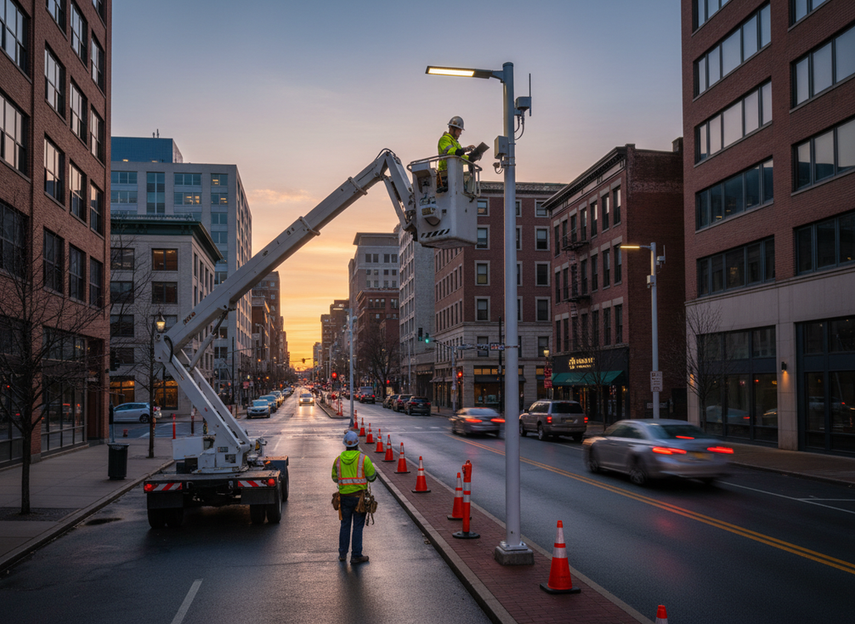
Why Maintenance Planning Changes Smart Pole Budgets
Smart poles usually combine lighting, controls, communications, and sometimes displays, so the maintenance surface is wider than a basic streetlight. That means cities should budget for uptime, response time, and component replacement, not only lamp performance. A pole that still lights but has a dead node, loose seal, or failed communication link can still create service work and public complaints.
For municipal teams, the main cost buckets are labor, access equipment, and parts or support. The monthly night inspections for outages and damage used by California transportation maintenance are a useful baseline for the lighting side, but smart poles usually need more than a glance at illumination. If the deployment includes controls, sensors, or networked devices, the acceptance testing and grounding checks for smart pole controls become part of the planning picture too.
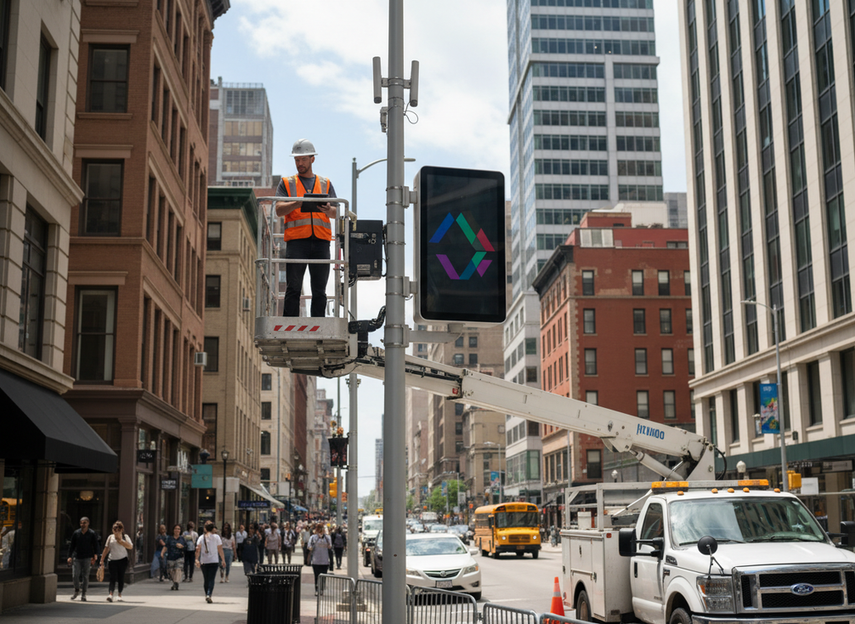
A municipal maintenance matrix should show task, frequency, labor role, access method, and spare-parts impact. If the city cannot answer who handles firmware updates, alarm response, or enclosure failures, the budget is probably too optimistic.
Build a Realistic Inspection Schedule
A workable schedule is usually tiered rather than fixed to one universal interval. A reasonable municipal baseline is a start-up inspection after installation, then periodic visual checks, annual electrical and controls review, and condition-based cleaning in harsher environments. Sites with road dust, salt spray, wildfire smoke, or industrial emissions often need more frequent enclosure checks and cleaning.
The deep preventive service every 3 to 5 years used in Texas high-mast lighting guidance is a useful planning analog for labor-heavy pole service. It does not mean every smart pole should follow the same clock, but it does show that deeper preventive work belongs on a multi-year cycle, not only after failure.
Routine Visual Checks
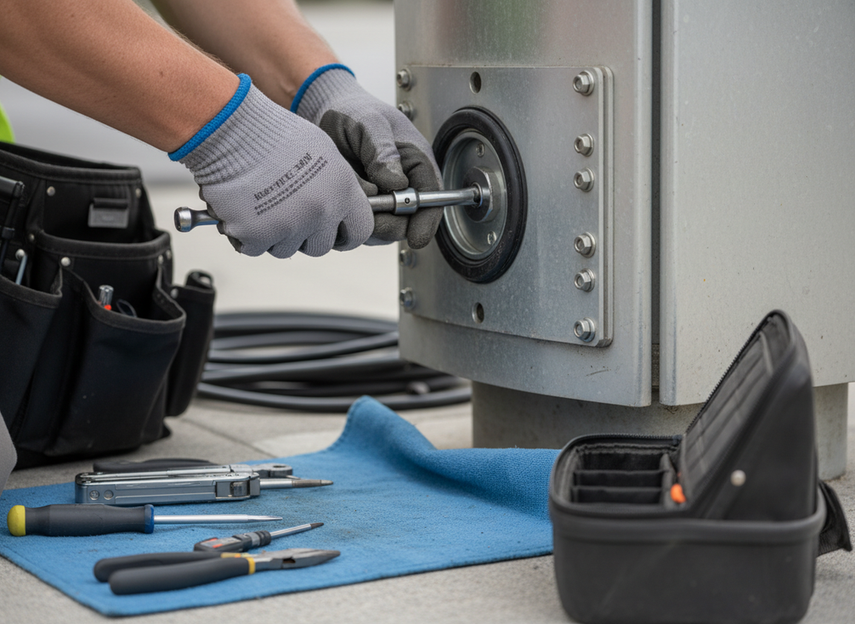
Routine checks should catch failed LEDs, obvious contamination, loose hardware, impact damage, and visible water intrusion. In many cities, crews can fold these checks into regular lighting rounds or patrol work. That makes the task cheap to schedule, but only if crews are told exactly what counts as a defect and where to log it.
Functional Testing and Controls Review
Functional checks should verify switching behavior, dimming, connectivity, sensor alerts, and any controller faults that affect uptime. Remote monitoring can reduce some unnecessary trips, but it does not replace field work. If the software says a node is online but the enclosure is full of moisture, the city still needs a physical inspection.
Preventive Service and Cleaning
Cleaning, seal checks, fastener review, and enclosure inspection are the recurring tasks that keep small issues from becoming outages. The right interval depends on local exposure. A coastal boulevard and a sheltered campus will not age the same way, so the schedule should be tied to local conditions, not a brochure promise.
Damage Response and Escalation
Cities should also define how crews triage storm damage, vandalism, and repeated outages. Critical locations may need faster dispatch than low-traffic corridors, and the contract should say who handles temporary repair, component replacement, and full unit replacement. If that is not written before deployment, response timing can become a dispute instead of a process.
For planning, think in terms of thresholds rather than a rigid calendar. If failures are isolated and cosmetic, a routine service route may be enough. If a location has repeat water ingress, repeated communications faults, or physical damage, it has crossed into a higher-response category and should be handled differently.
Compare Ownership and Service Models
The ownership model changes who carries the work, who pays for the truck roll, and who controls the response timeline. City-owned, contractor-managed, and hybrid models can all work, but they distribute risk differently.
| Service Model | Routine Inspection | Emergency Repair | Spare Parts | Software / Controls Updates | Budget Predictability |
|---|---|---|---|---|---|
| City-owned | City staff or city contractor | City or city contractor | Usually city-managed | Usually city-managed unless outsourced | Moderate to low, depending on staffing |
| Contractor-managed | Contractor | Contractor, within contract terms | Often contractor-managed | Often contractor-managed, if included | Higher if scope is tight |
| Hybrid | Split by task | Split by task | Shared or contract-defined | Split by system ownership | Moderate, but only if handoffs are clear |
The best model depends on local staffing, procurement structure, and risk tolerance. A city with a strong maintenance crew may prefer direct control. A smaller municipality may want service certainty and fewer internal dispatch demands. A hybrid model can work well when the city keeps oversight but outsources specialized repairs.
The contract details matter most for repairs, spare parts, and escalation timing. If the agreement does not clearly assign firmware access, alert response, or replacement lead times, the city may save money up front and lose it later in delays.
Track the Main 5-Year Cost Drivers
Over five years, ownership cost usually comes from energy, preventive maintenance labor, access equipment, replacement parts, controls or network support, and unplanned service calls. Cities should also count administrative time, because ordering, dispatch, and work-order tracking all consume staff effort even when the lights themselves are reliable.
Regional municipal planning work on LED conversions shows that payback is often measured in multi-year windows, not months, which is why a five-year model should include both operating savings and service burden. The municipal LED lifecycle payback context from the Capital District Regional Planning Commission is a useful reminder that lifecycle value is broader than first cost.
Five-Year Municipal Ownership Cost Drivers
A conservative planning view of where five-year smart pole cost pressure usually comes from. Actual shares vary by climate, access, controls package, and labor rates.
Show cost buckets
| Cost bucket | Typical role in a five-year budget |
|---|---|
| Energy | Recurring operating cost that moves with rates, dimming, and hours of use |
| Preventive maintenance labor | Scheduled inspections, cleaning, and electrical checks |
| Access equipment / truck time | Lift rental, crew time, lane control, or off-hours work |
| Parts and replacements | Drivers, nodes, seals, surge devices, or damaged modules |
| Controls / network support | Licenses, firmware updates, monitoring, or service access |
| Administrative handling | Work orders, dispatch, tracking, and reporting |
A city can use that framework to compare proposals, but it should not read it as a forecast. A downtown corridor with easy access may spend less on truck time, while a coastal route may spend more on cleaning and corrosion checks. Likewise, a system with strong remote alerts may reduce response time only if the city has a workflow that turns alarms into action.
The most commonly missed item is access cost. If service requires lane closures, traffic control, or specialized lifts, the labor cost of a service call can exceed the cost of the replacement part. That is why bid requests should ask vendors to identify access needs, service clearances, and estimated time per maintenance action before award.
How to Estimate 5-Year Ownership Cost Without Overpromising Savings
A defensible five-year model should include unit price, installation, annual energy use, preventive maintenance labor, replacement parts, controls fees, and a contingency for unplanned outages. If the inputs are uncertain, use a range instead of a single point estimate. That is usually more honest and more useful for finance staff.
For municipal smart pole LED maintenance schedules, the right question is whether the actual service plan matches the budget assumptions. If the plan assumes annual checks but the city ends up doing more work because of storms, vandalism, or network faults, the five-year cost will rise quickly. If the city has standardized hardware, good asset labels, and useful remote alerts, it may reduce emergency work and improve response time.
A simple way to build the estimate is to compare three cases: a low-cost scenario with easy access and few outages, a base scenario with typical municipal exposure, and a high-cost scenario with harsher weather, more truck rolls, or greater controls support needs. The result is not perfect, but it gives procurement and finance teams a realistic range for decision-making.
Procurement Checklist for Public Works and Finance
Before award, the team should confirm that the maintenance tasks and intervals are written in plain language, the warranty terms match the service plan, replacement parts are identified by part number, and access requirements are feasible with city equipment or contracted support. Controls support, licensing, and update responsibilities should also be clear.
The city should ask one more question before signing: who owns the data, the alerts, and the escalation path when a fault appears? If that answer is vague, the contract may look complete but still create friction later. That is especially true when a deployment includes smart controls rather than only lighting.
For teams comparing options now, the next step is to request maintenance matrices, warranty details, and five-year cost assumptions in the bid package, then score every offer against the same operating conditions. If you are evaluating a street-pole display or a broader smart city pole package, we can help you review smart pole display options as a navigation step, but the maintenance plan should still drive the final decision.
FAQs
How Often Should a City Inspect Smart Pole LED Fixtures?
A common baseline is a commissioning check, an early first-year walkthrough, then annual preventive inspections, with more frequent visual checks in higher-risk environments. Dusty, coastal, or high-vandalism areas may need tighter intervals.
Do LED Poles Really Need Maintenance If the Lights Last a Long Time?
Yes. Even when the light source has a long service life, cities still need to inspect drivers, seals, surge protection, controls, corrosion, and mounting hardware. LED longevity does not eliminate system maintenance.
What Is the Biggest Hidden Cost in a 5-Year Model?
Access and labor are often the most underestimated items. If service requires lifts, lane control, or overtime, a single corrective visit can cost more than a small replacement part.
Should Controls and Networking Be Included in Ownership Cost?
Yes, if the poles use smart controls. Licensing, communication support, firmware updates, and troubleshooting can materially affect long-run cost and should be included in the model.
How Should Cities Compare Vendor Warranty Claims?
They should compare the warranty to the actual maintenance plan and ask which tasks are required to preserve coverage. A warranty is only useful if the city can realistically meet its conditions.





