Every LED display procurement journey starts the same way: a Google search, a list of factory websites that all look identical, and three quotes for the same spec that differ by 40%. After that comes the real challenge — figuring out which supplier will deliver what they promised, on time, without the quality fading six months in.
Choosing a Chinese LED display manufacturer is not about finding the cheapest quote. It is about eliminating the wrong suppliers before you commit time, money, and your project’s reputation.
This guide walks you through the entire vetting process — from where to search, to what documents to demand, to what to look for when you walk the factory floor.
Why Your Choice of Manufacturer Determines Everything
The LED display supply chain in China has a wide quality spectrum. At one end are manufacturers that run their own SMT production lines, maintain in-house R&D teams, and ship to Tier 1 markets with full compliance documentation. At the other end are trading companies that buy panels from a third factory, add a margin, and disappear when the warranty claim comes in.
The gap between these two ends affects every part of your project:
Product consistency. A manufacturer with its own production line calibrates colour and brightness panel-to-panel. A trading company selling panels from three different sub-suppliers cannot guarantee batch-to-batch uniformity — and your 50 m² LED wall will show the seams.
Lead time reliability. When a factory controls its own production schedule, lead times are forecastable. When a middleman relies on another factory’s capacity, your 25-business-day promise can stretch to 60 days if that factory takes a larger order.
After-sales support. A manufacturer stocks spare modules, receiving cards, and power supplies for products it built. A trading company asks the original factory and hopes for the best. The difference matters most six months after delivery, not six days.
Certification authenticity. CE, RoHS, FCC, and UL certificates can be copied. A real manufacturer can show you the compliance test reports from the original testing lab. A trading company shows you a PDF.
This is why the vetting process matters more than the price comparison.
Where to Start Your Search
The starting point depends on how much upfront verification you need.
1. Google search. Searching “LED display manufacturer China” surfaces factory websites directly. Look past the homepage — check whether the website has a dedicated “Factory Tour” or “Production Line” page with real photographs, not stock images. A factory willing to show its floor is a factory willing to be judged.
2. B2B platforms (Alibaba, Made-in-China, Global Sources). These platforms give you a wide list but require more screening. Filter by “Verified Supplier” and “Assessed Supplier” badges. Check how long the supplier account has been active — accounts older than five years carry a lower risk of being seasonal operations.
3. Industry exhibitions. ISE (Barcelona), InfoComm (US), ISLE (Shenzhen), and Prolight + Sound (Frankfurt) are where established manufacturers exhibit. If a company has a booth at two or more of these shows consecutively, it has revenue and reputation to protect. Exhibitions also let you see physical panels and compare build quality across brands in a single afternoon.
4. Industry referrals. Ask your network of AV integrators, event production companies, and system installers. A referral from someone who has received and deployed a shipment carries more weight than any Alibaba review.
5. LinkedIn and trade media. Follow LED industry publications and LinkedIn groups where professional buyers share vendor experiences. These are unfiltered and harder to manipulate than platform reviews.
The best approach is to use at least two of these channels for each shortlisted supplier. If a factory appears on Alibaba but has never exhibited and has no independent press coverage, its track record is harder to verify.
5 Credentials Every LED Manufacturer Must Have
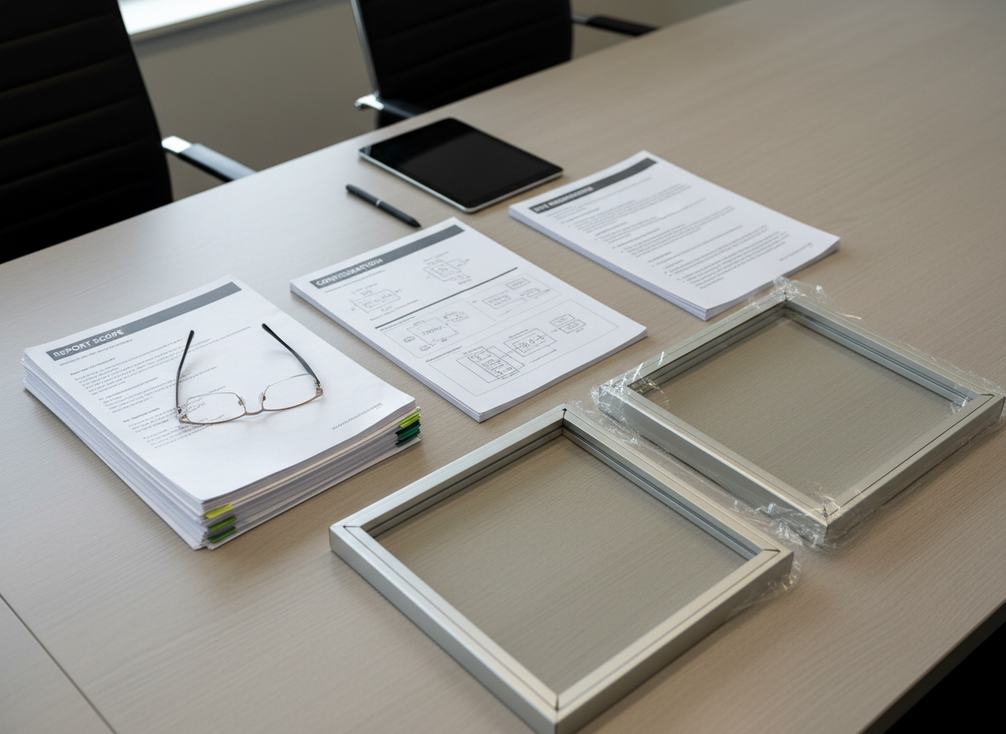
Before you schedule a factory visit or place a sample order, request these five documents. A legitimate manufacturer provides them without hesitation.
1. Business license. This is the most basic document. Check the registration date — the older, the better. Look at the registered business scope: it should explicitly list LED display or optoelectronic product manufacturing.
2. Export license. Any Chinese factory shipping internationally must hold an export licence. Without it, they cannot clear customs in their own name, which means they are using an agent — an extra link in the chain that complicates logistics and warranty returns.
3. ISO 9001 quality management certification. This is the baseline quality system standard. A factory without ISO 9001 has no documented quality control process. That does not mean it builds bad products — but it means quality is dependent on individual workers rather than a system.
4. Product-specific compliance certificates. For the European market: CE marking and RoHS compliance are minimum requirements. EN12966 and EN 50293 is mandatory for VMS and traffic displays. For the North American market: FCC and UL certification. Ask to see the test report, not just the certificate — the report comes from a named testing laboratory and shows the actual test conditions.
5. Patent or trademark documentation. A factory that has registered patents for its cabinet design, cooling system, or control technology is investing in R&D. A factory with no intellectual property is almost certainly assembling commodity designs from shared moulds — the same panels sold by 20 other companies under different names.
A factory that delivers all five documents within 48 hours of a request is organised.
The Factory Visit: A Room-by-Room Checklist
If your order exceeds $30,000, a factory visit is not optional. Here is what to look for in each area.
Production floor (SMT line). This is the heart of the operation. Surface-mount technology (SMT) machines place LEDs onto PCB boards at high speed. Look for brand-name equipment: Yamaha, Panasonic, or Fuji SMT machines indicate capital investment consistent with a serious manufacturer. Count how many SMT lines are running — one line can serve a small operation; three or more signals production scale.
Ageing room. Every LED panel should undergo a burn-in test — usually 72 hours of continuous operation in a temperature-controlled room — before shipping. Ask to see the ageing room. If the factory claims to age its panels but cannot show you the room, the claim is unlikely to be true.
Warehouse and inventory. A manufacturer with domestic and overseas warehouse stock (like Chipshow’s California (USA) and Netherlands facilities) can offer shorter lead times and local after-sales support. A factory running purely on build-to-order relies entirely on production capacity — which works until the capacity is taken by a larger client.
QC testing station. Look for brightness meters, colour calibration cameras, waterproofing test chambers, and vibration test rigs. A factory without dedicated QC equipment is shipping panels that have not been measured.
R&D lab. This is the hardest area to evaluate quickly, but it distinguishes a manufacturer from an assembler. An R&D lab will have prototype PCBs, test fixtures, thermal cameras for heat analysis, and half-disassembled competitor products on the bench for benchmarking.
Sample room. The finished-product display area tells you what the factory considers its best work. Pay attention to cabinet fit and finish, cable management, and screen uniformity. If the sample room panels have visible seams or colour variation, the production units will be worse.
8 Technical Questions to Ask Before You Order
These questions separate manufacturers who know their product from trading companies reading a spec sheet.
1. Which LED chip brand do you use, and can you provide traceability? Nationstar, Kinglight, Nichia, and Cree chips sit at different cost and quality points. A manufacturer should be able to state the chip brand for each pixel pitch tier and explain the trade-off.
2. What is your dead-pixel policy? Industry standard allows ≤0.01% dead pixels out of the box. Ask what happens if the rate exceeds this — and whether replacements are shipped at the factory’s cost.
3. Can I mix panels from different production batches? The answer should be yes, with a caveat about minor brightness variation that can be calibrated. A manufacturer that says “no” has batch consistency issues.
4. What is the cabinet weight per square metre? Standard aluminium rental cabinets weigh approximately 15–18 kg/m². Carbon-fibre cabinets — such as Chipshow C-Carbon — weigh 12.5 kg/m². If the quoted weight is vague, the factory does not manufacture the cabinets in-house.
5. What refresh rate do your panels achieve? For any application facing a camera, ≥3,840 Hz is non-negotiable. Panels rated at 1,920 Hz will produce scan-line banding on camera. Ask the manufacturer to demonstrate the refresh rate with a camera pointed at a running panel.
6. What certifications do your panels carry, and can I see the original test reports? Get specific by market: CE and RoHS for the EU; FCC and UL for the US; EN12966 and EN 50293 for European traffic applications.
7. What is your warranty term, and what does it cover? Standard warranty is typically 2–3 years. Ask whether the warranty covers labour, parts, or both, and whether replacement units ship at the factory’s expense.
Red Flags: 5 Signs of an Unreliable Supplier
Some warning signs are obvious; others only become visible when you know what to look for.
1. The price is 30% below every other quote. LED display manufacturing has a floor price driven by component costs. A quote that dramatically undercuts competitors either uses lower-grade components, skips burn-in testing, or is a bait price that will be renegotiated after the deposit.
2. The company cannot provide its factory address. A trading company operating from an apartment or shared office will give a registered address that is not a production site. Verify the address on Baidu Maps or Google Maps satellite view before visiting — look for an industrial building, not a residential block.
3. The salesperson cannot answer technical questions without “checking with the engineer.” A salesperson at a real factory walks the production floor daily and knows the product. One who must defer every technical question to a back-office engineer is distant from the product — a sign of a trading company.
4. The company has changed its name recently. Check the business licence registration date. A factory that has operated for 10+ years under the same name is committed to the industry. A factory that rebranded two years ago may be an old company with a bad reputation operating under a new name.
5. Sample orders are refused or delayed. A manufacturer confident in its product will ship a sample panel within two weeks. A supplier that delays, demands a minimum order before sending a sample, or ships a sample that looks nothing like the catalogue photos is not worth pursuing.
OEM vs ODM: Which Partnership Model Fits You
Chinese LED display manufacturers offer two main partnership models. Knowing the difference helps you choose the right engagement from day one.
OEM (Original Equipment Manufacturing). You provide the specifications, branding, packaging design, and sometimes the cabinet mould. The factory builds to your exact requirements and ships under your brand. OEM works best for buyers who have an established brand identity, sell into a specific vertical, or need custom cabinet dimensions that off-the-shelf models cannot meet.
ODM (Original Design Manufacturing). The factory offers its existing product range, and you select and brand existing designs. This is faster — lead times are shorter because tooling and moulds already exist. ODM works best for buyers entering the LED display market for the first time, or those who need standard configurations for general-purpose rental and installation.
| Factor | OEM | ODM |
| Customisation | Full — your design, your spec | Limited — factory’s design, your brand |
| Lead time | Longer (tooling + production) | Shorter (existing moulds) |
| Minimum order quantity | Higher (custom production runs) | Moderate to low |
| Upfront cost | Higher (mould fees, engineering) | Lower |
| Best for | Established brands, vertical specialists | New market entrants, standard applications |
Chipshow serves both models. ODM buyers select from the existing COB, outdoor, rental, transparent, and VMS product lines. OEM buyers work with the engineering team on custom pixel pitches, cabinet sizes, and enclosure specifications — from concept drawing to first shipment.
How to Verify Quality Before Your Order Ships
The deposit is paid, the production order is confirmed. The gap between now and the container arriving at your port is where quality verification happens — or does not.
1. Third-party inspection. Companies like SGS, Bureau Veritas, and TÜV Rheinland offer pre-shipment inspection services in Shenzhen. For approximately 300–300–500 per day, an inspector visits the factory, checks the production batch against the agreed specification, and issues a report with photographs. This is the most reliable quality gate for buyers who cannot visit in person.
2. Video walkthrough. If third-party inspection is not in the budget, request a live video call from the production floor. Ask the contact to walk to the ageing room, show the panels powered on, and pan the camera slowly across the screen surface to check for dead pixels and colour uniformity.
3. Sample panel before full shipment. Ship one completed panel by air freight before the full order leaves by sea. Test it in your own environment — measure brightness, check build quality, connect it to your control system.
4. Production milestone payments. Structure the payment as 30% deposit, 30% after production completion (verified by photos or inspection), and 40% before shipment. This keeps the manufacturer accountable through the entire production cycle.
5. Factory-direct shipping terms. Negotiate FOB (Free on Board) Shenzhen terms so you control the freight forwarder. This gives you visibility into the shipping timeline and prevents the factory from using a forwarder that adds hidden fees.
Frequently Asked Questions
Q1: Can I trust LED display suppliers I find on Alibaba?
Many legitimate manufacturers list on Alibaba, but the platform also hosts trading companies that present themselves as factories. Filter for “Verified Supplier” and “Assessed Supplier” badges, check the account age (5+ years is safer), and independently verify the factory address before placing an order. Never rely on Alibaba badges alone — request the five credentials listed in this guide.
Q2: What is the difference between a trading company and a factory?
A factory owns its production equipment, production floor, and quality control process. A trading company sources panels from one or more factories and resells them under its own name. The easiest test: ask for the factory address, verify it on satellite maps, and request a live video walkthrough from the production floor. A trading company cannot provide this.
Q3: How do I handle warranty claims and after-sales support from a Chinese manufacturer? A: Confirm the warranty term (typically 2–3 years), what it covers (parts, labour, or both), and who pays return shipping for defective units. A manufacturer with regional warehouse stock — such as Chipshow’s facilities in Houston and the Netherlands — can fulfill warranty replacements faster than shipping individual modules from China. Ask for the after-sales contact person and test the response time during the sample phase, not after the full order arrives.