

For 24/7 spaces, LED display maintenance has to do more than fix broken panels. The contract should define uptime, response timing, escalation steps, preventive work, and spare-parts responsibility in a way that matches how a command center actually runs. If the wall supports monitoring or decision-making around the clock, vague promises are not enough.
What 24/7 Operations Need From Maintenance
A round-the-clock control room needs a maintenance contract that treats downtime as an operations issue, not just a repair ticket. In practice, that means separating emergency support from routine service, then spelling out which failures are covered, which are customer-caused, and which are excluded. If the contract does not draw those lines, the vendor can look responsive on paper while the site still waits during a real outage.
For buyers, the first question is simple: what happens when the wall goes partially dark, the controller drops, or a full section fails after hours? In a 24/7 room, the answer should be written into the service scope, not left to interpretation. It also helps to link the contract to the room’s operating model, because a problem that is tolerable in a lobby is much more urgent in a command center. If you need broader procurement context around display contracts, the LED display standards and compliance guide is a useful background reference.
Build SLA Language Around Uptime
Good LED display maintenance contract requirements start by defining what the vendor is actually measured against. Uptime, availability, repair obligations, reporting, and remedy language should not all be folded into one vague promise. The SLA should say whether availability is measured at the wall, controller, panel, or system level, and it should name the exclusions that would otherwise blur the calculation.

A practical reference point for critical outages is a 2-hour to 4-hour on-site response window in mission-critical AV service tiers. Use that as a negotiation anchor, not as a universal rule. The real value is in separating acknowledgement, dispatch, and arrival, because a contract can sound fast while hiding delay in the middle step. If a vendor says "24/7 support," the SLA should still state what happens first, what happens next, and what counts as a completed response.
Here is the contract logic that buyers should check:
| Contract element | What to look for | Why it matters for 24/7 ops |
|---|---|---|
| Measurement point | Wall, controller, panel, or system level | Prevents the vendor from defining uptime in the most favorable way |
| Exclusions | Planned maintenance, customer-caused issues, third-party outages | Keeps availability math honest |
| Response timing | Acknowledgement, dispatch, and on-site arrival | Stops "fast" service from becoming a paperwork promise |
| Remedy language | Credits, repeat-failure handling, corrective action | Gives the buyer leverage when outages recur |
The strongest SLA wording is the kind that can be checked after the fact. If the clause only promises "best effort," it is probably too soft for a 24/7 control room unless there is a separate operational backup. If the contract includes credits, make sure they are proportional to the impact of downtime instead of just symbolic.
Clarify Response Times and Escalation
The response path should work like an incident tree, not a general help desk. First notice, acknowledgement, dispatch, and remote or on-site intervention should each be named in sequence. That matters because a minor fault and a wall-wide outage should not follow the same path. A single dead module may be annoying; a full-wall failure can stop operations.
For after-hours incidents, the contract should list the contact method, the first and backup contacts, and the severity trigger that moves the issue into urgent handling. It should also reflect geography and access rules. A vendor can only promise so much if the site is remote, secured, or hard to enter after business hours. In other words, "24/7" should mean 24/7 incident handling, not just a phone number that rings at night.
A useful way to write this section is as a checklist:
- Define what counts as a critical outage.
- State who must acknowledge the ticket.
- State how fast dispatch starts after acknowledgement.
- Name whether the next step is remote triage or on-site visit.
- List backup contacts for nights, weekends, and holidays.
That structure makes the contract easier to enforce and easier to compare at renewal. It also helps buyers spot a hidden weakness: some vendors advertise around-the-clock support, but the actual escalation path still depends on business-hour staffing.
Plan Spare Parts Coverage Without Guesswork
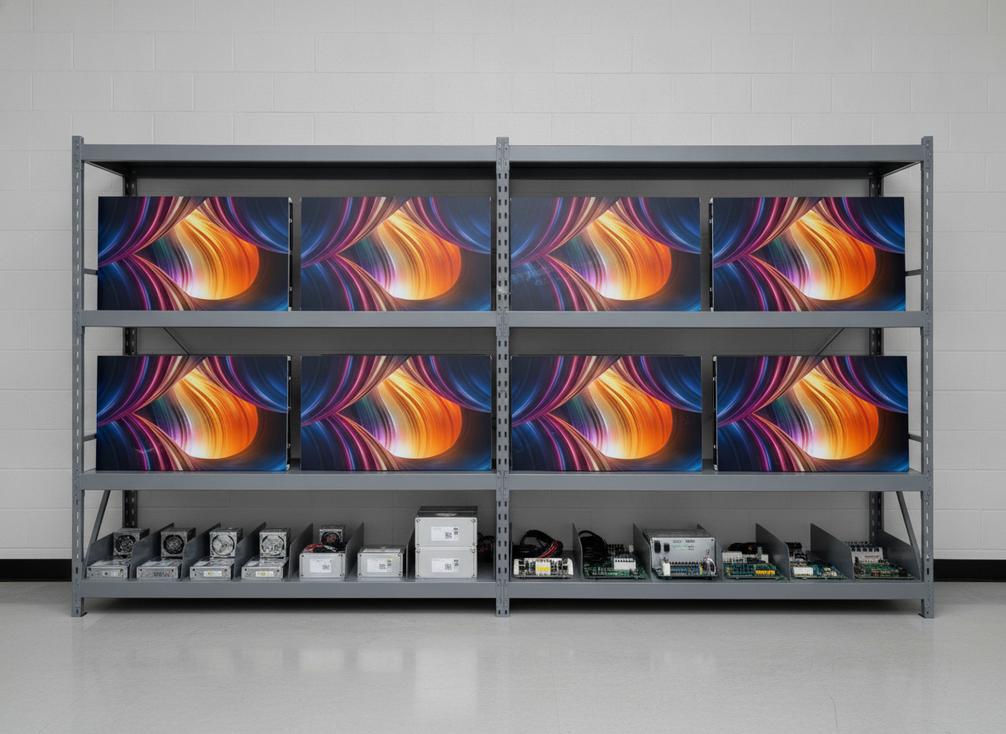
Spare-parts planning is where many LED display maintenance contracts break down. The question is not just whether parts exist somewhere in the vendor network. The contract should say who owns them, where they sit, when they are replenished, and whether substitutions need approval. Without that, a display can be "covered" and still sit idle while someone searches for a compatible module or power supply.
For 24/7 operations, the right stocking model depends on failure impact and lead time. If a single panel failure can affect operators right away, critical spares need to be close to the site or under clear vendor control. If replacement parts are slow to source, the contract should say how the vendor prevents a routine outage from turning into a prolonged one. Refurbished or equivalent substitutions should also be defined in advance so approval does not stall during an incident.
| Ownership model | What the contract should say | Best-fit use case |
|---|---|---|
| Vendor-held spares | Vendor owns stock, replenishes it, and approves substitutions | Sites that need fast access without managing inventory internally |
| Buyer-held spares | Buyer stores key parts onsite and controls release rules | Facilities with in-house tech staff and strict uptime needs |
| Shared model | Vendor maintains critical items while the buyer keeps select backups | Large facilities that want redundancy without overstocking every part |
The key is not the label on the inventory plan. It is whether the plan shortens the path from failure to repair. If the parts strategy does not clearly reduce waiting time, it is not protecting the wall.
Match Preventive Maintenance to Mission-Critical Use
Preventive maintenance should be written as named tasks, not a generic promise to "service the system." For command center LED walls, that usually includes thermal audits, visual inspections for pixel health, and seam alignment checks. A practical maintenance scope should also cover scheduled inspection, cleaning, firmware or controller review, and physical condition checks. Mirackle’s LED wall maintenance guidance is a useful example of the kinds of tasks buyers should ask to see in writing.
The contract should also say who handles access, who provides lifts or escorts, and whether maintenance requires a shutdown or a live-room workaround. In a 24/7 environment, the difference between a service visit and an operational disruption can be very small. That is why the maintenance window, notice period, and approval step matter as much as the task list itself.
A practical preventive-scope checklist looks like this:
- Scheduled inspections with documented findings
- Cleaning and cabinet condition checks
- Thermal and airflow review where applicable
- Pixel-health and uniformity checks
- Seam alignment verification
- Controller or firmware review when part of the contract
- Visit reports that show what was checked and what still needs follow-up
If the vendor cannot explain how the work is documented, the buyer may have no usable record when renewal time comes. Good reports make it easier to compare service quality, budget future work, and challenge repeat issues.
Compare Vendor Tiers Before Renewal
When it is time to renew, compare service tiers on the terms that affect uptime, not just on the monthly fee. Response coverage, parts inclusion, preventive visit frequency, reporting depth, and exclusions usually tell you more than the headline price. A cheaper tier can be fine if the room has tolerance for delay. It is a poor fit if the wall is central to live operations and the contract pushes most risk back to the buyer.
Watch for exclusions that shift the burden onto your team. Access problems, shipping delays, out-of-scope labor, and unclear coverage for repeat failures can make a premium tier feel less protective than it first appears. The right question is whether a higher tier actually improves response and recovery, or only adds administrative convenience. If it does not change the outage path, it may not be worth the renewal increase.
For a multi-room facility, renewal is also the time to decide whether to renegotiate terms, add onsite spares, or move up a service level. The best choice depends on incident history and tolerance for disruption, not on the vendor’s brochure language.
Contract Checklist for the Next Review
Before you sign or renew, confirm the SLA measurement point, the escalation path, and the remedy language. Verify who owns spare parts, where they are stored, and how substitutions are approved. Check that preventive maintenance is named in concrete tasks and that access, notice, and reporting are written into the process. If the vendor cannot tie those terms to your outage tolerance, the contract is probably not strong enough for a 24/7 room.
Use this review to decide whether to stay, renegotiate, or add inventory support. If the contract still leaves response timing, parts access, or maintenance scope vague, treat that as a warning sign rather than a minor drafting issue.
FAQs
How Should a 24/7 LED Display SLA Define Uptime?
It should define the measurement point, the exclusions, the reporting method, and the remedy structure. That keeps uptime from becoming a loose marketing term. For a command center, the key is not just the percentage itself, but whether the SLA explains how outages are counted and what happens when the same issue repeats.
What Spare Parts Should Be Covered in a Maintenance Contract?
The contract should identify the critical parts classes, such as modules, power supplies, processors, and other failure-prone items. It should also say who owns them, where they are stored, when they are replenished, and whether refurbished or equivalent replacements are allowed. Those details matter more than a vague promise to "keep parts available."
Can a Vendor Guarantee Same-Day Repair for a Control Room LED Wall?
Only if the contract says so and the logistics make it realistic. Geography, site access, and parts availability all affect whether same-day repair can happen. A fast response promise is more credible when it separates acknowledgement, dispatch, and on-site arrival, instead of hiding those steps inside one broad support claim.
Why Do Preventive Maintenance Terms Matter in Always-On Facilities?
Because the maintenance window, notice process, and documentation standard affect operations directly. If the work happens at the wrong time or without clear reporting, the site can lose uptime even when no major fault exists. Good preventive terms make scheduled service predictable and give you proof of what was done.
How Do You Compare Service Tiers for a Mission-Critical LED Wall?
Compare response coverage, spare-parts inclusion, preventive frequency, exclusions, and reporting depth against your actual outage tolerance. A tier is only worth more money if it shortens recovery time or reduces risk in a way your team can feel during an incident. If it only improves convenience, the value may be limited.
Final Takeaway
The best LED display maintenance contracts turn uptime goals into written obligations. For 24/7 operations, that means clear SLA definitions, realistic response timing, named escalation paths, documented preventive work, and spare-parts terms that do not leave the wall waiting. If those items are vague, the contract is weaker than it looks. If they are specific, you have a much better chance of keeping the room operational when it matters most.