


LED display maintenance contracts can look similar on paper, but the differences show up when a screen is down, a part is backordered, or a site needs help after hours. Buyers should treat the agreement as an operating plan, not just a price add-on. The core keyword matters because it frames uptime, support scope, and who owns each next step.

What Buyers Should Confirm Before Signing
Before signing, ask what the contract actually covers. Confirm whether preventive visits, remote troubleshooting, firmware guidance, and on-site labor are included or billed separately. Separate the manufacturer warranty from the maintenance contract and from any SLA language; those are related but not interchangeable. AVIXA’s published standards give buyers a recognized reference point for verification criteria, which helps keep scope from drifting.
Buyers should also verify who is authorized to perform work, whether local access is required, and what happens if the site is not ready for service. For higher-risk facilities, ask whether the vendor maintains documentation, escalation paths, and a defined process for replacements or repairs. If the provider references monitoring or diagnostics, ask what data is reviewed, how alerts are handled, and whether the client must approve access windows before work begins.
A practical review is to ask for the exact exclusions in writing. Common exclusions may include physical damage, misuse, structural changes, network outages, and work outside agreed hours. If the vendor bundles support into a larger project scope, the buyer should confirm which commitments survive after installation. That matters most for mission-critical deployments, where service promises need to stay visible long after the install team leaves.

SLA Terms That Matter Most
In LED display maintenance contracts, SLA language should be precise enough to measure but flexible enough to reflect real deployment conditions. The terms that matter most usually include response method, escalation sequence, service window, remedies, and communication cadence. A credible SLA should define what triggers a response, what the provider must do first, and how the client is updated when a problem is not resolved on the first pass. In practice, the safest reading is the one used in SLA contract reviews: look for performance standards, measurement methods, and remedies, not just a fast-sounding promise.
Avoid relying on a single speed promise. The better question is whether the vendor can route the issue, diagnose it, and dispatch the right resource without unnecessary handoffs. Maintenance SLAs commonly separate response time, MTTR, and uptime because each one tells you something different about the service experience. That distinction is useful in industrial maintenance SLA guidance and it matters here because a quick acknowledgment is not the same thing as a quick fix.
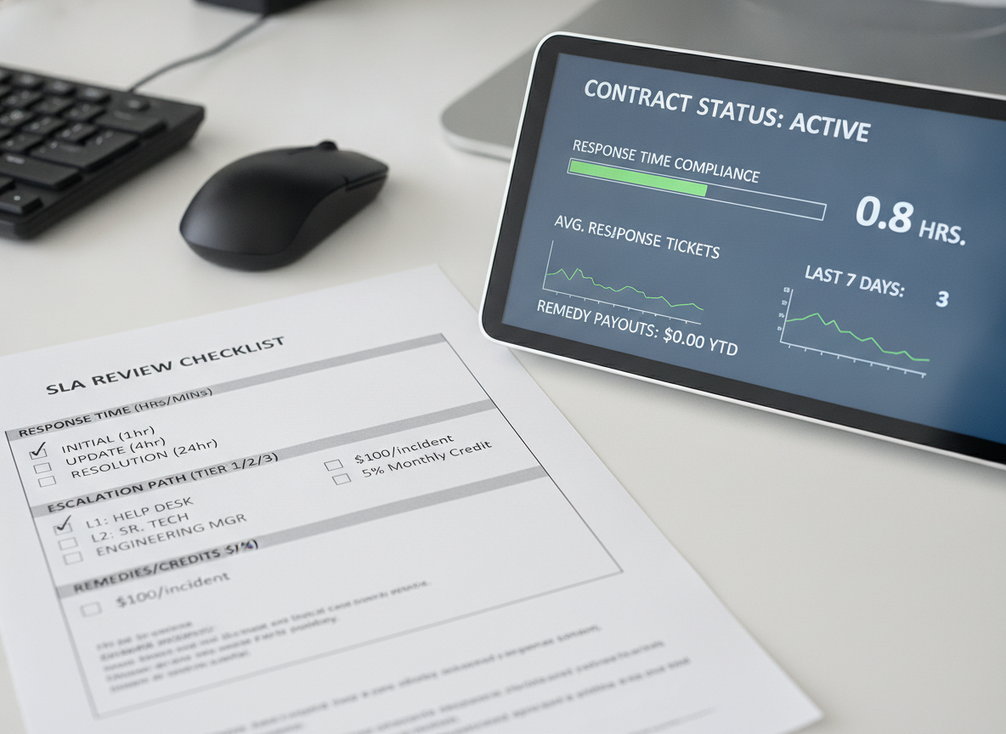
Buyers should also ask how the provider handles partial failures. For example, a dead module on a large display may not require a full replacement, but it may affect visibility or brand standards. The SLA should explain whether the vendor will attempt temporary mitigation, escalate to a replacement path, or schedule a return visit. It should also clarify whether credits, service extensions, or other remedies apply when the provider misses its own commitments.
A good decision sentence to use in procurement is this: if the contract only promises acknowledgment, it is not enough for a command room that needs live continuity. If it only names uptime without saying how it is measured, the buyer still does not know how service will feel in an outage. And if it combines remote triage, on-site arrival, and full resolution into one phrase, the risk is that everyone leaves the meeting with a different expectation.
Spare Parts and Replacement Readiness
Spare parts readiness is often the difference between a short interruption and a prolonged outage. Buyers should ask which parts are stocked domestically, which are factory-order items, and which are considered consumables. The agreement should state who owns spare inventory, how reserve parts are tracked, and whether the provider can substitute compatible components when a primary part is unavailable.
For mission-critical support, institutional AV guidance recommends documented serial numbers, inventory tracking, and staff training as part of a serious support plan. The University of Houston AV design standards are a useful benchmark for that level of discipline, even though every LED wall deployment will have its own logistics.
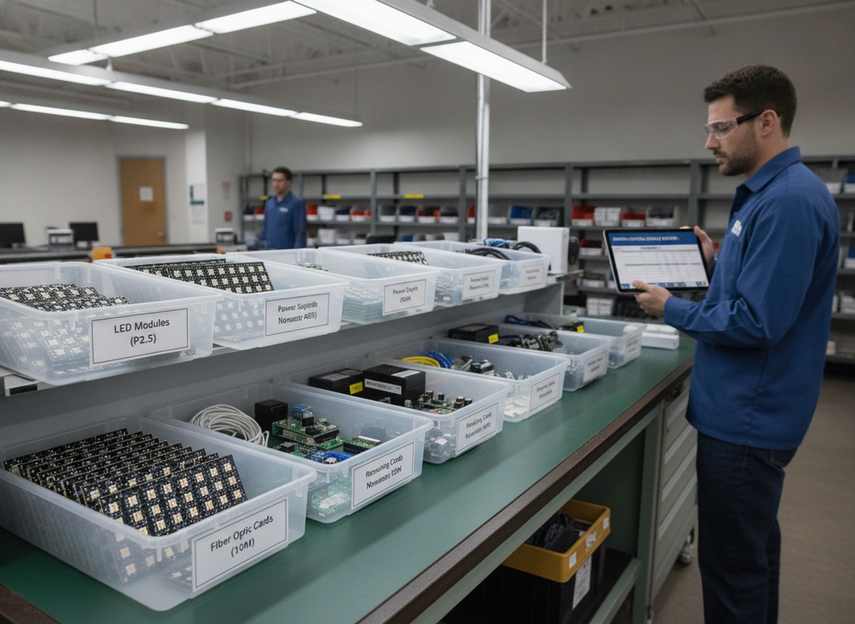
A practical spare-parts plan usually centers on the parts that most often stop the wall from operating cleanly, such as modules, power supplies, receiving cards, and cables. The exact depth of inventory should depend on wall size, duty cycle, and outage cost, not on a one-size-fits-all rule. If a screen is used for operations, safety messaging, or customer-facing communications, the replacement path should be more conservative than for a low-traffic display.
Also confirm whether the vendor will manage warranty claims on the buyer’s behalf or whether the buyer must work directly with the manufacturer. That distinction matters because warranty, maintenance, and SLA obligations are often handled by different parties. When the contract is weak here, the result is usually a slower handoff, not a cheaper outage.
US Service Expectations by Deployment Type
US service expectations vary by deployment type, and contract language should reflect those differences. A corporate lobby display may tolerate scheduled service windows, while a command center or public-facing venue may need faster coordination and clearer after-hours escalation. For mission-critical rooms, the buyer may also need access controls, documented handoff procedures, and service personnel who understand site rules before arriving.
Public-sector and regulated environments often expect more documentation, tighter access controls, and formal reporting than a standard retail site. That does not mean every private project needs the same structure, but it does mean the agreement should fit the operating environment. OSHA’s general guidance on workplace access and safe conditions is relevant when vendors must enter active facilities, especially if service work affects employee areas or public spaces: OSH Act requirements and restroom and sanitation rules show how entry, safety, and site conditions can matter during service work.
A command center solutions deployment should usually prioritize continuity, escalation clarity, and controlled maintenance windows. A smaller meeting-space rollout may place more weight on remote support and straightforward replacement procedures. For a C-Pad environment, where the display may function as a user-facing control surface, buyers should confirm touch-specific support, software coordination, and any dependency on third-party systems. The best contracts match service expectations to the way the space is used, not just to the hardware model.
A Practical Vendor Comparison Checklist
Use a checklist when comparing vendors so the decision is based on support quality, not just sales language. Ask each bidder to answer the same questions in writing:
| Check Item | What to Confirm |
|---|---|
| Scope | Preventive maintenance, remote support, on-site labor, exclusions |
| SLA | Service windows, escalation steps, remedies, reporting cadence |
| Parts | Domestic stock, lead times, substitutions, return process |
| Staffing | Authorized technicians, certifications, subcontractor use |
| Access | Site rules, security clearance, after-hours entry, escort needs |
| Documentation | Asset list, service records, firmware/version tracking |
| Warranty handling | Who files claims, who approves repairs, what is billable |
| Communication | Named contacts, ticket updates, incident summaries |
| Deployment fit | Public venue, corporate, government, operations, control room |
| Exit support | Transfer of records, handoff, spare parts disposition |
If the vendor’s answers are vague, that is a signal to slow down. Ask for a redlined draft and compare the language side by side. The goal is not to find the longest contract; it is to find the one that makes service outcomes visible and manageable. Start with the provider’s maintenance map, then validate it against the site’s real operating needs.
If you want a lower-risk rollout, ask vendors to walk through one hypothetical outage from ticket intake to closeout. Their explanation will reveal more than a polished brochure. For teams that want to compare multiple models, that exercise is often the most efficient way to separate dependable support from general promises.
FAQs
How Fast Should a U.S. LED Wall Service Response Be in the Contract?
There is no universal U.S. benchmark that fits every deployment. The better contract defines whether "response" means acknowledgment, diagnosis, or an on-site visit, and it ties that definition to coverage hours and site criticality.
What Spare Parts Should Be Included in a Maintenance Plan?
Common high-impact parts often include modules, power supplies, receiving cards, and cables, but the exact list should match the wall design and outage risk. The agreement should also say who stocks them and how replacements are dispatched.
Why Do Warranty Terms Matter More Than the Sales Pitch?
Because warranty language tells you what is actually covered, what is excluded, and whether labor or parts are included. A polished sales pitch can sound broad while the contract is much narrower, so the written terms should win every time.
Can a Vendor Subcontract Field Service Without Changing the SLA?
Sometimes, yes, but subcontracting should not weaken accountability. Buyers should confirm who owns escalation, who communicates during an outage, and whether the original vendor remains responsible for timing and resolution even if another team performs the work.
What Should Buyers Confirm Before Signing a Multi-Year Contract?
Check coverage hours, escalation contacts, spare-parts access, warranty boundaries, renewal terms, and who handles claims or replacements. If the contract does not spell those items out, the buyer is usually carrying more operational risk than the sales conversation suggests.
A well-structured contract should reduce uncertainty, not add it. If the vendor can explain scope, parts, escalation, and renewal terms in plain language, the agreement is usually easier to live with over time. For LED display maintenance, that clarity is the real value.





