For highway VMS LED display procurement, the safest approach is to treat standards, visual fit, and ITS integration as three separate checks before you shortlist a supplier. A sign can look compliant in a brochure and still need project-specific proof in the bid package, so start with the exact standard set, then verify the display context, then confirm how the controller and communications will work inside the agency’s ITS environment.

Which Standards Apply to Your Highway VMS?
Before you compare vendors, confirm which standards are actually in scope for the project. In the US, the MUTCD Chapter 2L sets the baseline for changeable message sign use and message content principles, so it is the right starting point for highway VMS compliance requirements. For interoperability, NTCIP 1203 v03 is the main reference for dynamic message sign object definitions and message formatting.
Project Requirements Versus Vendor Claims
Do not let a supplier’s wording stand in for the agency’s specification. Treat claims such as compliant, approved, or certified as items to verify against the exact bid documents, submittal package, and project standard set. That matters because the same sign can be acceptable in one project and incomplete in another if the agency asks for different message rules, controller behavior, or acceptance evidence.
A useful rule is simple: if the requirement is not in the RFP, drawings, or official project spec, it is not a pass yet. Use the standards review to define pass/fail language before you compare pricing or features.
What to Confirm in the Standards Package
Ask for the documents that let your reviewers trace each claim back to evidence. At minimum, that usually means product drawings, interface notes, test documents, and installation details. In many DOT submittal patterns, buyers also ask for NTCIP compliance statements, MIB files, and hardware or environmental test evidence, which is a good practical model even when your agency uses a different form.
If the package does not show how the sign, controller, and installation will be reviewed, the project is not ready for award. That is especially true for highway VMS compliance requirements, because approval risk usually shows up first in missing paperwork, not in the sales quote.
Where EN 12966 and NTCIP 1203 Fit
Use EN 12966 as a technical benchmarking framework, not as a universal US approval rule. The standard classifies visual performance with L, R, and C classes, which helps you compare how a sign presents luminance, contrast, and color behavior. That is useful when suppliers make broad brightness claims, but it does not replace agency review or local acceptance rules.
The practical takeaway is this: EN 12966 can help you judge whether a proposed sign looks plausible for the use case, while NTCIP 1203 tells you how the sign should talk to the central ITS software. If either side is vague, keep the candidate on hold until the submittal closes the gap.
| Procurement check | What to verify first | Why it matters for the bid review |
|---|---|---|
| Standards package | Which standards the offer explicitly claims to address, and which product documents map to each claim | Prevents treating a general compatibility statement as proof of compliance |
| Visual performance context | Whether the proposed display is described with the application context used by the supplier, rather than as a universal performance promise | Helps keep review tied to the use case and avoids over-reading missing performance data |
| Integration / interface checks | Whether the interface, communications, and control-side integration items are named and documented | Confirms the VMS can be evaluated as part of the wider ITS environment |
| Pre-award documents | Cut sheets, interface notes, drawings, declarations, and other bid-stage evidence | Provides the minimum paper trail needed before any technical acceptance step |
| Open questions | Any claims or gaps that are not resolved by the submitted package | Flags items that need clarification before procurement moves forward |

Brightness, Legibility, and Cabinet Fit
For highway VMS LED display reviews, brightness should never be the only question. A brighter sign can still underperform if the contrast, viewing context, or sign face design does not support legibility in real traffic conditions. That is why EN 12966’s visual classes are useful: they push the review toward a complete display context instead of a single headline number.
What to Compare in a Submittal Review
| Attribute | What to verify | Why it matters | Common red flag |
|---|---|---|---|
| Brightness and legibility claim | How the supplier describes performance, and what context it uses | A headline number alone does not prove real-world readability | A brochure that only lists a brightness figure |
| Viewing context | Expected approach speed, mounting height, and typical driver distance | Context changes how quickly a message can be read | No site-specific viewing discussion |
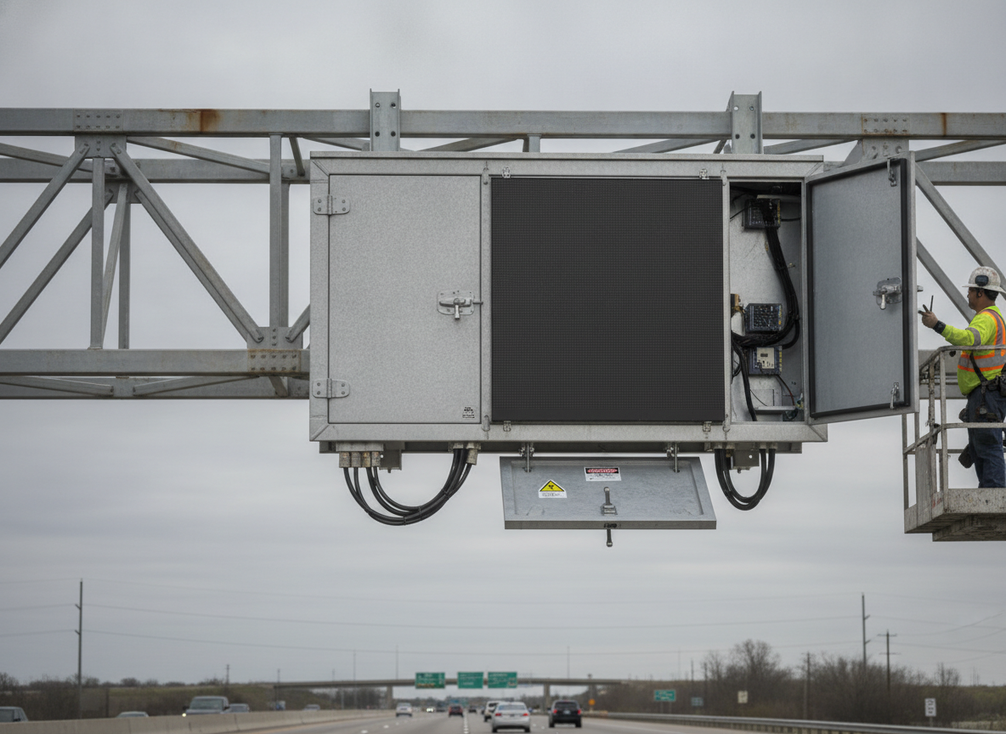
| Cabinet and mounting fit | Dimensions, structure, and any load or clearance limits | The sign can fail the project if it cannot be mounted safely | Missing installation drawings |
| Environmental protection | Weather exposure, temperature range, and enclosure details | Highway deployments face outdoor conditions year-round | Vague outdoor-duty language |
| Service access | Front-service or rear-access needs, plus maintenance clearance | Poor serviceability raises downtime and lane-closure risk | No maintenance access plan |
| Structural and load issues | Gantry, pole, trailer, or roadside support conditions | Fit affects safety and installation complexity | Hardware that ignores site constraints |
For most buyers, the cabinet and support structure matter as much as the display face. A sign that looks attractive on paper can become a problem if service access is awkward, the load is too high for the support, or the enclosure does not match the site conditions. If you are comparing options for an overhead or gantry deployment, review the traffic VMS solution path only as a browsing shortcut, not as proof that a specific model matches your project.
A good decision sentence here is: if the supplier cannot connect brightness, legibility, and enclosure fit to your exact site, the sign is not ready for shortlisting. The reverse is also true: a model with moderate-looking headline numbers can still be a better fit if the viewing context, service access, and structural details are documented cleanly.
How to Check VMS Integration With ITS
NTCIP 1203 v03 is the core interoperability reference when you are checking VMS integration with an ITS system. The practical question is not whether the sign mentions the protocol name, but whether the controller, message workflow, communications path, and agency operations model all line up before award. A protocol label by itself does not prove the sign will fit the agency’s network or workflow.
Controller and Message Workflow
Start with how messages are created, approved, queued, and displayed. The agency should know who owns day-to-day message control, how traffic operations staff will push updates, and what happens when a message fails or needs to be replaced. If the vendor cannot explain the workflow in plain terms, integration risk is still open.
This is where many teams get trapped by a technically impressive brochure. If the controller interface does not match the agency’s operating model, the sign may still be a bad fit even when the hardware looks right. That is why the NTCIP 1203 v03 dynamic message sign definitions belong in the review before award, not after installation.
Communications, Network, and Access Checks
Next, verify the communications path and any agency IT requirements. That includes network handoff, remote access, authentication, maintenance permissions, and any cybersecurity review steps the agency requires for ITS devices. The ALDOT supplemental dynamic message sign requirements are a useful public example because they show how submittals often ask for NTCIP statements, MIB files, and hardware evidence instead of relying on marketing language.
If the project needs a specific network approval or access control process, define it before the bid is awarded. Otherwise the sign can arrive on site with the wrong assumptions about who can log in, who can troubleshoot, and who is allowed to change messages.
Operations, Security, and Handoff Questions
For procurement teams, the handoff is just as important as the hardware. Ask who owns field support after acceptance, who handles message changes, and what the acceptance test will look like in a real operating workflow. If operations staff cannot validate the sign in the same way they will use it later, the project is still too paper-based.
This is the point where a candidate moves from "looks compatible" to "actually integrated." If the answer still depends on an informal promise, keep it out of the award path. For teams building a broader package, the traffic VMS solution page can help with navigation, but the only meaningful decision is whether the submittal closes the controller, communications, and acceptance gaps.
Use a Procurement Checklist Before Award
Use the checklist below as a final pass/fail sequence before award. It is meant to reduce approval delays, change orders, and post-award surprises, not to guarantee compliance on its own.
- Confirm the exact project standards set in the RFP, drawings, and spec book.
- Separate mandatory agency requirements from vendor brochure claims.
- Verify the visual performance context, including brightness, legibility, and site conditions.
- Check cabinet, mounting, service access, and structural fit against the installation drawings.
- Confirm the controller interface, communications path, and remote access plan for the ITS environment.
- Request the submittals, test evidence, and acceptance documents needed for review.
- Assign who owns message control, field support, and final acceptance before the contract is signed.
- Keep any unresolved compliance or integration questions open until the vendor answers them in writing.
If you need a browsing path after this review, start with the broader traffic VMS LED display options category and then narrow by project requirements. Do not reverse that order. The safest procurement move is to verify the standard set, confirm the fit, and only then move to pricing or model selection.
Final Takeaway
For highway VMS compliance requirements, the safest procurement path is standards first, visual fit second, and ITS integration third. That order helps you catch missing documentation, vague brochure claims, and interface surprises before award. If a supplier cannot show how the sign fits the project spec, the site, and the network, keep it off the shortlist until the submittal answers those questions in writing.
FAQs
How Do Buyers Verify Highway VMS Compliance Before Award?
Match the vendor’s submittal against the project specification, required drawings, and any official test or declaration documents. A brochure claim is not enough on its own. If the package does not show how the sign will satisfy the exact project standard set, treat the item as unverified until the gap is closed.
What Is the Difference Between EN 12966 and NTCIP 1203 in a VMS Project?
EN 12966 is a visual performance framework that helps compare sign readability-related attributes, while NTCIP 1203 v03 addresses dynamic message sign interoperability and object definitions. In a US project, the applicable role of each depends on the agency specification, so neither should be treated as automatic approval proof.
Can a Highway VMS Work With an Existing ITS System?
Often yes, but only if the controller interface, communications path, network access, and acceptance process are confirmed for the specific project. The phrase NTCIP-capable is not enough by itself. Procurement teams should confirm how the sign will be operated, monitored, and supported after handoff.
What Documentation Should a Vendor Provide for Approval?
Ask for drawings, product data, interface notes, submittal declarations, and any test or environmental evidence required by the agency. If the project calls for NTCIP statements or MIB files, include those too. The goal is to create a traceable paper trail before field acceptance, not after installation.
Why Do Brightness and Legibility Need to Be Reviewed Together?
Because a single brightness number does not show how the sign will perform in the real viewing context. Contrast, mounting height, approach conditions, and enclosure fit all influence the result. For highway VMS LED display reviews, treat brightness as one input, not the final answer.