


Digital billboard ROI can be attractive, but only if the site clears local permitting, the economics are built conservatively, and attribution is not mistaken for profit. If those three pieces do not line up, the project can look better on paper than it will in the field.

What Drives Digital Billboard ROI
The main question is not whether digital boards can make money in general, but whether this site can sell enough inventory at a price that still leaves room for capex, power, maintenance, and sales overhead. The OAAA measurement guide is useful here because it reminds operators to separate modeled performance from proof. A site with strong traffic can still underperform if sell-through is weak or pricing has to stay soft.
Revenue Inputs That Matter Most
For most operators, the biggest upside drivers are traffic exposure, advertiser mix, and sell-through. The practical test is simple: if the board reaches a valuable audience, but the local sales team cannot keep enough demand in the rotation, the revenue case weakens fast. That is why digital billboard ROI should be built site by site, not copied from a broad industry story.
A second check is rate discipline. Higher demand does not automatically translate into higher profit if the board has to be discounted to fill time, or if the market only supports short campaign bursts. If a project depends on unusually optimistic occupancy or premium pricing, treat the forecast as fragile rather than proven.
Cost Drivers Beyond the Screen
The screen price is only one part of the bill. Installation, electrical work, access to the structure, permitting support, content operations, and ongoing maintenance all change the real cost base. Industry analysis from IBISWorld also points to rising cost pressure across the broader billboard and outdoor advertising space, which matters because overhead can compress long-run returns even when revenue looks healthy.
That is also why local utility conditions and site access matter. A structure that is easy to service and power is usually easier to operate profitably than one that needs repeated workarounds. In this category, the cheapest build is not always the best buy.
Projected ROI Versus Measured Attribution
Projected ROI and measured attribution are different problems. The OAAA’s measurement guidance draws a clean line between measurement, which summarizes metrics such as impressions and reach, and attribution, which tries to show causality between ad exposure and consumer behavior. Put simply, a forecast can estimate revenue, but attribution has to prove that the campaign actually caused the result.
That distinction matters because advertisers often ask for proof that sounds closer to lift or sales impact than to raw exposure. If a vendor only shows impressions, recall, or generic audience estimates, that is not the same as proving profit. A good skeptic’s test is to ask what comparison group, lift method, or baseline was used. If the answer is vague, the proof is probably weaker than the pitch.
Digital Billboard Decision: Forecast, Proof, and Gate Checks
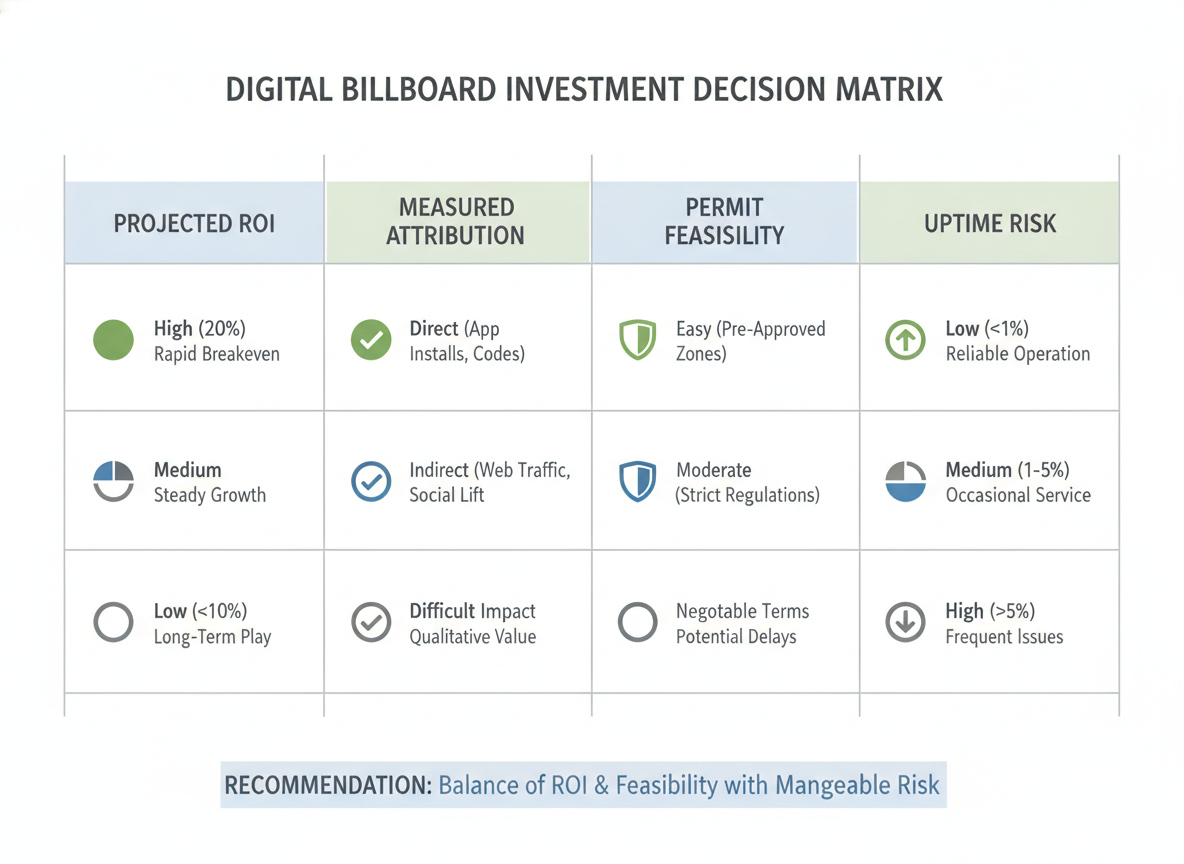
This matrix shows what each part of the business case can support and where the buyer still needs a separate check.
Show decision table
| Decision Area | What It Tells You | What It Does Not Prove | Best Use |
|---|---|---|---|
| Projected ROI | Whether the modeled revenue can cover expected costs under stated assumptions | That the project will actually sell as modeled | Use for underwriting and stress tests |
| Measured Attribution | Whether the reporting method can connect exposure to observed lift or behavior | That every impression created profit | Use for campaign proof and sales validation |
| Permit Feasibility | Whether the site can legally proceed under local and state rules | That approval is likely everywhere | Use as a hard go/no-go gate |
| Uptime Risk | How much service, weather, and visibility loss can affect revenue | That hardware alone guarantees stability | Use for operating-cost planning |
Permit and Zoning Checks in US Markets
Permitting is a hard gate, not a footnote. In some states, digital billboard rules can include sign removal ratios and brightness limits, as shown in Oregon’s digital billboard procedures. That means a site can fail the regulatory test even if the traffic count looks strong.
Local rules can be stricter than state rules. The City of San Antonio’s sign and billboard permits page is a useful reminder that some municipalities may prohibit new off-premise digital billboards altogether. So the first question is not "Will this board sell?" It is "Can this site legally host the board at all?"
Zoning and Sign Code Review
Start with zoning, sign code, roadway context, and parcel constraints. Setbacks, spacing, illumination controls, and conversion limits can vary widely by jurisdiction. A favorable parcel is not enough if the local code limits digital conversions or the site sits in a protected district.
Permit Packages and Approval Sequence
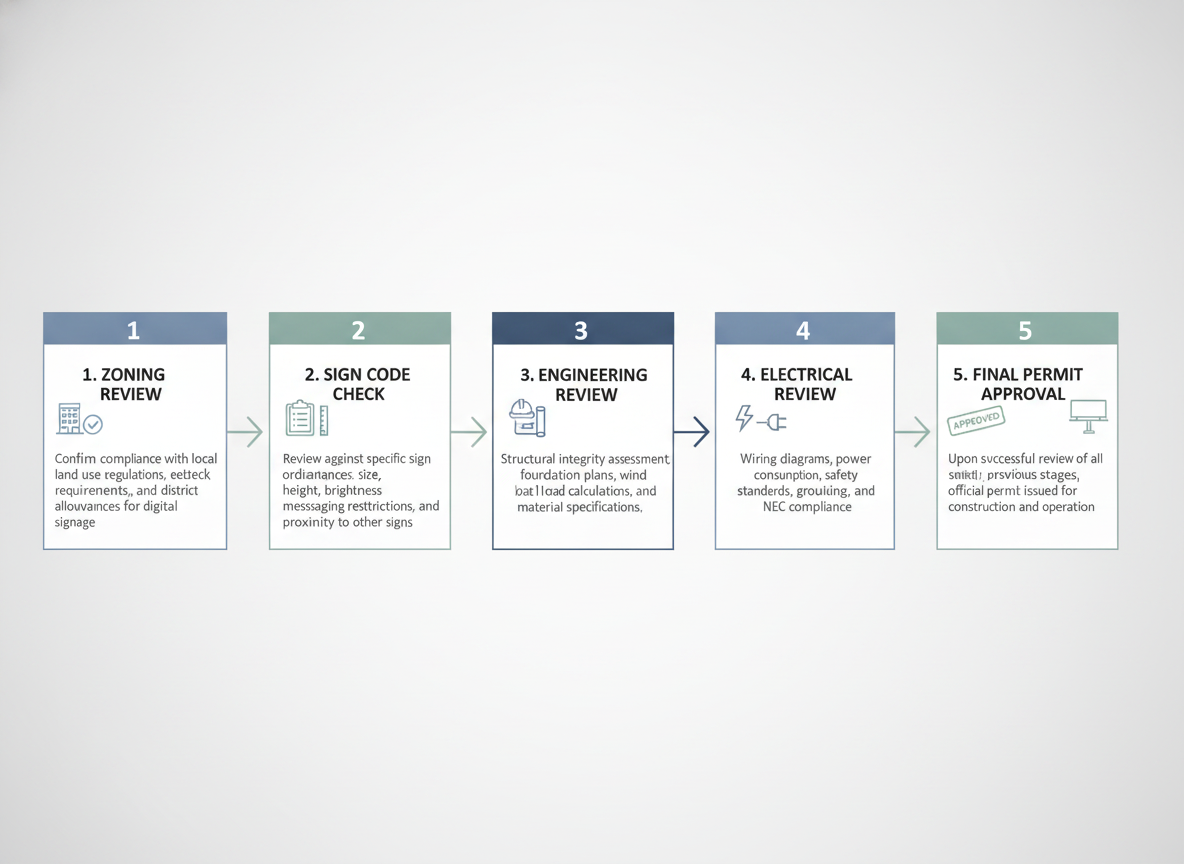
Most projects need drawings, site data, engineering support, and multiple layers of review before they reach the final sign permit. In practice, that can include zoning review, land-use review, utility coordination, and electrical signoff. Because the sequence changes by market, treat timelines as planning assumptions, not promises.
Common Red Flags That Slow Projects
Glare complaints, traffic concerns, historic-district rules, and neighborhood pushback can slow or reshape a project. Utility access, easements, and structure condition can also create hidden delays. A site can look finance-ready while still being permit-poor, which is one of the easiest ways to overstate digital billboard ROI.
Uptime, Maintenance, and Operating Risk
Uptime affects both revenue capture and advertiser confidence. If a board is dark, flickering, or frequently out of service, the lost display time is not just a technical issue. It becomes a sales issue. Industry commentary on digital billboard conversions describes these assets as perishable inventory, which is a useful shorthand for the way visibility, nearby development, and competition can change value over time.
- Plan for weather exposure, power stability, and service access before you sign off on the build.
- Budget for parts, labor, and remote monitoring as recurring operating costs, not as occasional surprises.
- Treat nearby construction, tree growth, or new signage as a real revenue risk, because visibility can change.
- Do not assume a strong launch year means stable long-run performance, since refresh cycles and overhead can keep pressure on returns.
For operators, the lesson is straightforward: OPEX discipline matters as much as the hardware spec sheet. A brighter screen does not help if the site is hard to maintain, slow to repair, or vulnerable to visibility loss. Long-run returns are usually better when serviceability is designed in from the start.
A Practical Go or No-Go Checklist
Use this sequence before you commit capital:
- Confirm that the site has enough advertiser demand to support a conservative occupancy model.
- Check zoning, sign code, and local approval rules before you price the project.
- Model total cost, including installation, power, permitting support, maintenance, and sales effort.
- Stress-test the revenue case without assuming unusually high rates or perfect sell-through.
- Ask whether the project still works if visibility weakens, service costs rise, or approvals take a harder path than expected.
If the answer to any of those steps is shaky, pause before you buy. Digital billboard ROI is a site-specific underwriting problem, not a generic promise. The next step is to run the site through the permit screen and rebuild the forecast with conservative occupancy and uptime assumptions.
FAQs
How Do Operators Estimate Digital Billboard ROI Without Overstating Demand?
Start with site-specific traffic, realistic sell-through, and a cost model that includes installation, power, maintenance, and sales overhead. Treat any industry average as a reference point, not a guarantee, and avoid borrowing another market’s pricing or occupancy assumptions unless the local demand profile is genuinely similar.
What Permits Are Usually Needed for a Digital Billboard in the US?
The approval path usually runs through zoning and sign-code review first, then engineering, electrical, and final permit steps. The exact list varies by city and state, so the practical move is to check whether the parcel can legally host a digital sign before you commit to design or procurement.
Why Is Attribution Harder Than ROI Modeling for DOOH?
ROI modeling is a forecast about what should happen under stated assumptions. Attribution has to show that observed results were actually caused by the campaign, which is a different standard. Reach and exposure data can support planning, but they do not by themselves prove profit.
Can a 3D DOOH Format Improve Revenue Enough to Change the Business Case?
It can help differentiate a site and attract attention in some markets, but it should be treated as situational upside, not a guaranteed revenue multiplier. The business case still depends on demand, permit feasibility, operating reliability, and whether the creative advantage translates into sustained sales.
What Should Make an Operator Pause Before Buying a New Digital Billboard?
Pause if the site has unclear zoning status, weak demand evidence, a cost model that only works with optimistic assumptions, or a maintenance plan that is too thin for the market. Those are the conditions that most often turn a promising concept into a slow or expensive rollout.





