IoT VMS is becoming the more practical path for 2026 corridor upgrades when cities need faster incident response, better operator control, and lower disruption than a full roadside rebuild. The catch is simple: connectivity alone does not solve traffic flow. Agencies still need MUTCD-aligned messaging, NTCIP-compatible integration, and a human override path before the sign can be treated as an active traffic asset.
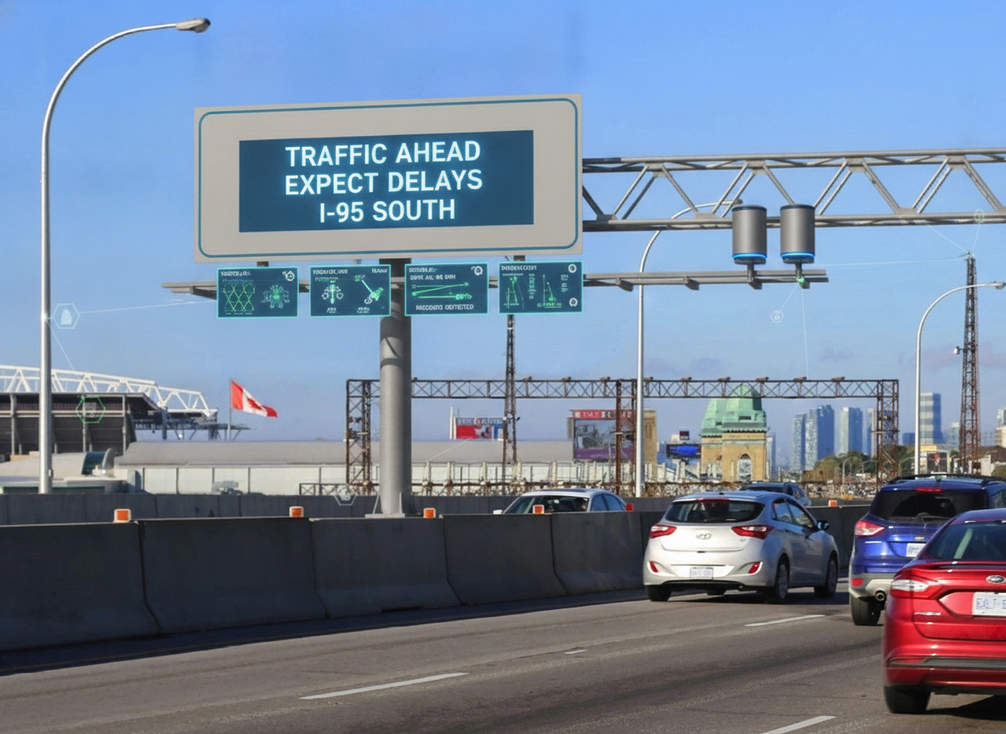
Why Static VMS Fall Short in 2026
Traditional variable message signs still help, but they often depend on manual updates or slow control paths. In practice, that delay can leave drivers seeing yesterday’s conditions while queues are already building. For corridor teams, that means a sign can be technically functional and still be operationally late.
The real issue is not just message speed. It is the gap between detection, verification, approval, and display. If an incident detector or traffic feed reaches the control room quickly but the sign update lags, the agency loses the chance to warn upstream drivers before conditions worsen. FHWA’s MUTCD Chapter 2L on changeable message signs also keeps the messaging use case tight, which is another reason static habits break down when agencies want a more responsive corridor.
For most DOTs, this is the decision layer: keep the existing sign if the current process still supports timely updates, or move to IoT VMS if the biggest problem is operational latency rather than structural failure. If the cabinet and structure are still usable, a connected upgrade is often easier to justify than a wholesale replacement. If the hardware is failing, the calculus shifts toward a broader rebuild.
Traffic & VMS is a useful browsing path when teams want to compare the broader solution family, but the buying question should still start with response time, not product names.
How IoT Turns VMS Into Active Nodes
An IoT VMS becomes more valuable when the full chain works: sensors detect an event, software interprets it, operators confirm or override it, and the sign updates quickly enough to matter. That is why "connected" is not the same as "useful." A sign that receives data but cannot translate it into a clear, timely message is still just a display.
Sensor Inputs and Event Triggers
Real-world inputs can include roadway detectors, incident reports, weather feeds, work-zone alerts, and corridor telemetry. The best setup depends on how often the signal changes and how much confirmation is needed before the sign updates. A low-risk advisory message may move faster than a lane-closure warning because the approval burden is lighter.
AI-Driven Message Logic
AI is most useful here as a routing and prioritization layer, not as an unsupervised decision-maker. In a healthy workflow, the system flags patterns, suggests messages, and escalates urgency, while the operator still decides what goes live. That boundary matters because traffic messaging is safety-adjacent and must remain explainable under field conditions.
Latency, Uptime, and Control Path Design
In this category, latency means the time from event detection to sign update. For readers, think of it as the difference between warning drivers before they enter a queue and warning them after they are already trapped in it. NTCIP 1203’s dynamic message sign object definitions matter here because standardized control and monitoring reduce integration friction across central systems.
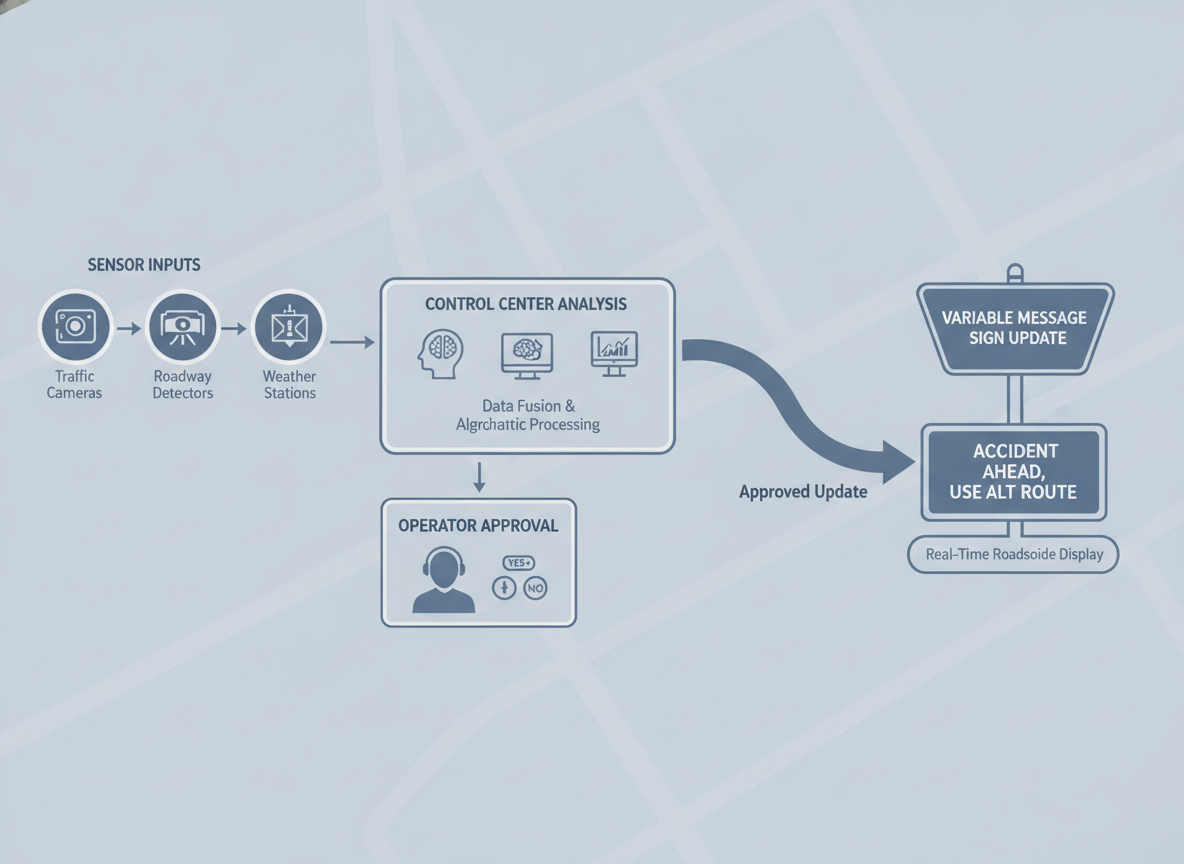
The practical KPI is not just display uptime. It is command latency, refresh reliability, and whether the system can fall back safely when the telemetry stream degrades. If a connected sign cannot be trusted to update quickly and cleanly, the city may gain visibility but not better traffic flow.
What Compliance Checks Matter Most
Connected VMS should be reviewed as a compliance and integration project, not just a hardware purchase. The most important checks are whether the message use matches MUTCD limits, whether the control layer is truly NTCIP-compatible, and whether operators can override automation when conditions change fast.
- Message Use: Confirm that the intended messages fit MUTCD Chapter 2L traffic operational, regulatory, warning, or guidance uses, and do not rely on the sign for broader public messaging.
- Message Design: Keep message design conservative and readable. FHWA’s Chapter 2L guidance is the anchor here, because overloaded or poorly timed messages reduce compliance and driver respect.
- Interoperability: Treat NTCIP compatibility as an integration question, not a marketing claim. NTCIP dynamic message sign guidance is useful as background for checking whether central control, monitoring, and message syntax will work with the existing corridor stack.
- Acceptance Testing: Verify manual override, fail-safe behavior, and command confirmation before full rollout. FHWA’s interpretation on acceptance testing and override behavior is a good reminder that a system that looks automated on paper still needs human control in the field.
- Security And Auditability: Connected devices expand the attack surface, so access control and audit logs should be reviewed alongside traffic performance.
Highway VMS / Gantry Signs Solution is a reasonable product-family link for teams comparing compliant-looking hardware paths, but the verification work still comes first. If a spec sheet does not clearly support the required message use, placement, and control behavior, treat it as a candidate to investigate, not a confirmed fit.
SIaaS Models for Corridor Upgrades
For budget-constrained agencies, SIaaS-style modernization can be a better fit than paying for a full rip-and-replace program up front. The main benefit is not lower price in every case. It is better alignment between spending, service responsibility, and corridor outcomes when existing structures and communications can be reused.
| Model | Upfront Spend | Deployment Pace | Maintenance Burden | Upgrade Flexibility | Best Fit |
|---|---|---|---|---|---|
| Full replacement | Highest | Slowest | Highest internal burden | Highest hardware reset | Legacy hardware is failing or the site needs a full redesign |
| Phased retrofit | Moderate | Medium | Shared or staged | Good, if the structure can stay | Existing structures are usable and disruption must stay low |
| SIaaS-style modernization | Lower initial capital, more service-based | Often faster than full replacement | More responsibility shifts to the service model | Strong if support and data terms are clear | Agencies want measurable outcomes without rebuilding the whole corridor |
What this means is that the best choice flips when the constraint changes. If the structure is sound and the procurement team wants predictable service responsibility, SIaaS-style modernization is often the cleaner model. If the hardware is near end-of-life or the site geometry is wrong, the service model may be less attractive than a deeper rebuild.

The hidden trade-off is dependence. A service-oriented model can simplify operations, but only if the contract spells out uptime windows, support response, data ownership, and upgrade scope. That is where smart city infrastructure as a service VMS models become useful: they shift the question from "What is the cabinet price?" to "Who owns performance over time?"
Traffic & VMS LED Display is a good browsing entry when teams want to see the broader display family behind connected traffic applications. For selection work, though, the model choice should still come before the product browse.
What a Deployment Checklist Should Include
Before a pilot becomes a corridor rollout, agencies should confirm the data path, the control path, and the operating fallback. IoT VMS is only as strong as the weakest link in that chain.
- Confirm the sensor inputs, ownership, and refresh cadence before writing message logic.
- Map the path from field devices to the control center and back to the sign.
- Set acceptable latency, uptime targets, and manual override rules before installation.
- Define maintenance access, spare parts strategy, and escalation contacts for outages.
- Require post-deployment reporting that ties sign performance to corridor operations metrics.
A useful self-check is this: if a sign update takes too long, if the operator cannot override it quickly, or if no one can explain what happens when data quality drops, the project is not ready for full deployment. That does not mean stop. It means tighten the control model before scaling.
C-Tra-VMS collection is a practical next step for teams comparing product families after they have defined the operating requirements. If the goal is retrofit efficiency, the C-Tra-KXB Lightweight VMS is a relevant navigation point to review only after the structural and communications constraints are clear.
FAQs
Q1. How Do IoT VMS Reduce Traffic Update Latency?
IoT VMS reduce latency only when the whole telemetry chain is short and reliable. That includes detector refresh rates, network uptime, message approval flow, and sign command routing. If any one of those steps is slow, the display may still be connected but not meaningfully faster than a traditional workflow.
Q2. What Should DOTs Verify for MUTCD and NTCIP?
DOTs should verify message use, placement, interoperability, manual override, and auditability during acceptance testing. NTCIP 1203 helps standardize control and monitoring, but it does not replace a corridor-level review of how the sign will actually operate in the field.
Q3. Can IoT VMS Work With Existing Highway Structures?
Often, yes, but only if the structure, mounting geometry, power, and communications access are still suitable. That is why retrofit feasibility should be checked before design lock-in.
Q4. How Do SIaaS Models Change Procurement Risk?
They shift the discussion from purchase price to performance responsibility. In 2026, procurement teams should ask who owns uptime targets, software updates, maintenance windows, and data services. If those terms are vague, the contract can look economical while still leaving the agency with the hardest operational risk.
What Smart City Traffic Teams Should Do Next
The right IoT VMS strategy is the one that improves message speed without weakening compliance or operator control. Start with the corridor problem, not the product catalog. If the structure is stable, the data sources are reliable, and the service terms are clear, a connected upgrade can deliver better traffic flow with less disruption than a full rebuild.