


- ICE LED, short for Independent Chip Encapsulation, is Chipshow’s in-house outdoor LED packaging technology that combines high brightness with low power consumption. Based on Chipshow’s own P6.67 testing, a panel reaches 14,000 cd/m² at 400 W/m², compared with 5,000 cd/m² for a standard SMD2727 panel, and draws about 70% less power at the same brightness. The technology is designed for high-brightness DOOH, naked-eye 3D, extreme heat and UV environments, and coastal installations.
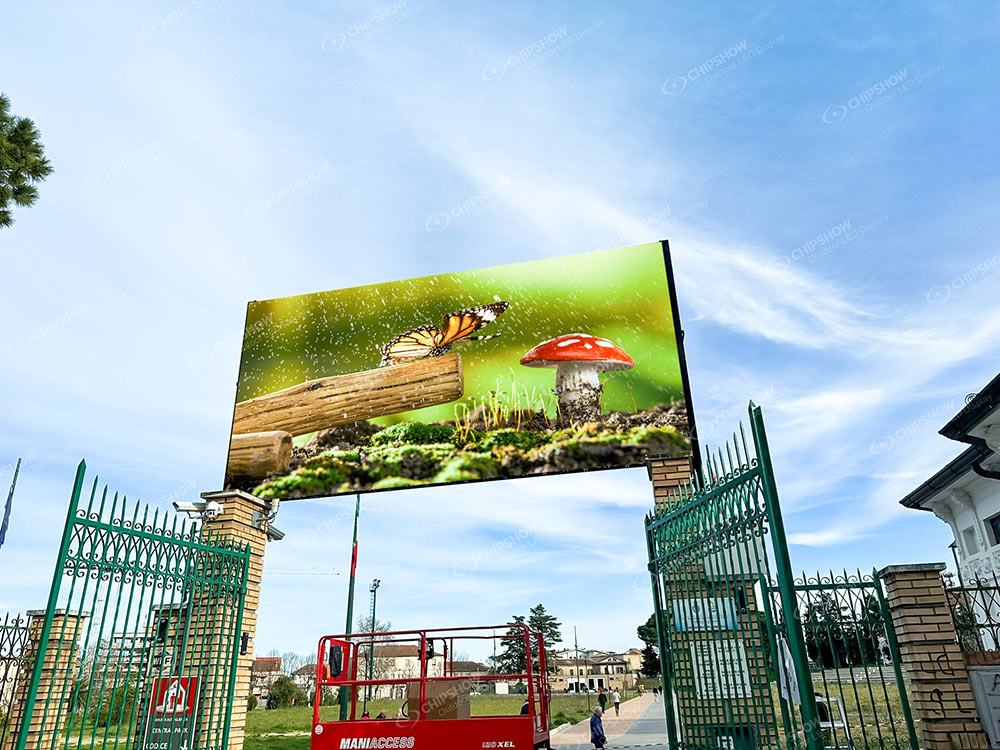
Outdoor LED buyers have long faced a trade-off. DIP LEDs are bright and weather-resistant, but their large lamp size limits pixel density, so fine-pitch outdoor screens are hard to achieve. SMD LEDs solve the density problem, but their open bracket design caps outdoor brightness, runs hotter, and ages faster under UV, salt spray, and high temperatures. ICE LED was developed by Chipshow to address that trade-off.
ICE stands for Independent Chip Encapsulation. The name follows the industry convention of naming a component after its structural feature, and the three-letter form reads naturally as “ICE.” Each red, green, and blue chip is encapsulated in its own sealed cavity instead of sharing one open bracket. That single structural change is the foundation for the technology’s brightness, efficiency, and long-term reliability.
What Is ICE LED?
ICE LED is Chipshow’s proprietary outdoor LED packaging technology, developed in-house and refined over 24 years of outdoor display design and manufacturing. It targets the specific gap that neither DIP nor SMD has closed on its own: the need for a small-pitch outdoor panel that stays bright, runs cool, and holds up for years in demanding conditions.
The name is descriptive rather than a brand invention. I-C-E stands for Independent Chip Encapsulation. The naming follows the long-standing industry practice of naming a component after its structural characteristic, and the three letters read naturally as “ICE,” which also fits the technology’s focus on cool, stable operation.
Traditional outdoor displays sit between two options. DIP (Dual In-line Package) LEDs are robust and bright, but the physical size of each lamp means pixel density stops well above P10, which limits image sharpness. SMD (Surface-Mounted Device) LEDs reach much finer pitches and better image quality, but their open, exposed bracket structure has real limits outdoors: lower brightness ceiling, higher power draw, and faster degradation under ultraviolet light, salt, and sustained heat. ICE LED restructures the lamp at the chip level so a single solution can carry the strengths of both routes.
How ICE LED Works
Three design choices work together to produce the ICE LED result. Each one addresses a specific weak point in conventional outdoor SMD.
Independent Chip Encapsulation
The core innovation is physical: the red, green, and blue chips are sealed in separate cavities instead of sharing one open bracket.
Isolating each color channel removes the heat interference between chips, which is the main cause of brightness decay in outdoor SMD panels.
Red chips are the most temperature-sensitive of the three. In a conventional 3-in-1 SMD lamp, all three chips sit close together and heat each other, so the red channel fades faster and the whole panel shifts color over time. In ICE LED, each chip has its own sealed cavity, so the red chip no longer absorbs heat from the blue and green chips. The result is slower decay and more stable color over the panel’s life.
The same sealed-cavity structure replaces the open bracket of SMD with a fully enclosed package. This lifts protection against dust, moisture, UV, and salt spray to a level closer to DIP, which is why the technology suits coastal and desert installations that would shorten the life of a standard outdoor SMD panel.
Independent Lens Optics
A dedicated lens on each color channel redirects light that would otherwise scatter, turning wasted output into usable brightness.
Each ICE LED carries a customized independent lens over its RGB cavities, combined with a matte inner-cavity finish. This design recovers the light that a conventional open-bracket SMD lamp loses to scattering and converts it into forward, usable luminance. The practical outcome is higher effective brightness at the same power draw, which is the number buyers actually see on a screen rather than the one printed on a datasheet.
Common Cathode Circuit
A common cathode driver supplies each color channel at its own optimal voltage, which lowers the power lost to heat.
Red, green, and blue chips have different voltage requirements. A common cathode architecture supplies each channel separately at its correct voltage, rather than driving all three from one rail and burning the difference as heat. This reduces wasted power and operating temperature, and it is what lets an ICE LED panel deliver high brightness without a matching jump in electricity cost.
ICE LED is not a one-size-fits-all answer. Its density currently starts at P6.6, so outdoor projects that need a finer pitch (P4 and below) may require a different solution. In mild environments with modest brightness needs and tight budgets, a standard SMD panel can remain the more economical choice. ICE LED earns its place where high brightness, low power draw, or harsh weather resistance is a hard requirement.
ICE LED vs SMD2727: Measured Performance
The numbers below come from Chipshow’s own testing on P6.67 modules, comparing ICE LED against a standard SMD2727 panel under the same conditions.
| Metric | ICE LED (P6.67) | SMD2727 (P6.67) |
| Brightness at 400 W/m² | 14,000 cd/m² | 5,000 cd/m² |
| Power at 5,000 cd/m² | 145 W/m² | 500 W/m² |
| Surface temperature (30 min white, 7,000 cd/m²) | 37.2°C | 52.3°C |
| Contrast ratio | 3,000:1 or higher | Lower, reflective surface |
At the same 400 W/m² power draw, ICE LED produces 14,000 cd/m², where SMD2727 reaches 5,000 cd/m². Looked at from the power side, hitting 5,000 cd/m² takes about 145 W/m² on ICE LED against roughly 500 W/m² on SMD2727, a difference of around 70% in power consumption at the same brightness.
The temperature gap matters for outdoor life. After 30 minutes of full-white output at 7,000 cd/m², an ICE LED panel surface measured 37.2°C against 52.3°C for SMD2727. Cooler operation slows aging and reduces the thermal stress that drives color drift and early failures.
The matte inner-cavity packaging also removes the specular reflection seen on SMD lamp surfaces, which raises contrast to 3,000:1 or higher and gives the panel a deeper, more uniform black level.
Single-Lamp Brightness
| LED | Red (mcd) | Green (mcd) | Blue (mcd) | Current (mA) |
| ICE LED | 1200 | 2800 | 550 | 10 |
| SMD2727 | 310 | 840 | 170 | 10 |
Failure Rate Under Identical Test Conditions
All tests were run with the same duration, frequency, and high/low temperature range, measured against a standard SMD panel.
| Test | ICE LED | SMD |
| Liquid nitrogen impact | Low | Higher |
| High-temperature stewing | Low | Higher |
| Thermal shock | Low | Higher |
| UV exposure | Low | Higher |
| High-temperature lighting | Low | Medium |
| Red dye penetration | Low | Medium |
A Field-Tested Track Record
The reliability numbers are not only from the lab. In a commercial plaza project in the Middle East, an ICE LED display has now run continuously for 18 months in an environment that stays around 50°C. Over that period the panel’s overall brightness decay stayed below 5%, and the total failure rate remained under 0.02%. The result validates the technology’s behavior in sustained extreme heat, where conventional outdoor SMD panels typically age noticeably faster.
Where ICE LED Excels
ICE LED is designed for the outdoor applications where brightness, power, and weather resistance decide the project’s success.
High-Brightness DOOH and Naked-Eye 3D
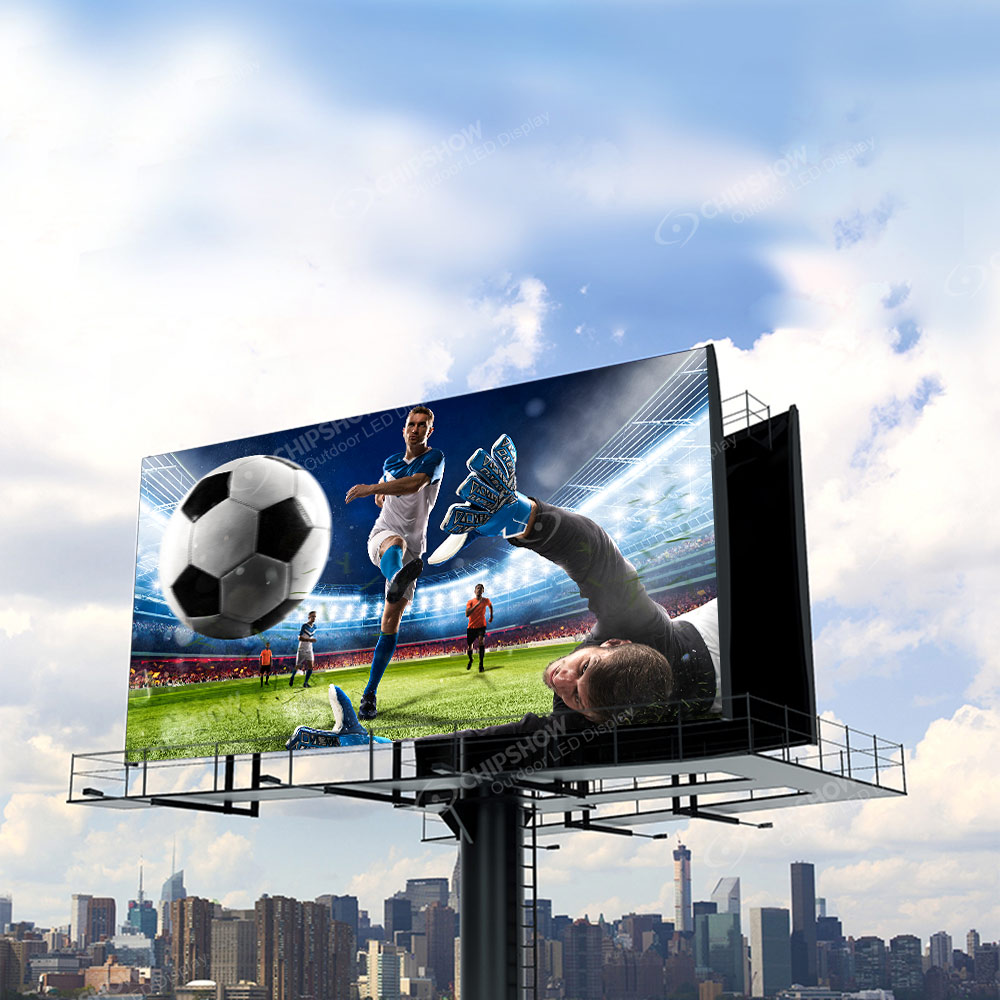
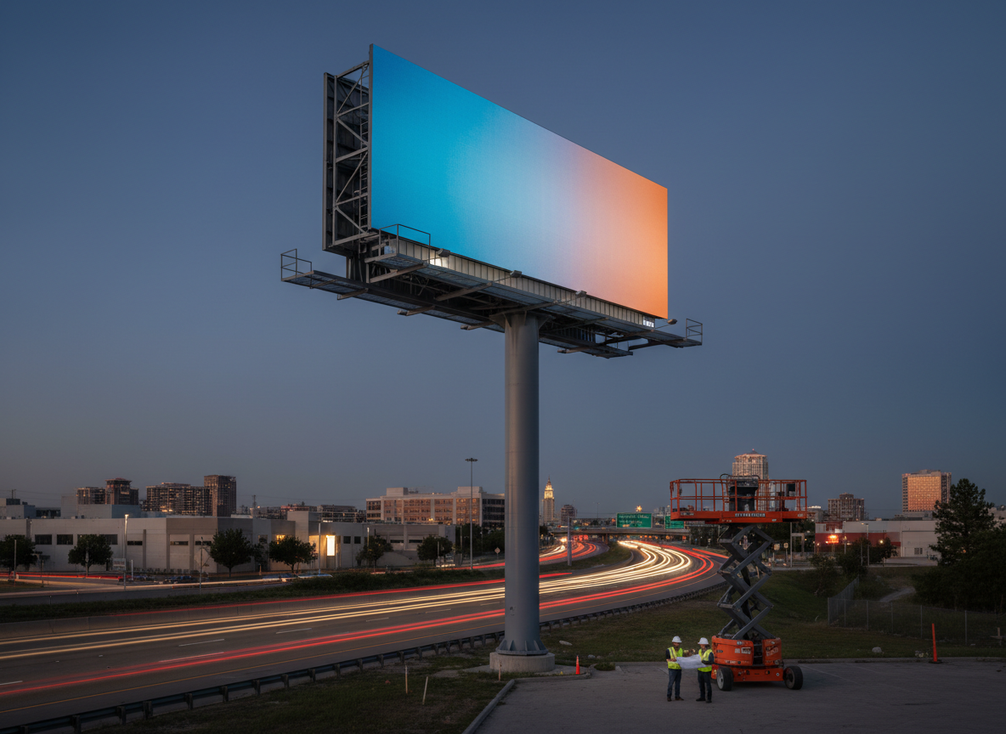
High-brightness digital billboards and naked-eye 3D landmarks need panels that stay readable in direct sun and draw as little power as possible for 24/7 operation. The P6.67 ICE LED solution is a practical fit for energy-conscious outdoor 3D screens, where the combination of 14,000 cd/m² and low power draw keeps both image impact and operating cost in check. See our outdoor DOOH display solutions for the full range.
Extreme Heat, UV, and Dust
Deserts and other high-temperature, high-UV regions put three pressures on a screen at once: intense heat, ultraviolet degradation, and dust or sand. ICE LED’s sealed cavities protect the chips from UV and dust, while the common cathode circuit keeps the panel cool under load. This makes the P8 and P10 configurations a practical choice for digital signage in these conditions.
Coastal Salt Spray and Storms
Coastal displays face salt spray, high humidity, and strong wind. The fully sealed ICE LED package resists the moisture and salt ingress that corrode open-bracket SMD lamps, which supports lower failure rates and lower long-term operating cost for large coastal screens, with P10 as a common pitch.
Solar-Powered, Energy-Efficient Advertising
Because ICE LED reaches high brightness at low power draw, the technology supports outdoor advertising that can run entirely on solar power. This is valuable for green initiatives and for remote or off-grid sites where grid power is expensive or unavailable.
The Chipshow ICE LED Product Series
ICE LED is available across four product series, each built for a different outdoor installation profile.
| Pixel Pitch | Brightness (cd/m²) | Power (W/m²) |
| P6.6 | 14,000 | 400 |
| P8 | 14,000 | 360 |
| P10 | 14,000 | 360 |
| P16 | 14,000 | 420 |
Pitch and power figures above are for the C-Slim general-purpose line. The C-Sport series is a dedicated P8 stadium perimeter display rated up to 10,000 nits.
- C-Slim series: a large-format, high-end platform with concealed cabling, front and rear service, and a fully enclosed module and cabinet design. It suits large landmark and high-end projects, including 3D displays.
- C-Sport series: a P8 stadium perimeter display for ice rinks and sports venues, with up to 10,000 nits brightness, a focused 100°/45° beam, and dual IP65 sealing.
- C-Fit series: a rear-service, screw-based economical option in a die-cast cabinet, suited to cost-sensitive rear-service projects and compatible with 3D displays.
Conclusion
ICE LED closes the gap that has split outdoor LED into two incomplete options. It brings DIP-class brightness and weather resistance together with SMD-class pixel density, in a package that runs cooler and draws less power at the same brightness. For outdoor projects where brightness, energy cost, and long-term reliability are the deciding factors, ICE LED is worth evaluating.
Based on Chipshow’s 24 years of experience in outdoor LED display design, manufacturing, and deployment, our team can help you match an ICE LED configuration to your viewing distance, environment, and power budget. Contact us to discuss your project requirements.
Frequently Asked Questions
Q1:What does ICE in ICE LED stand for?
ICE stands for Independent Chip Encapsulation. It describes the core structural design: the red, green, and blue chips are each encapsulated in their own sealed cavity rather than sharing one open bracket.
Q2:What is the main advantage of ICE LED over standard SMD?
ICE LED reaches higher brightness at the same power draw and lower power consumption at the same brightness. On P6.67 modules, it produces 14,000 cd/m² at 400 W/m² against 5,000 cd/m² for SMD2727, and draws about 70% less power at 5,000 cd/m². Its sealed cavities also improve protection against UV, dust, and salt spray.
Q3:Is ICE LED the right choice for my project?
ICE LED is most valuable when your project has at least one hard requirement among these: high brightness for direct-sun viewing, low power draw for energy cost or solar operation, or weather resistance for extreme heat, UV, salt, or dust. In mild environments with modest brightness needs and tight budgets, a standard SMD panel can remain the more economical choice.
Q4:What does ICE LED cost compared with a standard SMD screen?
ICE LED carries a higher upfront cost than a standard SMD panel, because its sealed packaging and independent lenses add manufacturing steps. Over a five-year operating cycle, the lower power draw, slower decay, and lower failure rate can more than offset that difference. Buyers should compare the five-year total cost of ownership rather than the price per square meter alone.
Q5:How do I maintain an ICE LED display, and what warranty does Chipshow provide?
Service access depends on the series: C-Slim and C-Easy support front and rear service, while C-Fit is rear-service. Maintenance follows standard outdoor LED practice: keep spare modules on site, schedule calibration, and confirm warranty terms with your supplier. Chipshow provides product documentation and technical support for ICE LED projects.





