


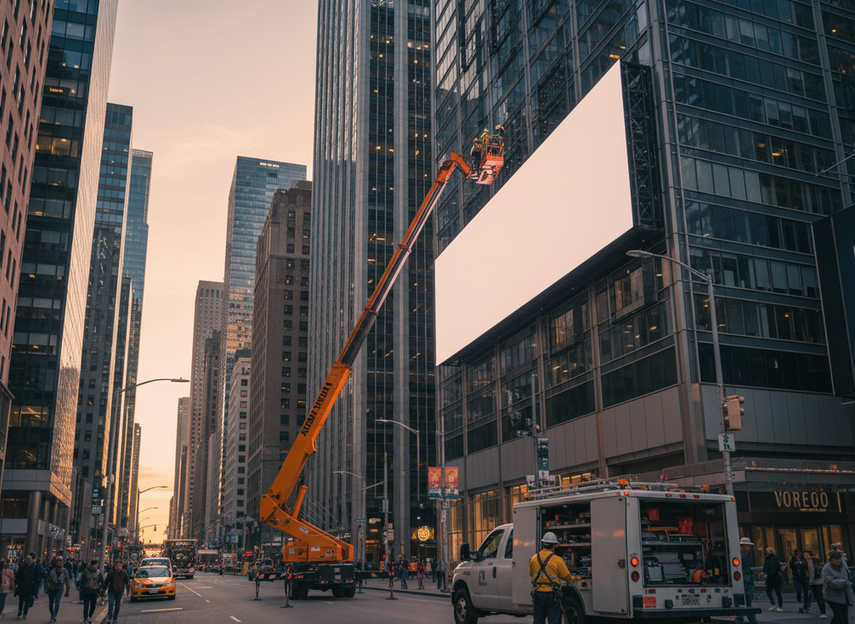
Front service economics and dispatch planning for high-rise DOOH matter because a dark screen is a revenue issue, not just a hardware issue. Digital out-of-home revenue reached a record $9.46 billion in 2025, which shows why outage planning affects campaign delivery and make-goods as well as maintenance cost. For operators of outdoor DOOH LED sites, front-service access is one way to cut access friction and reduce the chance of repeat visits.
Why Downtime Is the Real Cost Driver
For high-rise DOOH, the biggest cost is often not the failed module itself. It is the work around the repair: travel, scheduling, lift or access equipment, building sign-in, safety setup, and the risk that the first visit does not solve the fault. General cost of downtime benchmarks put outage cost in the low five figures per minute for critical systems, which is only a heuristic here, but it explains why a dark screen can become expensive quickly.
That is why serviceability deserves attention before brightness or pixel pitch. A display that is harder to reach can turn a small repair into a larger dispatch problem. The OAAA’s standard OOH business practices also reinforce how campaign delivery and documentation depend on reliable operations, which is another reason downtime has an economic cost.
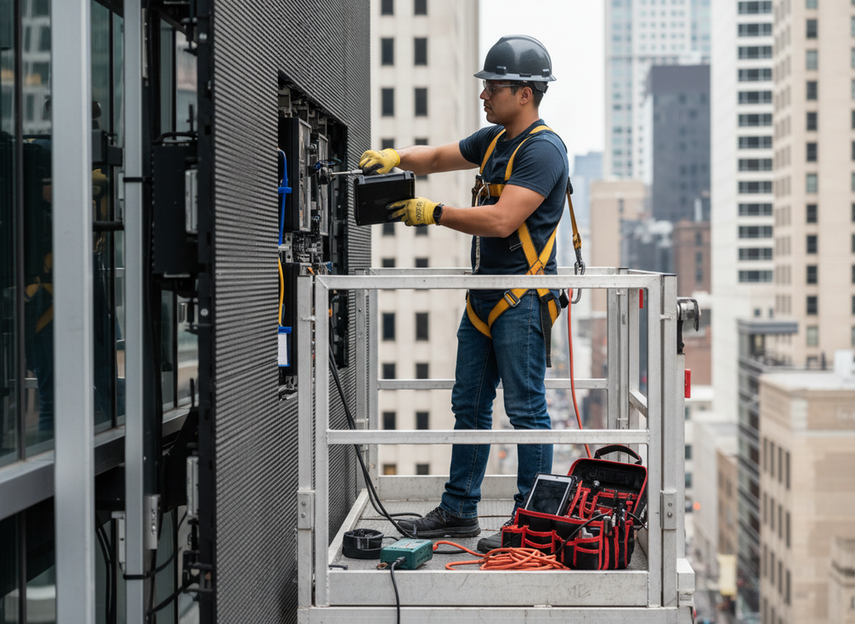
A useful decision sentence is this: if service access is difficult, total operating cost can rise even when the screen price looks competitive. If access is straightforward, the economics may favor a simpler service model. The difference shows up in labor hours, coordination time, and lost play time.
Front Service vs. Rear Service Access
Front-service access is usually the better fit when rear clearance is limited, the display sits on a tall facade, or the site is in a narrow urban corridor. Rear access can work when the building layout leaves enough room for crews and equipment, but that is less common in dense high-rise installs. In those cases, front-service outdoor LED planning can reduce dependence on the back side of the structure and simplify future maintenance.
Here is the practical difference:
| Factor | Front Service | Rear Service |
|---|---|---|
| Access clearance | Usually easier when the back side is tight | Needs usable rear space |
| Crew setup | Often simpler for repeat visits | Often more site coordination |
| Lift dependency | May still need lift planning, but sometimes less rear work | More likely to depend on rear access conditions |
| Urban facade fit | Often stronger for tight facades | Can be difficult on narrow streets or rooftops |
| Downtime recovery | Can improve first-visit resolution when parts are staged | Can slow recovery if access is restricted |
The key judgment is not that front service always wins. It wins when access is the bottleneck. Rear service can still be acceptable when the site geometry is forgiving and the crew can work without extra coordination. But on high-rise facades and wall-mounted city installs, rear access often becomes the weak link.
What Makes Dispatch Costs Rise
Dispatch cost rises when a service visit needs more people, more equipment, or more coordination than the repair itself. A bucket truck rental alone can run roughly $200 to $600 per day in the US, which is only one piece of the bill, but it shows why access equipment changes the math. Add labor, traffic control, security sign-in, and off-hours scheduling, and a simple fault can become a costly trip.
For operators, the hidden drivers usually look like this:
- access difficulty that forces extra setup,
- travel distance that creates repeat-trip expense,
- on-site labor that grows when diagnostics are slow,
- lift or platform dependence,
- and spare parts that are not local when the crew arrives.
A dispatch is cheapest when the team can diagnose, access, and replace in one visit. A dispatch gets expensive when the first visit only confirms the problem. That is why front service economics and dispatch planning for high-rise DOOH should be treated as one system, not two separate topics.
Labor, Access, and Lift Time
Crew time rises quickly when technicians need a lift, escorts, a closure window, or special building approval. That time can matter more than the actual component swap. For many operators, the real question is not whether a part can be replaced, but how much work it takes to reach the part safely and legally.
If the site needs repeated high-rise access, front service can reduce the number of steps. If the site still needs the same lift or permit every time, the savings are smaller. So the planning rule is simple: reduce the number of access layers before you worry about shaving minutes from the swap itself.
Local Spares and Repeat Trips
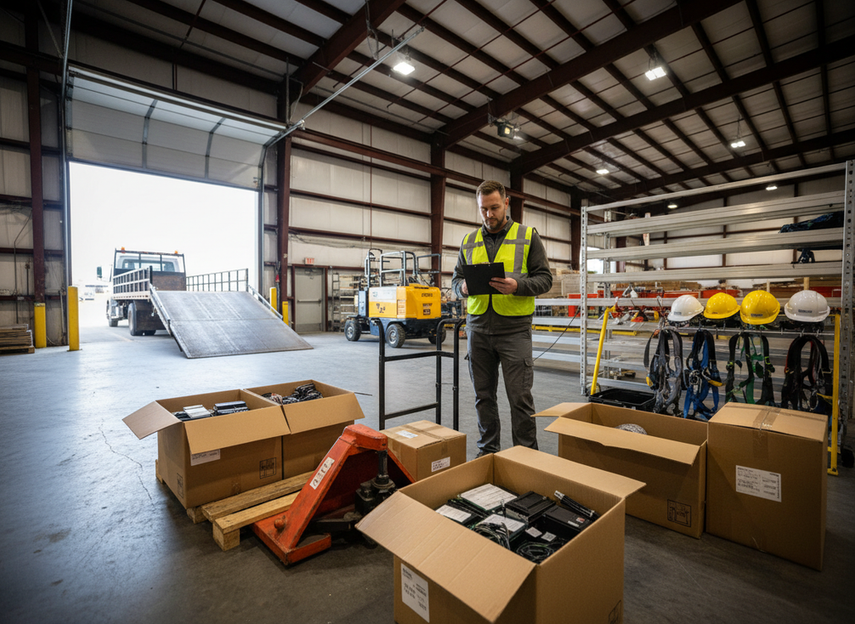
Local spare parts do not eliminate outages, but they can reduce repeat visits. If the failed item is on-site or nearby, the crew has a better chance of finishing the job in one trip. That matters most on distributed networks, where travel time compounds across many locations.
The catch is that spares only help when the replacement workflow is organized. A spare in inventory is not useful if the team cannot identify it, retrieve it, or match it to the failure quickly. The best spare strategy pairs stock depth with labeling, access logs, and replenishment ownership.
Replacement Workflow at the Cabinet Level
Standardized parts and clear labeling make a bigger difference than many buyers expect. When the same crew services multiple sites, a repeatable cabinet-level workflow reduces confusion and makes diagnosis faster. That is one reason operators sometimes prefer outdoor DOOH solutions that are easier to service consistently across a network, even before any specific model decision is made.
The goal is not to overbuild inventory. The goal is to make the most likely repair path predictable enough that dispatch does not turn into a scavenger hunt.
Planning a Local Spare Strategy
A good spare strategy starts with the parts that can take a cabinet or screen dark. Those items deserve more attention than non-critical accessories. From there, size inventory by site importance, dispatch radius, and the cost of a return trip.
Use this practical filter:
- High-criticality sites: keep faster-moving spares closer to the site.
- Distributed urban networks: prioritize parts that avoid a second trip.
- Short service windows: stock the parts most likely to resolve the issue on the first visit.
- Low-frequency sites: keep inventory lean, but still documented.
Do not treat spares as a cure-all. If the fault is misdiagnosed, the inventory is less useful. If the part is labeled poorly, the crew loses time. If replenishment is unclear, the next outage becomes harder, not easier, to handle. Local spares work best when they are part of a documented workflow, not a pile of replacement parts.
How to Choose a Service-Friendly Outdoor Display
Before you specify a high-rise or hard-to-reach site, check the access geometry first. Ask whether the display can be serviced from the front, whether crews can reach it safely and realistically, and whether the maintenance window matches the building’s rules. If the site is difficult, a service-friendly design can save more money over time than a cheaper display with awkward access.
The C-Slim series is a useful browsing path when front-service access is part of the brief. We are not treating it as a universal fit here, because detailed product facts can change by model and configuration, but it is the kind of category buyers often review when service access matters. The same logic can apply to C-Fit outdoor LED display options if the project needs a different trade-off between structure and service planning.
Use this decision order:
- Check whether front access is truly feasible at the site.
- Confirm how often the display is expected to need service.
- Estimate how much downtime the business can tolerate.
- Verify whether local parts and support can shorten recovery.
- Choose the service model that reduces the most expensive bottleneck.
A clear decision sentence helps here: if the site is hard to reach and downtime is expensive, front-service planning deserves priority. If access is easy and service is rare, the benefit may be modest. The right choice depends on the site, the crew, and the acceptable recovery window.
Service Access Checklist Before You Specify
Before you approve a project, confirm the access and safety details in writing. The OAAA digital billboard security guidelines are a helpful authority anchor for why access planning and security controls belong in the maintenance conversation, especially for billboard-style outdoor systems.
Access and Safety Review
Check whether the display can be serviced from the front, what equipment the crew needs, and whether the building or street layout creates extra risk. If the site includes a facade, rooftop, or busy corridor, document how the access method changes the maintenance plan.
Spare Parts and Local Support
Verify which parts are stocked locally and who owns replenishment. A nearby warehouse helps, but it does not guarantee immediate recovery if the wrong part is staged or the ownership chain is unclear.
Dispatch Timing and Service Scope
Confirm who gets called first, how escalation works, and whether travel, labor, and access equipment are covered in the service model or billed separately. That is the fastest way to avoid a low hardware price turning into a high service bill.
The strongest buying rule is simple: the cheapest display is not always the lowest-cost site over time. If service access, spares, and dispatch scope are not clear, the operating cost can rise long after installation.
Final Takeaway
Front service economics and dispatch planning for high-rise DOOH are about reducing the cost of being wrong at the site level. If access is difficult, a service-friendly design, local spares, and a clear dispatch workflow can protect uptime and reduce repeat trips. If access is easy, the savings may be smaller, but the planning discipline still matters. Compare service-friendly outdoor LED options by the access path they actually support, then request a fit check for the high-rise or hard-to-reach site before you buy.
FAQs
How Much Does Outdoor LED Display Maintenance Usually Cost?
There is no universal price, because cost depends on access difficulty, labor, lift use, trip count, and whether the needed parts are local. For elevated sites, the dispatch setup can matter more than the repair itself.
What Is the Difference Between Front Service and Rear Service for High-Rise DOOH?
Front service is designed to let technicians work from the display face, while rear service depends on usable access behind the structure. On tight high-rise sites, that difference can change both labor and downtime risk.
Can Local Spare Parts Really Reduce Downtime?
Yes, but only when the replacement workflow is organized. Local spares can shorten repeat visits and speed up swap-out, yet they do not help much if the fault is misdiagnosed or the parts are not labeled and replenished properly.
Why Does Dispatch Planning Matter More Than the Lowest Hardware Price?
A cheaper display can become the more expensive choice if it needs lifts, closures, escorts, or repeated trips to stay online. For DOOH operators, service cost can outweigh the initial quote over time.
Can a Service-Friendly Outdoor LED Design Work on Street-Level Sites Too?
Yes. Street-level corridors can still have tight permits, traffic control, or short maintenance windows, so front-service planning can be valuable even when the screen is not elevated. The benefit depends on how quickly crews can get in and out.





