


For LED display maintenance, the safest approach is to treat response time, spare parts, and escalation as separate terms, not one vague support promise. For 24/7 operations, the difference between acknowledgment, diagnosis, dispatch, and on-site arrival matters because each one changes how fast you can restore the wall and who is responsible while the clock is running. When those milestones are not written down, buyers often assume more coverage than the contract actually gives them.

What a 24/7 LED Maintenance SLA Should Cover
A real SLA for mission-critical displays should describe what support starts, what it includes, and what it excludes. That usually means preventive maintenance, break-fix support, parts replacement, and after-hours handling should be written as separate items instead of being bundled into one broad service promise.
In response milestones in support terms, the key question is where the clock starts and ends. For a command center or control room, the contract should say whether the vendor is committing to acknowledgment, diagnosis, dispatch, or on-site arrival. Those are not interchangeable. A quick reply from support is helpful, but it does not tell you when a technician is moving or when the display is likely to be worked on.

Response Time and Coverage Window
A 24/7 LED maintenance contract should name business-hours and after-hours coverage separately. If the room runs overnight, weekend, or holiday operations, the contract should not hide behind one generic support window. The after-hours escalation and coverage language in institutional SLAs is a useful model because it makes coverage explicit instead of assumed.
For buyers, the practical test is simple: can you tell exactly when the service clock starts? If the answer is no, the SLA is too soft for mission-critical planning. A phrase like "prompt response" may sound reassuring, but it leaves room for very different interpretations of what happens next.
Support Scope and Ownership
Support scope should spell out whether the vendor handles remote troubleshooting, onsite service, or both. It should also assign ownership for labor, replacement parts, freight, and shipping logistics. The repair and shipping responsibility section in a digital signage SLA shows why this matters: the support promise is only useful when the cost burden is clear.
That cost split is often where a contract looks better than it is. A low monthly service fee can still leave the buyer paying for overnight shipping, travel, or urgent replacement labor. If those items are not written out, the "support" line on the quote may not match the actual operating cost during an outage.
Escalation and Communication Rules
For 24/7 rooms, escalation is part of uptime, not an afterthought. The SLA should name who gets contacted first, who approves a replacement path, and how often the buyer will get updates while the issue is open. Without that, an overnight incident can stall even if the vendor is technically "available."
A good rule of thumb is to ask for a written handoff path for after-hours incidents, not just a general help desk number. That is especially important when the display supports operators, incident rooms, or public safety workflows where a delayed handoff creates more risk than the original fault.
How Local Spare Inventory Changes Repair Turnaround
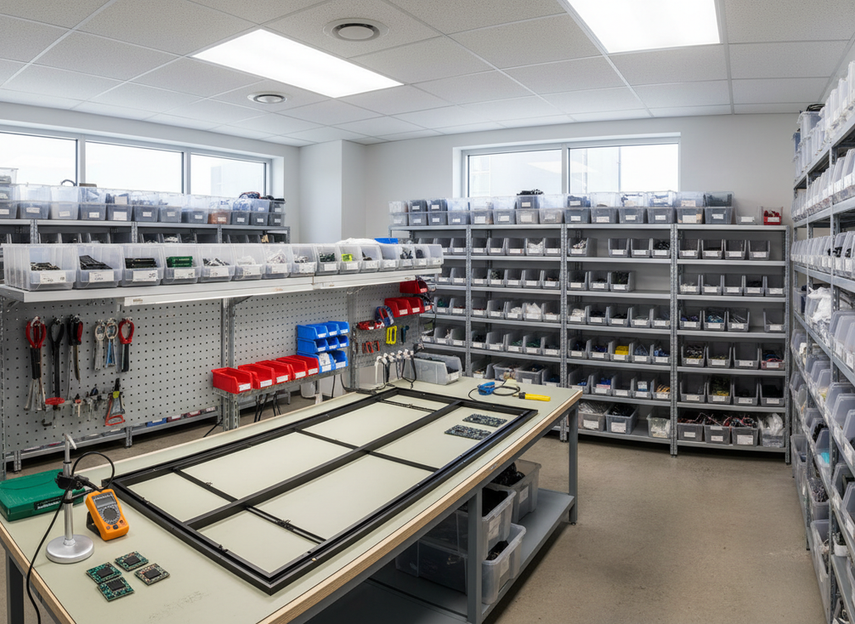
Local spares can shorten repair time, but only when the contract names the part categories, stocking location, and release authority. Geography alone does not fix downtime. A spare held in the same metro area is useful only if the buyer can actually get it released, shipped, or installed without delay.
In critical spare part planning, the useful starting point is to classify parts by operational impact and replacement lead time. That is a better method than trying to stock everything. For LED wall maintenance, the parts most worth documenting are usually the ones that most affect restore time, such as modules, power supplies, receiving cards, signal components, and any service tools that are hard to source quickly.
Core Spare Categories
You do not need a model-specific bill of materials to ask the right questions. You do need a category-level inventory plan. The important distinction is between parts that are actually stocked and parts that are merely orderable from a factory or distributor.
The local stocking for high-failure parts guidance supports this approach because high-failure or long-lead-time components are the ones most likely to delay restoration. For a 24/7 command center, the best contract language names which components are local, which are regional, and which still depend on factory lead times.
Stocking Location and Ownership
Stocking location should be written in plain language: on-site, local, regional, or ship-from-factory. Each one creates a different repair path. On-site stock can support the fastest recovery, but only if the buyer controls release and the provider is authorized to use it.
Ownership matters just as much. If the vendor owns the inventory, the contract should say who can release it and under what conditions. If the buyer owns it, the agreement should say how the vendor handles access, replenishment, and replacement after use. Without that detail, "local spares" can become a marketing phrase instead of a recovery plan.
Replenishment and Traceability
After an incident, the spare pool should not quietly shrink. A replenishment rule keeps the next outage from becoming slower because the first outage used the only replacement on hand. Traceability also matters because it shows what was consumed, what must be restocked, and whether the inventory plan still matches the site’s risk.
That is why a stocking plan is stronger than a verbal promise. If the contract only says "local inventory available," you still do not know whether the parts are reserved, used elsewhere, or already depleted.
What to Compare Across Vendor Contracts
When buyers compare LED maintenance contracts, the goal is not to find the longest list of features. It is to compare the exact wording that controls outage handling, spare access, and total cost. The strongest contracts make the service path visible. The weakest ones rely on broad language that sounds helpful but leaves too many gaps.
The following table is the fastest way to separate a real 24/7 support commitment from a vague one.
| Contract Term | What To Check | Why It Matters |
|---|---|---|
| Response definition | Does the SLA define acknowledgment, diagnosis, dispatch, or on-site arrival? | Prevents "response" from meaning only a phone call or ticket confirmation. |
| On-site coverage | Is after-hours, weekend, and holiday support written separately? | Shows whether the service is truly 24/7 or only business-hours with a hotline. |
| Spare inventory language | Are part categories, stocking location, and release authority named? | Tells you whether local stock can actually shorten repair time. |
| Escalation path | Are contacts, decision authority, and update cadence documented? | Reduces the chance that an outage stalls overnight. |
| Freight responsibility | Does the contract say who pays shipping, travel, and expedited logistics? | Exposes the real support cost, not just the headline service fee. |
| Exclusion clauses | Are exceptions, limits, or buyer responsibilities written clearly? | Keeps hidden carveouts from surfacing after the outage starts. |
For comparison terms, the response timing definition should be treated as the first filter. If one proposal defines response as acknowledgment and another defines it as arrival, those contracts are not equivalent. The ownership of repair and shipping also deserves a direct side-by-side check because it can shift real cost and recovery time to the buyer.
If you want a vendor comparison that works in procurement, compare the contract language first and the sales pitch second. That order matters more in a mission-critical room than it does in a typical office display purchase.
A Buyer Checklist for 24/7 Service Terms
Use this checklist before you sign or renew a maintenance contract:
- Verify the exact definition of response time, including whether it means acknowledgment, diagnosis, dispatch, or arrival.
- Confirm who handles remote troubleshooting, onsite labor, replacement parts, freight, and after-hours coordination.
- Ask for the spare-part categories, stocking location, and release authority in writing.
- Check who pays overnight shipping, travel, expedited freight, and any after-hours premiums.
- Confirm how incidents are logged, updated, closed, and reviewed after repair.
This is where written responsibility for costs and escalation and coverage rules become more than paperwork. If a contract does not show who acts, who approves, and who pays, the room may still have a service plan on paper but not a recovery plan in practice.
A practical review also asks whether the spare plan is tied to operational impact and replacement lead time, not just a generic inventory list. The critical spare planning logic is useful here because it helps buyers focus on the parts that actually change restoration speed.
Red Flags That Signal an Unrealistic SLA
Watch for these phrases and gaps during contract review:
- "Prompt response" with no clock start, no milestone, and no escalation path.
- "Best effort" support for a 24/7 room where downtime has an obvious cost.
- "Local spares" with no part categories, stocking site, or release rule.
- Freight, labor, travel, or overnight shipping that shifts to the buyer without being highlighted.
- Unsupported compatibility or certification claims that are not tied to written proof.
The main warning sign is not that a vendor cannot support the display. It is that the contract does not say enough to prove how support will work when the room is down. That is where vague response language usually causes the biggest gap between expectation and reality.
Wrap-Up
A strong LED display maintenance SLA makes the support path visible before the outage happens. The best contracts separate response milestones, define who owns parts and freight, and spell out what local spares really mean. If the terms are vague, treat that as a procurement risk, not a minor wording issue.
Before you sign, compare the written SLA side by side, verify spare inventory language, and ask for named response milestones. If you are reviewing a mission-critical room, start with the contract first and then check the hardware fit. A clear LED display maintenance agreement is easier to manage when the outage starts.
FAQs
What Does an LED Maintenance SLA Need to Define?
At minimum, it should define response milestones, support scope, escalation contacts, and who owns labor, parts, and freight. For 24/7 operations, also check whether after-hours coverage is written separately from business-hours support, because those terms often look similar but behave differently during an outage.
How Do Local Spare Parts Affect LED Wall Repair Turnaround?
Local inventory can shorten recovery time only when the contract names the spare categories, stocking location, and release authority. A nearby spare that is not actually accessible does not help much. The most useful wording shows whether parts are on-site, local, regional, or still dependent on factory shipment.
Can a Vendor Count Remote Support as a Response?
Sometimes yes, but only if the contract says so. Remote acknowledgment, diagnosis, dispatch, and on-site arrival are different milestones, and they do not deliver the same recovery speed. If the SLA uses one word for all of them, ask for a clearer definition before you compare vendors.
What Should Buyers Ask Before Signing a 24/7 LED Service Contract?
Ask who handles after-hours escalation, what parts are stocked locally, who can release them, and who pays freight or overtime costs. Also ask how incidents are logged and closed, because a good support process should leave you with a clear record of what was used and what must be replenished.
Why Do Command Center Displays Need Stricter Service Terms?
Because the cost of delay is higher. In command and control rooms, a vague promise is less useful than a written path for escalation, parts access, and repair ownership. Tight SLA language helps reduce the chance that an overnight issue turns into a next-day problem.





