

COB vs SMD for control rooms comes down to how you balance serviceability, viewing comfort, room geometry, and total cost over years of 24/7 operation. In this COB vs SMD LED comparison, the label alone does not decide the outcome. For control rooms, the better fit depends on uptime, maintenance access, and whether the wall geometry supports the layout you need.
COB and SMD in Control Room Buying
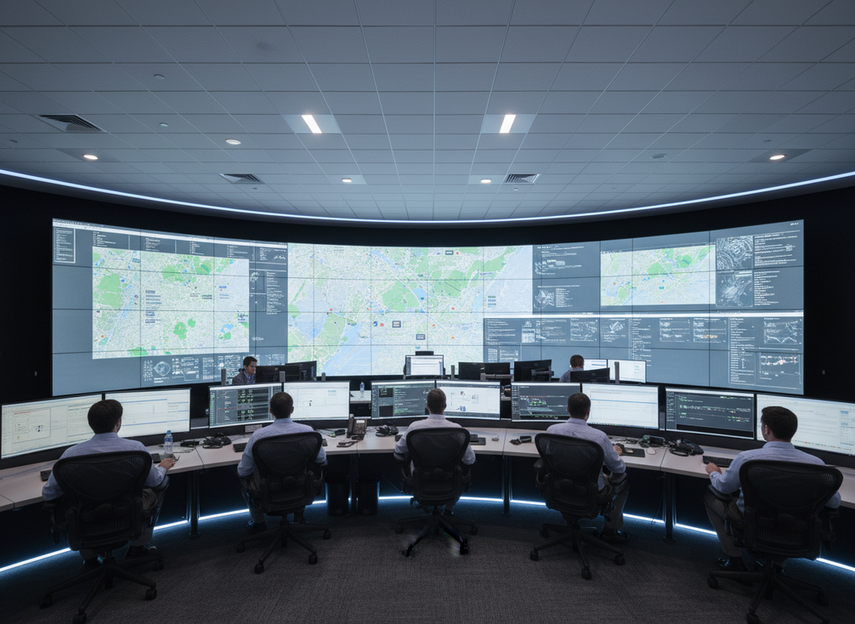
Control room buyers usually start with the same question: which display type fits the room’s operational goals? The answer depends less on the label and more on the operating environment. If operators sit close for long shifts, need low visual distraction, and expect the wall to run continuously, COB can be attractive because the front-facing structure is often positioned as more durable. If the project team wants a widely understood path with a long service history, SMD still has clear appeal.
ISO 11064-4 keeps the focus on the room, the operators, and the display’s role in decision-making rather than on one component choice. The standard’s ergonomic logic supports a display that is readable, maintainable, and suited to the task. For buyers, that means the real question is not “which LED type is better?” but “which LED type better fits the control room’s geometry, duty cycle, and support model?”

For broader mission-critical navigation, some teams review mission-critical indoor video wall options or commercial indoor LED display options as starting points, then check what is appropriate for the specific room.
| Decision factor | COB | SMD |
|---|---|---|
| Close-range comfort | Often strong for close viewing | Strong when well specified |
| Front-surface robustness | Typically a selling point | Depends on design and handling |
| Service familiarity | Can be more specialized | Usually more familiar to many teams |
| Visual uniformity | Often emphasized in premium control rooms | Can be excellent with the right build |
| Procurement flexibility | May be narrower by vendor | Often broader market availability |
| Best-fit use case | Long-hour, high-stakes rooms | Projects prioritizing known service paths |
Where COB and SMD Differ Most
The main difference is how the pixels are packaged and protected. In practical terms, that affects surface durability, perceived smoothness, and how the wall handles accidental contact during operation or maintenance. COB’s packaging approach is commonly associated with a more protected front surface, which can matter in control rooms where staff work near the wall or where the room sees frequent operator movement.
SMD is the more established category in many LED deployments. That often translates into broader familiarity among integrators, easier comparison shopping, and a deep base of field experience. For many buyers, that familiarity reduces procurement anxiety. It can also simplify internal review when facilities teams already know how to support SMD panels.
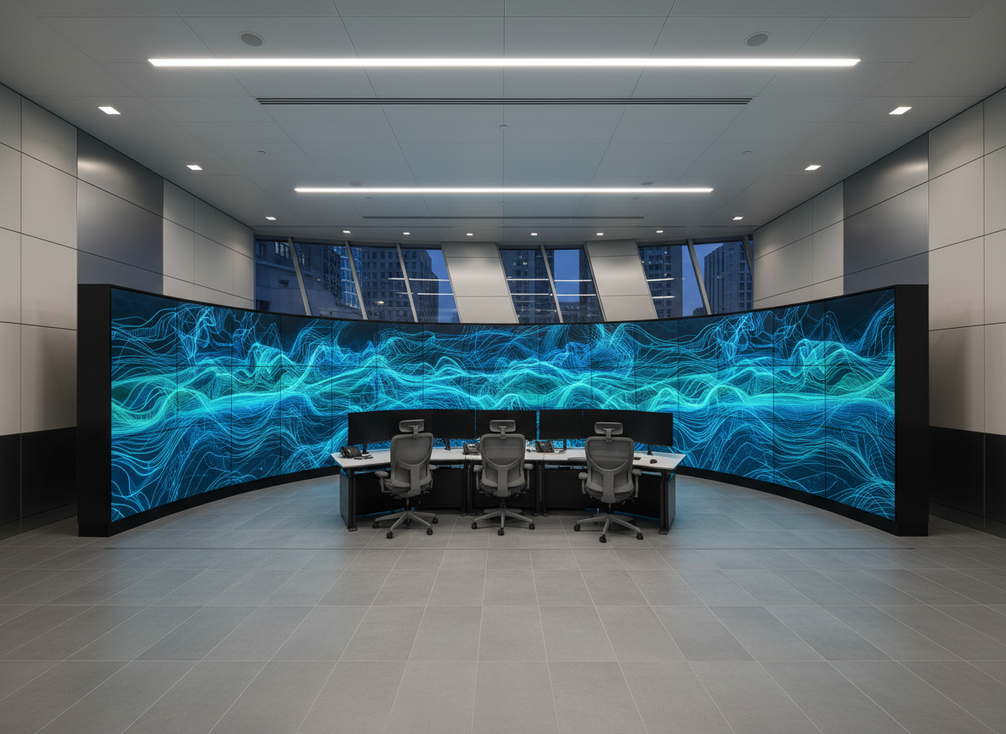
The visual difference is subtle but important at control room distances. When operators stare at dashboards and map feeds for long periods, small improvements in perceived texture, glare management, and screen continuity can matter. Still, a good SMD wall can perform well if the pixel pitch, calibration, and installation are right.
If you are comparing by product family rather than by packaging alone, pages such as fine-pitch COB indoor display and fine-pitch COB LED screen may help with navigation, but the final decision should remain specification-driven.
Repairability and Service Access
Repairability is where many control room buyers make their most conservative choice. If the wall is mission critical, the ability to isolate a fault quickly matters more than feature marketing. SMD systems are often easier for technicians to understand because the service workflow is widely known. That can be reassuring when multiple service partners may need to support the room over its life.
COB can still be serviceable, but buyers should ask sharper questions about module replacement, front access, spare parts, and the vendor’s turnaround process. Some COB systems are designed for efficient maintenance, but not all service models are equal. The real issue is whether the display can be restored without disrupting the operational team longer than the room can tolerate.
For control rooms, the ideal service plan is not just a box of spare parts. It includes access strategy, fault isolation procedures, stock levels, and clear escalation paths. If the wall is difficult to reach or the room cannot tolerate long outages, service access should weigh heavily in the selection process.
A useful conservative check is to ask the supplier how they handle replacement of common failure points, what is front-serviceable, and how much room is needed for routine maintenance. If the answers are vague, that is a warning sign regardless of COB or SMD.
Curved Walls and Layout Constraints
Control rooms are rarely perfect rectangles. They may include operator pods, curved sightlines, pillars, or unusual wall lengths. That makes layout flexibility a major part of the buying decision. COB can be appealing in visually demanding layouts because buyers often associate it with refined close-view appearance, which can help when the wall wraps around operators or sits at a small viewing distance.
SMD remains practical for custom layouts because many integrators know how to engineer around room constraints using standard cabinets, familiar mounting patterns, and well-tested alignment methods. In rooms where structural limits are already tight, a known installation path can be more valuable than a slightly different surface feel.
Before choosing, buyers should check how the display behaves at the required curve radius, whether the cabinet system supports the intended arc, and how seam visibility changes across the operator field of view. Small layout mistakes can create large ergonomic problems later. These are the core curved COB LED wall considerations, and they matter more than a simple technology label.
In some projects, a mission-critical product page such as zero-downtime fine-pitch LED video walls is useful only as a navigation reference. The important step is still to validate room dimensions, sightlines, and mounting assumptions against the actual control room.
Lifecycle Cost and Uptime Tradeoffs
Lifecycle cost is not the same as purchase price. A lower bid can become expensive if maintenance is slow, downtime is frequent, or the wall needs more hands-on attention than expected. For that reason, COB vs SMD for control rooms should be evaluated as a total operating model, not just a bill of materials.
COB can justify a higher initial cost if the room benefits from a more protected front surface, fewer operator concerns about accidental contact, or a premium viewing environment. SMD can win on lifecycle economics when the team values broad familiarity, competitive sourcing, and straightforward service routines. The right answer depends on how costly downtime is in your operation.
Uptime also includes the human side. If operators trust the display, read it comfortably, and rarely experience distracting defects, the system has more real-world value. That is why ISO 11064-4 matters here: it reminds buyers that the display is part of a work system, not a standalone object.
For buyers exploring product navigation, pages like C-MAX commercial indoor display or C-MAX P0.9 indoor display series can help orient internal discussions, but final cost modeling should still be done against service intervals, spare strategy, and acceptable outage windows.
What Buyers Should Confirm Before Choosing
Before you decide, confirm the viewing distance, target pixel pitch, room lighting, and operator task profile. A display that looks excellent in a demo room may not be ideal in a dim, data-heavy control center with long shifts and strict response times.
Also confirm the maintenance plan in writing. Ask who services the wall, how quickly faults are addressed, what happens if a module is discontinued, and whether the system can be maintained without major disruption to operations.
Finally, verify installation constraints. Measure wall depth, access clearance, cable routing, and curve requirements if any. If the room is already built, the display must fit the room rather than the other way around.
Quick CTA: If you are narrowing a shortlist, compare viewing distance, service access, and uptime target first; then use those constraints to decide whether COB or SMD is the safer fit.
FAQs
Is COB Better Than SMD for 24/7 Control Rooms?
No. COB is not automatically better. It can be appealing for close viewing and front-surface durability, but SMD may be the better operational choice when service familiarity, sourcing flexibility, or existing maintenance capability matters more. The right answer depends on the room’s risk profile and support model.
Which Option Is Easier to Maintain Over Time?
SMD is often easier for many teams because technicians are more familiar with it and spare-parts workflows are widely understood. COB can still be maintainable, but buyers should verify module replacement steps, access method, and turnaround commitments before assuming it will be simpler.
What Matters More Than the Technology Label?
Viewing distance, room geometry, uptime requirements, and service access matter more than the label alone. A well-specified SMD wall can outperform a poorly planned COB wall, and vice versa. In control rooms, system design usually determines success more than packaging type.
Should Curved Control Room Walls Push Me Toward COB?
Not necessarily, but curved layouts do increase the importance of visual consistency and installation precision. COB may be attractive in premium close-view environments, while SMD can still work well if the cabinet system and curve engineering are properly planned. The curve itself is only one variable.
How Should I Compare Lifecycle Cost Fairly?
Compare purchase price, installation effort, spare parts strategy, maintenance labor, and expected downtime cost. Then test each option against the room’s real operating hours. The cheapest wall upfront is not always the cheapest wall to own if outages are expensive or repairs are slow.