3D DOOH content workflow works best when teams treat the 3D effect as a production and measurement problem, not just a creative stunt. The screen, viewing angle, audience path, and campaign goal all have to line up. If any of those pieces are off, the illusion may still draw attention, but the campaign is less likely to deliver the result you expected.
Why 3D DOOH Fails Without the Right Setup
For most advertisers, the first mistake is assuming that attention equals ROI. OAAA’s creative best practices guidance makes the broader point clearly: creative quality affects DOOH performance, so workflow matters as much as hardware. That matters even more with naked-eye 3D, because the campaign can look dramatic before it performs well.
The usual failure mode is simple. A concept that looks strong in a pitch deck can lose impact if the screen geometry, site placement, or audience flow does not match the illusion. In that case, the creative may still be memorable, but not in the way the brief intended.
If the screen and site are not already a strong fit, 3D DOOH is usually a poor first choice, even when the idea is visually exciting. When the brand moment is important but the setup is weak, simpler motion creative often protects budget better than forcing a complex illusion.
That is why the rest of this article focuses on a repeatable 3D DOOH content workflow, not just on the final visual.
The Workflow From Brief to Launch
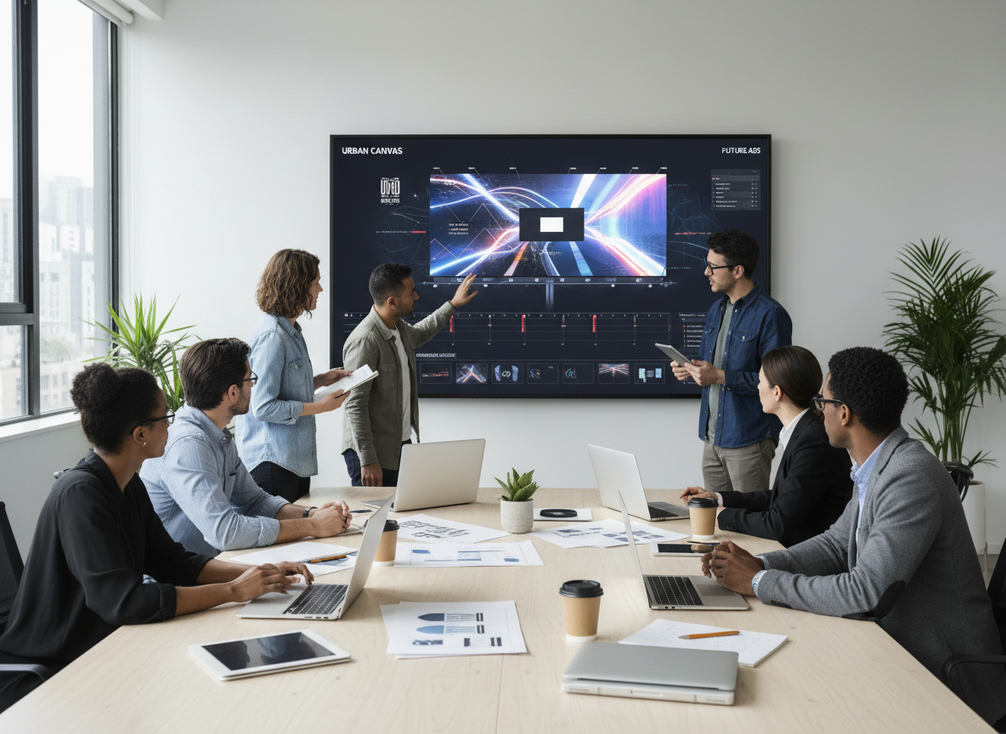
A practical 3D LED billboard content production workflow starts before animation begins. The first brief should define the campaign goal, call to action, audience, launch market, and the actual screen context. OAAA’s DOOH content and file specs guidance supports that order: define the format, the execution style, and the site-specific test plan before you finalize creative.
Creative Brief and Screen Fit
For a naked-eye 3D campaign, screen fit is not a nice-to-have. The content should be planned around the real screen shape, audience path, and viewing distance instead of being adapted from a generic social or video asset. That is especially important for anamorphic 3D LED campaign planning, where the illusion depends on a specific viewpoint.
The brief should answer four questions early: what is the message, what site is the creative built for, who will see it, and from which side or angle will they usually approach? If those answers are unclear, the production team is likely to spend time redesigning later.
Animation Build and Approval Loop
The build phase should include storyboard review, rough motion tests, and stakeholder sign-off before final rendering. That is where teams catch depth-cue problems, pacing issues, and object-scale mismatches before revisions get expensive. It also keeps the project from turning into an open-ended creative debate.
Every extra approval loop should add clarity, not just delay. If a concept needs repeated rework to make the illusion read correctly, the team should question whether the idea still fits the screen and timeline.
Site Testing and Final Launch Checks
Before launch, test the content on the intended screen or through a reliable site simulation. OAAA’s guidelines emphasize site-specific testing because DOOH output is not just about rendering a file; it is about how the file plays in the actual environment.
Check playback, file naming, brightness behavior, and operator handoff before the campaign goes live. A project can look polished in a review room and still miss the mark on-site if the environment changes the way the creative reads. For 3D LED billboard content production workflow, that final validation step is what keeps the launch from becoming a guess.
What Drives Production Cost
3D DOOH content usually costs more than standard DOOH creative because the workflow has more moving parts. The main cost drivers are:
- Concept development, especially when the idea has to be built for a single screen or corner.
- Specialized motion design, which is often more involved than standard flat video.
- Approval rounds, because more stakeholders usually want to see the illusion before launch.
- Revisions, which tend to multiply when the site fit is not locked early.
- Final rendering and packaging, which can take longer for custom 3D sequences.
- Tight turnaround windows, which leave less room to correct mistakes cheaply.
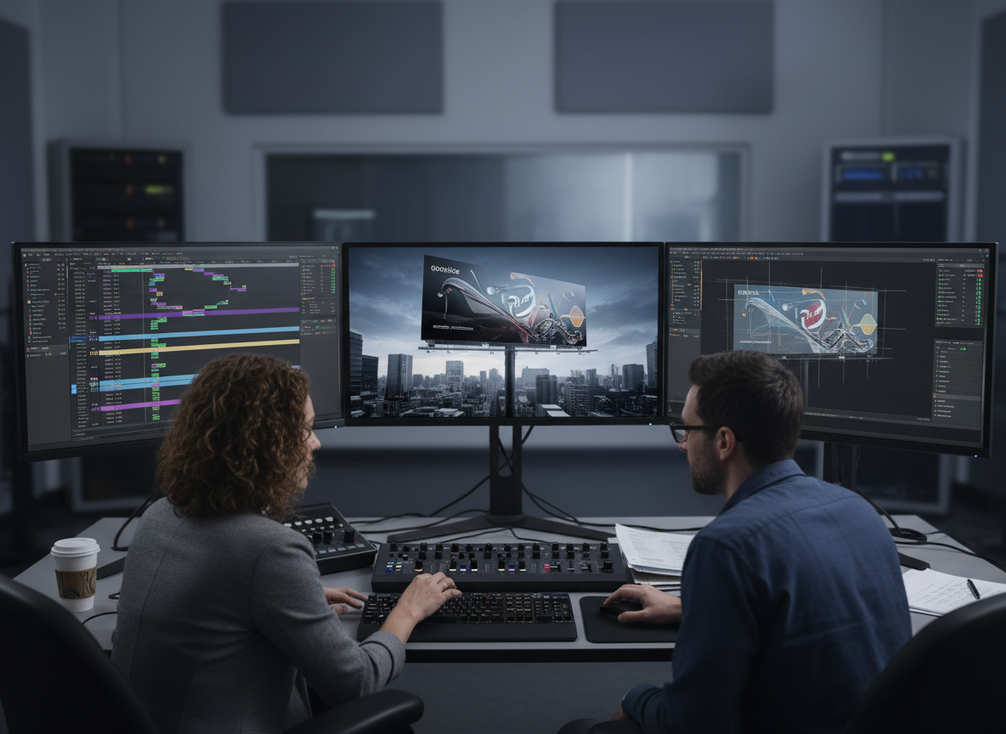
The main budget question is not whether 3D is expensive in the abstract. It is whether the expected media value justifies the extra production effort. A flagship campaign for a major launch may justify the spend if the screen and location are strong. A smaller or uncertain placement often does not.
If the campaign will need many revisions to land the illusion, the creative cost is probably already telling you the concept is too fragile for the budget. If you expect to reuse the same template across several sites, the first build is still costly, but later versions may be easier to adapt.
How Hardware, Viewing Angle, and Location Affect Results
The 3D effect depends heavily on site conditions. Anamorphic 3D content relies on a sweet spot, which means the illusion reads best from a specific viewing angle or approach path. That is a practical design rule, not a universal guarantee.
| Fit factor | Why it matters | What to verify | Launch risk if ignored |
|---|---|---|---|
| Screen placement | The screen has to face the audience path in a way that supports the illusion | Approach direction, mounting height, and visibility from the main traffic flow | The effect may look flat or distorted |
| Viewing angle | The 3D illusion is strongest from a specific vantage point | Main pedestrian or vehicle approach, not just general foot traffic | The sweet spot may be too narrow for the site |
| Audience flow | The creative has to meet people where they naturally look | How long viewers stay in frame and where they first notice the screen | The effect may be missed before it registers |
| Ambient light | Bright surroundings can change how clearly the screen reads | Daytime brightness, glare, reflections, and surrounding light sources | The illusion may lose contrast or impact |
| Transferability | Site-specific creative does not always move cleanly to another location | Whether the same content can realistically be reused elsewhere | A strong concept at one site may underperform at another |
The practical takeaway is that 3D billboard options are only worth serious consideration when the site can support the viewing geometry. If the location is too flexible, too bright, or too inconsistent, simpler motion creative often makes more sense. You can still build a strong DOOH campaign, but the 3D layer may not be the best use of budget.
For operators comparing outdoor DOOH solutions, the safest path is to validate screen fit before final rendering. If the site itself is still uncertain, treat the concept as provisional rather than production-ready.
Setting ROI Expectations and Tracking the Right Metrics
ROI tracking in 3D DOOH content workflow should start with one question: what would count as success for this campaign? If the answer is just "more attention," the measurement plan is too vague. If the answer is sales, the team still needs a way to connect exposure to outcomes without overstating causality.
MRC’s Likelihood to See standards matter because they distinguish between raw impressions and evidence that the ad was actually in a position to be seen. That is useful, but it is not the same thing as proving a sale. OAAA’s exposure methodology for downstream actions shows how mobile-ID style exposure frameworks can connect screen exposure to later behaviors, but those frameworks still support cautious interpretation rather than automatic proof.
What to Measure Beyond Sales
If sales data is available, use it. If not, build a stacked view around the campaign goal. That may include reach proxies, visits, site traffic, branded search activity, dwell time, or engagement signals depending on the buy.
The main point is not to collect every metric. It is to choose the ones that match the objective before launch so the report does not become a hindsight exercise. A 3D DOOH campaign can look successful on social media and still be weak in business terms if the measurement plan never matched the goal.
Where Attribution Breaks Down
Attribution gets messy when consumers see a screen, search later, visit much later, or convert through another channel. Shared devices, offline purchases, and long decision cycles can all blur the trail.
That is why you should not treat one exposure as proof of return. LTS helps measure whether the ad was likely to be noticed, but it does not tell you what the viewer bought. Exposure methodology helps estimate downstream action, but it still requires careful interpretation.
How to Judge Whether the Campaign Was Worth It
A campaign is worth repeating when the evidence fits the original goal. If the launch was meant to create broad awareness, strong reach and recognizable attention may be enough to justify another run. If the launch was meant to drive trackable conversions, then the measurement bar should be higher.
If the team cannot distinguish exposure validation from outcome validation, the ROI story is too weak to defend. If the campaign looks memorable but the metrics are thin, treat it as a brand moment first and a return-on-spend case second.
| Metric type | What it can support | What it cannot prove | Best use in ROI discussion |
|---|---|---|---|
| Direct sales | Actual business outcome when attribution is credible | It does not explain exposure quality or upper-funnel media value by itself | Use as the clearest ROI endpoint when available |
| Proxy metrics | Exposure, attention, or engagement signals | They cannot alone prove incrementality | Use when sales data is unavailable or delayed |
| Media metrics | Delivery and exposure under standards such as LTS and exposure methodology | They do not prove business outcomes on their own | Use to verify that the campaign had the chance to be seen |
When 3D Is Worth the Effort
-
Start with the business goal. If the campaign needs a premium moment for a launch or flagship placement, 3D may be worth the extra work. If the goal is broad, efficient reach, simpler motion creative can be a better fit.
-
Check site fit before you budget production. If the screen, viewing angle, and audience path do not support the illusion, the concept should be modified or dropped.
-
Estimate creative complexity honestly. A 3D concept that needs many revisions is usually a warning sign, not a badge of quality.
-
Confirm the measurement plan before approval. If you cannot explain how you will judge success, you are not ready to launch.
-
Choose the simplest creative that still meets the goal. For many campaigns, that will be a strong motion-led DOOH asset rather than full naked-eye 3D.
For readers comparing 3D billboard solutions with simpler setups, the key is to match the creative ambition to the site and the measurement maturity. If the fit is strong, 3D can be a smart attention driver. If the fit is weak, the safer move is usually a simpler build that is easier to produce, launch, and measure.
Final Takeaway
3D DOOH can be a strong attention play, but only when the workflow, screen fit, and measurement plan are handled with discipline. The effect is not automatic, and it should not be used to justify vague ROI claims. If you are planning a campaign, start with the site, define the proof you need, and choose the simplest creative that can still deliver the goal. For 3D projects with strong fit, we can help you narrow the setup before you commit.
FAQs
How Much Does 3D DOOH Content Production Usually Cost?
There is no reliable single price, because the cost depends on concept complexity, revision depth, approval rounds, and how site-specific the build has to be. A one-off flagship creative can take much more effort than a reusable template. The better question is whether the extra production work is justified by the media value and the campaign moment.
What Makes a 3D Billboard Campaign Look Convincing on Site?
The strongest 3D campaigns usually have a clear viewing angle, a screen placement that matches the audience path, and enough environmental contrast for the illusion to read. If the content was built for one site and then moved to another without adjustment, the effect can weaken quickly.
Can You Measure ROI From a Naked-Eye 3D Campaign?
You can measure value, but you usually cannot prove every sale came from the screen. Use LTS, exposure methodology, and downstream signals together, then keep the conclusion conservative. If the campaign goal was awareness, the measurement bar should look different than if the goal was direct conversion.
What Metrics Matter More Than Sales Alone in 3D DOOH?
It depends on the objective. Reach, visits, branded search activity, and engagement signals can all help if they map to the goal. Sales matter most when attribution is credible, but they are not always the only useful signal for a 3D DOOH launch.
When Should an Advertiser Choose Simpler DOOH Creative Instead?
Choose simpler motion creative when the screen fit is uncertain, the timeline is tight, the budget is limited, or the measurement plan is still vague. In those cases, the added effort of a 3D concept can create more risk than value. For many teams, the best campaign is the one that is easiest to execute well.