


Smart pole maintenance responsibilities are easiest to manage when municipalities treat them as a task-allocation problem, not just an asset question. The right setup depends on who owns the pole, who owns the electronics, and who is written into the service contract for routine work, software support, and escalation.

What Municipal Ownership Really Includes
For municipal buyers, ownership is broader than the steel pole itself. A smart pole can also include lighting hardware, connectivity equipment, controllers, power interfaces, and software-related upkeep. That is why a city can own the asset while still relying on an installer, integrator, or service partner for parts of the maintenance burden.
The main risk is not confusion over the title on the asset register. It is confusion over who gets the service ticket, who pays for specialized work, and who closes the loop when a fault spans more than one system. In a municipal service template, the handoff points for ownership, maintenance, and replacement are what keep those boundaries from drifting after deployment.
A practical rule for smart pole maintenance responsibilities is simple: if a task needs field access, electrical work, software support, or a specialized replacement part, it should have a named owner before procurement closes. If the city cannot name that owner, the RFP is probably too vague.
Map Maintenance Roles Before Procurement
Federal maintenance guidance for connected infrastructure separates routine inspection from specialized service, which is a useful model for municipalities reviewing smart pole contracts. The FHWA maintenance guidance for transportation management systems is a good reminder that inspection, cleaning, electrical checks, and sensor service do not belong in one vague bucket.

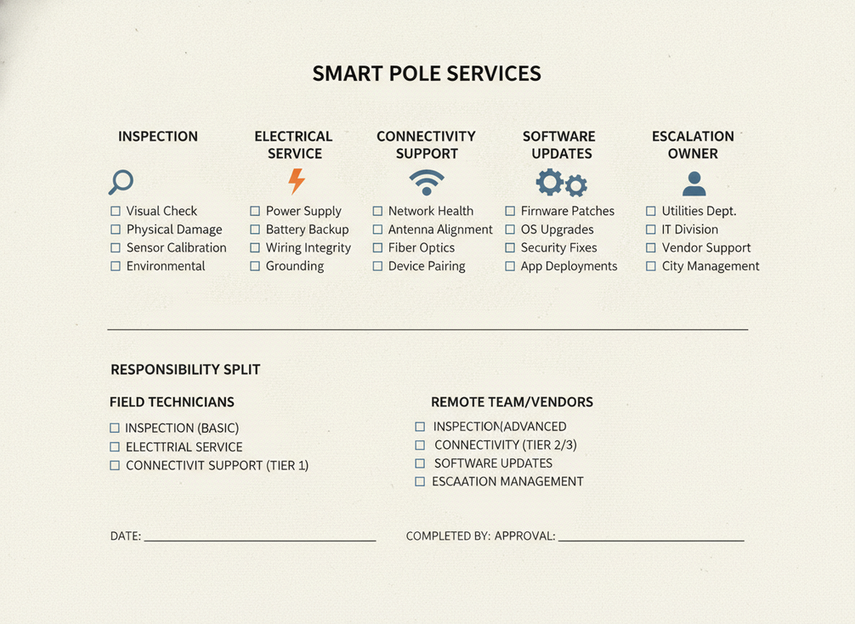
Typical Responsibility Split
In many municipal projects, the city keeps oversight while the installer, integrator, utility, or maintenance provider handles specialized service tasks. That split can work well, but only if the contract says what is included and what is not. The question is not whether the city owns the pole. The question is which team is on point for each maintenance task.
Maintenance Tasks to Assign
Before award, separate preventive maintenance, corrective maintenance, inspection, software support, and emergency response. Then assign the first responder for each one. For example, routine inspection may sit with the city or a contractor, while diagnostics, controller replacement, or firmware support may sit with the vendor. Access coordination matters too, especially if service work affects traffic, sidewalks, or lane closures.
Handoff Points That Prevent Gaps
The most common gaps show up when a pole has multiple layers of failure. A lighting issue may be an electrical issue, a connectivity issue may look like a hardware issue, and a software alert may be tied to a remote-access permission problem. Clear escalation language should say who diagnoses first, who authorizes replacement, and who closes the ticket. The city should not have to guess whether IT, public works, or the vendor owns the next step.
What to Confirm in the RFP
Use the bid package to force clarity on service boundaries, response workflow, parts responsibility, and documentation requirements. A good RFP also asks for preventive check schedules, issue escalation steps, and who is responsible for access and work records. If those items are missing, compare proposals carefully because the cheapest bid may be shifting work back to the city.
| Cost bucket | What it usually covers | Who often pays | What the city should verify |
|---|---|---|---|
| Labor | Field visits, troubleshooting, repairs | City, vendor, or shared | Is labor bundled or billed separately? |
| Truck rolls | Travel, setup, access time | Usually contract-based | Are callouts priced per event? |
| Parts | Replacements, modules, controllers | Varies by warranty and scope | Which parts are included? |
| Software support | Monitoring, licensing, updates | Often recurring | Who owns renewals and access? |
| Inspections | Scheduled checks, reporting | City or service partner | How often are checks required? |
| Coordination overhead | Permits, scheduling, cross-team routing | Often hidden unless named | Who tracks tickets end to end? |
Estimate the Real Cost Drivers
Smart city pole maintenance costs are easier to compare when you stop looking for one all-in number and instead separate the recurring buckets. One useful benchmark comes from New York City’s lifecycle analysis, which found that software maintenance and licensing can run at about 16% to 25% of initial license cost annually. That is only one part of the bill, but it is a real recurring burden that municipalities should not overlook.
The rest of the cost picture is usually less tidy. Labor, truck rolls, parts, software support, inspections, and coordination overhead all matter, and specialized labor pressure can make those buckets more expensive or harder to staff. Municipal budget guidance has also noted the recruitment and retention pressure around the specialized labor needed to maintain electronic and networked infrastructure.
That is why a proposal that looks cheaper on paper can become more expensive in practice. If the vendor charges separately for diagnostics, access, after-hours support, or remote monitoring, the city may be paying for more than it expected. For smart pole maintenance, the better question is not "What is the lowest bid?" It is "Which bid gives the clearest division of responsibility over time?"
Coordinate Lighting, Connectivity, Power, and Software
Smart pole ownership gaps usually appear at the seams between systems. Lighting, communications, sensors, power distribution, and software may each involve a different party, and the problem often starts when nobody is named as the first responder for the whole ticket.
Lighting and Electrical Service
Fixture replacement, wiring faults, and power issues usually need their own service path. Even when the pole structure itself is intact, a failed driver or electrical connection can take the asset out of service. Field work should also reflect safety procedures and access permissions, especially when service affects streets or sidewalks.
Connectivity and Network Support
Connectivity issues can look like hardware failures until someone checks the backhaul. If the pole depends on cellular, fiber, or wireless communications, the contract should say who handles those outages and who escalates them. In many cities, IT and telecom teams need a defined role even when they never touch the physical pole.
Software, Controls, and Remote Access
Smart pole maintenance responsibilities also need to cover updates, licenses, dashboards, and remote access permissions. A pole can be physically fine while the software side is stalled because the vendor, integrator, or city does not know who owns the credentials. That is a common source of delay in multi-vendor deployments.
Cross-Team Escalation
Public works, IT, utilities, and vendors should not all assume someone else opened the ticket. A single escalation owner, plus backup contacts, keeps the service chain moving. Smart communities research has pointed out that maintenance gaps often happen when public works and IT operate in silos, so the city should treat cross-team routing as a design requirement, not an afterthought.
What a Strong Service Agreement Should Say
A municipal smart pole service agreement should turn ownership decisions into contract language. The most useful clauses are the ones that spell out scope, response expectations, exclusions, spare parts, and documentation. A good template does not remove every dispute, but it reduces the number of surprises.
Scope and Exclusions
The contract should say what routine service includes and what sits outside the boundary. Cities should check whether software, connectivity, field labor, and replacement parts are bundled or billed separately. Exclusions need plain language, not legal clutter.
Response Times and Escalation
Response expectations should be written for normal issues, critical outages, and emergency repairs. The escalation path should name who is contacted first, who is second, and who handles after-hours work. That timing should fit the city’s operating priorities and staffing model.
Spare Parts and Warranty Boundaries
The agreement should state who stocks parts, who pays for replacements, and what the warranty covers. Cities should also check whether labor, shipping, removal, and reinstall costs are treated the same way as the part itself. If they are not, the contract should say so clearly.
Documentation and Handoff Records
Service logs, as-built records, maintenance history, and login handoff documents reduce long-term confusion. They matter even more when ownership shifts between departments or vendors. Make those records a required deliverable, not a courtesy.
Choose a Maintenance Model That Fits the City
There is no universal best model for smart pole maintenance responsibilities. The right choice depends on staffing capacity, asset criticality, network complexity, and how much control the city wants to keep.
The tradeoff is usually control versus convenience. City-managed maintenance keeps authority close to the work, but it asks more of internal teams. Vendor-managed or hybrid support can ease that burden when specialized labor is tight, but only if the service terms are clear.
Before moving from evaluation to award, check three things: who owns each task, who owns the ticket, and who owns the records. If those answers are clear, the maintenance model is probably workable. If not, pause and tighten the RFP language before you sign.
FAQs
Who Maintains Smart Poles?
It depends on the ownership and service contract. A city may own the asset while an installer, integrator, utility, or service partner handles routine work, software support, or field repairs. The key is to assign each task in writing so the city knows who responds first and who closes the ticket.
What Costs Usually Fall on the Municipality?
Common municipal costs include oversight, coordination, some inspections, and whatever service payments the contract assigns to the city. The exact split depends on the agreement. Cities should focus on labor, truck rolls, parts, software support, and access costs instead of assuming the lowest bid covers everything.
How Do Smart Pole Service Agreements Reduce Disputes?
They reduce confusion by naming scope, response expectations, exclusions, spare-part responsibility, and documentation requirements. When those items are written clearly, it is easier to tell whether a fault belongs to the city, the vendor, or another service partner. That matters most when a problem spans lighting, power, connectivity, and software.
Can One Vendor Cover Lighting, Connectivity, and Software Support?
Sometimes, yes, but the city still needs to verify the boundaries. One vendor may cover multiple layers, while another subcontractor handles part of the stack. The contract should still spell out who handles escalation, what is excluded, and which team has the access credentials.
What Should a City Confirm Before Signing a Maintenance Plan?
Confirm the ownership split, response terms, spare-part rules, documentation deliverables, and who owns service tickets from start to finish. If the plan also covers software or remote access, make sure the renewal, login, and update responsibilities are explicit. Those details usually matter more than broad marketing language.
Smart pole maintenance responsibilities are easiest to manage when the city writes them down before procurement closes. Keep the contract focused on task ownership, escalation, parts, and documentation, then choose the service model that fits your staffing reality.





