


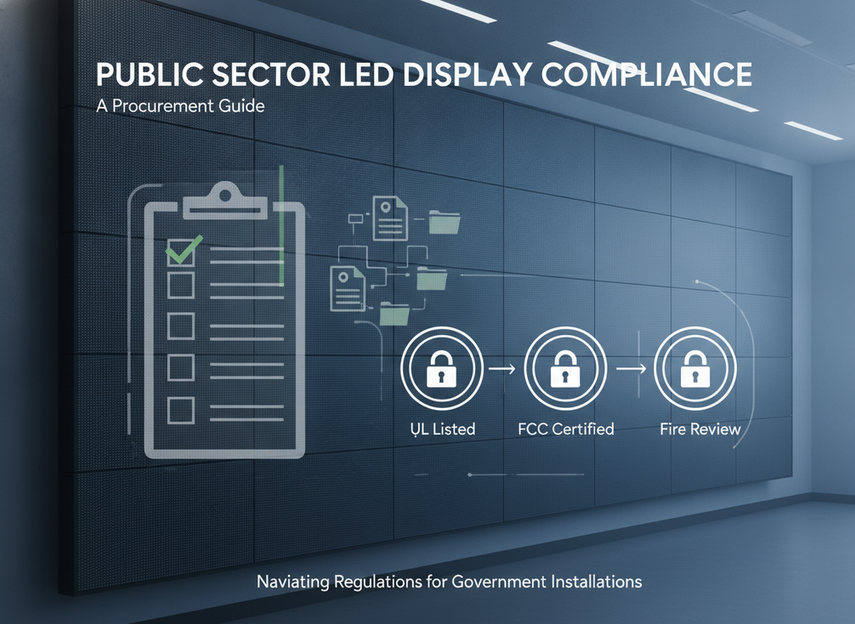
Public-sector LED compliance is not one mark that clears the whole project. It is a set of checks, documents, and site conditions that have to line up before procurement, facilities, accessibility, and fire reviewers can sign off. Use this checklist to turn approval questions into procurement-ready language, not to promise compliance before the project is reviewed.
What Approval Readiness Means
Approval readiness means the LED display, its paperwork, and its installation plan all match the review path for the site. In public projects, that usually means procurement, facilities, IT or AV, accessibility, and fire-safety stakeholders each have a different question to answer.
The practical goal is simple: can the vendor show the exact model, the right documents, and the right install conditions for this building? That is why public-sector LED display approvals should be written as a workflow, not a marketing claim. If the package only says the display is "certified," it is usually not enough for bid review or install sign-off.
For procurement teams, approval readiness is the standard, not feature depth. The right next step is to ask for model-specific evidence before award, then confirm that the installed layout still matches the approved scope.
Which Certifications and Marks to Verify
For US public projects, start by separating electrical safety from emissions and from installation documentation. Those are different gates, and one mark does not substitute for the others.

Electrical Safety Listings
Confirm that the shipped LED display is listed to UL 62368-1, the current safety standard UL identifies for audio, video, and information technology equipment in the US. That matters because a family-level brochure claim does not prove the exact cabinet, power, or control configuration that will be installed. Check the label, the test report, and the model scope together.
If the paperwork names a broader product line but not the actual build that will be delivered, treat that as a gap. For command center LED wall certifications US buyers often need the exact listing on the exact shipped configuration, not just a general brand statement.
FCC Emissions and Interference
For electronic displays with control gear, processors, and networked components, verify the FCC Part 15 basis that matches the facility and the way the wall will operate. Part 15 covers radio-frequency emissions and interference, so the practical question is whether the project documentation matches the space, not whether "FCC" appears somewhere in the brochure.
If the room has dense electronics, radio-sensitive operations, or communications equipment, the emissions class should be checked early. A public sector LED display compliance review often fails when the team treats FCC as a generic checkbox instead of a configuration-specific document request.
Documentation Buyers Should Request
A bid-ready packet should include the exact model number, certificates, test reports, installation drawings, and any conditions of use tied to the approved configuration. Public-sector submittals commonly work best when they show what is verified, what remains pending, and who owns each step. The UFGS 27 41 00 submittal structure is useful background for that kind of packet, even when the final agency format differs.
If a vendor only sends a brochure, that is a starting point, not proof. Ask for documents that match the exact cabinet, power, and control scope so the review does not stall later.
How ADA and Visibility Requirements Affect Layout
ADA review is usually about placement and access, not the display face by itself. In a public space, the key question is whether the installed screen or its enclosure interferes with circulation paths, reach, or access to controls.
Under the ADA protruding-object guidance, a wall-mounted object with a leading edge between 27 and 80 inches above the floor must not protrude more than 4 inches into the path of travel. That is why mounting height, wall projection, and route clearance matter so much in lobbies, concourses, and command rooms.
In practice, the display is only part of the review. The room layout, adjacent furnishings, and service access can create the problem even when the screen itself looks fine. If the installation sits near a public route, check the projection and the path width before the design is frozen.
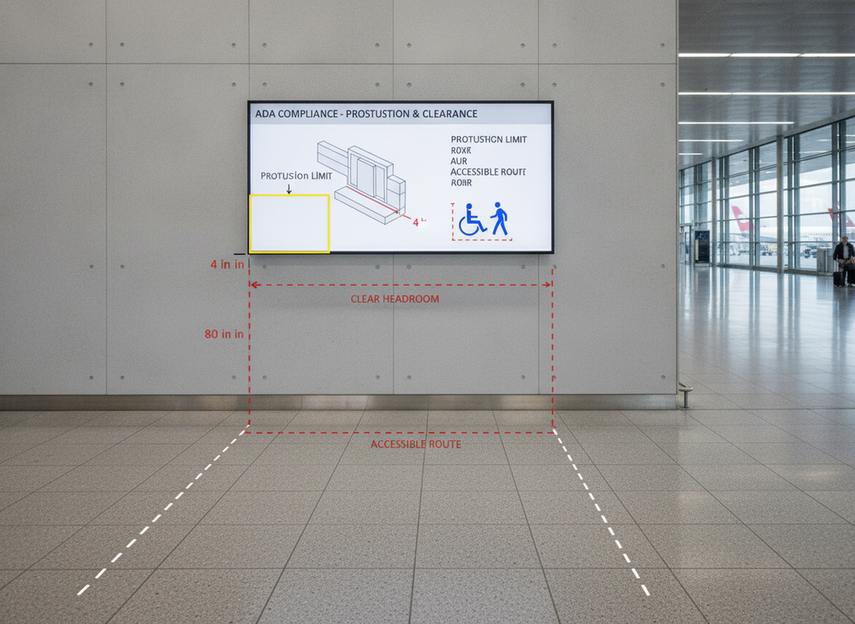
For public-sector LED compliance, treat accessibility as an installation review. If the route is tight, the display may still work, but the mounting plan may need to change before approval is realistic.
Fire Review and Installation Controls
Fire review usually focuses on the installation conditions around the display: egress, wiring, mounting, materials, and service access. It is not enough to say the product is "fire-safe." The local authority having jurisdiction still controls final acceptance, and the site conditions decide what gets reviewed.
The NFPA 70 National Electrical Code is relevant because it governs electrical installation details that can affect a sign or display project. For public-sector LED installations, the practical checklist should cover wiring, grounding, clearances, and access for maintenance.
Use this order when you prepare for fire review:
- Confirm that the mounting location does not block egress or emergency access.
- Verify cable routing, disconnects, and grounding details in the install drawings.
- Check that service access is realistic after the wall is installed.
- Match the submittal package to the local authority’s review path, not just the vendor’s standard sheet.
When this breaks down, it is usually because the project team treats fire review as a formality. In reality, a minor routing or access issue can hold the whole approval path.
Build a Bid-Ready Submittal Package
A public-sector submittal works best when every compliance item is written as a document request. That keeps the vendor answerable to evidence, not slogans.
A simple way to frame the package is to separate required, requested, and site-specific items. That helps procurement stay focused on what proves the scope, while facilities and compliance reviewers can flag what still depends on the building.
| Compliance gate | What to verify | What evidence proves it | What still needs site-specific confirmation |
|---|---|---|---|
| Jurisdiction and permitting path | Confirm which authority controls approval and whether a permit, variance, or separate review is needed | Agency checklist, permit guidance, zoning or sign-code references | Final reviewing authority, filing sequence, and local overlays |
| Electrical code compliance | Confirm the power, disconnect, grounding, and inspection plan | Stamped drawings, code references, contractor scope | Utility service details, panel capacity, routing constraints |
| Structural attachment | Confirm the mounting approach is engineered for the support structure | Structural calculations, anchor details, stamped drawings | Wall condition, substrate, corrosion exposure, final attachment method |
| Visibility and nuisance control | Confirm the location and settings avoid avoidable glare or distraction | Spec sheet, dimming controls, placement plan | Ambient light conditions, nearby receptors, operating schedule |
| Size and placement rules | Confirm the location meets local dimensional and setback restrictions | Site plan, measured elevations, code excerpts, frontage data | Exact field measurements, easements, rights-of-way |
| Fire and emergency access | Confirm the installation does not obstruct egress or life-safety access | Life-safety plan, access clearances, fire review notes | Fire lane dimensions, hydrant conflicts, local fire marshal comments |
| Final submittal completeness | Confirm every required drawing, form, and attachment is included | Completed checklist, signed application, drawings, product docs | Agency intake format, digital filing rules, resubmittal expectations |
| Post-approval field verification | Confirm the installed display matches the approved package | As-built photos, field measurements, commissioning checklist | Any deviation from location, dimensions, brightness controls, or wiring |
Use procurement language that asks for the exact model identification, listing evidence, test reports, installation drawings, and maintenance documentation. That is the cleanest way to keep public sector LED display approvals tied to something the reviewer can actually verify.
For teams that already know the building type, a mission-critical command center solution or a mission-critical video wall path may help with browsing, but the approval check still has to start with the exact submittal package.
Final Verification Before Award
Before award or install approval, run one last pass in this order: match the model to the bid scope, confirm the safety and emissions documents, check the ADA layout against the room plan, verify the fire and electrical review items, and make sure the authority’s comments are reflected in the final submittal. If any step depends on a local condition, leave it open until the site review is complete. The safest rule is simple: no single certification clears the whole project, and the final approval always belongs to the specific site and authority.
FAQs
What Certifications Are Usually Requested for a Public-Sector LED Display?
The most common requests are electrical safety documentation, FCC emissions documentation, and project-specific submittal files that match the exact model and installation scope. In practice, the reviewer wants evidence that fits the facility and the installed configuration, not just a product family label.
What Is ADA Compliance for an LED Display Installation?
ADA review usually focuses on placement, protrusion, routes, reach, and access to controls. A display can be fine as a product and still create an issue if it projects into a circulation path or blocks accessible access in the room.
Can a Vendor Brochure Prove Compliance for a Government LED Project?
No. A brochure is useful for early screening, but buyers should still request model identification, certificates, test reports, drawings, and any conditions of use. That is the difference between a sales claim and a reviewable submittal.
Why Do Fire-Marshal Reviews Delay LED Wall Approval?
They often delay approval when the install affects egress, wiring, materials, or maintenance access. Those details are site-specific, so the local authority may want drawings or revisions before sign-off.
What Should Procurement Teams Ask Before Awarding the Project?
Ask which exact model will ship, which documents prove the listing and emissions basis, what installation conditions are assumed, and who owns each pending item. If the vendor cannot answer those questions clearly, the award risk is still too high.





